We are all theologians
Theology books can send you to sleep, but when you are in quest for light on a question you have, you will devour many tirelessly. This post and the last two describe a lot of books briefly, for some of which I have first-hand knowledge; others skimmed. The vast majority, if not all, deserve our respect for addressing important questions seriously for the glory of God and our eternal life. Still, here we see dimly, then we shall see Jesus face to Face.
Some teachers of theology assign their students Helmut Thielicke’ s A Little Exercise for Young Theologians (1959, English translation 1962). Howard Marshall and many other writers wisely warn theology students not to lose sight of the reason for theological studies. It is simply to know and love God in the fullest (for example, Matthew 22:37-39).
Apart from theology books, there are theology teachers.1 Possibly the teachers are the more influential in the life of an individual, but books can be constant references long after the living voice is stilled. Let’s just say both are important and have varying authority to the Christian student. In this post I continue examining the books. The books used can contribute to turning a denomination in various directions. Could this have happened in the EMCC?
College texts. I sample what Missionary Church colleges such as Emmanuel Bible College, Kitchener, ON, used. I also feature what I know about texts in the theological schools of the United Missionary Church of Africa (UMCA), Nigeria, and contrast it with a sister theological school when it was run by the Sudan Interior Mission at Igbaja, east of Ilorin, Kwara State. I do not claim to be exhaustive.
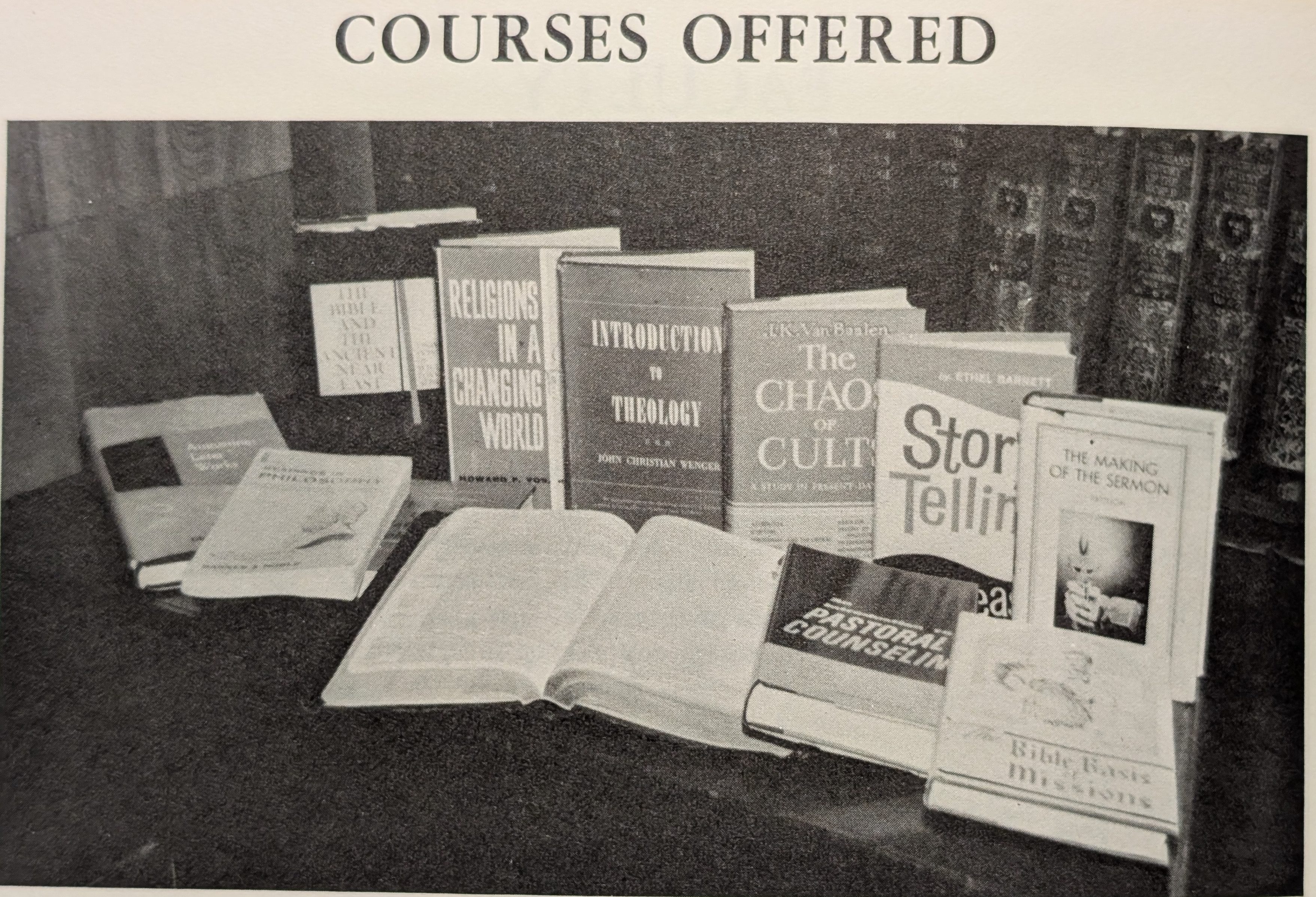
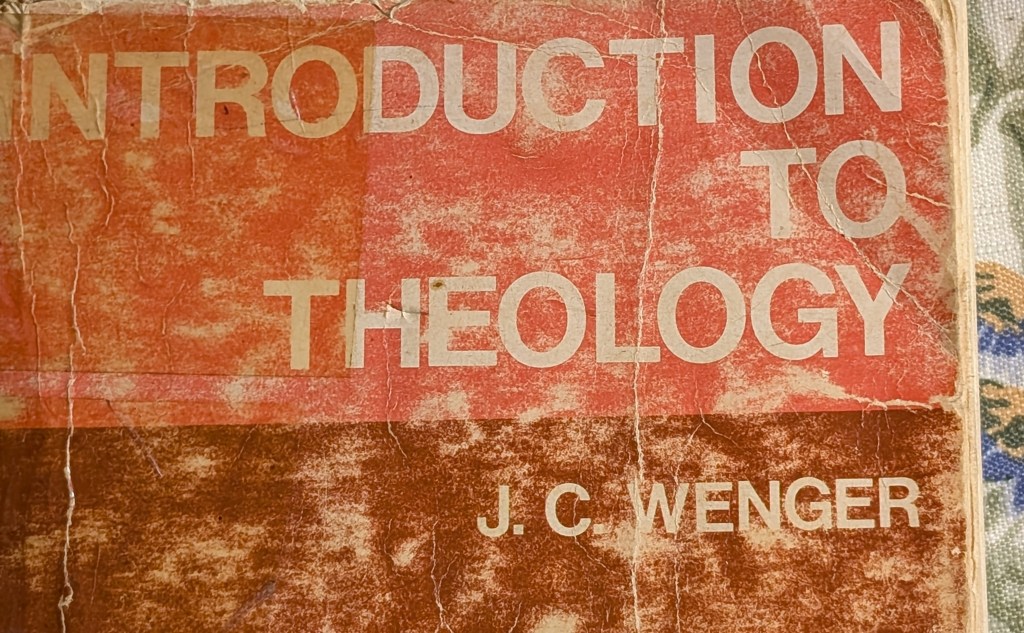
In the early days of Emmanuel Bible Institute (1940, “College” came in 1948) the school was a centre for Evangelical Teacher Training Association (ETTA) diplomas, geared to Sunday School teachers.2 Virgil K Snyder was a main theology teacher from 1944 to 1956, but what texts he used, I do not know. He wrote an MA thesis on “The Christian and War,” and participated in Mennonite Conferences.3 When Bruce Wideman (teaching 1956, president 1960) was the main theology teacher, he used John Christian Wenger, Introduction to Theology,4 the work of an American Mennonite. EBC student Jean (Lonsberry) Wilson had a copy which I now have. Wenger, a dedicated Mennonite Church leader, tended to quote Scriptures to illustrate or prove his statements, but he was fully aware of the major trends in theology. He studied at Westminster Seminary under Gresham Machen and in Europe under Barth, Brunner and Fritz Blanke in Zurich.5 I don’t know if Wideman was trying to nudge the United Missionary Church in Ontario back to its Anabaptist roots or not. My sister Lois (Fuller) Dow believed Wideman was still using Wenger when he taught her around 1970, but mainly students copied down his lectures; they didn’t actually buy a book.
Credit: Wikipedia
I have to jump ahead to my experience in the late 1970s under Thomas E Dow (PhD in 19816): he used and we bought, the old work of Northern Baptist Convention college president, Augustus Hopkins Strong, Systematic Theology: A Compendium.7 A Wikipedia article singled out “inclusivism” as a non-standard belief of Strong, a belief that pagans who repudiate their religion and conduct a repentant life are included in God’s saving grace.8 In light of current “conservative” Christian controversy, a position that would draw more disapproval now was that he accepted biological evolution as a work of God to enrich the universe,9 in common with a number of late 19th century evangelical theologians such as Benjamin B Warfield.10 Baptist historian Leon McBeth characterized Strong (1851-1921) as someone who did not fit in either the fundamentalist or the theologically liberal camps; Strong firmly criticized the latter.11 I am hearing from former students that many did not actually read Strong’s book because it was long and half of the print very small. I did read much of it and appreciated its strengths. When we came to the chapter on “Decrees,” however, Tom Dow told us to skip it, because it was not very useful. That was a clue to me to watch out for Reformed themes as possibly not all well-founded as supposed.
One correspondent remembers Dr Dow later using Henry Thiessen’s Lectures in Systematic Theology,12 and slightly later, professor Glenn Boyes persuaded Tom Dow to let him switch to Thiessen as well, “not because it was better, but hopefully the students would read it.”13 I am a little surprised at this selection because Thiessen was a zealous dispensationalist, who left Fort Wayne Bible College, operated by the Missionary Church Association, when that view was not favoured. See the Wheaton College article.14
Boyes switched to Millard J Erickson, Introducing Christian Doctrine,15 and eventually to Stanley Grenz, Theology for the Community of God.16 Both Americans, Erickson and Grenz worked as (non-Southern) Baptists, the first sparking a renewal of theologians writing systematic theologies, the latter introducing the usefulness of post-modern thought. Erickson is a standard moderate Calvinist. I have not used Introducing Christian Doctrine, but his longer Christian Theology has breadth in its discussion of the options Christians have proposed. Interestingly, he dropped the term “decree,” preferring the “plan” of God, which is friendlier to non-Calvinist ears, but he arrives at the same older conclusions about sovereignty anyway (“God is in control of everything”). I read various books by Grenz, including Community of God, Renewing the Center, and a short one on prayer. I heard him speak at a Canadian Evangelical Theological Association meeting once. Most of the questions afterward were along the line, “How have you been able to publish so many books already?” Some people can, others don’t.
The EBC theology teacher in the 2010s used Erickson’s longer text along with numerous other resources.17
You will have noticed the increasing use of Baptist theological texts, replacing the Methodist-Nazarene-Mennonite series of writers of earlier years noted in these posts. I believe this represents at least the “evangelicalizing” (in the sense of “mainstream evangelicalism”) of the Missionary Church in Ontario, a process I am still researching. There is the possibility we followed Dr Kenneth Geiger, UMC General Superintendent, and then first Missionary Church President, who turned away from his General Conference Mennonite origins, embracing Wesleyan theology (while chair of the National Holiness Association 1960-1964 he helped found the Wesleyan Theological Society).18 Later he led the Missionary Church into more involvement with American evangelicalism in the National Association of Evangelicals, and was on NAE boards for 25 years.19
Our western Canadian colleges maintained Wesleyan theology much longer than in the east, and of course, the Evangelical Church in Canada retained Wesleyan holiness in its college which continued in the merged Rocky Mountain College curriculum, according to professor Lucas van Boeschoten.20

Nigeria. Our sister church in Nigeria, the UMCA, also has a theological teaching tradition. The earliest missionaries were all holiness-Mennonites, with emphasis on the holiness. When United Missionary Society missionaries still staffed the English-language Theological College in Ilorin, the mission’s Liberty Press issued an English-language booklet: it is anonymous, but I suspect either Russell Sloat or John Bontrager edited it. Who used this booklet I do not know. “An Outline Course of Basic Bible Instruction” was a modest 42 pages, but quite good.21 My sister, Lois Dow,22 says there was an attempt to use Wenger’s Introduction at the Theological College (founded 1956) in Ilorin in 1972 about the time she was there visiting Tom and Carolyn Dow, a time when UMCA TC’s diplomas and degrees were tied to Emmanuel Bible College. After 1973, she also taught some theology courses, but does not remember requiring any assigned text. Lois paraphrased certain works for her students who were not familiar with international academic English, including Theilicke’s Exercise.
I taught systematic theology at several levels during my 20 years in Nigeria.23 Arriving in 1989, I inherited the use of a class set of the Nazarene Orton Wiley and Paul Culbertson, Introduction to Christian Theology at UMCA TC for the BA/BTh course.24 Unfortunately, I did not check to see if anybody was reading it! “Wiley and Culbertson” showed me that I was not Reformed (Calvinist) theologically. However, its statement about the purpose of the Church (merely “repository of the truth”), revolted me and I worked hard to expand that bare bones paragraph in the years following. Wiley’s own three-volume text is much better on ecclesiology.
In Nigeria I also found in UMCA college libraries copies donated by Missionary Church people of the book by the president of the Chicago Evangelistic Institute, Harry Edward Jessop, Foundations of Doctrine: In Scripture and Experience, A Student’s Handbook on Holiness (Nazarene, 1938); several of J C Wenger, Introduction to Theology,25 and Edgar Ellyson, Theological Compend (Nazarene). At least in Ontario, the City Mission Workers Society required the women to read and be examined on Ellyson’s book, but the MCHT’s copy came via Rocky Mountain College from Hillcrest Christian College.26
Later, I myself used for a while IVP’s Bruce Milne, Know the Truth: A Handbook of Christian Belief (1982) because they were cheap through ACTS Books and I like IVP’s books. I and my sister and other staff were anxious to get good books into the hands of our students. Know the Truth is a good book. Milne was a British Baptist (and Reformed in theology) who returned to the pastorate at First Baptist Church in Vancouver, BC, Canada. He transformed that old congregation into a thriving downtown church, according to my Church History teacher at Ontario Theological Seminary (now Tyndale), Dr Ian Rennie. Eventually I preferred Arminian textbooks over IVP’s generally Reformed writers and turned to American Danny McCain, We Believe: An Introduction to Christian Doctrine 2 Vols, published in Nigeria.27 McCain is the leader of an interesting organization that provides staff to Christian Studies Departments, or sets them up in any University that would take them. He himself may not be a member of the Church of the Nazarene, but his theology closely matches theirs.
For lower levels than degree, I used a Nigerian author’s book, David Abolarin, What Christians Believe.28 The advantage: it was local and affordable, and he wrote in Nigerian idiom and about Nigerian concerns. Students seemed to respond to his book. Dr McCain has lived in Nigeria for many years and understands Nigerian concerns as well, but his books still sound like an expatriate, as I did. Abolarin was an ECWA seminary graduate, and rather Reformed. I was not aware how strongly Reformed and dispensational that SIM-founded denomination could be. I knew two of the first four SIM missionaries at Patigi on the Niger River (1901) were MBiC men (Ebenezer Anthony and Alexander W Banfield; the other two were Baptists) and the relations between the SIM and the UMS had been close for decades, so it came as a surprise to me to hear ECWA students criticizing our theological students for not being Calvinistic. Sometimes I tried to promote I Howard Marshall’s Pocket Guide to Christian Beliefs 2nd ed (IVP, 1978), but could never obtain enough copies. Contrary to his publisher’s theological predilections, British Methodist Howard Marshall was publicly Arminian.29
In contrast to UMCA TC, from the nearby SIM/ECWA Igbaja Theological Seminary, to which we in Ilorin often went to attend their graduation ceremonies, I have an Igbaja Bible College syllabus that listed their courses and textbooks. In 1964 the school was run by mostly Europeans from North America or the UK. The textbooks of the theological courses (called “Bible Doctrine”) in the BTh are heavily Reformed and dispensational: the main text was Clarence H Benson, The Triune God: Unit XI ETTA, 1962. One supplementary textbook was William Evans, The Great Doctrines of the Bible (1949 ed). Evans was the Moody Bible Institute teacher I mentioned in Part 2. The other was by Louis Berkhof, a Christian Reformed author, his Summary of Christian Doctrine (1959). Additional references were mostly dispensational and Reformed titles. Many SIM missionaries from Canada were Toronto Bible College graduates, where dispensationalism was kept at bay, but many American SIM missionaries were Dallas Seminary and Moody Bible Institute alumni.
Enough has been recorded in the denominational histories and here about textbooks and in my MTh thesis30 to demonstrate, I think, that the Missionary Church in North America and Nigeria began with a Mennonite foundation, adding a Methodist/ Wesleyan theological consensus. Textbook selection suggests that the North American denomination lived on a memory of Anabaptism, gradually accepted mainstream evangelicalism, fundamentalist at first, later neo-evangelical or just plain evangelical. In Canada, the Missionary Church distanced itself in some areas (Ontario mainly) from Wesleyan Methodism, and now the EMCC in theology has an uneasy association of Baptist Calvinism and mild Arminianism with a tinge of Pentecostalism or charismaticism. What is better the reader will decide, but for my part, I wish the EMCC would revitalize its Five Traditions.31
Banner: A much battered copy from Nigeria of Wenger’s Introduction to Theology (1975 ed). Credit: C Fuller photo.
1Dr Sidney Kerr taught at EBC in the 1960s and influenced a number of able young men, including some from the United Missionary Church to become Jack Hyles-style independent Baptists. He taught pastoral methods, not theology as such, but his theological stance was apparently powerful, and may have contributed to the “baptist-izing” of the Ontario UMC.
2The founder, Clarence Benson, was a Presbyterian/Dutch Reformed pastor who joined Moody Bible Institute and turned to Sunday School revitalization as a life project; https://www.biola.edu/talbot/ce20/database/clarence-herbert-benson
3https://gameo.org/index.php?title=Snyder,_Virgil_Kinzie_(1906-1978)&oldid=132877.
4Subtitle: An Interpretation of the Doctrinal Content of Scripture, Written to Strengthen a Childlike Faith in Christ 2nd ed. (Scottdale, PA: Herald Press, 1956). The 1975 edition had the subtitle: A Brief Introduction to the Doctrinal Content of Scripture Written in the Anabaptist-Mennonite Tradition.
5https://gameo.org/index.php?title=Wenger,_John_C._(1910-1995)&oldid=154489
6Now available in a revised edition: Thomas Edward Dow, The Evangelical Ecumenism of James Arminius, McMaster Divinity College Press, edited by James R Payton Jr, 2026, through Wipf and Stock. Blatant promotion!
7Augustus Hopkins Strong, Systematic Theology: A Compendium (Old Tappan, NJ: Fleming H Revell, reprint of 1907).
8https://en.wikipedia.org/wiki/Augustus_Hopkins_Strong
9Strong, “Preface,” p vii.
10Mark A Noll, A History of Christianity in the United States and Canada (Grand Rapids, MI: Wm B Eerdmans, 1992) p 371.
11H Leon McBeth, The Baptist Heritage: Four Centuries of Baptist Witness (Nashville, TN: Broadman Press, 1987) p 594-595.
12As edited by Vernon D Doerksen, Introductory Lectures in Systematic Theology (Grand Rapids, Wm B Eerdmans, 1979, original edited by John Caldwell Thiessen, 1949).
13Glenn Boyes, personal communication, January 22, 2002.
14Thiessen had further problems in later schools over his theological rigidity; https://recollections.wheaton.edu/2009/11/thiessen-and-determinisms-cold-and-chilling-effects/
15Millard J Erickson, ed L Arnold Hustad, Introducing Christian Doctrine (Grand Rapids, MI: Baker Academic, 1st ed, 1992). I have used his larger book, Christian Theology in its first two editions. The third was revised by an English-language stylist. Maybe it’s an improvement.
16Stanley J Grenz, Theology for the Community of God (Grand Rapids, MI: Wm B Eerdmans, 1994, 2000).
17Kerry Petker, personal communication, September 2026.
18Since 1997 called the Christian Holiness Partnership.
19https://place.asburyseminary.edu/cgi/viewcontent.cgi?article=1072&context=findingaids This article has errors of fact.
20Course syllabi and textbook requirements kindly supplied by Lucas van Boeschoten, who taught theology, with others, at both Hillcrest Christian College, Medicine Hat, AB, and Rocky Mountain College (2002-), Calgary, AB.
21Ilorin, Nigeria: United Missionary Church of Africa, nd, but after 1972.
22Lois (Fuller) Dow, PhD in NT, McMaster Divinity College.
23I was by no means the only theology teacher in the 6 UMCA Bible and Theological schools.
24H Orton Wiley and Paul T Culbertson, Introduction to Christian Theology (Kansas City, MO: Beacon Hill Press, 1959).
25John Christian Wenger, Introduction to Theology 2nd ed (Scottdale, PA: Herald Press, 1956, 1975).
26Edgar P Ellyson, Theological Compend (Chicago, IL: Christian Witness, 1908).
27Danny McCain, We Believe: An Introduction to Christian Doctrine 2 Vols 2nd ed (Bukuru, Nigeria: ACTS Books, 2004).
28David Abolarin, What Christians Believe (Ilorin, Nigeria: By the Author, 1997).
29An early work: Kept by the Power of God: A Study of Perseverance and Falling Away (London: Epworth Press, 1969).
30James Clare Fuller, “We Trust God Will Own His Word: A Holiness-Mennonite Mission in Nigeria 1905-1978,” MTh thesis, McMaster University, Hamilton, ON, 2003, p 11-21.
31Theme issue “Five Traditions,” Reflections Vol 13, (2011-2012) by the Missionary Church Historical Society surveys Anabaptist, Pietist, Wesleyan, Keswickian and Evangelical streams in the Missionary Church.


Leave a Reply