
As the twig is bent…
Some Church traditions make the claim that they have never changed their teachings from the time of Jesus and the apostles. More recent bodies claim they have restored the original teachings of Jesus from the Bible, often implying nobody else has. As a historian, I identify both claims as false. I am provocatively going to claim that in the Missionary Church tradition, brief as it is from the 1850s to the first quarter of the 21st century AD, we have not produced an unchanging renewal of “First Century Christianity,” either. Anybody who counter-claims that “they only believe what the Bible says, nothing more or less,” is making a naive boast. We always read the Bible from frameworks we acquire.
We try. Good people try to be faithful. Try to re-acquire the meaning of the words of the Bible or creeds and articles of faith, and we can get closer.1 There is good and there is bad theology. But it is just not humanly possible to maintain over hundreds and now two thousand years the very same meaning and understanding of our 1st century Lord. I often picture a tree bent over by wind or some other process so that it is no longer upright, connected in some way, it is true, to the original plan of the tree, but growing away from it gradually.2

Credit: Public domain vectors.org
Admitting all that, some appeal to the superintending guidance of the Holy Spirit to lead us into all truth. (At least the apostles were.) Or they interpose divinely-guided bishops or a pope. Or someone reports (as I personally heard from a church leader in Nigeria) that Jesus himself personally taught him or her in visions, to guarantee the teaching in the present. There is some truth in hoping for the work of the Holy Spirit to bring back his Church. God does renew and reform the Church and its theology.3
The case of the Free Methodist Church. The FMC formed in 1860 out of the American Methodist Episcopal Church in New York State. Their issue was that they believed the parent denomination had deviated from original Methodism on some important points, so they were concerned with maintaining Methodist doctrine: The Twenty-five Articles, Wesley’s 52 Standard Sermons, and his Explanatory Notes on the New Testament. In 1860, the FMC explicitly added two doctrines not stated in the standards (some kind of sanctification: Wesley’s Plain Account of Christian Perfection was believed but not included in an official Methodist doctrinal statement, and, secondly, eternal punishments and rewards). I don’t say they achieved zero change, just that their historian, FM Bishop Leslie Marston, believed the FMC by 1960 had successfully maintained the doctrines.4
Can the Missionary Churches claim to teach the same doctrine as their founders? The Mennonite Brethren in Christ did not have a problem with the Dordrecht Confession of 1632, a Mennonite standard,5 but were very concerned to add Christian experience, sanctification and premillennial issues. These became articles in their doctrinal statements. J A Huffman honestly included a chapter “Practical and Doctrinal Developments” in his History of the MBiC.6 In time several powerful theological movements dominated the MBiC/ UMC/ Missionary Church, some of which I have covered in earlier posts. They grew often to the detriment of the Anabaptist tradition, and eventually Wesleyan holiness as well.7 Gospel Banner editor Everek Storms more than once drew attention to doctrines that were disappearing from Missionary Church pulpits.8 More recently, Dr Edward Oke reviewed doctrinal shifts accompanying the formation of the EMCC.9 Doctrine matters. Churches should not be careless.
MBiC Systematic Theology. Missionary Church philosopher (and a good theologian too), Dr Timothy Erdel, has a review forthcoming in the Missionary Church Historical Society journal Reflections on Missionary Church leaders which will include our theologians. We can look forward to that. Here I reflect on the textbooks used, not the theologians. There have been many excellent pastor-theologians.
The EMCC and its predecessors10 never produced an authorized systematic theology text of their own, the way many larger denominations do. The gradually changing “Articles of Faith and Practice” in the Mennonite Brethren in Christ/ United Missionary Church Disciplines and Missionary Church Constitutions do mark the changing theological consensus of the Church. I am not familiar with the Missionary Church Association theological statements to comment on that branch. A thorough study of those changes would reveal much about the continuity and developments in the Missionary Church tradition. I have incidentally mentioned some of those in the course of my two and a half years of EMCC History. “Articles of Faith” often lag behind the believing experience of the Church leaders and membership.
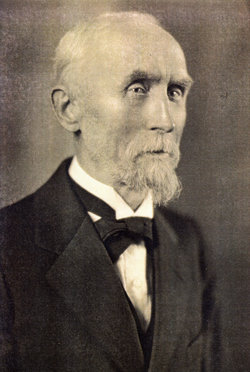
Credit: Find-A-Grave, supplied by Mary Fritz.
On the EMCC’s Evangelical Church side, there were a few authorized systematic theology books over its 160 year life, if you include the years of the Evangelical United Brethren, 1946-1968. The EvC and EUB were much larger bodies than the MBiC or the Missionary Church Association (MCA), which encouraged them to write their own literature. The Evangelical Church produced a number of theological works before and after their major schism in the 1890s and reunion in 1922.11 A major work was by a professor at their seminary in Naperville, Illinois, Solomon Jacob Gamertsfelder, his Systematic Theology (1913, 1921, reprinted as late as 1952 at least). It is somewhat on the liberal side theologically, and philosophically framed. The EC required its candidates for the ministry to read it in their study course.12 It may have been an optional reference at Hillcrest Christian College, Medicine Hat, Alberta, the school of the Evangelical United Brethren/ Evangelical Church, Northwest Canada Conference.13 The EC had shorter doctrinal surveys for members to study, such as Samuel Spreng, What Evangelicals Believe.14 The Missionary Church produced something similar, Ralph Ringenberg, ed, Believers in the Missionary Church.15
Credit: Asbury Seminary
Apart from many special studies, in the United Missionary Church era in 1953, J A Huffman published a collection on major theological topics, The Meaning of Things Believed by Christians, and finally his theology class notes in 1959, A Comprehensive System of Christian Doctrine: A Syllabus. I don’t think it ever became required reading in the United Missionary Church. Jared F Gerig of the Missionary Church Association, similarly published his Fort Wayne Bible College class lecture notes, The Conflict from Eden to Eternity, the result of 40 years of teaching theology.16 (My impression from those who took his son Wesley Gerig’s theology courses, is that Wesley Gerig read out his fairly unchanging notes and allowed little time for questions in class, though he would answer written questions outside of it.17 ) I am not aware of any Canadian Missionary Church theologian publishing anything like a systematic theology. Sam Goudie did publish a small Book of Religious Instruction (a catechism) in 1933 authorized by the Executive Committee of the MBiC, which was systematic theology in effect, but it made little impact. I examined it in my biography of Goudie.18 The US Missionary Church has produced a worthy catechism in recent decades as well called Foundations.19
If MBiC/ UMC/ Missionary Church authorities did not produce theological resources of influence, did they provide other avenues? The next two posts will look at the theological textbooks in the Reading Course for probationer preachers and some of the course textbooks in our theological or Bible colleges in Canada, Nigeria, and some in the USA. Will we be able to discern theological trends?
Banner: An anonymous tree growing sideways. It can happen to Churches, too.
1Grant R Osborne, The Hermeneutical Spiral: A Comprehensive Introduction to Biblical Interpretation (Downers Grove, IL: InterVarsity Press, 1991).
2The phenomenon is described in Arnold L Cook, Historical Drift: Must My Church Die? (Camp Hill, PA: Christian, 2000).
3Something like Roger E Olson, Reformed and Always Reforming: The Post-Conservative Approach to Evangelical Theology (Grand Rapids, MI: Baker Academic, 2008). The Latin phrase “Ecclesia semper reformanda est” was popularized by Karl Barth in the 20th century, https://en.wikipedia.org/wiki/Ecclesia_semper_reformanda_est
4Leslie R Marston, From Age to Age A Living Witness: A Historical Interpretation of Free Methodism’s First Century (Winona Lake: IN: Light and Life Press, 1960) p 273-274. A small schism did occur in 1932 by a group claiming to restore “original” Free Methodism. The “Reformed Free Methodist Church” has not done much. Other schisms over doctrine have occurred since 1960.
5They reproduced content (but not the words) of the Dutch Mennonite Dordrecht Confession of 1632 in the “Articles of Faith” in numerous Disciplines from 1882. Only the article on the “Ban” (a version of “shunning” a member considered to have sinned in a way harmful to the congregation) was dropped.
6Jasper Abraham Huffman, ed, History of the Mennonite Brethren in Christ Church (New Carlisle, OH: Bethel Publishing, 1920) p 145-165.
7Fundamentalism, for example. Pentecostalism. Evangelicalism in its Reformed and Baptist streams, has increasingly been an influence.
8Everek R Storms, “Doctrines Dying Out,” Gospel Banner (October 15 1953) p 3.
9Edward L Oke, “A Theological History of the Evangelical Missionary Church of Canada,” in Eileen Lageer, Common Bonds: Story of the Evangelical Missionary Church of Canada (Calgary, AB: Evangelical Missionary Church of Canada, 2004) p 362-373.
10See EMCC History Page “Formation of the EMCC” for details.
11Raymond W Albright included a comprehensive bibliography in A History of the Evangelical Church (Harrisburg, PA: Evangelical Press, 1942) p 464-493.
12 First authorized in 1919; Gamertsfelder, p vi. Still in Discipline of the Evangelical Church (Harrisburg, PA: Evangelical Publishing House, 1939) p 263-264.
13Two copies in the MCHT came from there, the 1921 2nd ed, the other printed 1952.
14Samuel P Spreng, What Evangelicals Believe (Cleveland, OH: Evangelical Publishing House, 1929).
15Ralph E Ringenberg, ed, Believers in the Missionary Church (Elkhart, IN: Bethel Publishing, 1976).
16Jared F Gerig, The Conflict from Eden to Eternity (Elkhart, IN: Bethel Publishing, 1990).
17Timothy P Erdel, personal communication, July 25 2026. [Added note: Apologies to Tim Erdel and his brother John for mangling Tim’s anecdotes and mixing up John’s corrections. Illustration of dangers to writers outside their area of familiarity!]
18 James Clare Fuller, Hidden in Plain Sight: Sam Goudie and the Ontario Mennonite Brethren in Christ (Eugene, OR/ Hamilton, ON: Pickwick Books/ McMaster Divinity College Press, 2024) p 272-279.
19Foundations: Teacher’s Edition 2nd ed (Fort Wayne, IN: Discipling Ministries, Missionary Church, Inc, 2002). Or https://mcusa.org/resources/foundations


Leave a Reply