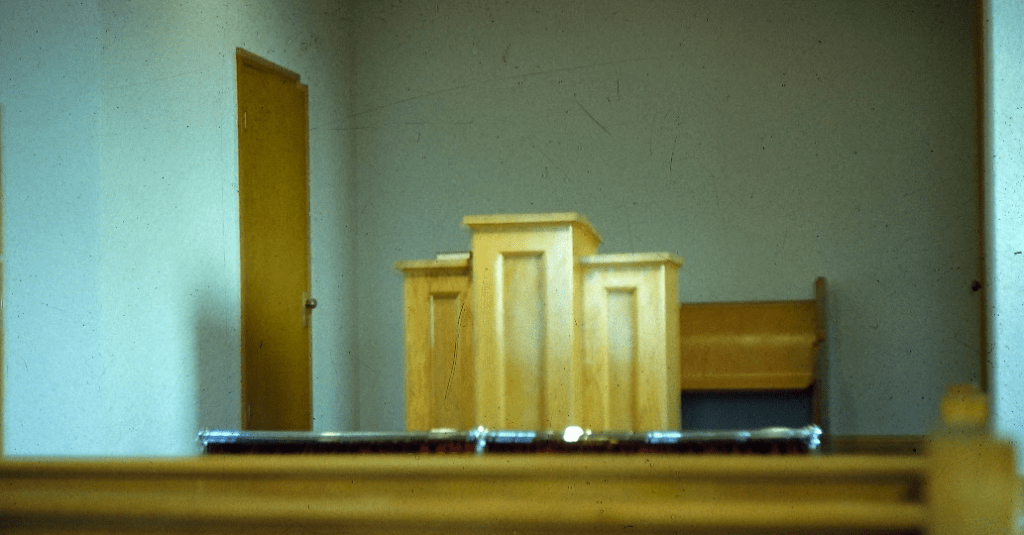
I mean the physical object, the piece of furniture in ecclesiastical settings for preachers to use.
There is no biblical mandate for this piece of furniture, so its use or non-use is a study in social history. What does the existence, size, placing, height, shape or anything else about a pulpit mean in the early or latter Evangelical Missionary Church of Canada? What does it mean to the preacher? What does it mean for the congregation? I suppose liturgists, anthropologists, architects and church historians and others will all have their say.1
When he read the Torah, Ezra stood on a specially-built platform to be seen and heard, a sort of one time pulpit. Nehemiah 8:4. The KJV uses the word pulpit only at this verse. English “pulpit” is via Middle French, from Late Latin, pulpitum, a stage or platform, but where that came from is unknown.2To my North American ears, the Britannica definition of the pulpit sounds strange by emphasizing a pulpit is a raised, and enclosed platform, reflecting British architectural history. Early Ontario denominations however, did continue that construction for a couple of generations.3
The current trend in Canadian evangelical churches is to eliminate the pulpit, which is why I am listing it as an endangered species.4 They are for sale or for firewood all over the country. It is an instructive to ask, “Why?”
Christianity is tied to preaching the word of God, whether you are evangelical, a liturgically-oriented church, a seeker-oriented church, or a pop-culture discussion-of-the-week-oriented club calling itself a church. I will leave it to others to review the vocabulary of the New Testament about verbal proclamation and persuasion.5
Biblical preaching does not need a pulpit. Jesus never did. Most of my years as a licensed/ ordained preacher in the EMCC, I have not had a pulpit ministry. I have taught thousands of lessons in classrooms of Theological or Bible Colleges with a table or a lectern. Yet I have used dozens of pulpits over the years. Some have suited my preferences in “sermonizing,” and some have not.
But let’s start with early Missionary Church pulpits. Probably for a fair period in North America, Mennonites did not even use them. Their Methodist revivalist mentors were completely at home with pulpits. The inevitable assimilation toward using the furniture of preaching occurred.
North American Anabaptists were a rural, simply-educated people. I will leave it to historians to trace the European origins of their architectural needs. I briefly reviewed some of it in my EMCC History series in Church buildings.6 In Pennsylvania, from where the Mennonite immigrants from Switzerland and South Germany settled and dispersed in the 17th century, they found it convenient, after meeting in log homes, or log school houses, or log meeting houses, to construct meeting houses in the “plain” style of the Society of Friends (Quakers). The first Mennonite Brethren in Christ people, that is, the early Missionary Church groups,7 used tables across one long side of the meeting house for the preacher.

Credit: https://blackcreek.ca/buildings/mennonite-meeting-house/
Maybe some used a movable lectern on the table, as I often did in the Nigerian United Missionary Church of Africa. [These days I need something to lift up closer to my eyes whatever I am reading from so I like something higher than the standard table height.] That assumes the preacher is standing, not seated as Jesus did teaching in the synagogue in Nazareth (he stood to read, Luke 4:16-21).
What should a pulpit do, functionally, for the preacher? Mennonite plain meeting houses might or might not have a single-step raised platform, just enough to help people see and hear the preacher. That’s mostly it. In addition there must be a place for the Bible and sermon notes.
Visual meaning. When the early EMCC people erected church buildings with a nave (an aisle down the middle of a longish building with the pulpit at the “front” opposite the entrances) instead of a wide meeting space, the longer the building, the higher the platform tended to become. As a non-liturgical Reformation church, the word of God was assumed to be central to congregational life and so the pulpit generally was front and centre.8 In Churches with the liturgy of the “Table” (communion, Eucharist) equal or primary to preaching, the pulpit tended to be placed on one side while the table (or altar, if the church used Catholic theology) would dominate the centre. A lectern for reading the Bible could be placed on the opposite side at the front of the hall or “sanctuary.”9 When the Ontario United Missionary Church Bethel Chapel built on Vaughan Road, Toronto, in the 1940s, they designed their Gothic-inspired building exactly like that: pulpit for preaching on the left, lectern for Bible reading on the right, communion table in the centre at the end of the aisle. I don’t know of any other Ontario MBiC or UMC building designed like that.

Credit: Vern Sherk Collection, Missionary Church Historical Trust
The early EMCC was definitely a preaching Church. The Lord’s Supper was observed quarterly. Ministers were required to record the number of sermons they delivered per year (usually hundreds) and for some reason these were all tallied and printed in the Conference journal for each Conference. As long as these statistics were kept, one can follow the fortunes of the sermon in the denomination. I am planning a blog about the Missionary Church sermon some day.10
Learning from others. The Mennonite Brethren in Christ builders did not construct pulpits in a vacuum. They had a non-conformity ethic that reacted to the “worldly” churches around them. At the same time, for many years in Ontario at least, they had a custom of sending out preachers into the neighbouring church buildings of sister denominations on one day of the Annual Conference days. The preachers also participated in funerals with other denominations. Whether they liked them or not, the preachers had to use the pulpits those Churches used: Methodist, Evangelical Association, Presbyterian, Christian Church, Brethren in Christ, United Brethren, Baptist … It is inevitable that pulpit designs were disseminated by such interactions.
There are still other sources of pulpit design. When I was assisting the Chinese congregation in Sudbury become established in the early 1980s, our Chinese preacher, Rev Tai Sum Ma, who had a Lutheran background in East Asia as a church planter, ordered a pulpit to be constructed with the Greek capital letters Alpha and Omega on the front, matching the words “ALPHA AND OMEGA” on the communion table. I was curious, but never asked him why he did that. Later I saw the same symbols on other Lutheran architecture.
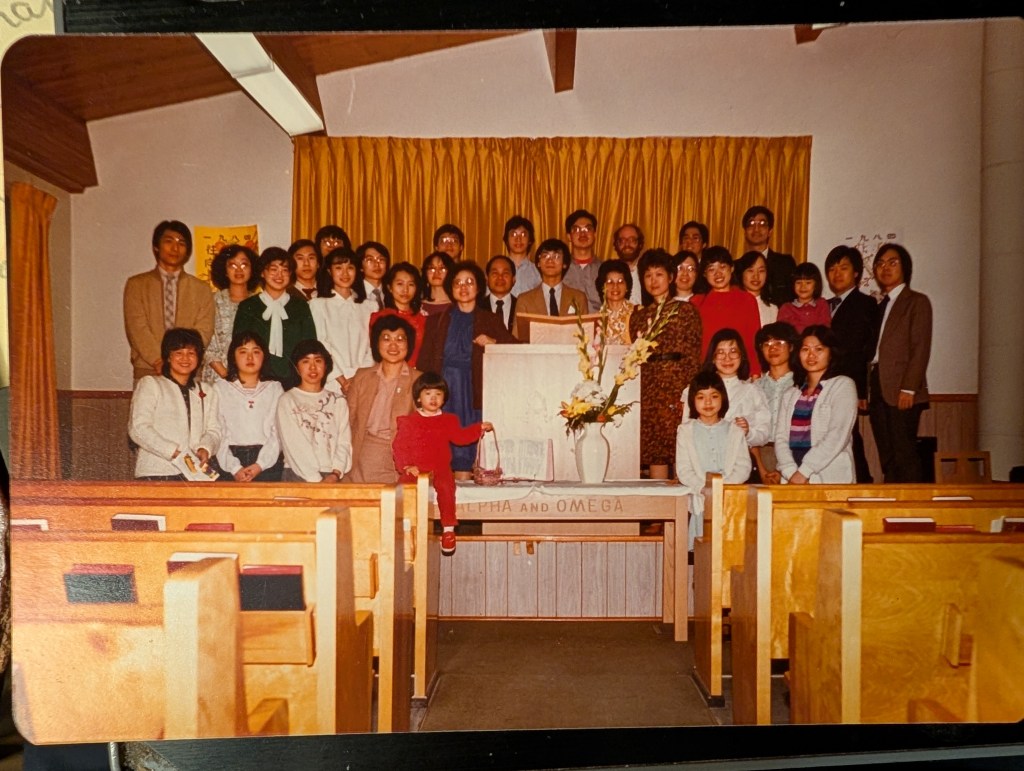
The pulpit we had a Evangel Missionary/ Community Church in Kitchener was constructed about 1949, at the request of the building committee from Bethany UMC, Kitchener. They used professional carpenters, and it had three quasi-Gothic panels in the front wood-work and one each on the sides, for example. That tells me the members of Bethany liked mild Gothic architecture more than the plain featureless wood of their pre-renovated home church building. Assimilation was working its charm.
Visual archives in the MCHT. Pulpits recorded in a series of photos by an Ontario Conference official in the 1950s11 reveal their general character. The photographer took exterior photos of UMC church buildings but also matching interior ones when no or few people were present, often using ambient light only. Most of the pulpits have plain sides and front, often having a ledge around the actual lectern part where a Bible and sermon notes could be propped. Many by then had pulpit lights attached. A few had inlaid rectangular panels of a different wood colour. A few sport bare Gothic pointed arch panels, three if the pulpit were wide, two for those that lift only a lectern-type top. One had carved pillars to lift the arches. In the 1990s, another Canada East District official took a similar series of church building photographs, some of them inside, especially of the buildings of new congregations.12
Pulpit surroundings. Most older UMC meeting halls had wooden wainscotting across the front of the room, rising up to match the height of the pulpit platform. Some buildings have some kind of niche behind the chairs or usually a bench, which are behind the pulpit. Some niches open behind with curtains (usually red) for a baptistry. Nearly all the photographs show a communion table in front of or below on the main floor (depending on the size of the meeting space), and many have flowers on the communion table. A few had an open Bible displayed. Some flower arrangements are so big they obscure the pulpit entirely. Many had two pots of ferns on either end of the platform (real or plastic I cannot say—I have seen both.) I don’t think they had any symbolic meaning. The wood work of the furniture seems to have been stained darkly in older buildings; newer ones tend to have lighter-coloured wood. Country or smaller church buildings may have home-built pulpits made of plywood. Whether professional or community-built, the vast majority of these pulpits are quite plain, in accord with the Discipline instructions to construct “plain” buildings. Some of these pulpits surely descended from the 19th century.13

Courtesy: Sider Collection, MCHT.
So why have so many pulpits been ditched? I was away in Nigeria while this was happening (my usual excuse for being astonished at ordinary change in Canada that goes on all the time). I mentioned in an earlier post how I came back to Canada on home assignments to find the pulpit at Evangel first under question, then moved aside, then gone, replaced by a flimsy music stand which did double duty as the stand for the music scores and sermon notes and Bible.14 I understand the pulpit and pews were sold to a Mennonite group between 2003 and 2005. For several years, the regular stands were not able to hold the weight of even a moderately-sized Bible. There would be comical distractions while a music stand top slowly sank under the weight of the Scriptures. Preachers learned they had to include their texts and readings in their notes because they couldn’t trust the stand. And now the notes are all on a laptop, tablet or smart phone.
There are two main reasons, I think, for the disappearance of pulpits. The first is the declining prestige of the pastor/ preacher in Canadian society. Pulpits were big and solid because congregations agreed with the preachers that proclaiming the Word of God was eternally important, and the person who did so was honoured, (whether that was scripturally proper or not). The pulpit suggested authority. Before the First World War, sermons were often reported in local newspapers, if you believe it. The message was from God. The messengers, as Paul remarked, are mere servants (“mini-sters”) (I Corinthians 4). Now clergy are little higher than politicians or used-car salesmen.15 How that came about is partly, I think, a steady cultural push to make religion private, not public, and the scandalous behaviour of religious leaders exposed for all to see beginning on TV and even more on social media. Preachers have responded by reducing the symbols of prestige (big pulpits on platforms) and attempting to wander from the stage into the congregation, and using a minimum of visible text “props” (big Bibles). Preaching without notes has always been promoted by some teachers of homiletics; it is an old debate. There was a new emphasis on being “Spirit-led,” coming from the charismatic movement which down-played preparation and study, as well as a more recent populist appeal: being able to speak forcefully and volubly with “common-sense” arguments.16 The Black church in North America has long respected pulpit eloquence. It is reflected in the popularity of rap songs’ uninterrupted flow of speech.
A second major reason, I believe, is a reversal in evangelical thinking about the position of preaching in the Church. A change in theology, in other words. Many have been convinced, ironically in agreement with our liturgical kindred, that Worship is the major task of the Church. I dealt with this in my blogs on worship in the EMCC.17 We haven’t gone quite as far as to make the communion service central to our meetings, but stop at worship as prayer, singing and playing as many instruments as we can to make it as fast and loud as we like, in competition with rock concerts. This is perfectly symbolized by the replacement of the pulpit by the keyboard, drums, et al.
I hope this doesn’t sound like a rant, but I miss the large pulpits I first preached from. I could spread out my notes (using 8 ½ by 11 inch pages), my Bible, and probably some book or books I wanted to quote from. I preferred displaying the original books because I wanted to encourage people to search out and read original theology or missions books, not to display my supposed learning. And the higher the platform, the more I feel a need to grip the solid heavy wooden pulpit! Maybe the old English preachers felt this need with their high and enclosed pulpits?
Banner: Pulpit in the Sarnia UMC. 1950s. Courtesy, Sider Collection, MCHT.
1Good beginning might be the Wikipedia article, https://en.wikipedia.org/wiki/Pulpit
2https://www.britannica.com/technology/pulpit
3As in the pulpits illustrated by Page Toles in Marion MacRae and Anthony Adamson, Hallowed Walls: Church Architecture of Upper Canada (Toronto: Clarke, Irwin and Co, 1975).
4Also pews.
5John Stott was one of many of those who did; Between Two Worlds: The Art of Preaching in the Twentieth Century (Grand Rapids, MI: Wm B Eerdmans, 1982). Many editions since, with the subtitle The Challenge of Preaching Today.
6EMCC History, https://emcchistory.blog/2025/06/21/emcc-church-buildings-part-2-built-bought-rented/
7See “Formation of the EMCC” in the “Pages” EMCC History introductory home page for the origins of the Church.
8Compare this Reformed comment: https://reformation21.org/the-disappearing-pulpit/
9I’ve made it clear in earlier posts how I believe “sanctuary” is a totally inappropriate word for the Christian meeting and worship spaces.
10An issue of the Missionary Church Historical Society journal Reflections focused on preachers, “Preachers and Preaching,” Vol 9, 1 & 2, (Spring and Fall 2007).
11Probably Director of Evangelism and Church Extension Lloyd K Sider.
12Probably mostly taken by Director Home Missions Glenn Gibson. Glenn Menard also took a series of photographs in the 1990s-2000s, all from outside buildings however. All these collections are in the Missionary Church Historical Trust, Elmira, ON.
13I am compiling a catalogue describing all pulpits and their contexts I know of in the Ontario MBiC/ UMC/ Missionary Church or the EMCC.
14EMCC History, https://emcchistory.blog/2025/04/12/we-worship-3/
15https://www.ipsos.com/en-ca/news-polls/doctors-most-trusted-profession-in-canada ; https://www.pharmacists.ca/cpha-ca/assets/file/news-events/mosttrustedprofessionals.pdf
16I notice that some popular TV preachers slow down when they have to refer to actual biblical research, not their own ideas. Rapid-fire praying preachers slow down when they need to refer to details of prayer requests.
17EMCC History, https://emcchistory.blog/2025/04/12/we-worship-3/


Leave a Reply