Not many of us help to found a new denomination. The 16 names printed for over 75 years in “Origin of the Mennonite Brethren in Christ,” in the Discipline (like a constitution) of the members of the 1st meeting of the United Mennonite Church, a precursor group to the Mennonite Brethren in Christ/ United Missionary Church, are mostly well-known names. They show up in the further history of the Church.1 Eleven of them have profiles in Huffman’s History of the MBiC.2 Most of them have profiles in the Global Anabaptist Mennonite Encyclopedia Online (GAMEO).
A few men are not well-known. Among them is Michael Haug, one of three probationers in the March 1875 merging conference of the New Mennonite Church and the Reforming Mennonite Society at Snyder’s Meetinghouse, Bloomingdale, Waterloo County.3
Hopefully, some descendant of Michael Haug possesses a photograph of the man, but the Missionary Church Historical Trust currently does not.4 His date of death is not recorded online in any document I have been able to search either, though it must have occurred between 1912 and 1921.
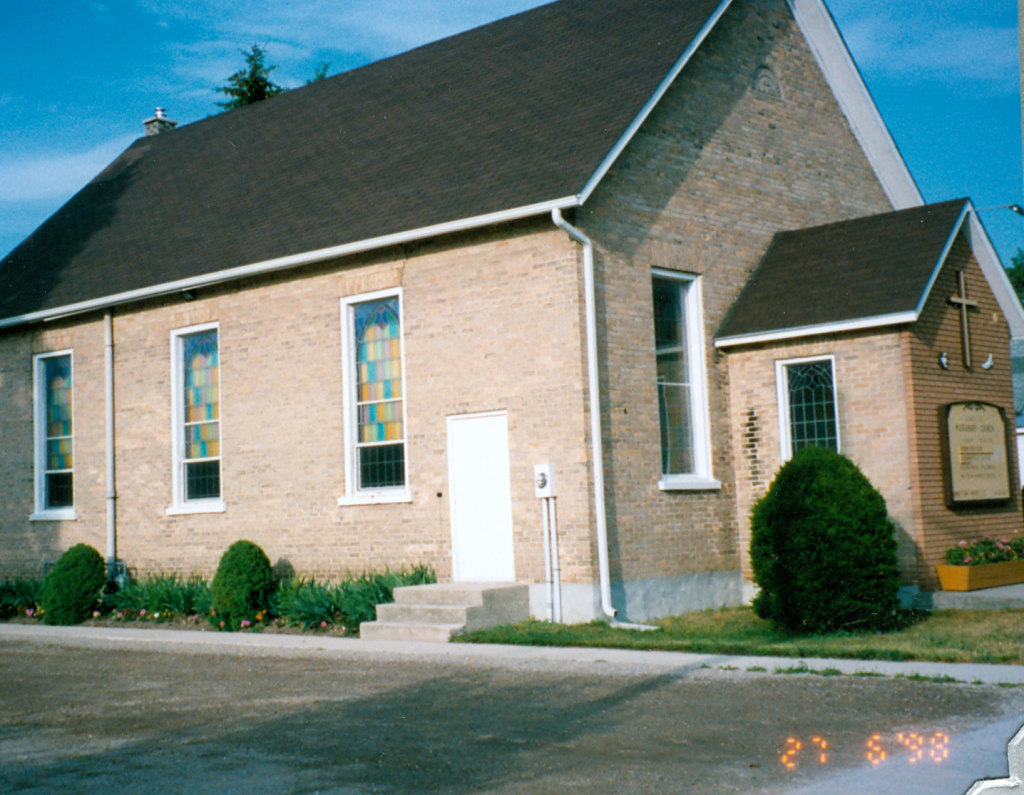
and his family worshipped 1886-1893 at least.
Courtesy Glenn Menard Collection, June 27 1998, Missionary Church Historical Trust.
Haug served the MBiC as a minister from about 1874 to 1892 in a number of locations and capacities. He was ordained either in 1876 or 1877. In 1878, Michael Haug wrote to Daniel Brenneman, for the newly established Gospel Banner, saying that he had been labouring at Maryborough, Ontario, for four years.5 As best as I can reconstruct his career in the Church, he began as a preacher for the newly formed congregations later known as the Maryborough field, formed from the Mennonite community meeting in Wallace Township, Perth County.6
1874-1879 Maryborough (straddling the Perth/ Wellington County line)
1879-1882 Brant Mission/ Elmwood and Hanover (Gray County). Assisted by C Hauser 1879-80.
1882-1884 Port Elgin, (Bruce County) with deacon Amos Bowman as helper
1884-1885 Nieverville, Manitoba as a colporteur for a Tract Society
1885-1886 evangelist (one of seven that year)
1886-1892 local preacher/ evangelist living at Port Elgin
For an unrecorded reason, Presiding Elder Solomon Eby removed Michael’s name from the roll of MBiC ministers in a Quarterly Meeting at Port Elgin, and the following Annual Conference upheld the expulsion in a private session. Michael Haug remained in fellowship with the Church as far as I know until the end of his life, as I hope to show, so whatever the reason was, neither he, nor the congregation treated it as a serious problem.
The Haug family show up in a number of places in the surviving diaries of Sam Goudie. Although the record is strangely spotty, they also show up in Canada census returns from 1861 to 1931, so we can also reconstruct some of the life of this interesting clan. An Anna Haug (born Guth, d 1845) named on a grave marker in the cemetery of First Mennonite, Kitchener, may indicate other Haugs in Waterloo County unrecorded elsewhere.
Michael was the first-born son of Mattheus (Matthias) G Haug (1799-1887) and his wife Elizabeth Elbert. Mattheus emigrated from Germany some time in the first part of the 19th century to Waterloo Township in Waterloo County.7 The marriage was performed by the maverick Lutheran preacher Frederick Bindemann, who performed many marriages for Waterloo people. Bindemann stated that Mattheus was “52” at his marriage to Elizabeth, “29,” but something is in error because Mattheus, if really born in 1799, would be at most 44 in 1843, the probable year of the wedding.
After Michael was born on November 7 1844, Elizabeth bore six more children, all in Waterloo Township, 5 more sons, and finally a daughter in 1866.8 Some of the brothers figure in Goudie’s diaries: Elias “Eli” Haug (b 1847) and Noah Elbert Haug (b 1852).
Mattheus, a farmer who was listed as a Mennonite in 1861, died in St Jacobs, ON, in 1887 and was buried in the Martin Meeting House cemetery. Elizabeth followed a few years later.
In 1867, Michael married Phoebe Ann Detweiler from Roseville, ON,9 in southern Waterloo County, from the Roseville Mennonite Church. She was a younger sister to Noah K Detwiler/ Detweiler, a prominent evangelist of the first generation of the MBiC. Elder Detwiler was the first to be ordained in the Reforming Mennonite group in 1874.10
By 1871, Michael and Phoebe were in Saugeen Township in Bruce County, around Port Elgin, where he worked as a carpenter. The Mennonite Church in Port Elgin was undergoing an awakening in those years under Solomon Eby11 and since the books say all but about two members became revived, probably this stirred the Haugs as well.12 They had one child, Will, one year old. The census, which Canada conducts every ten years, entirely misses the family’s years at Wallace, during which apparently Will died, and another son, Solomon, was born (4 years old in 1881).13 By 1881, Michael was serving the Elmwood field, living in Bentinck Township in Gray County. In Bentinck, they employed Sophia, 19, born in Germany, as a domestic worker.
I cannot find the family in the 1891 census, perhaps because over the years, census takers had trouble spelling the family name, and in fact the family sometimes spelled it various ways, as well: I have seen Haugk, Houck, and Hough, trying to capture the final German guttural consonant, a sound English barely uses. There is an English name “Hogg” but that does not ever seem to have been tried.
At some point after 1893, the Haugs moved to Berlin. Solomon Leander, their son, worked as a baker in Berlin (Kitchener) when he was 18 (1893), and married Emma Mertz/ Martz February 18 1896. She was Detroit-born, 26, but living with her parents in Breslau at the time of her wedding. We will meet Solomon again. In 1901, still living in Berlin, Michael and Phoebe had an adopted daughter in the household, Viola Flossie Detweiler, 8 years old. That year all the household listed German as their mother-tongue, and Michael described himself as a painter, as he did in 1911.14
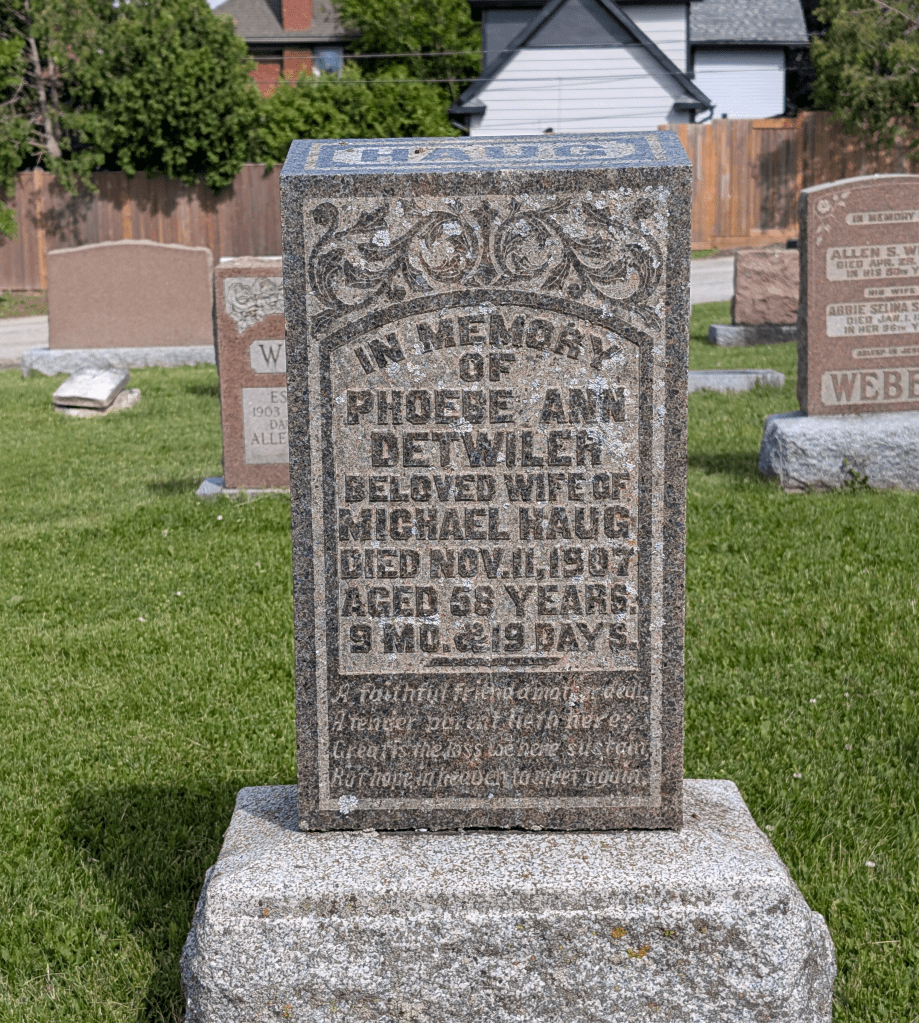
Where Michael is buried is not known yet.
Courtesy C Fuller June 14 2026
Phoebe Ann (Detweiler) Haug died on November 11 1907, in her 59th year. Since she was buried in First Mennonite Cemetery, Berlin, I believe she was resident there at the time. Three years later, Michael married a two-time widow, Barbara (Bauman) (Bowman) Stevia he knew from his years in Port Elgin,15 on September 6 1910, and he joined her in Bentinck, where Sam Goudie met him for tea in 1912. “Had a good visit.”16
Barbara’s first husband was the deacon and farmer Amos Bowman of Port Elgin, who attended the merging conference at Bloomingdale in 1875. After Amos’ death in 1891 and after Goudie was transferred from Port Elgin to Maryborough, Barbara married Charles August Stevia in Saugeen in 1896. Stevia died in 1905 in Bentinck.17 Barbara must have been an attractive personality for Michael to think of her three years after his own wife died. In the 1911 census Barbara had one of her sons staying with them in Bentinck, Alhanan (b 1874), an unmarried electrician. (Alhanan sent a testimony of a rather dramatic conversion on Lake Huron ice “two years ago” to the Gospel Banner, 1 published on January 1 1895, p 11).
The year of Michael’s death has not yet been discovered, but by 1921, Barbara was widowed, back living in Saugeen, staying now in the household of her farmer son-in-law and his wife, Daniel and Sarah Ann (Bowman) Trafelet. It could be that the Trafelets moved to Toronto, because that is where Barbara died in 1927, and where they are recorded in 1931.18
Sam Goudie noted Michael and Phoebe’s stay in Berlin when he was pastor of the Berlin MBiC church (1900-1903). In his diary he mentioned borrowing M Haug’s horse so he could collect a load of apples from the farm of J B Shantz.19 It is mostly Solomon Haug who is mentioned these years, however, because Solomon was processing the stages of becoming a preacher in the MBiC. This is another sign that the dismissal of Michael Haug by Solomon Eby in 1892 did not cause resentment, the way these actions often do. Sam Goudie had even recorded a quarterly home prayer meeting he attended in Port Elgin, in the home of Michael Haug in 1893, which I take to be one of the regular meetings of the congregation.20
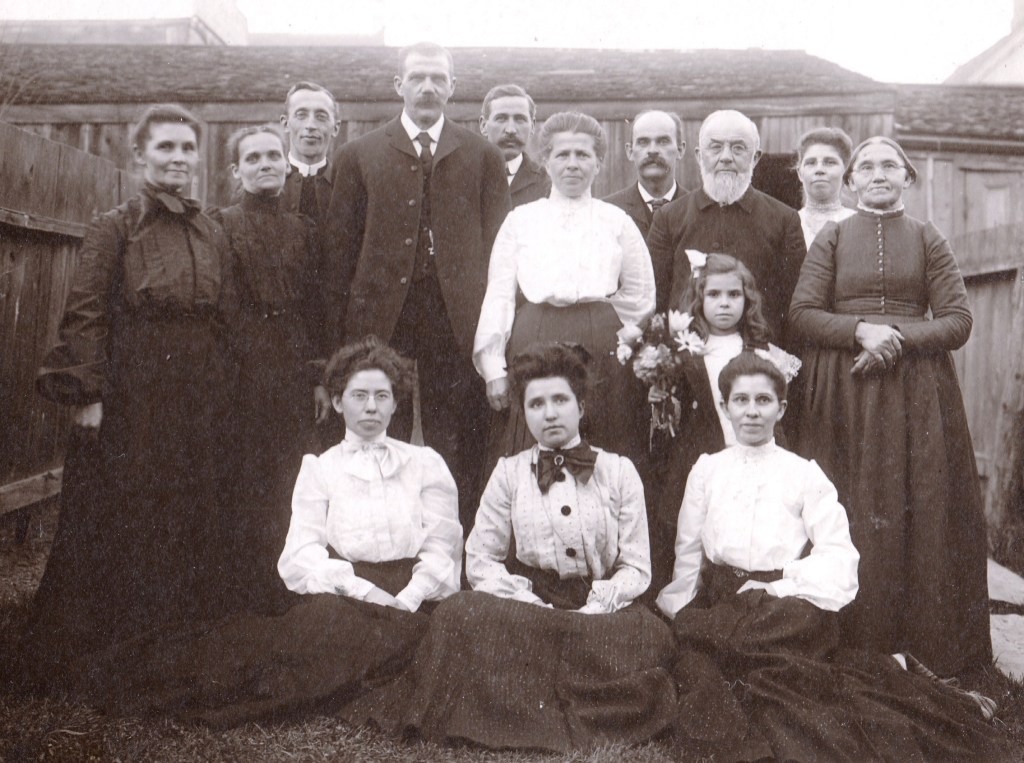
Solomon Leander Haug. I have not found the year of Solomon’s death. In fact neither he nor Emma appear in the 1921 or 1931 censuses. It’s rather frustrating. Sam Goudie noted Solomon Haug led a prayer meeting in the Berlin MBiC church in 1902 and was present at the New Years Holiness Convention at Breslau in 1903.21 He wrote “Mrs. S. [Emma] Haug took dinner with us” in Berlin in March 14 1902. On June 30 1903, S Haug attended a Munro Park Alliance Convention with Goudie in Toronto after the Goudies were stationed there in the spring.22 When Solomon started writing MBiC probationers’ exams in 1905, Sam as the examiner, noted he was marking them.23 Solomon was noted in Berlin city street directories as a store clerk in the 1906 edition, (information current in 1905) but listed as a Methodist, for some reason.
Solomon did serve in the Ontario Conference of the MBiC briefly:
1902-1904: Guelph Mission
1906-1907: Breslau as helper to Silas Cressman with Aaron S Shoemaker and other local help, such as Peter Geiger
Also in Toronto (1903-1905), Sam met other Haug relatives. He took a clock to “N. Haug’s shop” for repair (Noah Haug was noted in the Waterloo Region Generations website as a watchmaker.) He recorded Eli Haug bringing his belongings to store at their Lippincott St, Toronto, parsonage.24 Still another Haug was recorded in Sam’s diaries in Toronto: he mentioned talking to a Jerry Haug in 1903, and listed him as one of six baptized in 1904.25 I haven’t been able to fit Jerry into the Haug clan yet.
So my survey of the Haug family comes to an end. I want to leave them by re-visiting in imagination Sam Goudie’s time with Michael and Barbara in Elmwood, Bentinck Township, in March of 1912. The 45-year old Presiding Elder on the official Quarterly Conference duties to his district. The 77-year old former carpenter, preacher and painter in retirement, married not even a year and a half to a widow that Goudie knew in her first marriage to the deacon Amos Bowman, 21 years before when he was their pastor in Port Elgin. Twenty years before Michael and his first wife Phoebe Ann in Port Elgin, hosting a quarterly prayer meeting. Borrowing his horse to go for apples in Berlin.
Michael Haug had been present at the formation of the Reforming Mennonites, the United Mennonites; had witnessed the merging producing the Evangelical United Mennonites and then the Mennonite Brethren in Christ before Goudie had even become a believer in Jesus Christ. Michael Haug who had been dismissed from local preacher status a year before Sam was appointed to his first pastorate as an ordained Elder at Port Elgin. What are they going to say? What are they going to remember together? The conflicts? The revivals? The deaths of friends and colleagues? They had decades of community life in the MBiC in common, some happy, some sad. I think Sam Goudie respected the former preacher and his wife enough not to dismiss him or her, but took time out of his Quarterly Conference rounds to listen to them. He always prayed with those he visited. “M. Haugs for tea/ & spent evening there/ had a good visit.”26
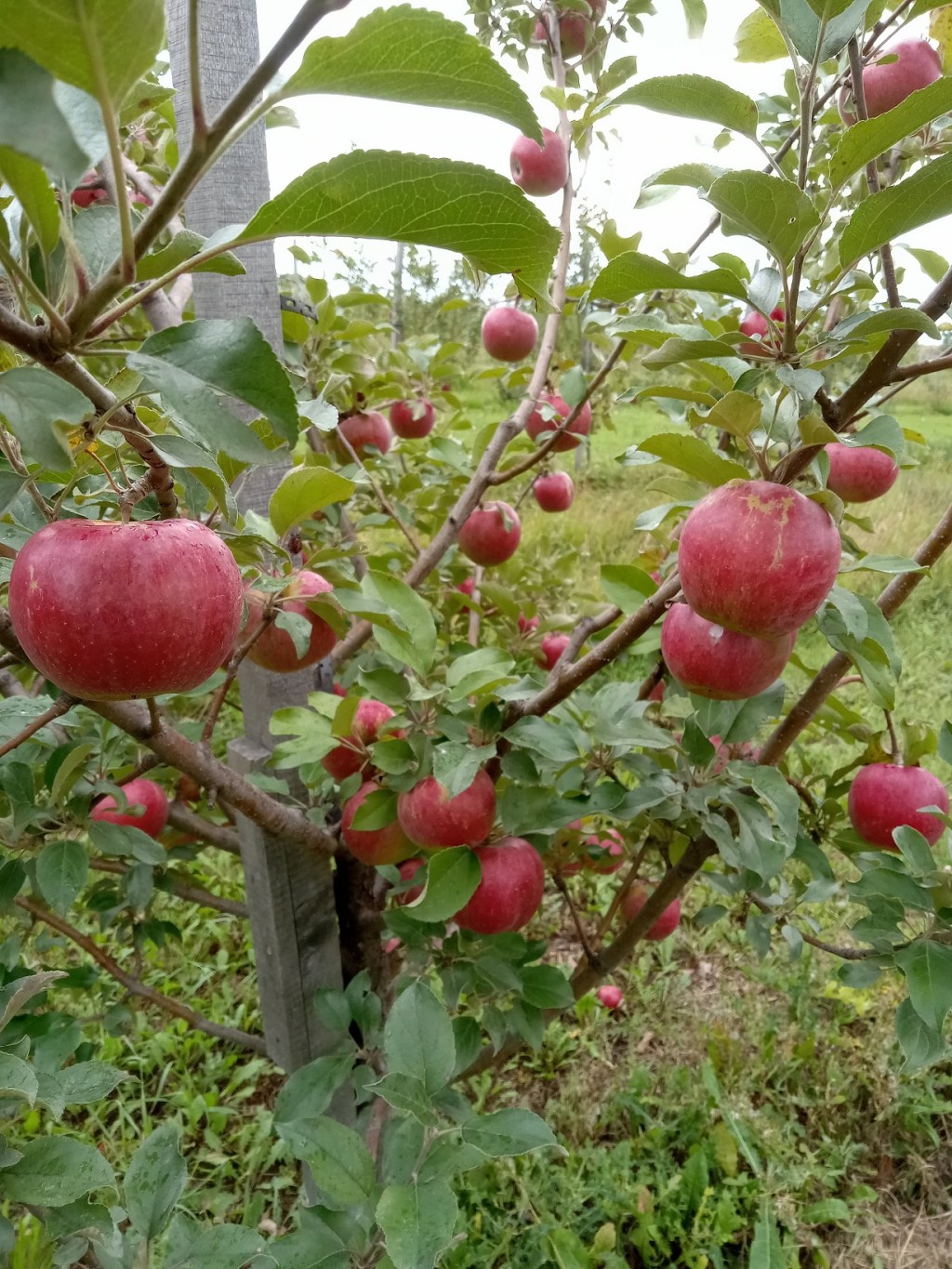
Banner: Michael Haug lent his horse and wagon to Samuel Goudie to get a load of apples in October 1902. Courtesy: Hildebrandt apple farm, photo by Peter Fuller, Manitoba.
1Three were American, representing the Indiana-Michigan members: Daniel Brenneman, John Krupp, and Samuel Sherk.
2Jasper A Huffman, ed, History of the Mennonite Brethren in Christ Church (New Carlisle, OH: Bethel Publishing, 1920) p 222-276.
3The other two were Menno Bowman and Joseph Raymer, both of whom have profiles in Huffman and GAMEO. One of the ten ministers, Daniel Wismer, returned to the Mennonite Conference shortly after. The three deacons, Joseph Schneider, Amos Bowman and William Hembling did not receive profiles in Huffman.
4Several of the men in the 1875 Conference have no known likeness as well. When my son Thomas and I filmed a few years ago a documentary about the Mennonite Revival in Markham in the 19th century, we could only illustrate the existence of Abraham Raymer and Christian Troyer by their tombstones. One of the graves is even marked merely with a rough field stone.
5Michael Haug, “Letter,” Gospel Banner (Vol 1 No 1, July 1878) p 2.
6Fretz, Joseph and Marlene Epp. “Wallace Mennonite Church (Palmerston, Ontario, Canada).” Global Anabaptist Mennonite Encyclopedia Online. January 1989. https://gameo.org/index.php?title=Wallace_Mennonite_Church_(Palmerston,_Ontario,_Canada)&oldid=114484.
7Growth of the city of Kitchener has entirely swallowed up Waterloo Township.
8Details in Region of Waterloo Generations website.
9November 10 1867. She was born January 23 1849.
10Clare Fuller (2014), “Detweiler, Noah (1839-1914),” https://gameo.org/index.php?title=Detweiler,_Noah_(1839-1914)&oldid=135607.
11EMCC History, “Port Elgin Bibles,” posted Dec 6 2025.
12Huffman, p 42.
13This would put Solomon as born about 1877, but another document says he was born in 1875.
14Flossie married Ray Shannon Shiedel and when she died in 1971, she was buried in the Breslau Mennonite Cemetery. Region of Waterloo Generations website.
15Barbara Bauman (1845-1927) from Woolwich Twp, Waterloo, married Amos Bauman/ Bowman March 13 1866. They had nine children.
16Sam Goudie, “Diaries,” (March 16 1912). Diaries quoted courtesy the Eleanor (Goudie) Bunker Family Collection.
17Region of Waterloo Generations. The Canada census never recorded any of the Stevia family, as far as I can see, which is weird, but not unprecedented.
18The MBiC Trafelet family are also an interesting one, with family members in Wallace, Breslau, Port Elgin and Toronto. An Esther Trafelet was married to Sam Goudie’s friend Josiah R Good, from Breslau.
19Sam Goudie, “Diaries,” (October 3 1903).
20Sam Goudie, “Diaries,” (1893).
21Sam Goudie, “Diaries,” (January 23 1902) and (January 1 1903).
22Sam Goudie, “Diaries,” (June 30 1903).
23Sam Goudie, “Diaries,” (Jan 1905). Oddly, Sam was uncertain how to write the surname, writing both “Haug/ Hauck.”
24Sam Goudie, “Diaries,” (March 7 1905).
25Sam Goudie, “Diaries,” (July 11 1903).
26Sam Goudie, “Diaries,” (March 16 1912).


Leave a Reply