Pursuing some history project, I came across an Ontario Conference Journal record that a certain “F. Willison” was “conditional” at the time the Conference needed to know who was available for stationing (assigning to ministry locations) in September 1932.1 My curiosity was aroused. I had never seen that name in our church documents elsewhere. Willison was a woman, for she was listed among the City Mission Workers. She was unmarried or widowed, for in those days our Conference had credentialing only for single women, about 20 years old and above. As “conditional,” Willison was saying she could do something, but she had a condition or conditions that prevented her from doing certain things. Normally such persons were not appointed unless there was an emergency such as a worker who became sick and needing time off, or the condition resolved itself and the conditional person informed the leaders they were available.
So who was “F. Willison”? The latest Canada Census returns open to the public are from 1931, but in 1921 there was one “Flossie Willison,” 16 years old, a “shoe worker,” living in Aylmer, Ontario.2 Interestingly, her father Charles, a painter by trade, was listed as Scotch, and in religion “Mininight,” (I kid you not).3 Her mother, Isedora, French ancestry, listed her religion, and that of her children, as “Mission”! If this were my Willison, she could have been about 27 or 28 in 1932.
I knew that our denomination had a city mission in Aylmer in 1921, started in 1900 by Lorena Shantz and Annie Ball, known both as Mennonite and locally as a “mission,” so despite the enumerator’s ignorance of the spelling of Mennonite, both descriptions could fit our church. There the matter sat for months.
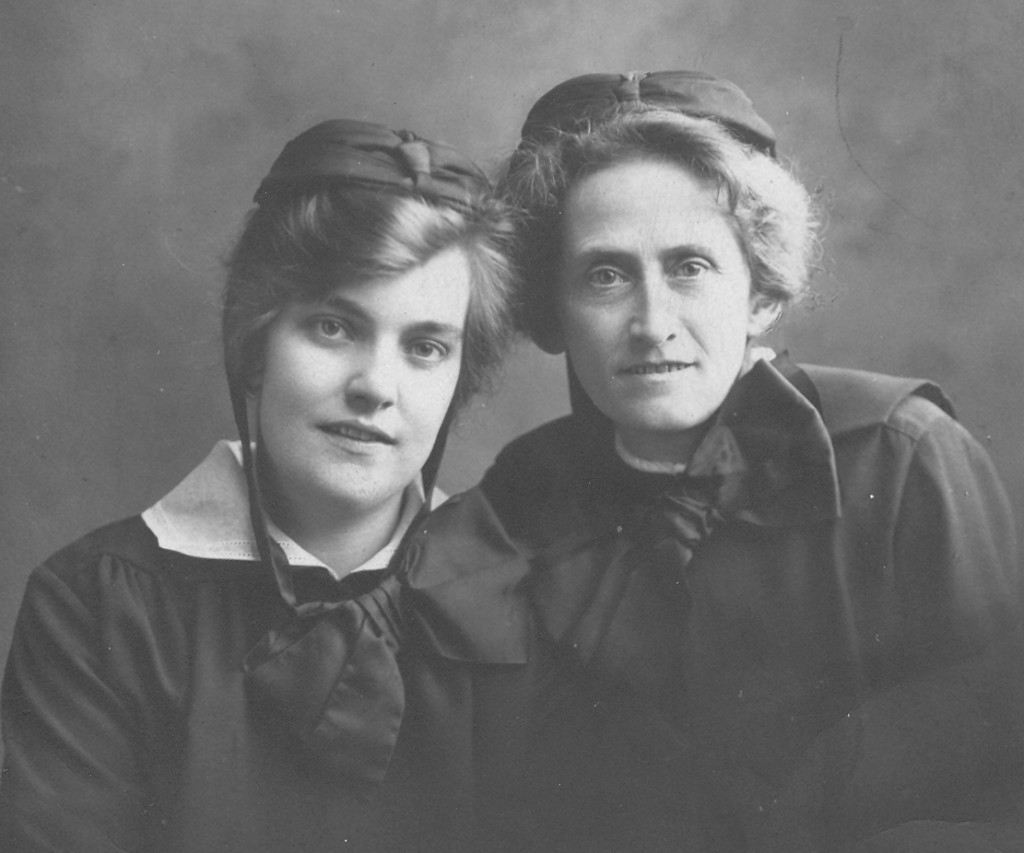
Credit: Missionary Church Historical Society.
Then I came across a poem by “Flossie E. (Willison) Kilmer (Mrs. Kenneth Kilmer)” in the United Missionary Society magazine Missionary Banner from 1952 “dedicated to my friend Miss Annie Yeo.” This was interesting. Our famous MBiC Canadian missionary to Nigeria, evangelist Annie Yeo (1905-1983)4 from nearby St Thomas, was almost the same age as Flossie. This almost proved Flossie Willison was Flossie Kilmer, and the “F. Willison” of 1932. Often, “Flossie” was an affectionate form or nickname of women named Florence, but this lady seems to have Flossie as her given name. In 1904 the first of popular children’s books describing the adventures of the Bobbsey Twins (Flossie and Freddie and another pair) came out and a cohort of little girls about that time received the name.5 Flossie was born July 1904, according to the 1911 census. That year, the enumerator declared the family were all “Scotch.”
Then a few weeks later, working on the Missionary Church Historical Trust collection, I came across the excellent history of the Aylmer EMCC from 1990 edited by Jean Pearce, which I had neglected to read before.6 Mrs Flossie Kilmer, almost 60 years later, was one of those interviewed for the early history of the former Mennonite Brethren in Christ mission in Aylmer. The history mentioned many Willison relatives. In fact the story also cleared up other mysteries: the origin (Aylmer) and first name of an early preacher listed only as “T W Brook,” and the origin (Aylmer) and married name of Maggie Rennie, another City Mission worker who became Mrs Thomas W Brook.7
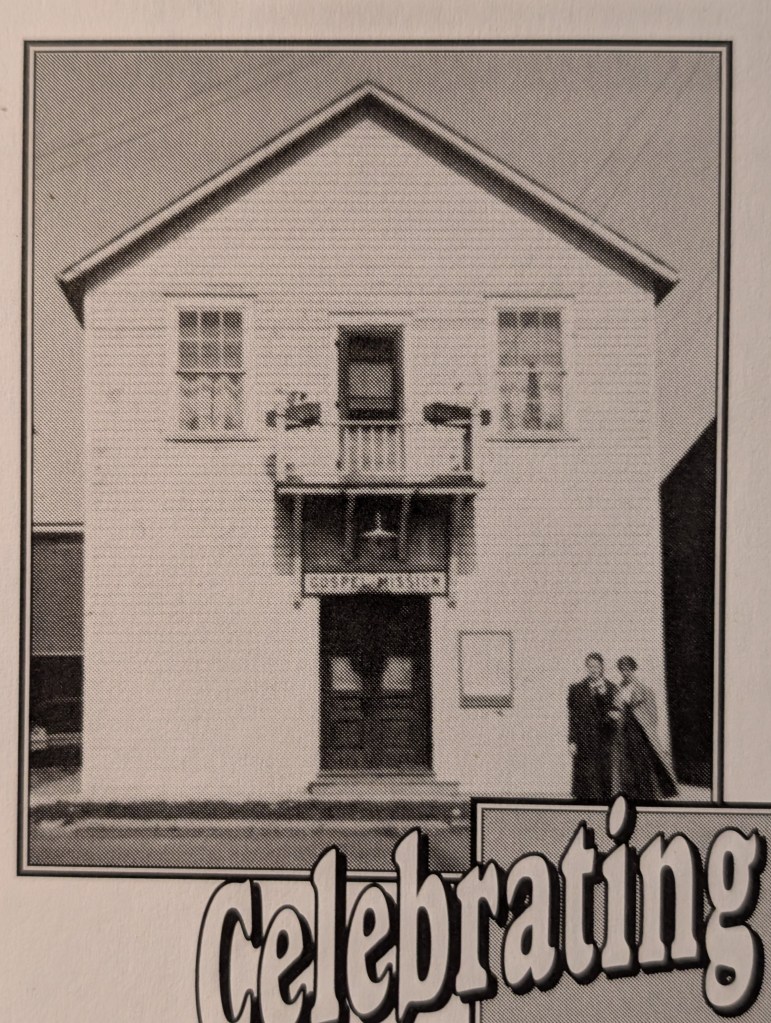
Credit: Aylmer history calendar 2000.
The Aylmer Mission was begun with the name “Gospel Mission,” on April 13 1900, with two women, Lorena Shantz (1874-1946)8 and Anna (Annie) Ball.9 In 1901, Emma Hostetler was assigned the leader in Aylmer with Jennie Little, helped by Webster and Laura (Moyer) Irish. In 1902, Jennie was sent to St Thomas, and the Aylmer mission was led by some of the Conference’s ablest early City Mission Workers (organized in 1902), Hostetler continuing and Althea Priest helping. Althea married Alex W Banfield in 1905 and went to Nigeria for 25 years, Hostetler followed in 1907, but died of yellow fever there in 1912.10 The Aylmer church switched female teams and male pastors for a while, and has remained as a steady fruitful congregation in the Ontario EMCC.11
Kenneth Kilmer was born in August 1906 to Abraham and Annie Kilmer, a Methodist farming family, later of the United Church, in Elgin County.12 He was perhaps fourth in a family of 5 children. At the time of the 1931 census, Kenneth, 24, worked on the farm of George Culp in Bayham Township in Elgin. Bayham borders on Lake Erie. The Culps listed themselves as “Dutch,” a common variation of “German,” used by many families after the First World War to diminish prejudice against German-origin people. The enumerator mistakenly, I believe, counted Kenneth as Dutch, when consistently the Kilmers recorded themselves as English in other census returns. “Percy Kenneth, son of Mrs. Kilmer and the late Abram Kilmer” and “Flossie Edna” were married November 18 1933,13 probably explaining the “condition” Flossie honestly stated with her enrollment in the City Mission Workers Society. Possibly she never preached for them as such, but was signaling her willingness.
I don’t know much more about Flossie Kilmer, except that she remained a member at the Aylmer MBiC/ UMC/ MC congregation, long enough to write poems, remain friends with City Mission Workers (Annie Yeo was one before going to Nigeria), and supply memories about early stages of the church. I like people who stay around their congregation for the long haul.
Loving the Church “It is hard enough for us” (I wrote in the seniors’ newsletter) “to love those near us, that I wonder if you will allow me to enlarge the circle still again? I am not talking about Christians in other countries. I would like to expand the circle of our love to the brothers and sisters in Christ of the past.”
Are you familiar with the apostle John’s instruction: “For this is the message that you have heard from the beginning, that we should love one another” (I John 3:11 NIV)? He was quoting his master, Jesus, who said the same thing (John 15:12). It is clear that we are wise to do so and in fact must learn to love one another in the Church. Present tense.
Many people, Christian people, don’t care about the past. I had a pastor once who openly said he did not bother with church history. I suppose he had his reasons. As a teacher in Nigeria, I had to think through why we bothered to teach history. I used to review the old reasons I heard in high school: lessons to implement, mistakes to avoid, understand human beings and the present, gain a sense of values (that one came from my Bible-quoting grade 11 history teacher, Mr E Gomm, a boy in WW2 Germany, who had been forced into the Hitler youth and hated uniforms ever since, agnostic, who nevertheless awoke my interest in history, for which I thank God).
When it comes to history of the Church, though, there is a further reason to study it: love the believers who lived in the past. As Jesus said in a dispute about the resurrection, God “is not the God of the dead, but of the living, for to him all are alive.” (Luke 20:38) This is true not just of Abraham, Isaac and Jacob. Jesus is alive and, as he remarked to the apostle Thomas, blessed are those who have not seen him, yet have believed (John 20:29) and love him: “Grace to all who love our Lord Jesus Christ with an undying love.” (Ephesians 6:24) So in lesser measure we can love the saints (all believers) of all times, including Flossie, Kenneth, Maggie and Thomas.
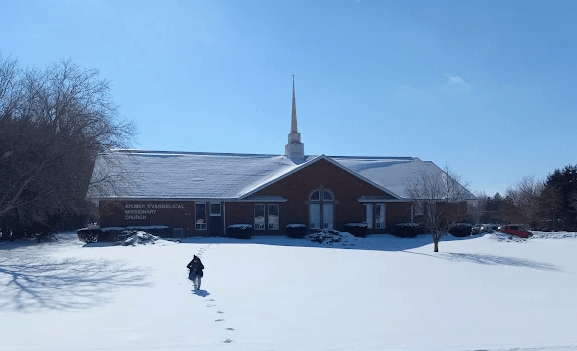
Banner: Aylmer Evangelical Missionary Church in the winter of 2022, Credit: Aylmer EM Church website, photo by “Percy T.”
A version of this article first appeared in Prime Times, the newsletter of the Older Adults Still in Service (OASiS) in May 2021. Used with permission of Jackie Harden, after the death of her editor husband the Rev Tim Harden in 2022.
1Mennonite Brethren in Christ Ontario Conference Journal 1932, p 26.
2In 1931, she was recorded as head of a laundry.
3In 1901, Charles, 18, and a brother, William, 15, listed themselves as “Friends,” that is, Quakers, while the rest of the family were Methodists. To confuse us, he had a sister Dora, and he married a “Theo”dora/ Dora. A younger sister of Flossie, Elsie G, was only 6 months old in the 1911 census, and was born in the USA. Intriguing details. All Mennonite.
4Ruby Wilson and Olive Evans, Annie Yeo: A Life of Service (Burlington, ON: Welch Publishing, 1985).
5https://en.wikipedia.org/wiki/Bobbsey_Twins
6Jean Pearce, ed, History of the Aylmer Missionary Church 1900-1990: 90 Years (Aylmer, ON: Aylmer Missionary Church, 1990).
7I used this new information about Thomas and Maggie Brook in EMCC History blog “The Strange Case of the MBiC East End Mission,” published April 6 2024. In later Aylmer church memory, as in their 2000 calendar history, “Celebrating Christ in Our Community 1900-2000”, the family surname was “Brooks,” the more common form, but contemporary spelling was Brook.
8Lorena Shantz was born at Lebanon, Maryborough Township, Wellington County, https://generations.regionofwaterloo.ca/getperson.php?personID=I38641&tree=generations and married Omer Bion Henderson Jr (d 1945). She died in 1946 and is buried in 1st Mennonite Church Cemetery, Kitchener.
9The Canada Conference had opened a mission in the neighbouring town of St Thomas in 1899 with Lorena Shantz and Laura Moyer, so that in 1900, the St Thomas workers, then Laura Moyer (soon married to MBiC elder Webster Irish) and Nellie Little, helped those in Aylmer. Unfortunately, I have not been able to locate more information about Annie Ball, who served for only the one year.
10 Daniel Bennett, Thomas Fuller and Clare Fuller, “3 Generations of Hostetlers,” YouTube Channel: Ontario Church Stories (19:32) 2017. https://www.youtube.com/watch?v=-Gk0Q3Zhw3s
11Pearce, p 4, 7; “Celebrating Christ,” after the month “December.”
12Canada census of 1901, 1911, 1921 and 1931.
13https://elgin.ogs.on.ca/ancestor-indexes/newspaper-indexes/st-thomas-times-journal-indexes/sttj-1933-nov-dec/


Leave a Reply