This is my trouble--/These were my fathers/ So how am I supposed to feel?/ Way out on the rim of the broken wheel.
from Bruce Cockburn, “Broken Wheel” (1981)
When Presiding Elder Alvin Traub of the Mennonite Brethren in Christ Northwest Canada Conference wrote the Introduction for an MBiC catechism in 1930, he promised that the booklet would be useful to oppose “destructive criticism” of the Bible.1 Traub’s terminology reflected the language of fundamentalism. The EMCC and I, too, are greatly indebted to the fundamentalist movement, but I feel a bit as Canadian singer/ song writer Bruce Cockburn did about his Christian inheritance in 1981. There is something “broken” about it.
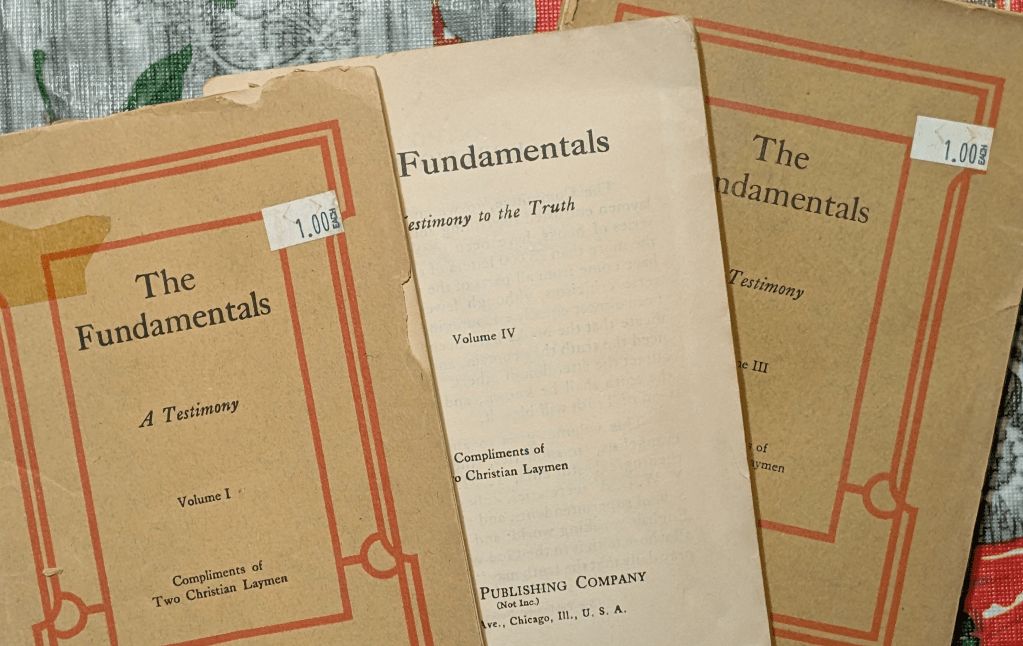
The word “fundamentals” of course, gained a new use as the series title of 12 booklets printing articles by authors from diverse denominations.2 Most of the authors were living at the time, but a few had died when their articles were selected. Amzi Clarence Dixon, Louis Meyer and Reuben A Torrey each edited volumes of The Fundamentals: A Testimony to the Truth.3 What fundamentalists did not like could be termed “modernism” or “liberal theology.” Liberals in theology “sought to remove or reinterpret inherited elements of Christian belief that clashed with modern [hence “modernism”] naturalistic rationalism…readily accepted ‘higher criticism’ of the Bible…and either dropped miraculous elements…(such as the virgin birth) or redefined them in symbolic terms (as was often the case with the resurrection of Jesus).”4
Courtesy: Fuller family collection
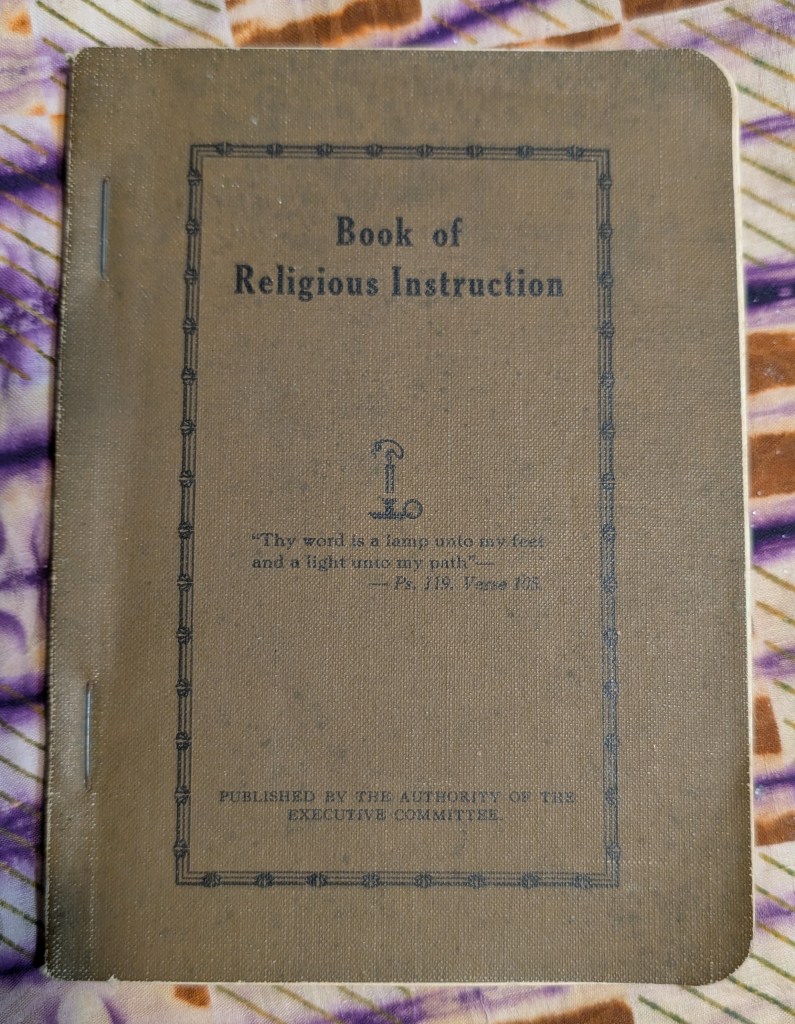
The study of fundamentalism spreads across 20th-century North American Church history, but has not received much attention in connection with the Missionary Church tradition and even less so the Canadian branch. Dr Timothy P Erdel has probably provided the most reflection on the connection in the Missionary Church (see footnote 11). Alvin Traub wrote when he was president of Mountain View Bible College in Didsbury, Alberta, which he founded in 1926. The fundamentalist movement had just come through one of its most public defeats in reputation. Who has not heard of the infamous 1925 “Scopes Monkey Trial”?5 So when he wrote that the booklet contained “the fundamental doctrines of the Bible,” it was not a randomly selected phrase. He was joining the fight. (I analyzed the booklet in my biography of Sam Goudie.6)
Mainstream media today remembers fundamentalism as a curious or even ridiculous relic of early twentieth-century North American—mostly American—Christianity.7 Few North American Christians today would cheerfully name themselves “fundamentalists,” though some do.8 The word is still widely used by journalists and popular writers for a variety of religious groups, including militant Muslims, that writers and their audiences reject. In 1910, an American Presbyterian assembly first named as their “fundamentals” 1) inerrancy of Scripture, 2) the Virgin Birth, 3) substitutionary (vicarious) atonement, 4) bodily resurrection of Jesus and 5) authenticity of miracles. Later fundamentalists replaced 2) with the Deity of Christ, and miracles with 5) the premillennial Return of Christ. “Pre-millennialism” lost support for the movement, but satisfied many others. Just note that no church creed or articles of faith before the 19th-century required belief in any millennial system. In addition to a doctrinal set, however, fundamentalism acquired a further characteristic: a militant stance against any one or organization that did not uphold the program.9
Missionary Church people in the USA and Evangelical Missionary Church of Canada would probably accept being described as “conservative Christians” (ironically, for we earlier preferred to be known as radical Christians!) Pollsters want us to accept being “conservative,” anyway. Missionary Church archivist Dr Timothy Erdel, who taught in the philosophy department at Bethel College (now Bethel University, Mishawaka, Indiana), affirms that although supporting a number of fundamentalist causes, such as maintaining biblical truthfulness, the actuality of miracles, and the bodily resurrection of Jesus,10 the Missionary Church never quite identified with fundamentalists whole-heartedly.11 Other Wesleyan holiness denominations similarly had reservations about fundamentalism.12 There are some good reasons for this ambivalence, shared by our Mennonite cousins.13
One was that mainly separatist and cessationist Baptists, Presbyterians and Christian (“Plymouth”) Brethren who were generally Reformed (Calvinist) in theology led the fundamentalist cause.14 Reformed theology, especially in its Princeton Seminary form, has been strongly against a number of early Missionary Church convictions. The Mennonite Brethren in Christ/ United Missionary Church were openly Arminian and Wesleyan. I would like to deal with Mennonite and Methodist Arminianism in a follow-up post.
“Separatism” has at least two meanings here. One is that fundamentalists split or were expelled from their denominations when they were not able to displace modernism.15 The other is the doctrine of separation, some times even double separation: that a true Christian cannot associate with people supporting serious doctrinal error or those who are otherwise sound but do so associate with those who are not orthodox.16 A well-known example was the rejection of Billy Graham by people such as Bob Jones Sr, when Graham had Roman Catholics sit on the platform of his New York campaign in 1957. (This story, though actually more complex, decided for me that I was not a “separatist” Christian.)
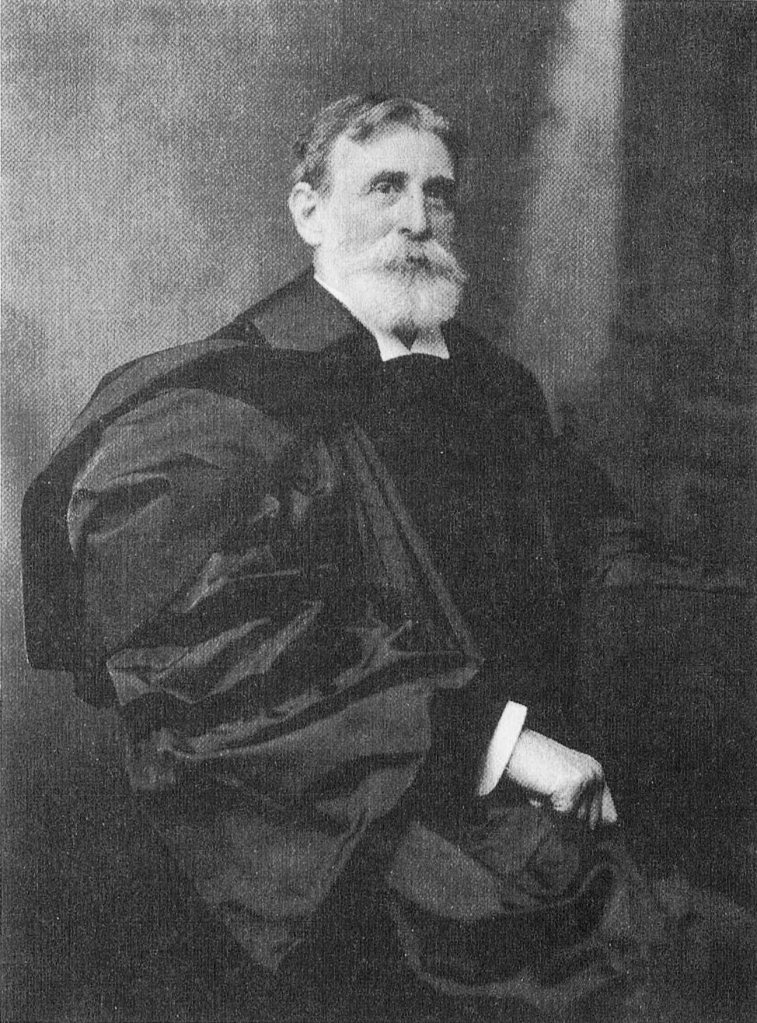
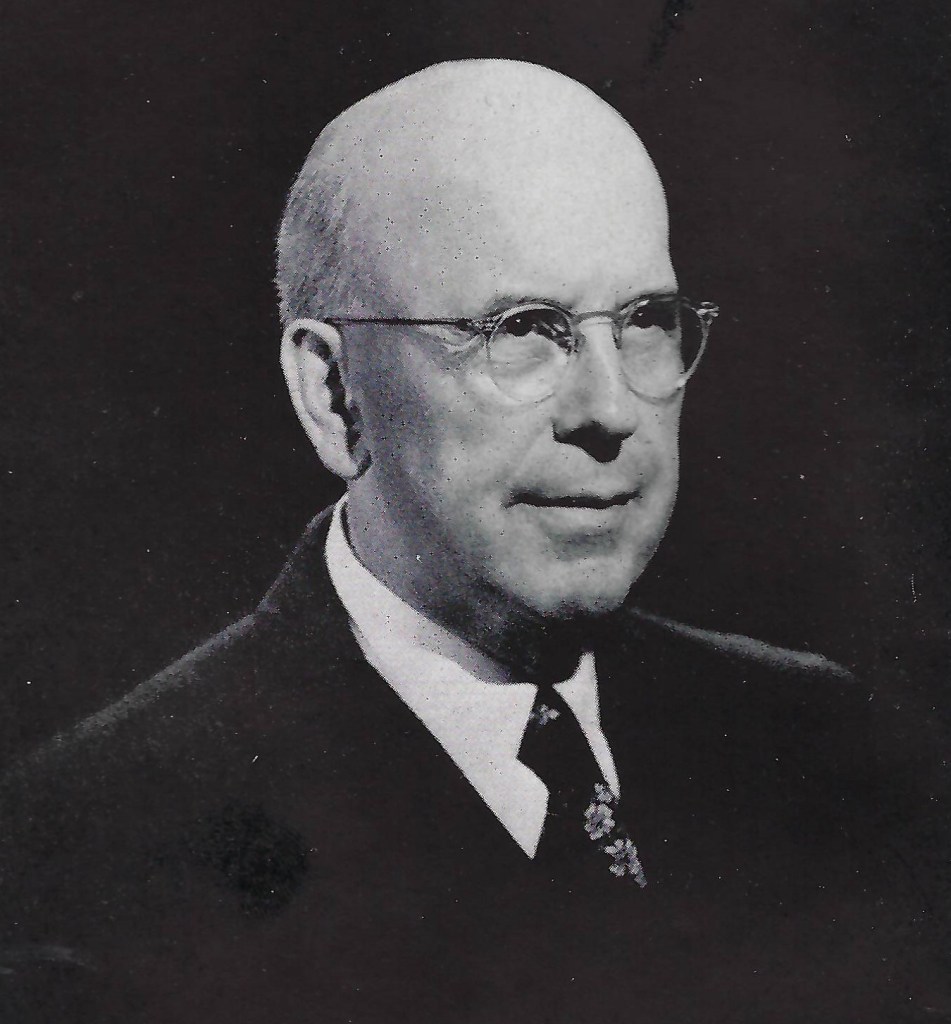
Next, fundamentalist leaders condemned theological liberals or modernists in sharp terms and questioned their salvation, whereas the MBiC explicitly agreed to “recompense no man evil for evil.” (Romans 12:17) and not “promote strife between nations, classes, groups or individuals.”17 Further, most fundamentalists taught that women should not teach or preach in the Church, and certainly not be ordained. The MBiC did not ordain women, rather the denomination “dedicated” them to teach and preach from the 1880s to the 1940s. Hundreds of women were authorized to lead missions and congregations.18 The gap in the time recognizing women in ministry in the Missionary Churches from about 1945 to 1995, I believe, represents in part, the chilling effect of the fundamentalist movement over the Missionary Church’s theology and practice.19 Since the 1990s, dozens of women have been credentialed and ordained in Missionary Churches.20 As well, Reformed theology vigorously disagreed with Wesleyan sanctification theology.21 The MBiC was not cessationist: spiritual gifts continued after the NT era. Finally, most fundamentalists were dispensational pre-millennialists as well, which the MBiC as a whole did not accept, though we came close, often including theology books by Moody Press, or writers trained at Dallas Theological Seminary, for example, in our church libraries. Jasper Abraham Huffman (1880-1970), our first theological educator with academic degrees, though teaching in various schools because we had none of our own, upheld pre-millennialism, but consistently opposed dispensationalism from 1913 to 1958.22 He recognized, better than most, I believe, the threat fundamentalism posed to the theological positions of the Mennonite Brethren in Christ.23
Credit: Missionary Church Archives, Mishawaka, IN
The MBiC, however, had probationers read William E Blackstone’s Jesus is Coming (editions from 1878 to 1908), a premillennialist standard, which has also been described as a dispensationalist book.24 The Missionary Church Historical Trust received a donation of a large book by Clarence Larkin with grand dispensationalist end-times charts. Somebody had it. Young people did go to holiness institutes and colleges that would have taught dispensationalism, such as, perhaps, the Chicago Evangelistic Institute (f 1910), a precursor school to Vennard College. (Lloyd Cressman and J Harold Sherk were graduates of CEI). Both schools were started by holiness women, a clue that some fundamentalist themes might not have been welcome.25 I have seen no evidence, however, that Ontario young people who returned to MBiC ministry went to Moody Bible Institute, a leading dispensationalist school.26 Some respected pastors in Ontario, who trained at Toronto Bible College under Presbyterian John McNichol (principal 1906-1946), had reservations about aspects of premillennialism.27 McNichol kept dispensationalism out of TBC’s doctrinal statement, contrary to almost all other Bible Schools in North America.
Fundamentalism went underground after the 1920s and emerged in the 1940s and 1950s in two forms, but both forms displayed vitality in numbers, institutions, missions and some determined to return to rigorous scholarship.28 It is still manifested in many ways without the name in such disparate areas as the home schooling movement, support for the KJV-only, the New Reformed movement, militarism, anti-evolutionary young earth creationism and the far right politics of white “evangelicals.”1
1 Erdel, p 87, 98-99.
Banner: Copies of The Fundamentals (1910-1915), Courtesy: Fuller family collection
1Samuel Goudie, ed, with Alvin Traub, Book of Religious Instruction ([Kitchener,] ON: Executive Committee of the Mennonite Brethren in Christ Church, 1933) p 3. Traub, Goudie and Silas Cressman had been authorized to produce the catechism by the 1924 MBiC General Conference.
2Presbyterian, Baptist, Congregationalist, Anglican, Christian Brethren. Methodists were not prominently involved. By nationality: at least 35 American, 12 English, 6 Canadian, 2 Scottish, 1 German, 1 Irish, 8 not known; “Canadian Faces of Fundamentalism and Modernism,” Class notes of C Mark Steinacher, McMaster Divinity College, Hamilton, 2002. Steinacher profiled all six Canadian writers for publication.
3(Chicago, IL: Testimony Publishing, 1910-1915). I have original copies of the first seven volumes in Kitchener, Ontario, rusty staples and all, imported to Nigeria from the UK by ACTS Books. A long roundabout journey from Chicago!
4Kevin N Flatt, After Evangelicalism: The Sixties and the United Church (Montreal & Kingston: McGill-Queen’s University Press, 2013) p 11.
5George M Marsden, Fundamentalism and American Culture: The Shaping of Twentieth-Century Evangelicalism: 1870-1925 (New York: Oxford University Press, 1980) p 184-188.
6James Clare Fuller, Hidden in Plain Sight: Sam Goudie and the Ontario Mennonite Brethren in Christ (Eugene, OR/ Hamilton, ON: Pickwick Books/ McMaster Divinity College Press, 2024) p 272-279.
7Richard A Wright, “The Canadian Protestant Tradition 1914-1945,” in George A Rawlyk, ed, The Canadian Protestant Experience 1760 to 1990 (Burlington, ON: Welch Publishing, 1990) p 157.
8Kevin T Bauder, “What’s That Smell? A Fundamentalist Response to The Smell of Sawdust,” in Timothy George, ed, Pilgrims on the Sawdust Trail: Evangelical Ecumenism and the Quest for Christian Identity (Grand Rapids, MI: Baker Academic, 2004) p 57-67.
9John G Stackhouse, Canadian Evangelicalism in the Twentieth Century: An Introduction to its Character (Toronto: University of Toronto Press, 1993) p 11-12.
10Marsden, p 117, 262 n30.
11Timothy Paul Erdel, “The Evangelical Tradition in the Missionary Church: Enduring Debts and Unresolved Dilemmas,” Reflections 13-14 (2011/2012) p 81-82, 84.
12Paul M Bassett, “The Fundamentalist Leavening of the Holiness Movement,” Wesleyan Theological Journal 13 (1978) 65-91 and Stan Ingersol, “Strange Bedfellows: Nazarenes and Fundamentalism,” Wesleyan Theological Journal 40 (2005) 123-141.
13James C Juhnke, Vision, Doctrine, War: Mennonite Identity and Organization in America 1890-1930 (Scottdale, PA/ Waterloo, ON: Herald Press, 1989) p 129-130, 257-262.
14Marsden, p 46.
15As T T Shields was from the Baptist Convention of Ontario and Quebec in 1927; Stackhouse, p 28, 33.
16Bauder, p 63-67.
17The Doctrines and Disciplines of the Mennonite Brethren in Christ Church (New Carlisle, OH: General Conference Executive Committee, 1924) p 23-24.
18Margaret Lamberts Bendroth, Fundamentalism and Gender: 1875 to the Present (New Haven, CT: Yale University Press, 1993) p 34-36.
19Bendroth, p 41-53, describes dispensationalism confirming men’s leadership in Church and home as necessary to quell disorder, and women’s subordination to men as a permanent result of the Fall, not reversed by Christ’s redemption and the gift of the Spirit.
20Jason C Garnaat, “In Memory of Her: A List of Over 500 Women in North American Ministries in the Missionary Church and its Predecessors,” Reflections (Fall 1995) p 4-9.
21Most sharply by the collected essays of Benjamin B Warfield, Perfectionism (Philadelphia, PA: Presbyterian and Reformed Publishing, 1931, republished 1958).
22Jasper A Huffman, “Editorial,” Gospel Banner (January 13 1913) p 1, and his A Comprehensive System of Christian Doctrine: A Syllabus (Winona, IN: Higley Press, 1959) p 192.
23I am not able to speak for the Missionary Church Association, which merged with the MBiC/ UMC in 1969.
24https://en.wikipedia.org/wiki/William_E._Blackstone
25https://www.vcaa.net/heritage.html
26Contrary to a guess in Charles S Gingerich, “An Experiment in Denominationalism: A History of the Missionary Church of Canada, Ontario Conference, 1849-1918,” thesis for MA, Wheaton College, 1994, p 81.
27Eg, Arthur Walsh, Harold Boadway.
28George M Marsden, Reforming Fundamentalism: Fuller Seminary and the New Evangelicalism (Grand Rapids, MI: Wm B Eerdmans, 1990).


Leave a comment