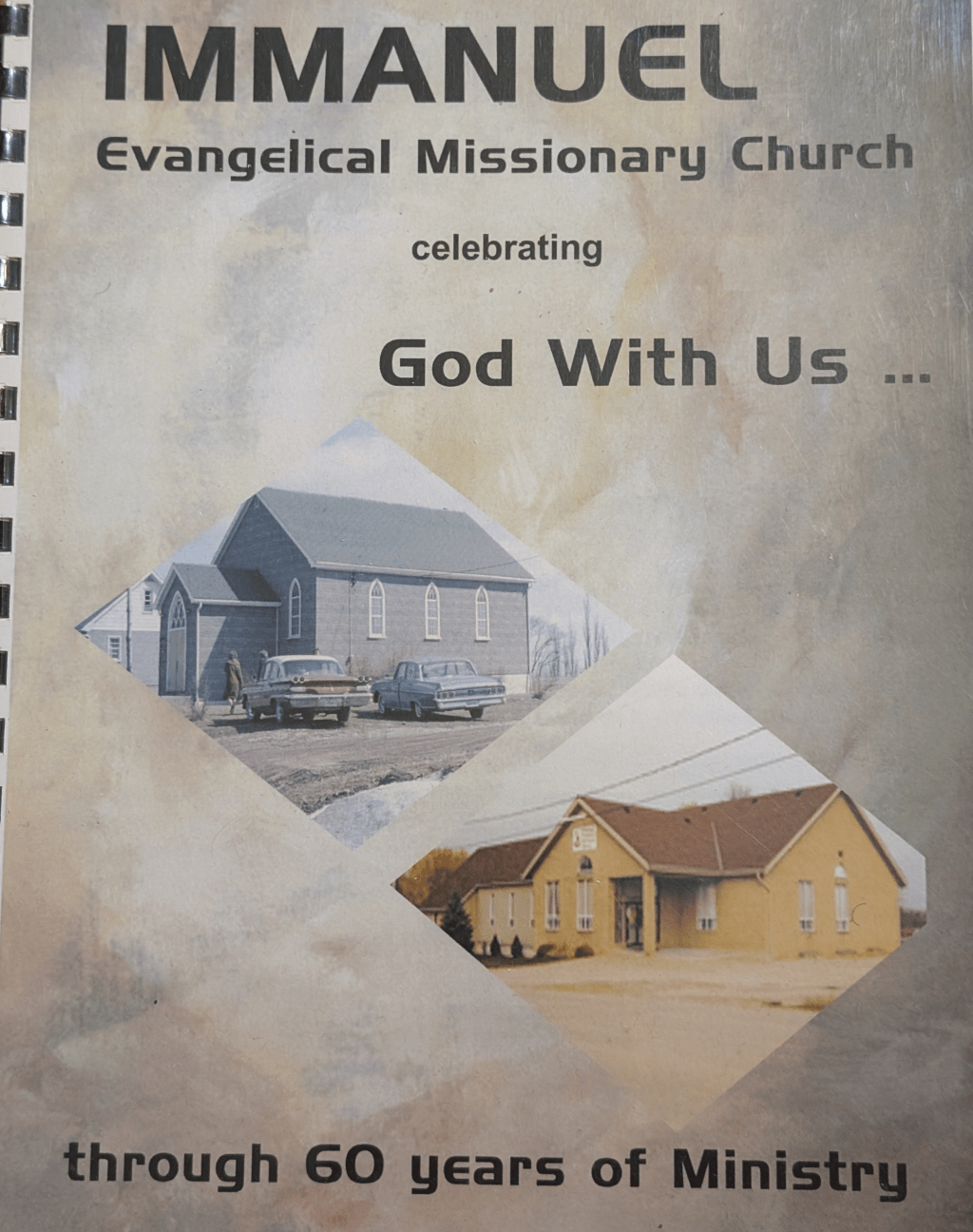
A big anniversary comes around for a congregation and often the members think of a big party, or possibly an anniversary booklet to celebrate. Parties are nice, but histories are the delight and the headache for people like me. We try to gather evidence about the continuities, shifts and meanings of practices and theology at the local level, in my case, the former Canada East District of the Evangelical Missionary Church of Canada. I have collected many local histories for myself, and for the Missionary Church Historical Trust (MCHT) historical collection. These comments come from my experience of reading and using local church histories.1
The MCHT in Elmira, ON, keeps local church histories. All denominational archives do or should. In our situation, the histories range all the way from one page anniversary bulletin inserts to 210 page books. Many are 2 or 3-page typescripts. Most local historians are amateurs, that is, they write for the love of their congregation. We have at least 89 separate titles, only 38 of which are longer than 10 pages. They represent the work of 56 named authors and committees. Local church historians are humble people, many merely calling themselves “compilers,” not even editors, though that is what they had to be. About 30 histories are anonymous. Churches may use local print shops, or even their own church Gestetner or office printer, which normally produced Sunday bulletins. Often the church board is credited as the publisher; only one author used a commercial publisher. Frequently there are no standard title pages, some booklets are unpaginated, and references may be sketchy or non-existent. The title on the cover may not match the title inside the book, some even forget to date the writing. Few state a copyright, though rarely would any attract malicious infringement.
But we need local church histories.
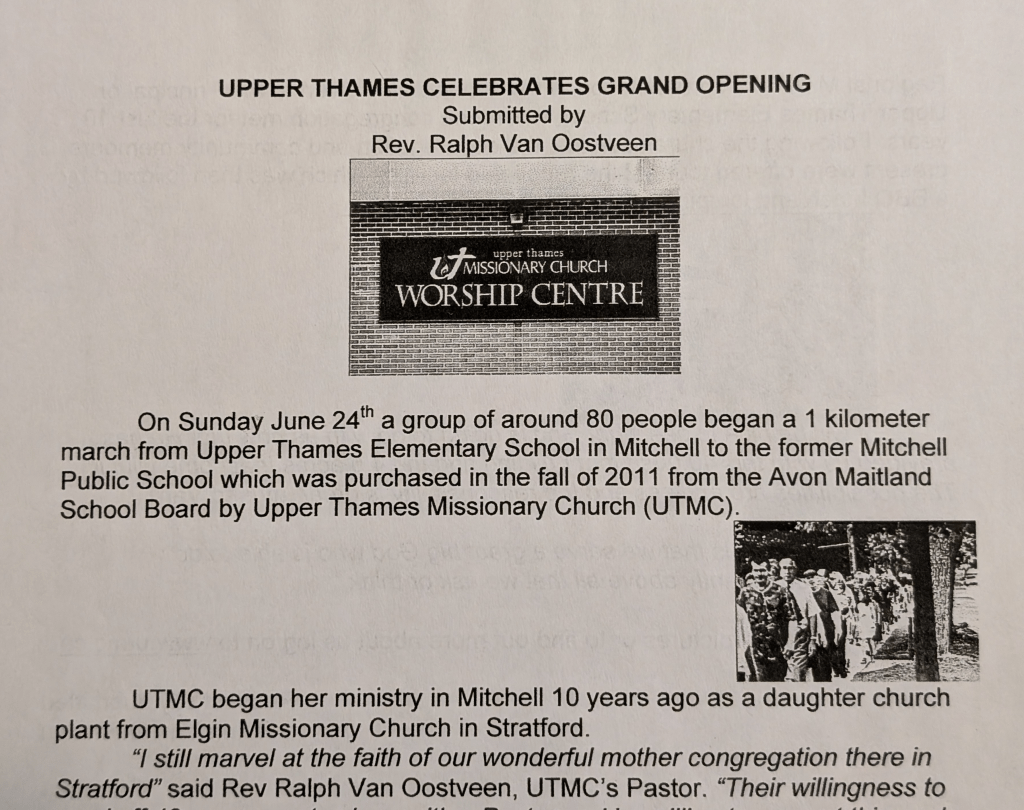
Someday, they will have much to tell. Courtesy: MCHT.
Local church histories preserve Local Memory. The big general histories of a denomination cannot do this. Local memory recalls details that just get lost in the big picture of things. Also many official histories act as promotional accounts. Almost nothing bad happens, according to them.2 Local histories often have vital clues to how things used to be believed and done that current thought and practice in the churches have lost sight of. This has been called the “whig theory of history”: everything leads up to our status quo. ( https://en.wikipedia.org/wiki/Whig_history ) They preserve stories, and memory of people that no one else but the local church knows. They can be heavily factual with a minimum of the abstract. “Mrs Pitt taught the nursery class in the basement for 26 years,” as opposed to “Qualified staff cared for the coming generation.”
Local histories are like a family photo album: they have special interest for the members. These people represent the spiritual genealogy of the present generation.
Local histories can also be Maddeningly Narrow. Some are content with a list of ministers and years they served. Nothing more. Some tell us all about the repairs in the plumbing (granted, extremely useful at the end of a long morning service.) They may say they had a wonderful youth fellowship in the 1960s, but no reasons given. Some histories never give a statistic about membership or attendance or the changing neighbourhood. It is a problem in many histories that they concentrate on the history of the building, not so much the people when dating the start or major events of the church. And as I reflected in EMCC History blogs about the buildings the EMCC used or built in Ontario, the buildings shape us as users and worshipers as much as we build and renovate them for our use.3
Local church living memory rarely goes beyond 60 or 70 years, if a congregation is blessed with memories from members who stayed with the church that long. That still means, however, that those older members were very young when they started out in the congregation and were not very aware of what was going on in their church. They probably have anecdotes about funny (therefore memorable) but probably trivial events or tragic events that stuck in their minds. But events before 60 or 70 years ago are out of reach of living memory. Before that, churches have fuzzy memories or even legends to go by. Spellings of names and dates of pastoral appointments are missing or get twisted.
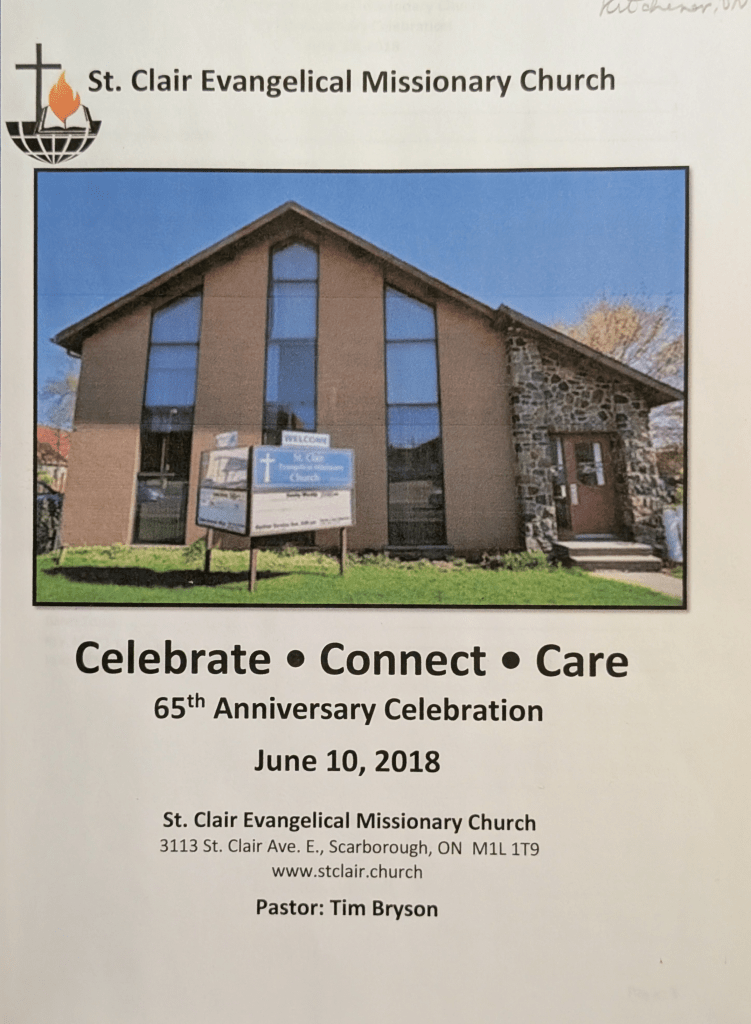
Courtesy: Tim Bryson, MCHT
Documents are evidence. You would think that contemporary documents would promise a check on legends. They tell you that Brother so and so was preaching in 1895 at XYZ field, and not, as memory has it, at ABC station. Statistics tell you that, in fact membership was falling in the 1920s at such and such a church, and not continuously growing as local impressions said.
Documents have their own hazards, too, as the original contexts have possibly been forgotten, and they have to be interpreted with care. Old terminologies get new meanings, or slip out of use, customs drop out, new fads and fashions arise, and of course technologies replace others. A problem with documents may be the simple lack of them (they were never kept),4 or when the newsprint exercise book used to keep track of Sunday School attendance got left out in the rain one day, the paper warped and the ink ran, leaving a mess that had to be thrown out. Some of my USBs are already getting corrupted. (In 30 years, will anyone remember what a USB was?)
What can be done? Churches have to protect their records. They can make copies and put them in separate secure places. One church lost its earliest records when thieves stole the heavy safe containing them. They can publish some records, as happened with the earliest New Mennonite Church records of Blair, Ontario, which were somehow donated to the Mennonite Archives of Ontario. The MAO is a good repository, mind you, with excellent staff and facilities to care for records.
In our day the sheer volume of records and data can overwhelm a church system; what to keep? More and more churches recorded their pastors’ sermons (rarely, on reel to reel tapes, but often audio-cassettes, VHS or CDs, then DVDs) but who wants them after a few years? (The Missionary Church Historical Trust does, but even we have limited space.) Even more problematic for the future is that many church records exist in a digital “cloud” somewhere in Antarctica or Ireland, and how do those essentials get preserved in a retrievable form for historians of the future? People have to think about these things!5
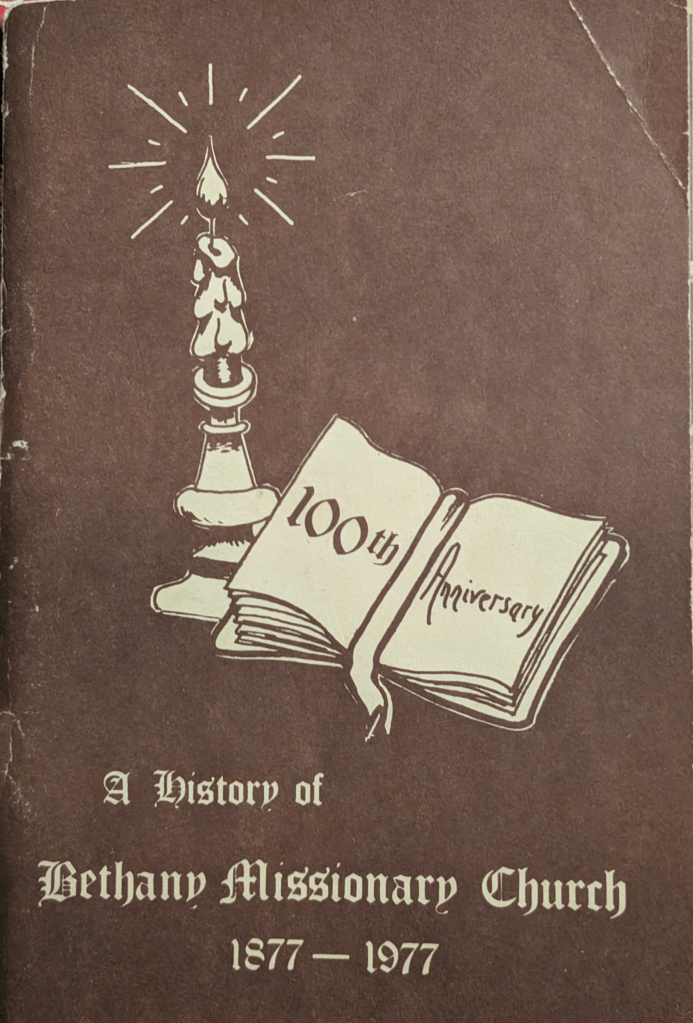
their 150th anniversary. Courtesy: C Fuller.
Some local histories stand out. Ward M Shantz grew up in Bethany EM Church, Kitchener Ontario, and had a long experience as a pastor in various congregations, a Bible College leader and District administrator.6 When the 100th anniversary of Bethany approached, his experience in the denomination showed in his retirement project to write Bethany’s history.7 He knew the former customs of the denomination and the local congregation. He had access to church records, and a sense of the history of Berlin/ Kitchener, the community of the congregation. The result is a model topical account of a leading congregation.
Another excellent history is the one for Banfield Memorial (now, alas, out of the denomination, much diminished, as Wellspring Worship Centre) in Toronto by another fine mind, Dr F Arthur Sherk, a professor of mathematics and son of an MBiC preacher, J Harold Sherk. Dr Sherk had similar advantages as Shantz, knowing the congregation for most of his life, and being involved in the life of the district.8
A third shining example is the history of Bethel, the Lion’s Head church, by Charles Gingerich, who made excellent use of Conference Journals, interviews and local records, even though he did not grow up in the congregation.9 His training as a historian at Wheaton College shows!
Jenny Versteeg produced an award winner in my estimate in her 2025 history of the Listowel, ON, church, Guarding the Deposit.10 She is an experienced writer, and makes good use of documentation. Her knowledge of local context makes this local church history stand out.
Other high quality histories were written by Margaret Montgomery and Winnie Srigley for Palmerston EM Church, who recognized the churches in the rural Maryborough field (Wallace, Maryboro, Glen Allen). These appointments together supplied the membership of the congregation that moved into Palmerston town in more recent years.11 Carol McCulloch edited an innovative history for Immanuel EM Church at Paisley, heavily relying on photographs, following up the pastors who served the church over the years (“Where are they now?”) in a way I have never seen any other church try.12 Muriel I Hoover noted so many aspects of her church at New Dundee for its centennial. Her book is weaker on recognition of the numerous rural appointments that went together to form the Bethel congregation of 1978,13 but it repaid rereading for my own projects. She had material. (Bethel has done the right thing by having its own dedicated archives room and a series of dedicated curators.)
The St Catharines Bethany Community Church produced an interesting version of its history for its 125th anniversary in 2024, by constructing 30 panels for a hallway of their building. Advised by Larry Shantz, their long-time pastor, it gives meaningful snapshots of the stages of the growth of the congregation again, showing local memory unknown to the MCHT. The MCHT does not have a version of this in its collection, though I do have photographs of the panels.
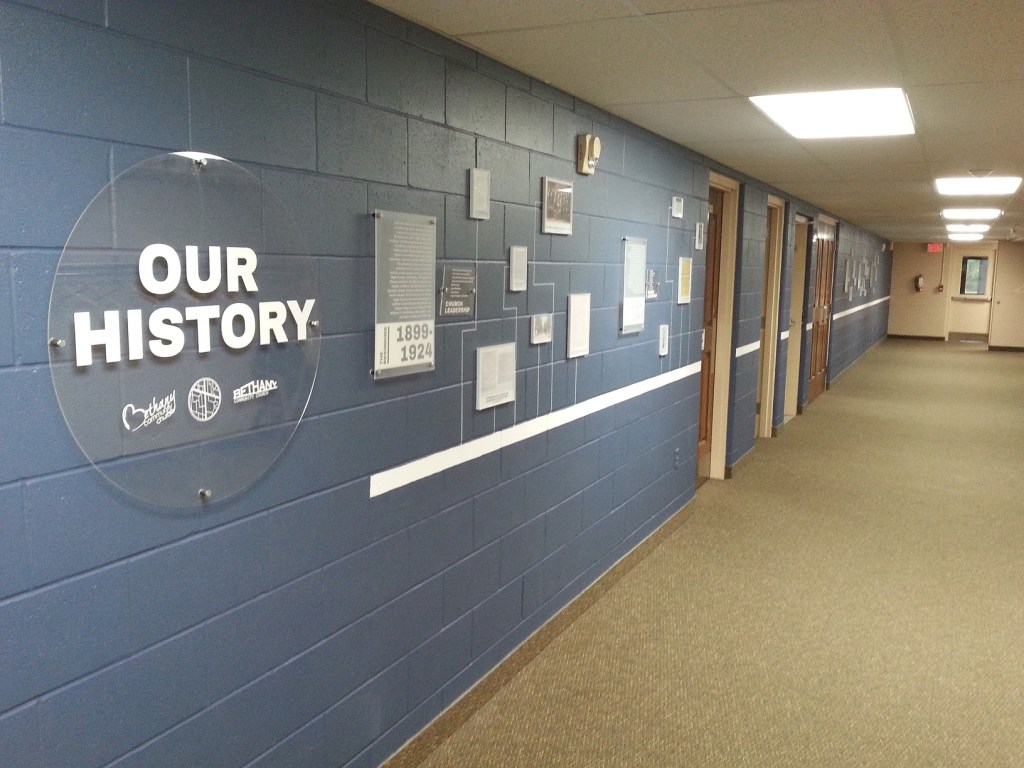
Photo Courtesy Mark Fuller.
The EMCC in Ontario has a history that after the 1993 merger of the Missionary Church of Canada and the Evangelical Church in Canada stretches back to the 1830s.14 In some cases we know more about our earlier history, if you can believe it, than was known in 1920; the case of the New Mennonite Church (1851-1875) being one example.15 With the recent translations of the letters of Evangelical Association pastor Elder Jacob Anthes from German, we know more about the background of the revival in Port Elgin that led to Solomon Eby and his Mennonite congregation taking on new ways 1869 to 1874 than we ever knew before-see EMCC History, “The Port Elgin Bibles,” December 6 2025. We know almost nothing about the current history of the EMCC in 2026 because stories are only published piecemeal so far, until local church histories are written and national board minutes allowed to be public. Also, congregational websites are increasingly shy about telling us anything about their origins. Everybody wants to be only current.
Many congregations have produced centennial histories, some churches may even survive to need bicentennial histories. With the pace of change, especially the closing of older congregations once thought to be bastions of the denomination, and loss of others by them leaving the Church for leadership or doctrinal reasons, much could be lost. I was a member of a Missionary Church in Kitchener from 1978, but its 77-year history ending with a merger in 2020 may lead to its neglect. If God spares me, I may be able to write it.
Or maybe some readers will be moved to write one?
Banner: Cover of Immanuel Evangelical Missionary Church, Paisley, ON 60th anniversary history, ed Carol McCulloch. Photo courtesy C Fuller.
1Guides for writing local church histories from my randomly-acquired collection are Louise B Campbell, compiler, The Local Church History Program: A Manual ([Winona Lake, IN: Free Methodist Church Headquarters,] 1984) and Ralph Milton, How to Write and Publish Your Church History (Winfield, BC: Wood Lake Books, 1986). There are more modern guides, I am sure, and online.
2Candidly and wittily addressed by Timothy Paul Erdel in “Pedagogy, Propaganda, Prophetic Protest, and Projection: Dangers and Dilemmas in Writing an Authorized Denominational History,” 2002 Conference on Faith and History Biennial Meeting, Huntington College, Huntington, IN. Copy kindly supplied by Tim Erdel, Missionary Church Archivist.
3EMCC History, “EMCC church buildings Part 1-5” published on June 7, June 21, July 19, Oct 4 and Oct 6 2025.
4Sorry to mention a personal situation, but my 13 months as pastor at Elk Lake, ON, is unrecorded in the Canada East Conference Journals, because I was appointed after the 1987 Journal went to press and gone before the 1988 Journal was published. There are probably other personnel who have similar experiences of becoming invisible.
5Currently the subject of much thought in the EMCC archives ad hoc committee led by Scott Clubine, EMCC vice-president.
6Clare Fuller (2015), “Shantz, Ward Montford, 1910-2009),” https://gameo.org/index.php?title=Shantz,_Ward_Montford_(1910-2009)&oldid=132007
7Ward Montford Shantz, History of Bethany Missionary Church 1877-1977 (Kitchener, ON: Bethany Church Board, 1977).
8F Arthur Sherk, Keeping Faith: A Centennial History of Banfield Memorial Church (Willowdale, ON: Banfield Memorial Church, 1997).
9Charles S Gingerich, The Peninsula Pilgrims: A History of Bethel Church (Lion’s Head, ON: RDP Graphics, 2007).
10Jenny Versteeg, Guarding the Deposit: A History of Listowel Evangelical Missionary Church 1925-2025 (Listowel, ON: For the Author, 2025).
11Margaret H Montgomery and Winnie Srigley, Celebrating Our Heritage 1874-1999: 125 Years Under God’s Leadership (Palmerston, ON: Palmerston Evangelical Missionary Church, 1999).
12Carol A McCulloch, ed, Immanuel Evangelical Missionary Church Celebrating God with Us Through 60 Years of Ministry (Paisley, ON: Immanuel Evangelical Missionary Church, 2012). The congregation is simply “Paisley Missionary Church,” since about 2021.
13Muriel I Hoover, Bethel “House of God” A History of Bethel Missionary Church 1878-1978 (New Dundee, ON: Bethel Missionary Church, 1978).
14See “Formation of the EMCC” on the EMCC History homepage to follow all the foundings and mergings that led to the current EMCC.
15EMCC History “New Mennonite Church of Canada West and Ohio Part 2,” June 8 2024. Basically, Huffman’s 1920 history of the Mennonite Brethren in Christ Church relied on Samuel F Pannabecker’s BA thesis of 1918 that was a first attempt, but Pannabecker did not have access to documents now available gathered in the Mennonite Archives of Ontario at Conrad Grebel University College in Waterloo, Ontario.


 EMCC History
Leave a reply to timerdel Cancel reply