Except for outside groups, Christians of every shape, size and colour make videos and watch movies, whether documentaries or narrative fiction, whether in a cinema, on TV or on a cellphone. As Paul Fromer, professor of writing at Wheaton College and a deputy editor for Christianity Today wrote, “Should a Christian go to movies? We might as well ask, ‘Should a Christian read books?’ Yes and no.”1
This blog will use personal memories with original research. Nobody else has investigated the Missionary Church use of film that I know of. I am only randomly scratching the surface here.
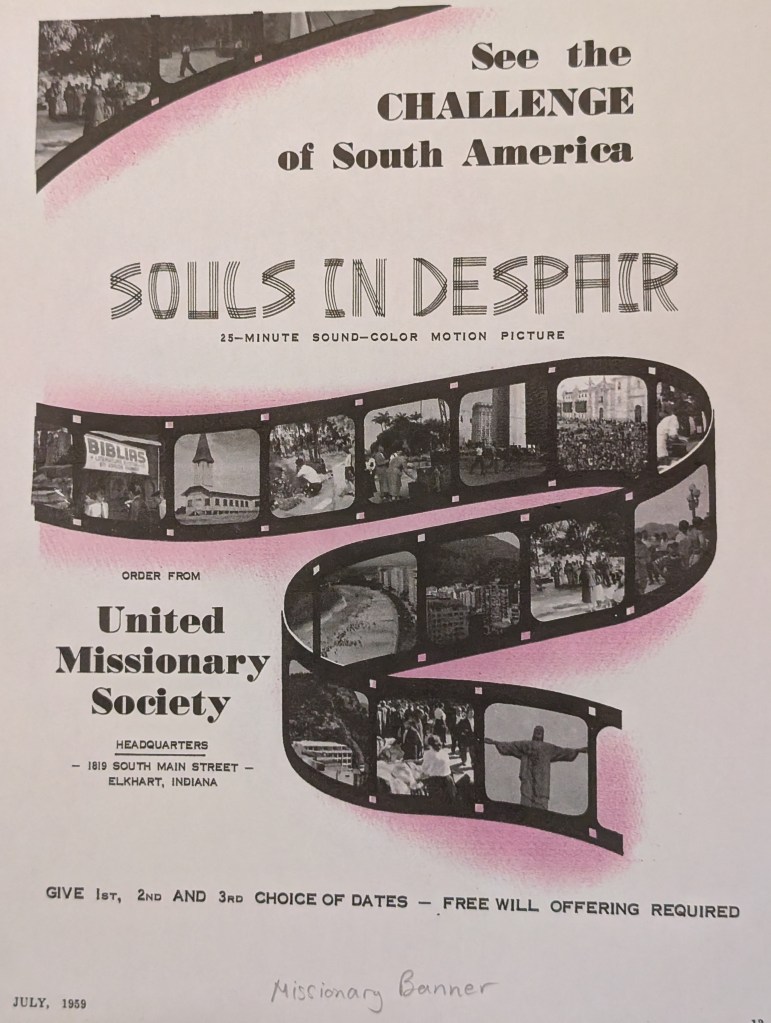
Credit: Missionary Banner (July 1959) p 13.
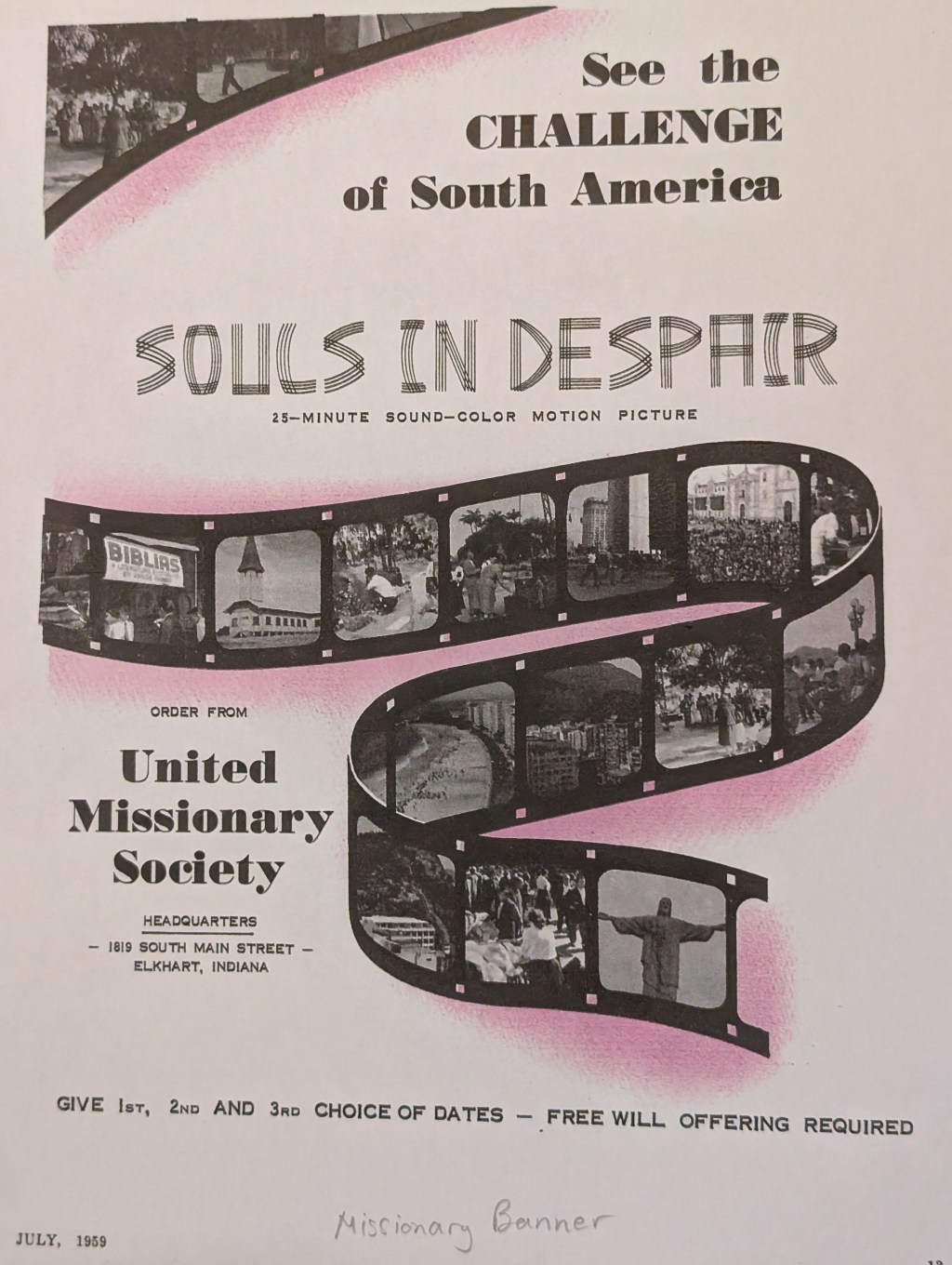
As I mentioned last time in EMCC History, the United Missionary Church probably produced its first motion picture in 1959, when the United Missionary Society offered Souls in Despair, a documentary about the recently opened UMS field in southern Brazil. It was narrated by the UMS president, Your Worship Hour radio preacher Quinton J Everest, giving the stamp of authority and respectability to the new medium (new to the UMC), if there were any doubt.2
Gradually, cautious, biblical Christians started to use film in their churches: not for Sunday morning, but in teaching events and evening meetings, and especially in youth groups.3 Here’s a further example: I cannot remember who produced the film, or its title, but pastor David Illman used a movie at St Clair Missionary Church, Toronto, the school year I attended there (1974-75). It followed a young woman who wanted to become a fashion model, but who has a moral crisis when the photographer tells her she would make more money with nude photo shoots. Maybe a reader can identify it.
I want to recollect here an experience the following year, when I was taking some make-up courses at Carleton University in Ottawa. With the University of Ottawa InterVarsity group, I had the privilege of visiting Christian film-maker and canoeing enthusiast Bill Mason in his home.4 He showed us some of his beautiful movies still in the making, including one about a pack of wolves he filmed in a large enclosure on that very property in Gatineau, Quebec.5
When I became a pastor in Sudbury, 1981-1984, I borrowed the public library’s film projector and movies (they were free). I previewed National Film Board of Canada projects. Few if any were feature films—I just wanted discussion starters, such as The Summer We Moved to Elm Street (1966),6 or the award-winning 8-minute antiwar film Neighbours (1952). They also had the black and white Cathedral Films’ Life of Christ series. I used some, but was put off by the “slow and holy” emotionless acting of the figure of Jesus Christ. My son Thomas tells me that was an earlier expectation Christians had about how to portray the Saviour. Maybe it’s me and my times, but I like the more emotional portrayals. I notice people like the smiling Jesus in the TV series, The Chosen.

Credit: National Film Board of Canada
A Baptist young adult gathering in Sudbury, (not in their church building), showed Clint Eastwood’s Pale Rider (1985). I knew nothing about Eastwood except he played cowboys and cops. I am not sure if there was anything more than entertainment involved, although Eastwood played a former preacher and the title refers to Revelation 6:8. The characters quote the passage. I was bewildered.
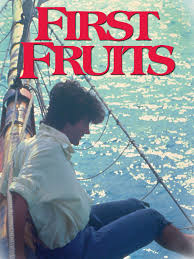
Meanwhile, churches were invited to order films for their use from numerous Christian film libraries and agencies across North America.7 I found films advertised in Christian magazines such as Christianity Today. In a sampling from 1977 to 1982 I recorded World-Wide Picture’s Shiokari Pass (1973), Francis Schaeffer’s multi-part How Should We Then Live? (1977), The Miracle Goes On (about John W Peterson, 1977), the Genesis Project’s Noah (1979) and Jesus (1979), Mel White’s Deceived (1980), Discipline in the Christian Classroom (Focus on the Family), Ann Keimel’s Hi, I’m Ann (1980), Fire in the Sky (1980), Ron Carlson’s six-part The Counterfeits, Zeffirelli’s Jesus of Nazareth (12-part series study set, VHS 1981), Charlie and Martha Shedd’s five-film series Fun in Marriage Workshop (ca 1981), Joyce Landorf’s 6-part series His Stubborn Love (ca 1980), Gateway’s First Fruits (1982) and so on. As a pastor in Elk Lake, Ontario, (1987-1988) I ordered something from a film library, but it did not arrive on time, since it was sent by mistake to Elk Lake, British Columbia! C’est la vie.
Shortly after, in Nigeria, I found my fellow World Partners missionaries, Dr George and Mrs Helen Schroeder, had a film library of their own. Many Nigerian churches rented the movies, or George took them out to assist his evangelistic preaching. On UMCA Theological College Chapel missions trips, I saw Journey to the Sky about the Christian Sadhu Sundar Singh many times, or Apache Fire, a dramatized story about a violent Apache man who was converted though Cherokee evangelists. The story did not need much dialogue, the situations were similar to what some Nigerians experienced, such as danger from snakes, scorpions, prisons and chases through rough country. I also watched Pilgrims Progress, filmed in Ireland, in which Evangelist is played convincingly by Liam Neeson in his first cinematic role. Most of the Schroeders’ films were Ken Anderson’s Gospel Films 16 mm products, but one, Angel in Ebony (Taylor University, 1954) about Sammy Kaboo Morris was not. I showed some of them myself in village visits.

Later Missionary Church productions. During these years I was collecting videos produced by the Missionary Church. I don’t have a list of them all. The Missionary Church Historical Trust preserves some MC videos: for example, “Challenge of Northwest Ecuador” (34 minutes, 1991), and “Chosen for Challenge,” about the establishment of the Rondonia District of the Brazilian Missionary Church (27 minutes, nd). Most of them we left in Nigeria in 2010, but by then DVDs had replaced video-cassettes, and Nigeria used PAL formats instead of NTSC and other technological incompatibilities, so it was rather a lost cause. I got literal headaches getting a generator to work, adapting the 50 cycle 220 volt Nigerian standard to 60 cycle, 110 volt North American equipment on hand with plugs and outlets that did not fit each other. I used documentaries on Islam from Orbis, and historical dramas from Vision Video in some of my classes. Mold and dust destroy the tapes sadly.
The EMCC put out The Heartbeat of our Mission in 1993 and in 1995-1996, five news-format VHS tapes called EMCC Today, produced by the late Glenn Gibson. Individual missionaries have always been urged to develop audio-visuals,8 the slide show being a long-time favourite. Stan Yoder (from Sierra Leone) on deputation in 1989 showed an 8 mm home movie that I thought was effective, and I used slides and VHS video-cassettes myself long after the DVD had taken hold. Some of these audio-visuals are in the MCHT, but I suspect thousands of missionary slides and some videos of historical value (as opposed to purely family photos) remain in the collections of missionary families, or have been lost entirely because the families didn’t know what to do with them.
The celluloid movies were costly to buy or rent. When VCR and VHS video-cassette technology was introduced, it spelled the doom of the film libraries. Christianity Today witnessed it, though it may not have recognized it at first, in a series of articles in the January 23 1981 issue. At first Christians were rejoicing that the VCR (video cassette recorder), by taping shows families wanted to see, helped them avoid viewing unwanted content.9 But the VCR could also copy Christian films, if the makers were so rash as to broadcast them on TV. Then came the video outlets, from corner stores with a few shelves, to Blockbuster and Jumbo Video. Why buy an expensive series, when you can buy or rent a VHS for far less? All 33 film packages of the Genesis Project Genesis and Luke would cost about $US10,000.10 Not only that, a church could make their own video content with inexpensive cameras and play it back on a TV screen.11 (Projectors were expensive, but they became less so in time.) At first, video production companies tried to keep the prices up, but the cost of duplicating a video was a tiny fraction of the prices they were charging.12 Filmstrips and film series were still being produced and promoted, but not for long.13 Terry Lindvall and Andrew Quicke studied this period which terminated with the collapse of the Christian film industry about the mid 1980s.14
Credit: Penguin-Random House, 2004.
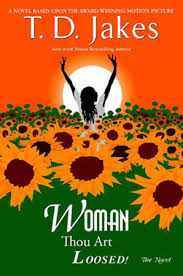
Christian or at least religious video went into a kind of slump. T D Jakes began making movies that got attention, especially Woman, Thou Art Loosed! (2004) and African-American movies got a boost. Then a famous actor/director, Mel Gibson, released The Passion of the Christ (2004). Gibson, a sedevacantist catholic (“the pope’s chair is vacant”), wanted to make an extremely graphic movie about Jesus’ trial and execution. He included everything in the New Testament he could, but incorporated legendary material as well, in Aramaic and Latin dialogue. Billy Graham and others endorsed the movie, and it made tons of money. Hollywood’s mouth watered, and suddenly big studio faith-based projects were “green lit,” giving us The Nativity Story (2006), One Night with the King (2006) and others. What is more, Sony Pictures started supporting the Kendrick brothers’ independent projects.15
Mention of the Kendricks bring us to practically current times. Their long string of notable films that made money, using ridiculously low budgets and many volunteers–Flywheel, (2003), Facing the Giants (2006), Fireproof (2008), etc, but increasing the budget with each success, ignited a renewed religious/ Christian film industry. Stayner Camp used these films as well as God’s Not Dead (2014).16 Evangel Community Church did not use many theatrically released movies, but we did use Fireproof and War Room (2015). At other times we used teaching video series from churches in Manitoba and Texas. Most faith-based films are still released direct to DVD/Blu-Ray. Many are quite formulaic, the talent is mediocre, and often sermons disguised as stories. Some stand above the others.
I will conclude with a comment about another movie series: The Left Behind movies (2000, 2002, 2005, 2014), based on the books by Timothy LaHaye and Jerry Jenkins. The books had multi-million copy sales, the movies not so great. The first adaptation did not meet with LaHaye’s approval and a second version was issued.17 I don’t know how well the movies were received in EMCC homes or churches. Again, the theology is dispensational, and probably welcomed by some in the EMCC. Historically, as I mentioned in an earlier EMCC History blog, the Church would not accept dispensationalism nor its America-centric, racist, militaristic and illogical story which was dictated by the doctrinal scheme. If you are curious, it was skewered in the multi-year podcast of Fred Clark (2003-2008), known as The Slacktivist. http://www.patheos.com/blogs/slacktivist/ .
1Carl F H Henry, ed, Baker’s Dictionary of Christian Ethics (Grand Rapids, MI: Baker Book House, 1973) p 439.
2Missionary Banner (July 1959) p 14.
3EMCC History, “Movies and the EMCC Part 2.” Posted August 30 2025.
4https://www.nfb.ca/directors/bill-mason/
5See also https://en.wikipedia.org/wiki/Bill_Mason
6https://collection.nfb.ca/film/the-summer-we-moved-to-elm-street
7Andrew Quicke, “Independent Protestant Film, from Silent Era to Its Resurgence,” in Protestants on Screen, ed by Gaston Espinosa, Erik Reding and Jason Stevens (Oxford University Press, 2023) p 77.
8The MCHT has dozens of deputation products in VHS, CD-R or DVD from the 1990s to 2017 in Box 9012.
9Dennis Tegtmeier, “VCR’s [sic]: Key to Taming the TV Monster,” p 26-27.
10Beth Spring, “The Ambitious Genesis Project Falls on Hard Times,” Christianity Today (August 1982) p 40.
11Carol R Thiessen, “VCR’s: Plunging into an Unexplored Medium,” p 29-30.
12“Video Materials Available for Churches,” p 30.
13Mark H Senter III, “Noteworthy Offerings on Acetate,” p 28 and Dale Sanders, “Recent Filmstrip Offerings,” p 31.
14Terry Lindvall and Andrew Quicke, Celluloid Sermons: The Emergence of the Christian Film Industry, 1930-1986 (NY: New York University Press, 2011).
15J Ryan Parker, Cinema as Pulpit: Sherwood Pictures and the Church Film Movement (Jefferson, NC: McFarland, 2012) p 7, 9, 41, 75. Provident Music/ Films is owned by Sony Pictures.
16Jean E Hallman Morby, Hands Hearts Heads: Stayner Camp 1925-2015 and Still Strong (np: [Evergreen Christian Ministries], 2025) p 287.
17Daniel Silliman, Reading Evangelicals: How Christian Fiction Shaped a Culture and a Faith (Grand Rapids, MI: Wm B Eerdmans, 2021) p 91-132. Silliman is aware of the doctrines LaHaye required to be included in the books and movies. His chapter on Left Behind concentrates on the theme of decision compelled by events ascribed to the Bible.


Leave a Reply