
I was eating my lunch off a commemorative plate when a thought struck me. Commemorative church plates were not exactly meant to be used to hold my beans and greens, but to commemorate and be displayed. The Canadian Presbyterian Church Heritage Centre in Carlisle, ON, had by 2021 a collection of over 675 of them!1 You can buy them in antique stores or online as well. But personally, one can collect only so many, and I needed a smaller plate size to remind myself to eat less. This plate has a small chip gone and some of the gilt is less than when it was manufactured 45 years ago in Collingwood, ON. I won’t tell you what it commemorated out of respect for the organization! We used to have two. The other became sherds, and is now in a landfill no doubt.
Courtesy: Missionary Church Historical Trust
Archaeologists depend on pieces of broken pottery to date a site or a strata. It is nice if the whole item remains intact—wonderful even—but not necessary. Potsherds are some of the most durable materials in the ground where people lived. Clay pots were the plastic containers of the world, common and cheap.
Lamentations 4:2 cries “How the precious children of Zion, once worth their weight in gold, are now considered as pots of clay…” Broken pots are useless, yet still useful. You could carry coals from one fire to light another with a potsherd, or you could write brief messages on them, like a tweet. The Bible refers to potsherds (Psalm 22:15 (dry), Isaiah 45:9 (nothing but potsherds), Jeremiah 19:2 (Potsherd Gate), Job 41:30 (jagged like potsherds). Break the pot: Lev 11:33, 35; Jeremiah 22:28 a broken pot, Job 2:8 Job took a piece of broken pottery…, Ps 2:9 smash them like, Ps 31:12, Isaiah 30:12, Jeremiah 25: shattered like fine pottery, Rev 2:27 dash them to pieces like pottery.

Courtesy: MCHT
J A Huffman hoped to find an ostracon, a potsherd with writing on it, scratched, incised or written with ink, when he spent some weeks as a volunteer excavator in Palestine in 1930.2 Alas, he did not find any. Greeks used them for voting. Commanders of Judah wrote messages on them to report the situation of the siege of Lachish to the king in Jerusalem, 587 BC.3
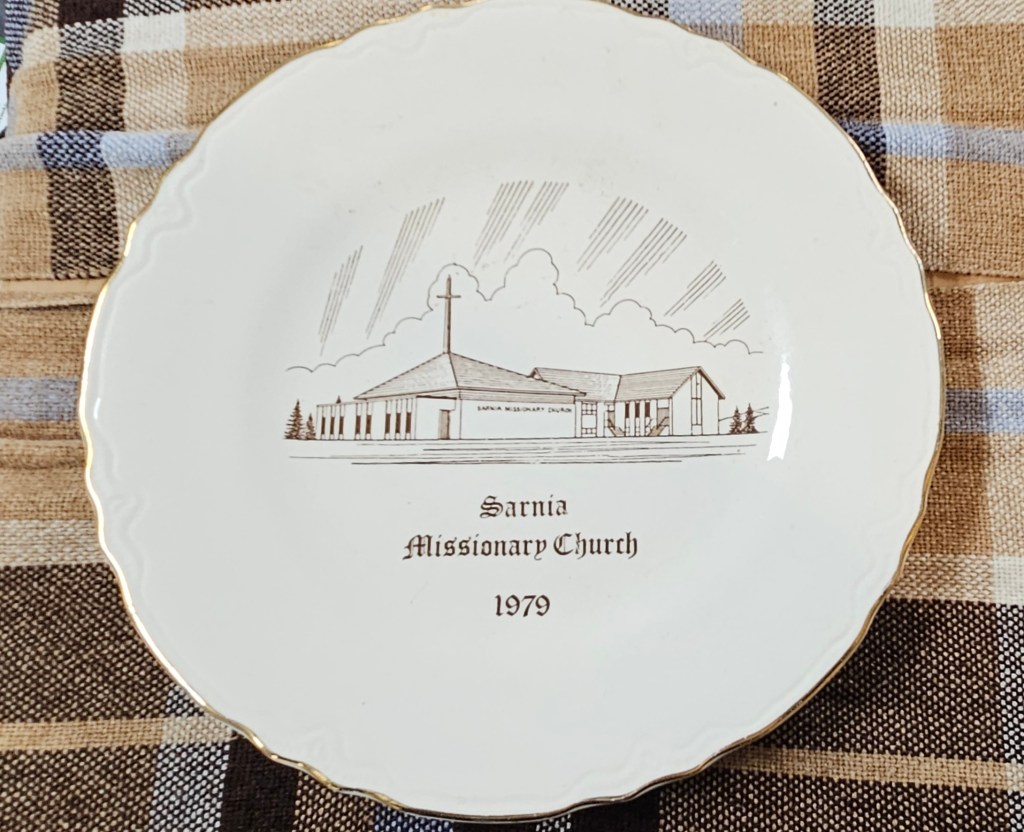
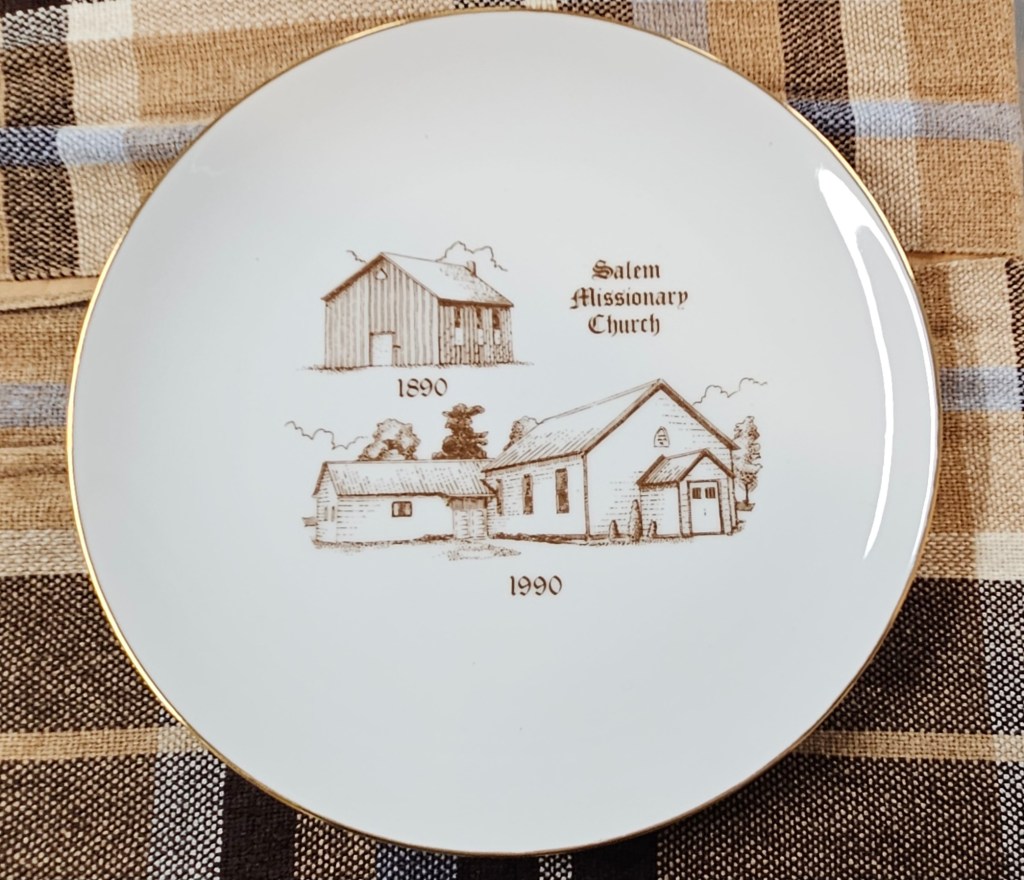
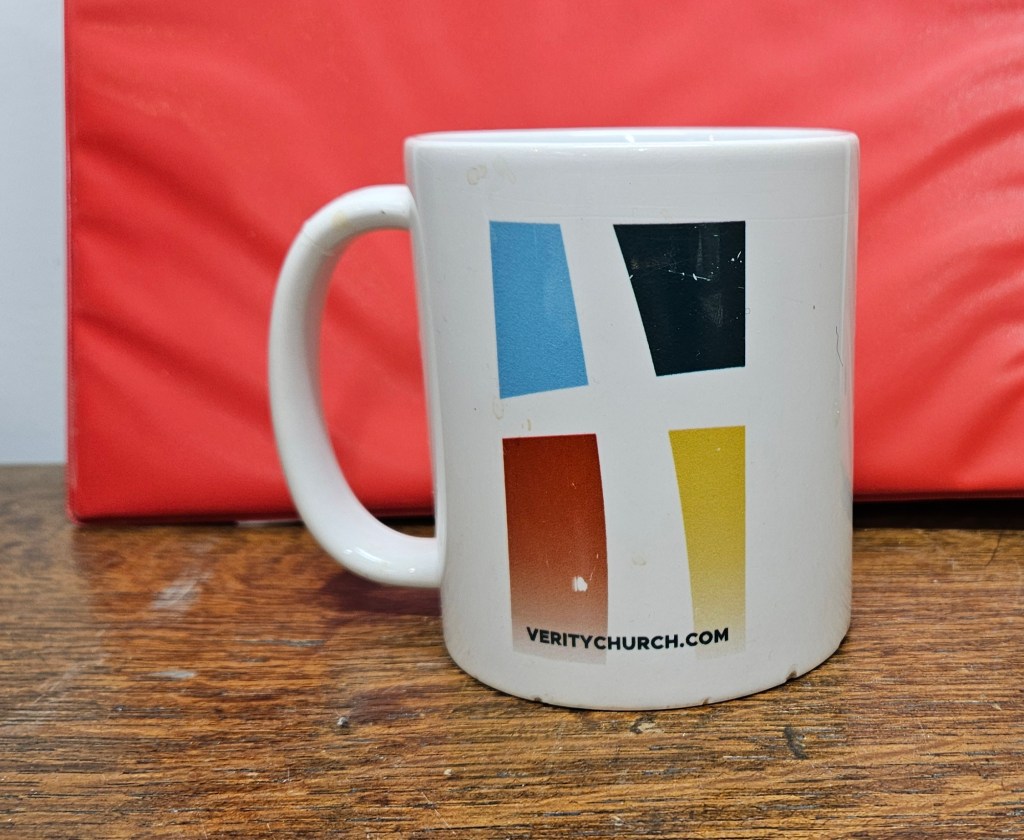
But to get back to our commemorative plates. Occasionally Missionary Churches in Ontario issued them. Organizations also use mugs with their logo on them for publicity, not commemoration, a slightly different use. The Missionary Church Historical Trust has ten commemorative plates in its collection, plus a few related mugs, cups and saucers:

Courtesy: MCHT
china plate Franklin Middleton Memorial Camp, Round Lake, ON [pre-Mishewah] <1972
china plate Altona (Christian/Missionary) Church 1875-1975
cup & saucer 2 Hespeler MC 78th 1898-1976
china plate Markham MC 1877-1977
china plate 2 Sarnia MC 1979
china plate 2 Emmanuel Bible College 1940-1980
china plate Stouffville MC 1903-1980
china plate Elgin MC 1952-1984
china mug Elgin MC ca 1985
china plate Salem MC, Spring Bay, Manitoulin, 100th 1990
china mug Elgin MC 100th Anniversary 2006
I have heard that Gormley Missionary Church also issued a church plate, maybe for their centennial in 1973.
Courtesy: MCHT
Church plates were used in a specific period in the EMCC: mostly in the 1970s and early 1980s. Then they mostly went out of fashion. There was an earlier period of commemorative church plate use in North America with plates ordered from Germany in the 1890s but the Mennonite Brethren in Christ did not seem to participate in that fad. I suspect it was because the plates were used as fund-raisers, and the MBiC discouraged worldly fund-raising customs. We favoured direct donation by members (“The Lord loves a cheerful giver”-my emphasis.) According to the Presbyterian website the practice was revived in the USA in the 1950s. Apparently by the 1970s, EMCC members had lost the prejudice or the theology that prevented churches selling plates.
I do not know what was happening in the Missionary Church in the USA, maybe our brethren and sisters there can respond to this post. A factor for us in Ontario may be that the company we mostly bought from was based in the town of Collingwood, ON, where we had a congregation, and still do.4 I used to think the plates were manufactured in Collingwood and churches then had their custom design added in gilt. Photographing the plates in the MCHT had me look more closely, and I learned the plates were actually produced in China, only the design was added in Collingwood.
Courtesy: Fuller Family
Commemorations have always been with us, how we do it changes with the times. Kings issue medallions, military issue ribbons and medals, governments mint coins, stamps and monuments. Churches sometimes have parties, potlucks, and just going out for pizza. Celebrations are universal.
Banner: The plate says it all. Courtesy, Missionary Church Historical Trust
1https://pcheritagecentre.ca/collection/commemorative-china-plates-and-mugs/
2I have seen this in some writing about J A Huffman, but can’t recover it at this time.
3John H Walton, Victor H Matthews and Mark W Chavalas, The IVP Bible Background Commentary: Old Testament (Downers Grove, IL: IVP Academic, 2000) p 688.
4Hope Chapel.


 EMCC History
Leave a reply to James Clare Fuller Cancel reply