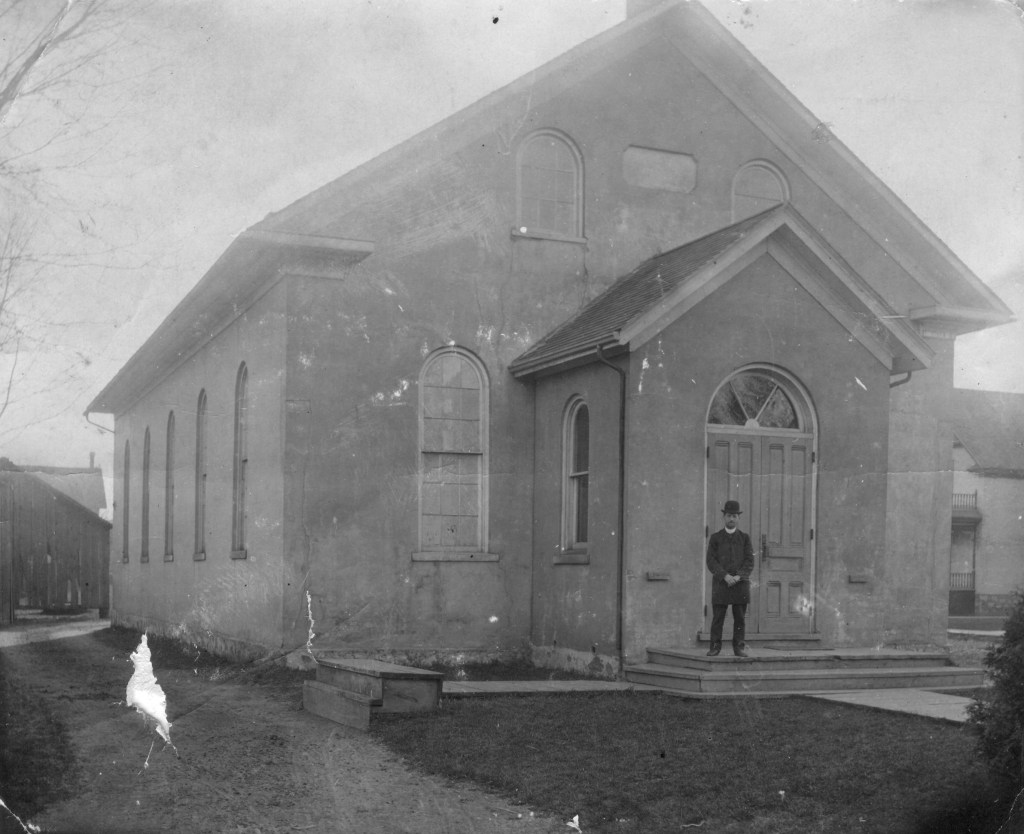
The Mennonite Brethren in Christ Discipline had instructions about how church buildings were to be constructed. They were to be “plain” (Mennonite language) and, borrowing an idea from the Free Methodists, pew rents were not allowed: “Let all our buildings be kept plain, and not more expensive than necessary for comfort and health, and with free seats.”1 Pew rents had been a regular way many churches raised money. Charles Dickens mocked it in a novel.2
The halls were constructed by local people, sometimes by the members themselves, out of materials and with methods they used in their own barn, school and house construction. Mt Joy, north of Markham, recorded the suppliers of materials and the workmen who did the main construction. Some were members. The committee obviously knew something about house construction.3
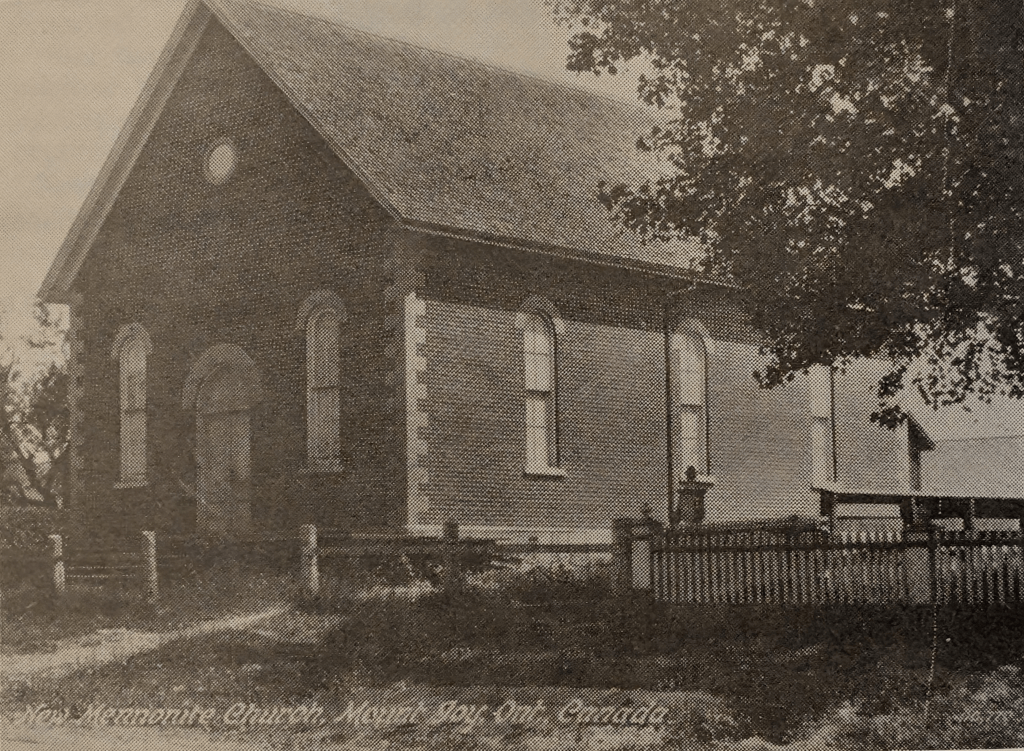
Credit: C McDowell and others, Built in This Place (1977) p 12.
“Plain” could mean no “Gothic,” which was sweeping through Ontario mainstream church architecture in the 19th century, especially after 1850, or it could mean no ornamentation of any architectural tradition.4 “Gothic Revival” was a reconceived version of the original gradually-evolving church building style in Europe which began in the 12th century and lasted somewhat into the 16th century, when other styles arose. Gothic Revival was promoted in England in the 19th century as the ideal style for church buildings, even claiming it as theologically correct.5 Rejecting all this, Mennonites declined arched windows, towers or steeples, ornate carving, or buttresses. They could build in brick or stone, but wood was abundant and cheap in rural communities. There were no musical instruments and no choir loft or area, because there were no choirs.
There were no interior baptistries either. Most Mennonite Churches baptized by effusion (pouring water over the believer’s head). In the MBiC, they did not need tanks for baptizing because baptizing by immersion was preferred in real lakes and streams, and it was cumbersome to fill, heat and empty baptistries. Inside there could possibly be a platform for visibility of the speakers (16 inches in Mt Joy’s case), but no stage which smacked of worldly entertainments. There could be an unbacked bench or benches at the front, below the pulpit, called variously the penitent’s form or altar (as in Romans 12:1-2).6 Pulpits could be very plain, or with simple carved decoration.7 Local church histories often recall the wood stoves and pipes which designated congregation members would light, sometimes hours before the service time on the colder days. Fire was always a danger to church buildings. When night time services were expected, MBiC churches lit coal oil (kerosene) lamps.
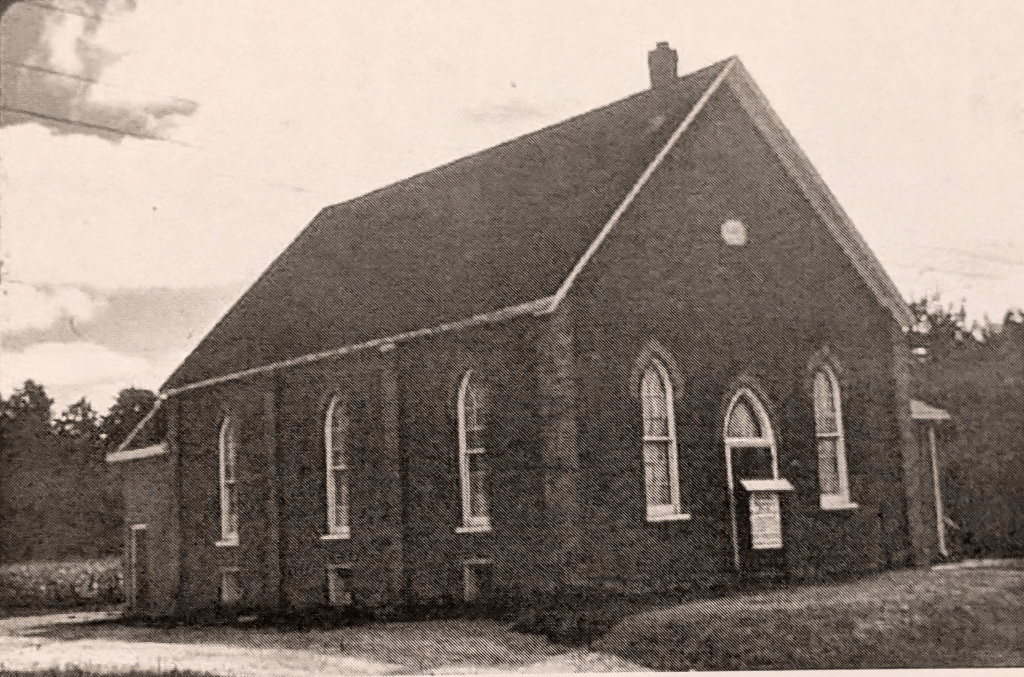
Credit: T Bunker, The Hamlet of Altona (2014) p 39.
The 1875 Altona union building shared with the Christian Church congregation had pointed windows and front door, for it had been constructed with the view that Congregationalists, Christians, United Mennonites and “other Orthodox” congregations would be allowed to use it and other tastes prevailed.8 When the Stayner appointment of the Nottawasaga circuit bought the old Stayner Methodist church building,9 they acquired a simple wooden building with triangular-topped windows that hinted at the Gothic.10 Eventually prejudice against Gothic (or at least arched) windows subsided. To most uneducated members and Ontarians, the windows simply meant “church building,” and nothing more.11

From my research, it is clear that the first wave of meeting house construction after 1824 and 1863, from 1875 to about 1885 in older Mennonite communities, were all in what I am calling “Mennonite plain.” Bethel’s 1878 building in the country NW of New Dundee was of this sort. The windows were rectangular.12 As the Church expanded and founded new communities in non-traditionally Mennonite sites, in the vernacular wooden frame building the windows and occasionally a door are given Gothic pointed tops. Sometimes the arches were instead Georgian rounded windows, or even all rounded, as in Berlin in the Bethany blue chapel of 1877, by then an old-fashioned style for Ontario, though not regular for Mennonites. (The blue colour was certainly non-standard.)13 When an available building was rented or bought in later years, almost all had Gothic windows, but in the rural (and most of the MBiC people were rural) locations almost nothing more was added to the wooden frame buildings, except a porch, and then a basement, and finally a Sunday school or social activity hall. No steeples or bells. Even as late as 1949, when Evangel UMC was built in Kitchener, no steeple or cross was added until a Baptist-trained pastor added one in the 2000s! Alf Rees debated with himself about putting a cross on the outside wall of Banfield Memorial, on Centre St (now Wellspring), Toronto. It was the Jewish architect who persuaded him to emphasize a cross in the brickwork.14
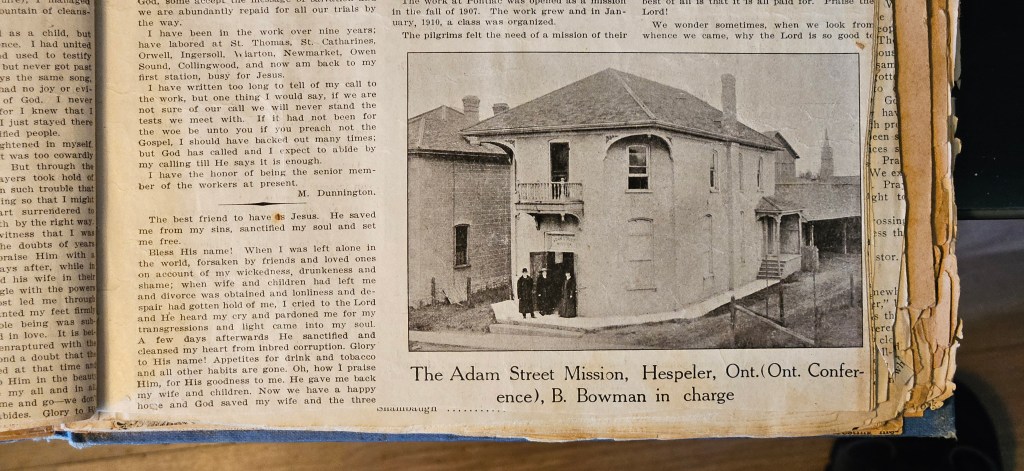
When the Canada Conference moved into towns and Toronto, they rented any kind of hall they could find, as in Owen Sound, Collingwood, St Catharines, St Thomas, Aylmer, Hespeler and Stratford, places where churches resulted, or Orwell, Ingersoll, Guelph, Waterloo, Wingham and Wairton, where they did not. Halls were changed frequently and accepted as constructed and rented as is, except to make them purely functional for evangelistic meetings.
Few new buildings were constructed in the 1920s and 30s and 40s. In fact the main story in Ontario was many churches lifting the building to dig out a basement, mainly for Sunday school space and church social functions.15 Beginning with Evangel UMC in Kitchener (1949),16 Sarnia (1951/52), and a new Stratford building (1952/53), the Ontario Conference started constructing a new generation of worship places. In the United States, Joseph H Kimbel, a United Missionary Church pastor and architect, began advising and leading in the construction of numerous new worship spaces.17
While definitely not Gothic, in the 1960s, the pointed roof line was often emphasized in the gables as a hint of “upward” gazing. Hawkey Church Management (founded ca 1965),18 built many new UMC buildings with laminated wood arches in the main hall that was a deliberate glance to the Gothic ideal. Kitchener Faith built on the EBC grounds, Stayner, Toronto St Clair, Waterloo Lincoln Heights (1969, though the construction company was not Hawkey), First Missionary Pembroke, the current New Dundee Bethel and probably Vineland, all used this basic structure.
Banner: Elder Charlie Krauth, Bethany (Berlin) MBiC pastor, on steps of the 1877 building shortly before it was demolished in 1908. Courtesy: Missionary Church Historical Trust.
1The Doctrines and the Discipline of the Mennonite Brethren in Christ Church (New Carlisle, OH: General Conference Executive Committee, 1924) p 80. See also Marion MacRae and Anthony Adamson, Hallowed Walls: Church Architecture of Upper Canada (Toronto: Clarke, Irwin & Company, 1975) p 195.
2MacRae and Afamson, p 290.
3Clarence McDowell and others, Built in this Place: Markham Missionary Church Centennial 1887-1977 (Markham, ON: Markham Missionary Church, 1977) p 9-10.
4John Webster Grant, A Profusion of Spires: Religion in Nineteenth-Century Ontario (Toronto: University of Toronto Press, 1988), p 52. He says the Gothic style showed up in Ontario in the 1830s.
5MacRae and Adamson, p 145.
6Practiced by Charles G Finney; many Methodists, including the Salvation Army used this.
7The pulpit could be the subject of a separate blog investigation. A table (widely used in rural church buildings in Nigeria) or a lectern could be the first versions used.
8Byer, p 1. The Christian Church did have a choir and an organ, p 2, which the New Mennonites did not use.
9Originally on the NW corner of the intersection of the Second Line and Hwy 26. Edward Chester, Great is Thy Faithfulness: Stayner Missionary Church 1890-1990 (Stayner, ON: Stayner Missionary Church, 1990) p 2.
10The Mennonite Brethren in Christ congregation moved and later bricked the Methodist structure, at the congregation’s current location. Much of this was destroyed in a fire in 1999, with a small part retained in the rebuilt structure.
11My opinion. Grant, p 175, claims the real Gothic reached its peak (no pun intended) about 1880 in Ontario, and was replaced by the Romanesque, but you would never know it in rural Ontario.
12One Hundred Years and More in Wilmot Township (Wilmot Township, ON: Wilmot Township, 1967) p 55, shows its vertical wood batten siding, a common construction technique at that time. Reproduced in “EMCC Church buildings Part 1”. Bethesda’s building, built by Primitive Methodists, and the Dornoch meeting hall also originally had vertical wood batten siding.
13Ward M Shantz, A History of Bethany Missionary Church 1877-1977 (Kitchener, ON: Bethany Missionary Church, 1977) p 6.
14Wayne F Shirton, Tried, Tested, Triumphant: The Eventful Life of Alf Rees (For the Author, 1997) p 99-100.
15Clare Fuller (2022), Global Anabaptist Mennonite Encyclopedia Online: https://gameo.org/index.php?title=Mount_Pleasant_Evangelical_Missionary_Church_(Singhampton,_Ontario,_Canada)&oldid=173542
16I was told Evangel was the first UMC church with a kitchen inside the building, and possibly the first with a built-in (heated!) baptistry, which other congregations used until they had their own (eg New Dundee, Stratford).
17. Kimbel deserves much more attention than I can give here. Joseph H Kimbel, “Christian Architecture: A Representative Christian Art,” The Asbury Seminarian (23:2) 1969, p 16-18.


Leave a Reply