
Official records can be so misleading. Not intentionally, it’s just that organizations do not feel obliged to document the careers of personnel when the person was not in the organization. Early MBiC preacher Nelson Kiteley’s story is lopsided with only the profile that has stood for him for 105 years.
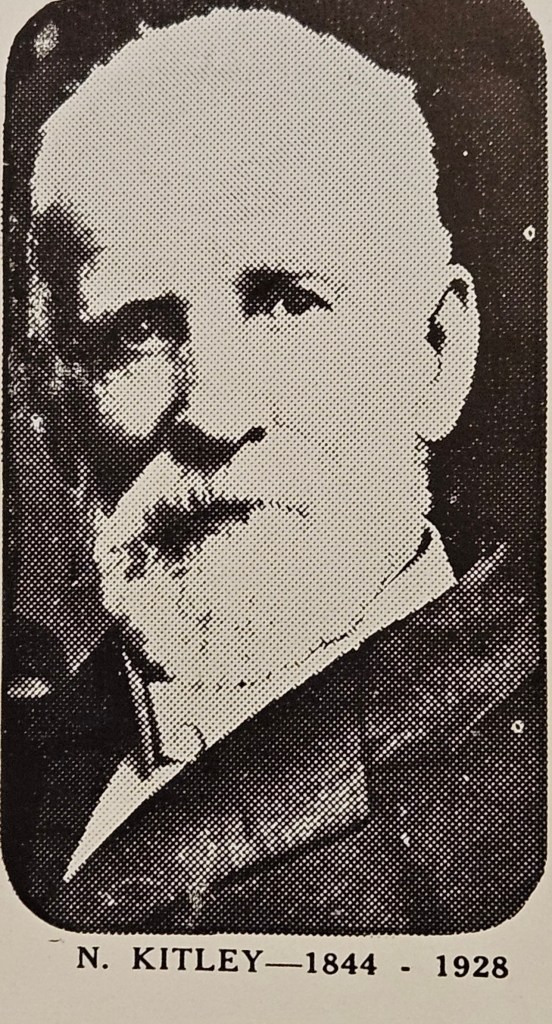
Ontario origins. Nelson Kiteley was born the second son of a Quaker father and a Church of England mother. When he was 16 the Canadian census listed him as Anglican. He was converted through a congregation of the Christian Church, attracted to the ministry of the Tunkers (Brethren in Christ) and transferred his service to the Mennonite Brethren in Christ. As if that weren’t enough, he began a career as a preacher in Ontario and then moved to Michigan. The profile in Jasper Huffman’s History of the MBiC Church records some of his MBiC ministry in Michigan, only hinting at service in other times and places.1 These incomplete records (and obvious spelling mistakes) are what first drew my attention to him. The story of this EMCC / Missionary Church preacher of the first generation is still not complete or certain.
The Journals of the MBiC Canada Conference routinely garbled the unusual township name where Nelson was born to Henry and Sarah (Davis) Kiteley on April 15, 1844, and so did the Huffman profile, followed by his obituary.2 East Gwillimbury is in northern York County (now York Region), about 50 kilometres north of Toronto, Ontario. Nelson’s brothers were James (1842-1919) and George (1849-1919). James was born near Mt Albert, which is in south east East Gwillimbury and George probably in the same area. “H Kiteley” owned the 9th farm south of Mt Albert on the 8th Concession, on the 1860 map of East Gwillimbury Township. The neighbours from across the road owned the land in 1878.3 Sarah their mother was born in Ireland in 1816. Nelson’s farmer father was Ontario-born, from a long line of Society of Friends (Quakers) from England via the USA. Henry’s brother Joseph settled in the Quaker community around Norwich, Ontario, in Oxford County, and died a Quaker. It appears Henry remained a Quaker as well.
But Nelson went another way. He was converted through the Christian Church (probably the “Christian Connexion”)4 in northern York County in 1864. There was a Christian Church meeting nearby at a building, only marked by a cemetery now, just west of the 8th Concession on the first sideroad south of Mt Albert.5 When Nelson attended one of their annual meetings in Newmarket, ON, he noticed some things he thought were unscriptural.6 This was probably the 1866 Christian Connexion annual conference in Newmarket, ON, mentioned in a memoir.7 At that time the Christian Connexion was non-Trinitarian in theology.8 Maybe his Quaker background or even his Anglican mother suggested other views on what was “biblical.” Or perhaps his wife?
November 10 1864, Nelson, 20, married Maria Dougherty, 20, at Onondaga, ON, SE of Brantford, ON, where he had a farm.9 Maria’s parents were Irish Presbyterian immigrants. She was born in Whitchurch Township, York County, in 1844, but grew up in Onondaga.10 She gave birth to 7 children: Martha Ann (K) Brothers, James Henry , Alfred E , Sarah J , Jamima “Mima” Mary (K) Niswander and twins Charlotte V and Louis Whitfield .11 Maria died in December 1888 and was buried in the Harriston Cemetery, Harriston, Wellington County, ON. Nelson remarried at the end of 1889 to Rachel Alexander (1867-1963) of Dorchester in the area of London, ON, and they had 4 more children, Edward “Edd” Alexander G, Emerson Alvin Wilford, Norene E and Irene Ruth. Rachel’s parents were George and Elizabeth Ann Alexander, but she was living with a Wesleyan Methodist family with a different surname in 1871, which suggests perhaps she was an orphan, or was cared for by some other family arrangement.12

Credit: Find-a-Grave, photo by “Irish girl”
Becoming a minister. Meanwhile, Nelson was following his calling, by taking a farm in Wellington Co near other Kiteley relatives at Peel and Maryborough Townships,13 and then Howick Township slightly farther north in Huron County about 1875 where there was a small Tunker community.14 The Huffman profile claims he “entered the ministry in 1870,” but this is unconfirmed. In 1875, according to his own account, the Tunkers elected him as a preacher along with John Reichard. Reichard believed the two were chosen because Kiteley could preach well in English (which suggests he had already been exercising the gift), and he (from Brethren in Christ in Waterloo) could preach in German. Kiteley had been impressed by attendance at Brethren in Christ events in Markham before moving to Wellington Co. By then, his brother George was farming in Wellington Co. George’s wife, Esther Byer, was a Tunker from Markham.15 Nelson’s parents (now both Quakers) were living with George and Esther, and the parents followed George to Howick where he identified with the Tunkers (1881 census). At some point George also became a preacher, probably a Brethren in Christ one [he was a member in Michigan (Sider, p 30)], though I have not confirmed that. His death certificate said his religion was “Mennonite.”
In 1882, Nelson “united with” the Evangelical United Mennonites,16 and began to enter the records of the MBiC. The MBiC community closest to Howick would have been the Maryboro field appointments, perhaps at Brotherston (Wallace Township, Wellington Co), just south of Howick. In 1884-1885, he was assigned to be an evangelist in the Canada Conference, which suggests the Conference treated him as on probation, not quite an elder in the MBiC system. There was no note of him being re-ordained in the MBiC or his BiC ordination being transferred, however. From 1885 to 1888, he was an official “helper” on the Maryboro field (covering Maryborough, Wallace and Glen Allen preaching points) under Elders Menno Bowman, Franklin W Moyer and then Moses Weber. This would allow him to stay on his farm. This farm, later owned by the Versteegs, is known [Jenny Versteeg, Guarding the Deposit: A History of the Listowel Evangelical Missionary Church 1925-2025 (2025) p 5.] During 1887-1888, he worked with Edward F “Ed” Gill as a fellow helper, who moved to Michigan later. Finally, in Ontario, he was re-assigned as an evangelist for the year 1888-1889. Maria his wife died that year, as we saw, and with many children to care for, Nelson’s life was certainly upset.
Michigan. Many Ontario people were migrating to Michigan to farm in the 1880s, and the MBiC Canada Conference followed up MBiC members, sending preachers to care for them and open new churches.17 I will document this large movement of Ontario members to Michigan in a later blog. Free Methodists were evangelizing from Illinois, and Mennonites colonizing mostly from Indiana.18 George Kiteley was the first of the Kiteleys, moving there with his parents in 1884. Nelson moved with his new wife and his children to Michigan in 1889, and took an appointment for the Canada Conference MBiC on the Bliss field, which included Bliss, Clearwater, Cass River, Caledonia and Elmer, in 1890, if I have understood the minutes correctly. Bliss and Clearwater were in the far north of the Lower Peninsula of Michigan, which would really strain any minister if he truly was appointed the same year to more southerly fields. Emmet County was the site of an early Mennonite Church settlement which split in 1886/1887 over Old Order concerns, perhaps a reason for MBiC interest in the area.19 I will suppose the Canada Conference stationing committee was as unfamiliar with the geography of Michigan as I am?
It appears Nelson’s circumstances prevented him from accepting full-time appointments for some years. He returned to being local help in 1891-1892, and as helper at Brown City, (mostly in Sanilac Co) under Ebenezer Anthony, along with Moses Sherk 1892-1893, and local help again in 1893-1894. Finally in 1894, Nelson Kiteley was appointed as a full-time minister on the Bliss Mission in the northern Emmet Co until 1897. I don’t know when Nelson’s brother James moved to Michigan. He was in Mayville, MI, (Freemont/ Fremont Twp, Tuscola Co) in 1896.

Nelson Kiteley is second row from the front, on the left.
Courtesy: Missionary Church Historical Trust
In 1896, the Canada Conference set up the Michigan District as a Mission Conference, and proposed to the 1896 MBiC General Conference that it be granted status as a full Conference of the denomination. This was granted, and provided with over 500 members, mostly transfers from Ontario. Their first Conference was held in 1897. Thus Nelson Kiteley was one of the founding ministers. I don’t see him being elected to any higher leadership position, despite his experience.
The Kiteley brothers’ mother, Sarah, died March 26 1896 at the home of George, then in Freemont, MI. Their father Henry had died four years earlier at George’s home. Sarah’s funeral was conducted by an Elder S “Reichar” in the “Brethren Church” in Greenwood, MI.20 I am curious about this elder’s name and church. There was a BiC Samuel Reichard in the area (Sider, p 30). The name could be misspelled and the church could be Brethren in Christ. The MBiC had a congregation meeting in Greenwood Twp, St Clair Co (later in Yale, St Clair Co) as well.21
According to the Huffman profile, Kiteley served a steady string of Michigan Conference fields, perhaps beginning with “Caledonia.” This was probably in Kent County, SE of Grand Rapids, originally a Mennonite and a New Mennonite location. MBiC evangelist Mary Ann (Hallman) Simmons22 also settled there but the congregation was gone by the 1940s. My records are incomplete from this point. Clearwater (1899-) in Kalkaska Co in the north followed,23 then the rest in the “Thumb” of Michigan: Cass River (1902-1903, including Shiloh, Mizpah (Tuscola Co), Wheatland, and Fox School House) mostly in Sanilac Co; Snover (1903-) in Moore Township, Sanilac; Ubly (1906-1907) in Bingham Township, Huron Co; and Elmer Mission (1907-1910?, Elmer and Brown School House) again in Sanilac.24 In 1911 at 67, Kiteley was doing pioneer church planting at Marlette, Marlette Township in Sanilac. “We have only a few members in this place, have not a Sunday appointment yet have a weekly prayer-meeting…We need a Tabernacle-meeting to open the work here.”25 A congregation which for many years had 40 to 50 members did form.26 Marlette merged with Lamotte 1971-1972, and Lamotte is doing well.27 If Michigan followed the usual MBiC policy of leaving preachers for no more than three years, or four if the Annual Conference so voted, we could fill in some of the unknown years in the Huffman profile, but it ends about 1910.
Nelson’s two brothers both died in 1919, James in February at Bliss in Emmet Co, MI, and George in December at Fairfield Township, Shiawassee Co, MI. They each left many sons and daughters.
The next record I have of Nelson was his “superannuation” (Methodist language for retirement with pension) in 1923, when he was at Marlette, connected to the Lamotte MBiC Church some kilometres north. Marlette is where he died in July 1928. His wife Rachel lived on to 1963, and died in Caro, Tuscola Co, and was also buried in Marlette.
So this Ontario/ Michigan preacher served congregations from about 1875 to perhaps 1923, 48 years, in both the Brethren in Christ and the Mennonite Brethren in Christ Church. No dazzling career, no flashy monument, just perseverance. Jesus rewards such (James 1:12, Hebrews 10:36).
The presence of so many Ontario preachers and families like the Kiteleys in Michigan knit the two MBiC Conferences together for a long time, with fraternal visits and intermarriages, but gradually the ties weakened to an occasional nice memory.
Banner: Bliss Missionary Church building. Credit: Bliss Township, Levering, MI https://blisstownship.org/church.html
I thank Kevin Blowers, Missionary Church archivist, Mishawaka, Indiana, for help with this post.
1Jasper Abraham Huffman, ed, History of the Mennonite Brethren in Christ Church (New Carlisle, OH: Bethel Publishing, 1920) p 249. I am told (Dennis Engbrecht) that Huffman left some compiling of the profiles to his students.
2“Kitely,” Gospel Banner (August 13 1928) p 14.
3Gladys M Rolling, East Gwillimbury in the Nineteenth Century: A Centennial History of the Township of East Gwillimbury ([East Gwillimbury], ON: For the Author, 1967) p 121, 235.
4A number of groups in Ontario could have been referred to as “Christian Church,” a movement of Restorationist denominations believing they were restoring New Testament Christianity; https://www.ccchs.ca/Papers/Restoration%20in%20Canada%20an%20Overview.pdf The modern “4 Cs,” the Congregational Christian Churches in Canada is one of them. Some Restorationist church advocates were active in York and Ontario Counties in the 19th century.
5Franklin Pioneer Cemetery, 5550 Herald Sideroad. See Rolling, p 145.
6E Morris Sider, The Brethren in Christ in Canada: Two Hundred Years of Tradition and Change (Hamilton, ON: The Canadian Conference, Brethren in Christ Canada, 1988) p 28-29.
7Mrs Polly Ann Henry, Memoir of Rev. Thomas Henry (Toronto: Hill and Weir, 1880) p 133.
8C Mark Steinacher, “An Aleatory Folk: An Historical-Theological Approach to the Transition of the Christian Church of Canada from Fringe to Mainstream, 1792-1898,” ThD dissertation, Wycliffe College, Toronto School of Theology, 1999, p 151-155.
9County Marriage Registry of Canada West, 1858-1869.
10Whitchurch was a township just east of East Gwillimbury in York County.
11Canada census 1881 clearly includes Louis/ Lewis as a 2 month-old baby in Huron County. Huffman’s profile is wrong that Maria had only 6 children. The transcribers of the census misread their name as Kritchey, but it is the Kiteley family.
12Canada census 1871 lacks a digital document of her enumeration, making it hard to find the name of the other family.
13Canada census 1871.
14Sider, p 29. Huffman’s profile dates this to 1873, but Sider’s account is based evidently on a writing by Kiteley himself. The Huffman profiles could have been provided by the preachers involved (a profile form in Sam Goudie’s handwriting exists), but some were evidently written up by people who were working on faulty memories or difficult handwriting.
15Genealogical websites.
16See “Formation of the EMCC” for all the stages and denominational names.
17Huffman, p 107-108. Similarly, Brethren in Christ, Sider, p 30.
18Leslie R Marston, A Living Witness: A Historical Interpretation of Free Methodism’s First Century (Winona Lake, IN: Light and Life Press, 1960) p 429; John C Wenger (1957), “Michigan,” Mennonite Encyclopedia, Vol 3, p 672-676, or https://gameo.org/index.php?title=Michigan_(USA)&oldid=179511.
19Wenger, p 674.
20“Obituaries,” Gospel Banner (April 14 1896) p 16.
21Everek R Storms, History of the United Missionary Church (Elkhart, IN: Bethel Publishing, 1958) p 121.
22Clare Fuller (2016), “Simmons, Mary Ann Clemens Hallman (1867-1948),” https://gameo.org/index.php?title=Simmons,_Mary_Ann_Clemens_Hallman_(1867-1948)&oldid=134714
23Illustrated by a report of seven weeks of meetings he sent to the Gospel Banner (January 1900) p 12.
24As listed in Huffman, p 249, published in 1920.
25Nelson Kiteley, “Pastors’ Reports,” Gospel Banner (August 10 1911) about p 13.
26The Mennonite Encyclopedia article of the 1957 is certainly wrong quoting only 13 members for 1954. In 1949 it had 54, and in 1957, 47.
27Margaret Whitmer, “Church Marks 125th,” Sanilac County News (August 1 2012), https://sanilaccountynews.mihomepaper.com/articles/church-marks-125th/ This article has no mention of the merger, and has some anachronisms.


 EMCC History
Leave a reply to timerdel Cancel reply