As the old joke goes, “Put two [you name the religious group] in a room and you will get three opinions.” Baptists, Jews, Mennonites, et al– humans are prone to divide. Websites on the internet claim there are about 44,000 church organizations (denominations) known (2025).
The apostle Paul referred to divisions in his day, for example I Corinthians 11:18-19, but he was just remarking on differences among Christians in one city!
The early Missionary Church/ EMCC was not driven by what would be called the “ecumenical” movement that led many mainstream denominations in England, the USA and Canada and elsewhere to declare that the Churches’ divisions were sinful and ought to be rectified.1 The motives of precursors of the Mennonite Brethren in Christ were practical and local: find others with “like precious faith” (a favourite phrase from 2 Peter 1:1-2 KJV) and see if they could get along in ministry and discipline.2
All this to say, the Reforming Mennonite Society/ Church that organized in Eby’s Meeting House in Berlin, Ontario, in May 1874, quickly found partners and discussed uniting with those who had formed before they did. Within a year they merged with the New Mennonite Church (formed 1849/1852) which had up to 400 members in Ontario and a few recognized preachers in Ohio and Michigan. In a meeting in March 1875 at Schneider’s (Snyder’s) Meeting House at Bloomingdale, Waterloo County, the majority of the members and leaders of the NMC and the whole RMS/C united under the name United Mennonite Church.3 This was merger number 1 in the EMCC story.
However…A few notable New Mennonite Church leaders did not join the UMC: they were founding preachers Daniel and Jacob Hoch and deacon Jacob Albrecht from The Twenty (Jordan) in Lincoln County, and preacher Abraham Z Detweiler and deacon Jacob Z Detweiler from Doon, Waterloo County. The main reason seems to be the Hoch brothers did not agree to “open communion” which many in the new United Mennonite Church wanted. It is rare for mergers to gather every member, congregation or district of the various parties. The disruption provides a moment for people who were for various reasons unhappy about the current state of their association to drop out. When the MBiC adopted second blessing theology after 1883, some York County former New Mennonite leaders reduced their participation to almost nothing without quitting out-rightly, such as Christian Troyer and Abraham Raymer. Casper Wideman may also have adopted a similar stance.
Incomplete Mergers. Other mergers followed (1879, 1883), which are outlined in the denomination’s Disciplines (organizational rules) and well told in Missionary Church history books.4 The leaders in the 1883 merger with a Brethren in Christ group (Swankites) hoped that another faction, the “Wengerite” Brethren in Christ would also join, but apart from a few members, preachers and an editor, the Wengerites remained out. J A Huffman’s book records numerous details of the stages and efforts for that merger, which brought about 248 members into the union.5 By then, the merging Mennonites had grown to about 1647 members (Huffman, p 80). One more Wengerite congregation joined in 1920.6
There were other attempts at merger or merger discussions that did not result in unions that have come to my attention as recorded in the Gospel Banner, Mennonite Brethren in Christ or United Missionary Church General Conference journals or Annual Conference journals. Since nothing officially happened, they are unmentioned in our official histories. Such attempts at union suggest the hopes of the young organization to reduce ecclesiastical isolation.
1. One main scout for further mergers in the beginning seems to have been Daniel Brenneman, the Presiding Elder of the Indiana and Ohio Conference.7 Even in his old age he was hoping for more mergers.8 A union he explored around 1880, was with Daniel S Warner and his followers, who was to go on and lead the large Church of God Restoration Movement (otherwise known as of “Anderson, IN”).9 This attempt did not end well, because Warner began to attack organized groups, including the Evangelical United Mennonite Church and its successor, the Mennonite Brethren in Christ Church (formed December 1883). Brenneman recalled Warner said the MBiC was a “daughter of the Mother of harlots.” That comment would not help relations much.10 In time, a few MBiC members in Ontario were convinced to follow Warner and the Gospel Trumpet people, as they were called.11

Credit: opposite title page, Bible Readings on the Second Blessing (1905)
2. In the early 1890s, the Gospel Banner gave attention to a holiness organization in Pennsylvania called the Heavenly Recruits Association, and even published their newsletter for several years until the HRA decided to publish for themselves in early 1892.12 I don’t know who made the contact for the MBiC, possibly MBiC Pennsylvania Conference leaders. The Gospel Banner published numerous articles and letters to the editor about “union,” in 1890-1892, mostly in favour.13 One of the leaders of the HRA was Christian Wismer Ruth, who was to become an evangelist of the Church of the Nazarene, of which the HRA eventually became part. It helped that Ruth had Evangelical Association and Mennonite relatives. Ruth spoke at a number of protracted meetings in the MBiC, such as three weeks at the Scott field, north east of Markham, in the winter of 1892.14 Unfortunately, Ruth was sick for 10 days of his stay there, but still managed to see about 4 conversions. Some correspondents to the Gospel Banner rejoiced at the association with the HRA, though no merger resulted. Later, C W Ruth was a camp meeting evangelist, at least for the Ontario MBiC, so relations remained friendly.
3. From 1893, the Gospel Banner printed the newsletter of a group of mostly ex-Salvation Army officers15 in Ontario who started congregations from 1892 under the name Christian Workers Churches. These missions were mostly in Toronto and we have already met these people in these blogs.16 Here Menno Bowman (co-Presiding Elder with Solomon Eby 1891-1900) seems to have been the contact. The leaders were people such as Peter W Philpott, Alfred W Roffe, and George E Fisher.17 Others were Robert McHardy, Charlie Tobias Homuth (later of the MBiC), James Deeson, George and Mrs Murray (formerly C&MA missionaries). CWC pastors attended an MBiC camp meeting in Markham in 1895, and Presiding Elders Bowman and Eby led Quarterly Conference meetings in various locales in Toronto 1895-1897, even though there were as yet no MBiC appointments in Toronto. They invited interested people to observe and even participate in the Mennonite ordinances of Washing the Saints’ Feet and the Lord’s Supper, after explanatory preaching, of course. Correspondents reported a wide variety of denominations represented in the meetings.
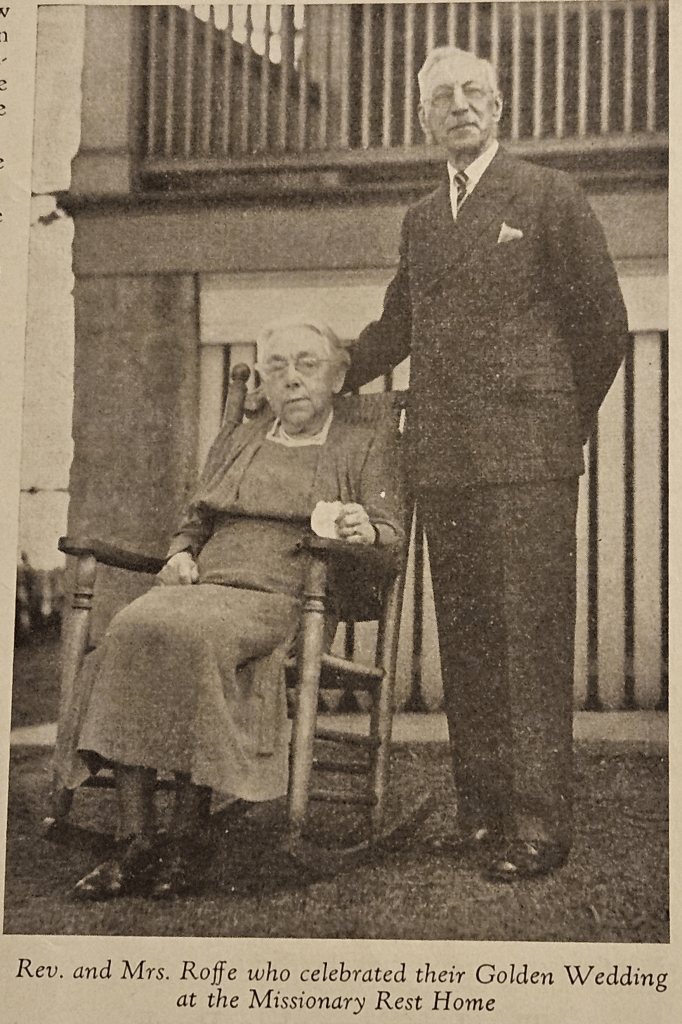
Christian and Missionary Alliance superintendent
Credit: Evangelical Christian (June 1940) p 303.
Philpott moved to Hamilton, ON, in 1897 and built up a CWC mission there. The interest of the CWCs in the MBiC withered. Samuel Goudie, when a pastor of the West End Mission18 of the MBiC in Toronto 1903-1905, visited several of the Toronto CWC leaders and events.19 Churches associated with Philpott developed into the Associated Gospel Churches.20 The modern denomination tends to be fundamentalist and Calvinistic, but as Salvation Army officers, the leaders would have been Arminian and Wesleyan holiness at the start. On the other hand, at the start of the Pentecostal Movement in Toronto in 1906, several of the CWC leaders adopted tongues as the evidence of being baptized with the Spirit, and their congregations shifted into a Pentecostal orbit (some oneness and some trinitarian), from which Philpott and the AGC distanced themselves. Pentecostals claimed that by 1908 there were 6 Pentecostal missions in Toronto. Most of them were developed from CWC people.
Next blog will look at several explorations of closer cooperation and possible merger in the 20th century. Two actually worked.
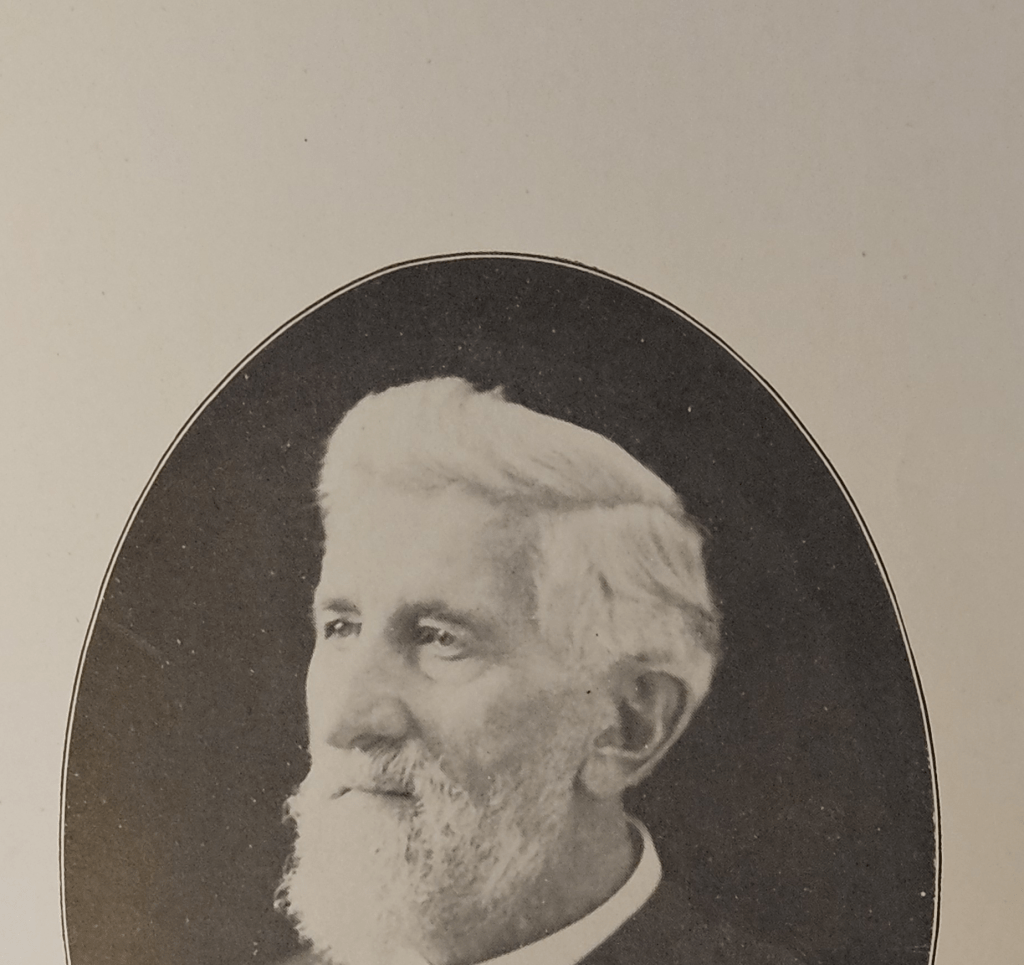
Banner: Daniel Brenneman (1834-1919), merger seeker, MBiC Indiana Presiding Elder. Credit: Huffman, ed, History of the Mennonite Brethren in Christ Church (1920), opposite p 74. Public domain.
1Geoffrey Wainwright, “Ecumenical Movement,” in The Oxford Companion to Christian Thought, ed Adrian Hastings (Oxford, UK: Oxford University Press, 2000) p 189-191; David F Wright, “Ecumenical Movement,” in New Dictionary of Theology ed Sinclair B Ferguson and David F Wright (Downers Grove, IL: InterVarsity Press, 1988) p 219-220.
2See “Formation of the EMCC” in the opening “Pages” of EMCC History for the merging story.
3See EMCC History Blog “NMC: Preachers and deacons.”
4The earliest is Jasper Abraham Huffman, ed, History of the Mennonite Brethren in Christ Church (New Carlisle, OH: Bethel Publishing, 1920) p 59-73, 76-95. The Disciplines, revised and published after every General Conference, noted mergers from the beginning.
5Huffman, p 88-94.
6Huffman, p 94.
7Huffman, p 74-76; Wayne Brenneman, “Daniel Brenneman: The Birth of a Church,” Reflections (Summer 1993) Vol 1 no 1, p 27-32.
8Daniel Brenneman, “The Union Question,” Gospel Banner (January 30 1913) p 4.
9John W V Smith, “Holiness and Unity,” Wesleyan Theological Journal 10 (Spring 1975) p 33.
10Daniel Brenneman, Gospel Banner (December 1 1889) p 4.
11Notably Samuel S Moyer of Berlin, recorded in Don Moyer’s genealogical compilation “Abraham’s Children,” unpaginated, reproducing a memoir of Samuel which told how he and his family left Bethany MBiC in Berlin and joined the “Gospel Trumpet people” in 1895. Page “195” in my copy. The Gospel Banner noted some attempts in the Jordan (Vineland) area to persuade MBiC members there; Jesse S Guy, “Letter of Correction,” Gospel Banner (July 1 1892) p 4.
12Henry S Hallman, editorial, Gospel Banner (February 15 1892) p 8.
13Eg Mrs Caillie M Harrison, “Union,” Gospel Banner (June 15 1891) p 3; Daniel Brenneman, “Union,” Gospel Banner (July 15 1891) p 10; M H Struhm, “Union,” Gospel Banner (September 1 1891) p 15.
14Christian Raymer, “Fields,” Gospel Banner (April 1 1892) p 8.
15Story told in Robert G Moyles, The Blood and Fire in Canada: A History of the Salvation Army in the Dominion 1882-1976 (Toronto: Peter Martin Associates, 1977) p 121-128.
16Also in London, Oshawa and Hamilton. Up to 26 missions were eventually attempted; Lauren K Redinger, A Tree Well Planted: The Official History of the Christian Workers’ Churches and the Associated Gospel Churches 1892-1993 (Burlington, ON: Associated Gospel Churches, 1995) p 8.
17Philpott: David R Elliott, From Anvil to Pulpit: Peter W Philpott’s Spiritual Journey, His Family and His Struggle for Ethical Integrity (Parkhill, ON: Theological Resources, 2023). Roffe is remembered well in the C&MA: Lindsay Reynolds, Rebirth: The Renewal of the Christian and Missionary Alliance in Canada (Toronto: Christian and Missionary Alliance in Canada, 1992) p 52, 54-55, 57-59, and elsewhere. Fisher: not much has been done on this man’s career. Born in in 1853 in Birmingham, UK. He apparently became affiliated with the Pentecostal Holiness Church in Toronto and later in North Carolina (d 1924). Pentecostal Holiness Advocate (May 30 1946) p 10, has a profile.
18Later famously known as Banfield Memorial, now Wellspring Worship Centre, Willowdale.
19Sam Goudie, “Diary,”December 3 1903, with H S Hallman; September 26 1904 to hear Peter Philpott; November 12 1904 visiting Fisher and Roffe.
20Redinger, p 25-32.


 EMCC History
Leave a reply to James Clare Fuller Cancel reply