The Mennonite mission for Armenian orphans in the Ottoman Empire at the end of the 19th century began after a round of violence that started in 1894. It led to massacres of Armenians in 1895-96 at various places in Turkey. Canadian political analyst Gwynne Dyer, while recognizing the enormity of the genocide, researched Armenian activities to resist Turkish forces, in particular from 1915.1 Again in 1919-1920, Armenians were negotiating with the French mandate forces in Cilicia to arm and defend against Turkish besiegers at places such as Hadjin, but were ultimately abandoned by the French, leading to another massacre and destruction of the town.2 American government advocacy for Armenians dried up after the war because the US needed Turkish support for new political agendas. It is a too common tale of betrayal in the name of expediency.
The Armenians’ human response of violent resistance to the long policy of government violence and discrimination against them was interpreted by the Ottoman government as rebellion and subversion, naturally. H S Hallman in a Gospel Banner editorial, noticed the conflict, and, referring to Armenian reprisals against Turks, commented that drawing the sword leads to death by the sword, as Jesus said (Matthew 26:52).3
A survivor of the late 19th-century events arrived in the USA and visited J A Sprunger’s Light and Hope Deaconess Hospital in Cleveland, Ohio, in August 1898, pleading for workers to help care for his people, especially orphans.4 This man was Garabed Der Hagopian from Zietoun (now Suleimanli) in Adana province, south central Turkey.5 His wife had died in the massacres. The matron of the Hospital, Marianna Gerber, a Swiss lady with 20 years’ experience in deaconess work,6 volunteered to go. Rose Lambert, a new deaconess from an Indiana MBiC family, agreed to go with her and see what God would allow them to do.7 At first they were sent off under the Mission Society Light and Hope.8 Hagopian continued to tour, visiting many churches in Waterloo County in 1902. The MBiC’s Sam Goudie invited him to speak at Bethany MBiC Church.9

Credit: Max Haines, Light and Hope: The Story of …John A Sprunger and Katharina Sprunger… (2021) p 375.
Various groups honour Gerber and Lambert as their own without acknowledging other affiliations. Other Mennonites claim Lambert, not clearly noting her connection to the MBiC or the UOMS.10 It is likely Gerber was never a member of a Mennonite Brethren in Christ congregation, though Everek Storms lists her so.11 She was, however, supported by a family in Kansas in the MBiC Nebraska Conference.12 On the other hand, Missionary Church histories (Huffman, Storms) tell Gerber’s life but ignore her later independent work founding Zion’s Orphans’ Home at Zindijere, a site near Kayseri, central Turkey, 1907-1914. Pentecostals claim a part in her life as well, which is unrecognized by Missionary Church histories.13 Storms lists her as retired in 1908, but she was vigorous until leaving Turkey in sickness in 1914 to raise funds in the USA during the war.14 An Assemblies of God account does not acknowledge her role in Mennonite institutions such as the UOMS, either! I suppose that Gerber as a good publicist used, in a good sense, all her community contacts for the sake of her orphans. Her 1917 testimony, published just before her death in December of that year, uses the Pentecostal terminology she picked up from Pentecostals after 1910. Daniel W Kerr of the AoG15 (originally of the Evangelical Association, one of the founders of the Missionary Church Association, and then a pastor in the Christian and Missionary Alliance) wrote the foreword.16 In this blog, I am trying to pull all these people together!
As I mentioned last blog, the women arrived in Turkey in December 1898 and through contacts with former missionaries of the American Board of Commissioners for Foreign Missions (ABCFM), chose Hadjin (now Saimbeyli), Adana province, as the place to begin orphanage work.17 They attempted to open a second orphanage in the city of Sis (Cis, now Kozan) in 1900,18 but had to withdraw after 6 months when Turkish authorities opposed them. Ottoman objections to the use of “Armenian” required the mission to register as the “United Orphanage and Mission” without reference to the ethnic group. It was a non-denominational mission, but Mennonites supplied nearly all the members. Of course, Christian compassion led the Mission to help any Kurdish and Turkish orphans or families they came across.19
The Ottomans were suppressing the Armenian language and culture. UOMS missionaries had to use Turkish with their Armenian community, though some covertly learned Armenian as well.20 After the war, Rose Altic was able to learn Armenian without hindrance.21 Modern Turkey is still suppressing Armenian history in the land, destroying monuments, churches and changing textbooks, to make it seem Armenians never existed.
Besides orphan work, the two missionaries helped widows and toured villages teaching the gospel. They hired destitute people to provide them with income and eventually taught trades and home economics. They encouraged Bible study. Gerber held large revival meetings in the Armenian Apostolic Church in Hadjin.

Courtesy: Hunking Family Collection, Missionary Church Historical Trust
Depending on the perspective of the authors, the senior Gerber or the junior Lambert becomes the leader and hero of the story. Gerber was certainly the bolder of the two, but for health reasons, Gerber left after 5 years. Lambert left after 11 years and so was remembered by more orphans. Not so much the men. Organizationally, Joshua Fidler was field superintendent from 1901 to 1903, and Ford Barker after 1903 but they did not have the same intense daily contact with orphans and widows the women had. In 1903 Gerber resigned from the UOMS, believing God was calling her to another area of Turkey, which the UOM Board did not agree to. Gerber had a Pentecostal-like experience in her youth in Switzerland, before the American Pentecostal movement of 1900 and 1906, and she followed her understanding of God’s leading, as related in her book.

Courtesy: Hunking Family Collection, Missionary Church Historical Trust
The Canadian connection in Turkish Armenia began in 1899 with two women of Ontario, Ada Moyer and Fredericka Honk, with experience as Light and Hope deaconesses and also as MBiC City Mission workers, (Moyer in Ontario, and Honk in the Indiana-Ohio Conference).22 According to a letter written on January 10 1900, the two women had reached Hadjin before Christmas.23 Curiously, on passing through Adana on the way to Hadjin, they stayed at the home of Canadian Dr Nesbitt Chambers and his American wife Cornelia (Williams) Chambers, missionaries of the American Board, members of the Presbyterian family mentioned in EMCC History blog “Mennonite Armenian mission Part 1”.24 I like to think they appreciated each other’s purposes in Christ. Ada stayed on the field until 1914, but Fredericka died on her way home to Ontario due to typhoid, and was buried at Alexandria, Egypt, in 1909.
Thomas Ford Barker was a former Salvation Army officer from New Brunswick, who for 3 years was a church planter with the MBiC in Ontario.25 He had an “agreement” with Ada Moyer made when they went for a walk in Toronto’s vast Mt Pleasant Cemetery before she left. Arriving in Turkey in April 1900, Ford married Ada in Smyrna (Izmir) in June.26 He became the superintendent for the field in 1903 after the Fidlers left.27 He held that position, except for an extended furlough for health reasons around 1907-08, until expelled as British subjects from Turkey at the entry of the Ottoman Empire into World War I. “Expelled” may be the wrong word, for although recalled by their mission board, they believed they were being pursued for arrest during the weeks it took them to get to a port and out of the Empire.28 Numerous American Board missionaries, as Americans, remained in Turkey as the USA did not declare war against Axis powers until 1917.
The next Canadian to arrive (1909) was Ethel Nelson from Owen Sound and stationed at Everek. She fell in love with her language teacher, which was not allowed by the mission, a standard rule in many mission societies of the time. Although admonished by mission leaders, she left the mission in 1912 and married him anyway. Her husband was a Greek pastor, Younis S Savides. They had a successful career in ministry in the United States, 17 years of it serving Armenians, I am glad to say.29
Nelson arrived on the field just after a stressful two week siege of Hadjin by Turks, documented by Rose Lambert.30 Turkish regiments, villagers and other opportunists used the confusion in Turkey after an attempted coup to restore the former sultan, Abdul Hamid II, to attack Armenians. Armenians had welcomed the initial overthrow of Hamid in 1908 and the Young Turks’ promise of equality, but the Young Turk nationalists were insincere toward minorities. In 1909, about 30,000 Armenians were massacred in Adana province alone, including 76 church personnel and families from Hadjin.31 The siege was not exactly coordinated by the Young Turks government, but they certainly took their time repressing it, which they finally did quite speedily when a willing regiment leader asserted himself.32
In 1915, the government used state-organized paramilitary groups and Kurds to round up Armenians, and pretended they did not know what was going on. Publicly, the action was a war-related emergency “deportation,” but secretly, the Turkish government instructed the same authorities to cause the death of as many Armenians as they could.33
An Armenian Hadjin survivors’ website adds greatly to putting names and families as well as faces to the people the UOMS served. Missionaries named some children and Armenian co-workers for supporters’ benefit, but the Armenians preserve family photographs and memories of relatives not reported in the mission. It is true the foreign workers had to flee and had their buildings destroyed a few times.34
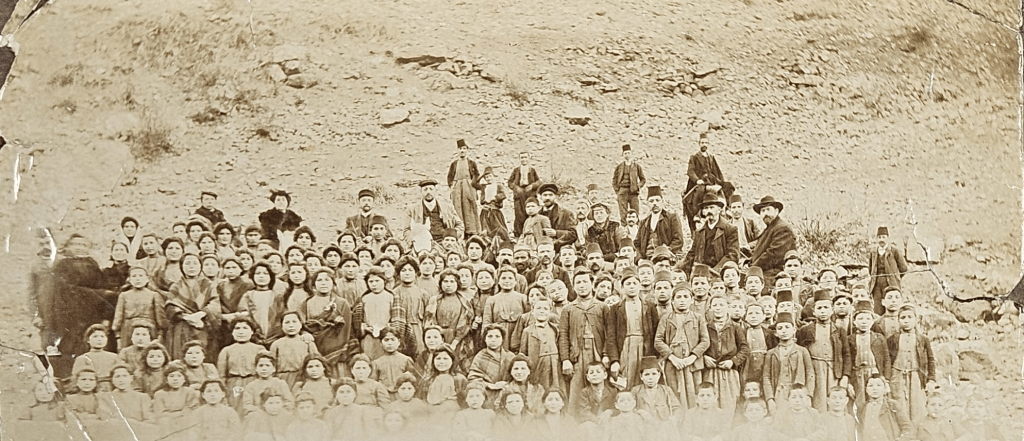
The UOMS followed the normal custom of missions to publicize their mission by a magazine, called Our Monthly (or Bi-Monthly) Letter, published from 1914 to 1938.35 The Missionary Church Inc Archives at Mishawaka, IN, on its website has available many photographs donated by one of the Michigan missionaries to Turkey, Dorinda Bowman. The Missionary Church Historical Trust preserves 10 more in the Hunking Family Collection.36
Banner: UOMS orphan group at Hadjan, ca 1908. Courtesy: Hunking Family Collection, MCHT
1Canadian analyst Gwynne Dyer, “Turks must come to terms with the Armenian genocide,” KW Record (April 15 2015).
2Asadour Chalian, Proud Son of Hadjin: A Memoir of an Armenian Genocide Survivor: The Story of Asadour Chalian (Asbarez, 2015).
3Henry S Hallman, “Editorial,” Gospel Banner (October 15 1895) p 8-9.
4Everek R Storms, What God Hath Wrought: The Story of the Foreign Missionary Efforts of the United Missionary Church (Springfield, OH: The United Missionary Society, 1948) p 83.
5Max Haines, Light and Hope: The Story of the Rev. John A. Sprunger and Katharina Sprunger and their Heritage (Berne, IN: For the Author, 2021) p 76-77.
6Storms (1948) p 137, lists her as if an MBiC member; supported by the Nebraska Conference: p 84.
7Oliver B Snyder and Abraham B Yoder, “Amongst the Armenians,” (1928, reprinted in 1930), A B Yoder, ed, UMS Yearbook 1928 p 36. One of Lambert’s obituaries states Rose remained a member of the MBiC church in Elkhart, Indiana, while living in Texas after her marriage.
8Snyder and Yoder, p 36.
9Sam Goudie, “Diaries” (1902 January 7) and saw him off by train, “Diaries” (1902 March 9).
10Elaine Sommers Rich, Mennonite Women: A Story of God’s Faithfulness, 1683-1983 (Scottdale, PA: Herald Press, 1983) p 136-137. Rich’s profile of Lambert does not note Marianna Gerber’s leading role in establishing the Hadjin orphanage.
11Storms (1948) p 137.
12Storms (1948) p 84.
13 https://news.ag.org/en/Features/This-Week-in-AG-History-Dec-4-1915.
14Max Haines and Clare Fuller (2020), https://gameo.org/index.php?title=Gerber,_Maria_A._(1858-1917)
15https://archives.ifphc.org/Uploads/Heritage/2018_05.pdf
16Maria Anna Gerber, Passed [sic] Experiences, Present Conditions and Hope for the Future (Pasadena, CA: For the Author, 1917).
17Haines, p 73.
18Esther Haigazion, “Sis, Turkey in Asia,” Gospel Banner (May 1900) p 7.
19Snyder and Yoder, p 36. Moyer was from Vineland, Honk from New Dundee.
20Rose (Lambert) Musselman, Hadjin, and the Armenian Massacres (NY: Fleming H Revell, 1911) p 62.
21Storms (1948) p 92.
22Haines, p 328-239. Haines documented the Light and Hope connection, mainly by the women wearing the L&H deaconess uniform in photographs. Haines, besides brief references, adds a profile of Fredericka Honk, p 213-214, which supplies more details to Storms (1948) p 85, 87. See also Max Haines and Clare Fuller (2020), “Honk, Fredericka 1878-1909” https://gameo.org/index.php?title=Honk,_Fredericka_(1876-1909)
23Not March 4 as stated in Huffman, p 193. Armenian descendants from Hadjin, a city now obliterated, have a fine project about their home town accessible here: https://www.houshamadyan.org/en/home.html. The website includes the work of the UOMS in an article by Rosemary Russell (2016), “Hadjin—Missionaries.”
24Fredericka Honk and Ada Moyer, “Safely Arrived at Hadjin,” Gospel Banner (February 17 1900) p 7. Honk and Moyer did not name the “missionary from Woodstock, Can.,” but the couple are known from Peter Bush, “The Armenian Genocide and the Chambers family, 1879-1923,” Presbyterian History (Fall 2015) p 4-5.
25Clare Fuller (2016) in GAMEO: https://gameo.org/index.php?title=Barker,_Ada_Moyer_(1875-1982)
26Margaret Purdy, Vera Rosenberger and Grace Cressman, “Mr. and Mrs. T. Ford Barker,” Pioneers in Missions Series I: Armenia and China (Ontario District WMS, 1966) p 23-24.
27Not in 1902 as stated in Huffman, p 194.
28T Ford Barker, “Exceedingly Sad Incident and Glorious Deliverances,”Gospel Banner (January 28 1915) p 10. Other missions had staff detained in Turkey for the duration of the war.
29Purdy, Rosenberger and Cressman, “Miss Ethel Nelson,” p 28. This episode is detailed in letters from Daniel C and Blanche Eby, May 9 1912 from Hadjin to Harvey and Ethel Frey, Box 3030 MCHT.
30Rose (Lambert) Musselman, Hadjin, and the Armenian Massacres.
31Lambert, p 34-35.
32Lambert, p 78-80.
33 The Nazis learned from and copied the Turks’ methods 20 years later; Stefan Ihrig, Ataturk in the Nazi Imagination (Cambridge MA: Belknap Press/ Harvard University Press, 2014).
34The Missionary Church Archives preserve a record book of about 500 orphans enrolled 1898-1909.
35From 1915 to 1938, Storms (1948) p 158. These are perhaps the years Storms collected. The newsletter was started earlier according to Haines, p 73, which quotes, from 1914, that it was Vol 4, published in Berlin, ON (that is, Kitchener, after 1916.) Unfortunately, the same letter is transcribed on page 216 with one change, that it is Volume 1! Later it was published in Cleveland, Ohio, according to Storms. Vol 1 for 1914 seems to be correct.
36In an album of photos and clippings perhaps produced by a Mr Snyder (Oliver B Snyder? Jacob Snyder?) and collected by Willis Hunking concerning MBiC missionaries in Turkey and Nigeria, Box 6080 MCHT.


Leave a Reply