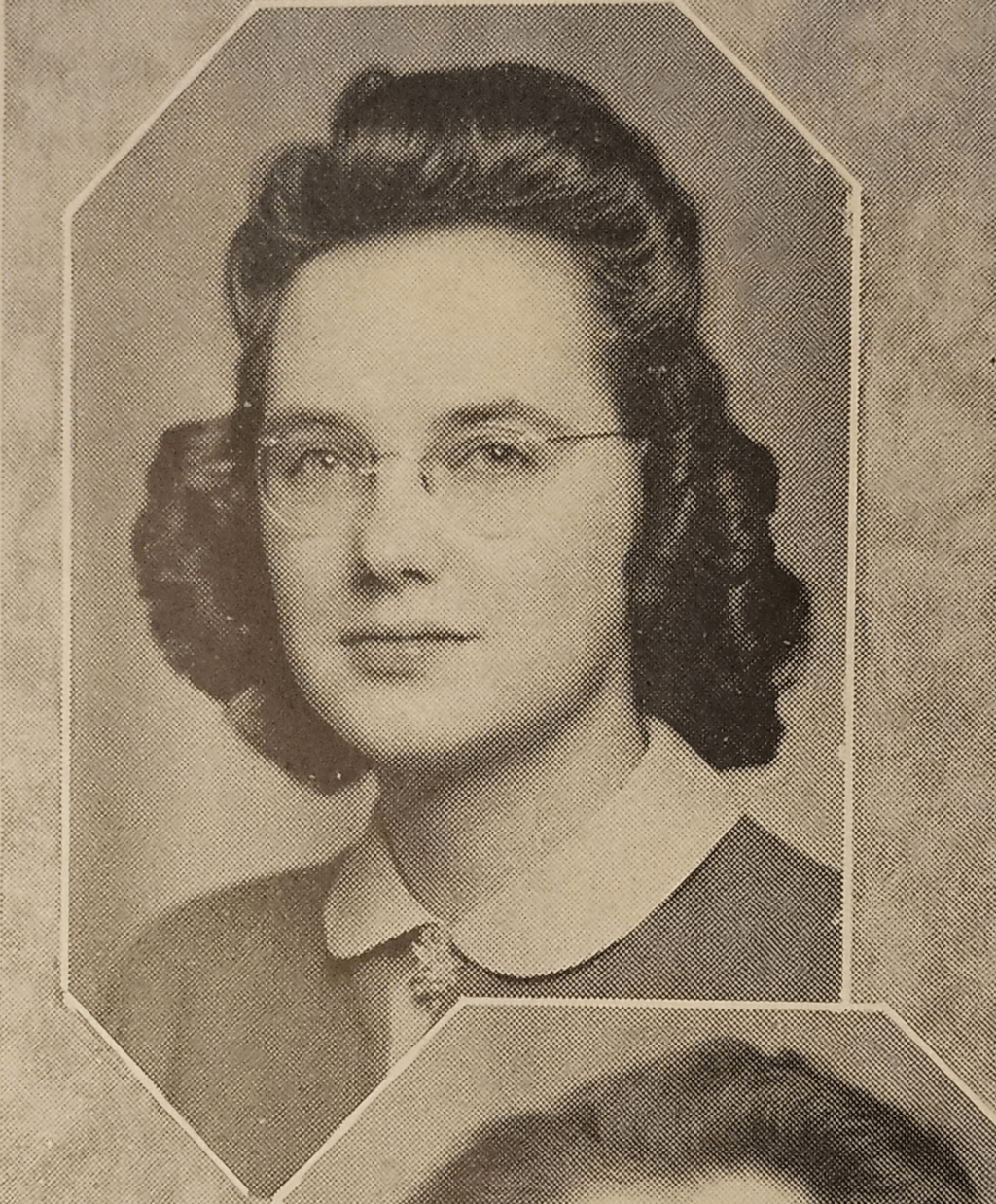
Some women in the early EMCC in Ontario served in public church work outside the City Mission Workers Society (CMWS). Noted in Church literature, or hired/appointed by local congregations, they were uncredentialed by the MBiC Ontario Conference 1885-1946. Elizabeth Risdon, whom I profiled in two earlier blogs, never, as far as I know, had a role in an MBiC meeting other than as a worshiper. God seeks worshipers, John 4:23, so that was perfectly fine. I am thinking about people such as Eileen (Lageer) Warner (1923-2017) who served at Port Hope in 1946-1947 with a partner who had been a City Mission Worker. She called herself a deaconess, before beginning her long missionary and teaching career.1 Her service in a pastoral role fell between the CMWS’ closing year in 1946 and the start of the Ontario Conference Home Mission Board in 1948.2
Reports in the Gospel Banner in the first decades of the denomination3 frequently named people who assisted evangelists such as Andrew Good, Noah Detwiler or Eusebius Hershey. The assistants may have been (male) probationer-preachers, but often young women also volunteered to help with evangelistic campaigns, and some of them, Maude Chatham,4 Eliza Williams5 and Euphemia Guy, were licensed as workers before 1898, when the Conference began forming the CMWS.
Lucy (Bingeman) Rosenberger (b 1866), originally from Waterloo County, helped out in meetings in Unionville, MI, late in 1890 just before her marriage to Samuel Rosenberger.6 Lucy continued to write for the Gospel Banner. Michigan fields were part of the Canada (Ontario) Conference until 1896. Her twin sister Lizzy also married a Rosenberger but that couple stayed in the New Dundee area.
An early report mentioned a Miss Eby and Maria Block helping out in tabernacle meetings.7 In 1893, Maria submitted a testimony from Galt, ON.8 Neither show up in official lists. There were many “Miss Ebys,” in the MBiC, so I can’t say more about her.
Annie Troxel (1872-1959) and Sarah Klahr were left at the St Thomas, ON, mission when Maude Chatham had to go to the Chatham home to nurse her brother Edmund in 1898.9 Annie Troxel did not show up in the official lists of recognized workers, but Klahr did. Annie was paired with Maude Chatham at Collingwood in September 1899.10 She married David Krug Bowman, and was a member of Bethany UMC in Kitchener at her death.

Credit: Don Moyer, Abraham’s Children (1994 ed).
In tabernacle meetings with Chris R Miller at Sherkston, Cora May Sider (1879-1963), Daisy Young, and Sylvester Fretz, get recognition.11 Cora Sider was the daughter of Elder John A Sider and his wife Louisa Jane (Sherk), and later married Elder Isaac Brubacher. Daisy Young married Elder Frank Gugin but she is listed for a year or two before that in the city mission work, and Cora was not. Lizzie (Moyer) Bolender (1872-1944) from Markham also assisted in a protracted meeting in St Thomas in 1899. This means she had travel to and find accommodation in St Thomas, a bigger commitment than local evangelism from home.12 Menno Bowman reported Lizzie helping at a holiness convention.13
Katie Gortner, Gordner or Gardner (spellings vary), was another volunteer tent-meeting helper mentioned several times from 1895 to 1901 as if she were an enrolled worker.14 I have not identified her to my satisfaction. She may be the same lady who is recorded in the 1901 Canada census as an Ontario-born domestic worker, in a Mennonite household in Wilmot Township, Waterloo County.15 This Katie Gardner, 34, was a Mennonite of German ancestry. German was her mother tongue.16 Katie “Gortner” helped in a holiness convention at the St Thomas mission with Susie Bowman, Lizzie Moyer and Livy Hallman.17 Susie Bowman was an enrolled CMW, but Livy Hallman was not. Livy married C N Good in 1900 after his first wife, Lovina (Schneider/ Snyder) Good died in February 1899.
Leah Purdy did public Christian work, leading evening services in a United Church, and in various MBiC church revivals and youth meetings for several years around Sarnia before being enrolled in the CMWS in 1942. She is among the 133, but I also count her here.18
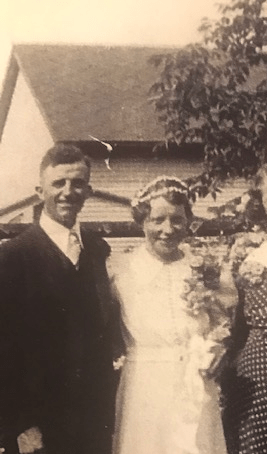
Courtesy: David Oppertshauser.
In later years there were women who are remembered as city mission workers, but never showed up in the lists before 1946, such as Margaret Tindall (1903-1966) (later married to Clayton W Oppertshauser) working at Listowel.19 “M Tyndal,” however, wrote the poem honouring C N Good on his retirement as City Mission President in the Ontario Conference Journal of 1937 in the first person, as if she were truly a City Mission Worker. She certainly had a Quarterly Conference license to preach in the congregation.20 This suggests to me she was actually a CMW, but somehow the records failed to record her. There was also Coral Young (ca 1923-2002) who worked at the Stratford Church although I have not been able to pin down the period she served. It would have been in the late 1940s or the early 1950s.21 Laurene Malcolm served as a “helper minister” on the Palmerston Church field from February 1946.22 The website of the Palmerston Missionary Church considers her a City Mission Worker,23 although, as we have seen, the City Mission Workers Society was shut down in the annual conference of 1946.

Credit: The Pilot 1946 p 26.
Christian women will minister in Jesus’ Church in the power of the Holy Spirit. Western culture has these distinctions of public/private and official/unofficial. Some other cultures do not. Some women gain authority just by their gifts and service.
The Women’s Missionary Societies organized in Ontario about 1939 and their activity in some ways offset the loss of the city mission program. I will examine the rise of the WMS in later blogs. Ontario’s Emmanuel Bible School/ College beginning in 1940, soon appointed women to teach as women had been doing in MBiC mission fields for decades. One, Gladys S Eby, MA, was a credentialed worker (entered ministry 1932) from the Canada Northwest Conference, and taught at EBS/C 1945-1950.24
In the 1960s, women started to be elected as delegates for their congregations to the Annual Conferences of the United Missionary Church and thus eligible to speak and vote on doctrinal and credentialing questions, a role some people discredit.25 They began to be hired for youth leaders and Christian Education directors, though not often called pastors. I have not studied this very closely yet. Maybe one of my readers will.
The thirteen women noted in this post all served their Lord, and Jesus will reward them. Those whom I have overlooked, Jesus will remember them too, better than we have done yet.
Banner: Eileen Lageer of Owen Sound, 4th year in EBS. Credit: The Pilot 1946, p 22.
1Lageer’s courses on Church Growth and Cultural Anthropology at Emmanuel Bible College instructs my Christian work to this day. I plan a blog about her career, mainly as a writer. Missionaries were certainly UMS credentialed.
2There was an Ontario Extension Board for a while up to 1948 involving men, which was briefly parallel to the City Mission Workers.
3Unfortunately not all early issues or even years of the Gospel Banner (1878-1969), the official magazine of the Mennonite Brethren in Christ Church and the United Missionary Church, have survived in paper copies at Mishawaka, IN, in Elmira, ON, or in microfilm. There is some definite information loss.
4GAMEO article: Clare Fuller, “Chatham, Maude Elizabeth (1870-1951).” Global Anabaptist Mennonite Encyclopedia Online. May 2015. Web. 11 Jun 2023. https://gameo.org/index.php?title=Chatham,_Maude_Elizabeth_(1870-1951)&oldid=132853.
5I know almost nothing about Eliza Williams except she served at Chesley 1897-1898, Collingwood 1898-1899 with Sarah Madden, and was available but not assigned 1899-1900.
6Lucy Bingeman, “Our Fields of Labor,” Gospel Banner (January 1 1891) p 8. This Unionville is in Tuscola County, MI, not in Markham Twp, York Co, Ontario. Samuel Rosenberger was a probationer for a time himself after the wedding.
7I saw the reference recently, but haven’t been able to find it.
8Maria Block, “Letter,” Gospel Banner (July 18 1893) p 10.
9Gospel Banner (Dec 13 1898) p 9.
10Gospel Banner report (September 12 1899).
11Chris R Miller, “Report,” Gospel Banner (June 13 1899) p 13.
12Lizzie (Elizabeth) Moyer was profiled in Don Moyer, Abraham’s Children (binder of Moyer genealogy), [on the 86th page in my 1994 edition].
13Menno Bowman, “Report,” Gospel Banner (January 17 1899) p 12.
14“Our sister workers, sisters Chatham and Gardner…” are mentioned by Noah Detwiler helping during tent meetings in Maryborough (and Wallace Twp, near Palmerston, ON); Gospel Banner (Oct 1 1895) p 12. She was also mentioned as helping Maude Chatham at St Thomas; Gospel Banner (April 24 1899).
15Canada census 1901 for Wilmot Township, Waterloo Co, working for the Jacob R and Mary Miller and family, Mennonites.
16In the 1891 census she is called Cathrine Gordner, 25, her mother was US-born, sister-in-law to Jacob R Miller, head of the household. Mary Miller, 30, is apparently her sister.
17Gospel Banner (April 24 1899), where she is called “Gordner.”
18W Cecil Brown, “Report,” Gospel Banner (Vol 62 No 17 1939) p 14.
19David Oppertshauser, personal communication, April 2019; Verna (Oppertshauser) Hardie, personal communication, May 2019.
20Listowel EM Church history document.
21Thomas E Dow, personal communication, February 9 2019; Coral’s mother, Elminda (Shantz) Young had herself been a city mission preacher 1907-1910. Obituary at canadianobits.com/ontario/webbbs_config.pl/noframes/read/291.
22Margaret Montgomery and Winnie Srigley, Celebrating Our Heritage: Palmerston Evangelical Missionary Church: 125 Years Under God’s Leadership (Palmerston, ON: Palmerston Missionary Church, 1999) p 18.
23https://palmerstonemc.com/about/our-history/
24The Pilot 1949, p 18-19, records Eby teaching Acts, biblical basis of missions, and psychology, for example.
25Eg, Mrs Ellis Lageer (“Teddy”) was a delegate from St Clair UM Church, Toronto, in 1964.


 EMCC History
Leave a reply to jamcdowell244b31c939 Cancel reply