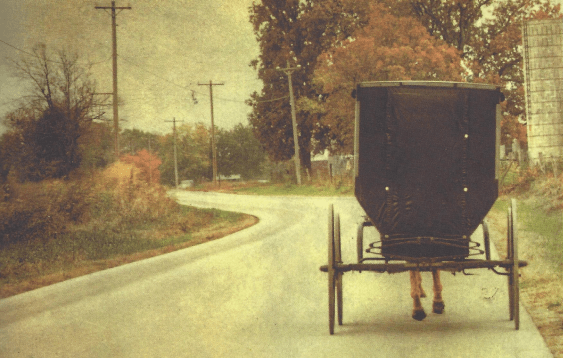
Browsing one day in the United Missionary Church of Africa Theological College library in Ilorin, Nigeria, I came across a curious book in the fiction section, a 1951 dark red hard cover novel called High Bright Buggy Wheels. It was written by a Canadian woman, Luella (Sanders) Creighton, and it was about Ontario Mennonites. I skimmed through it and could see that the setting seemed curiously like the Mennonite Brethren in Christ Church, a precursor to the Evangelical Missionary Church of Canada, and yet not like them. In Tungan Magajiya, Niger State, 400 km farther north of Ilorin, I later found another copy in the UMCA Bible College Library. I supposed this Canadian novel had been left behind by Canadian missionaries of the United Missionary Society,1 but it was odd that the women (I guessed; there were no owners’ signatures) had the book. What did it mean? Flipping some pages, I saw a few surnames that reminded me of leaders in the early EMCC in Ontario, such as Bricker, Goudie, Reesor and Shantz, plus some that were not so common.
I suspected it was a novel of “leaving the Mennonites (or Amish)” genre and I did not want to read that kind of story.2 Back in Ontario after 2010, I began researching the life of Samuel Goudie, Mennonite Brethren in Christ pastor and Presiding Elder (like a superintendent) who lived for many years in Stouffville, Ontario. I wondered if the novel did more than vaguely reference Ontario Mennonites. I ordered a copy online.
My copy was a reprint with a new introduction by Cynthia Flood, the daughter of the author.3 Flood sketched the life and career of her mother, and the circumstances behind the novel’s writing. Luella Creighton was born (1901) and partly raised in Stouffville! Her step-mother was a Stouffer! By this time I knew that Goudie was a Scottish, not “Mennonite” name, and in Stouffville, only one Mennonite family had this name, the family of Sam and Eliza Goudie and their three children. The story was about Tillie Shantz,4 a young woman from the farm who was expected to marry Simon Goudie, a zealous young Mennonite farmer and live the life of a submissive prescribed Mennonite farmer’s wife. Of course you know it won’t stay that way in a book like this. We get a hint of this when, at the beginning of the story, during a camp meeting, Tillie on an impulse sneaks out of a meeting to accept the invitation of a worldly young man, George Bingham, to go on a wild buggy ride with him in the countryside.
Samuel J Steiner, a Mennonite archivist, has commented on High Bright Buggy Wheels in a Goodreads internet reader’s review. He says the Mennonites in the novel do not represent any Ontario Mennonite community he knows, and he is right.5 Luella Creighton crafted a composite of the Markham/ Whitchurch Townships’ Mennonites she knew. There are pieces of several kinds, taken more or less from the Markham Mennonites, the Tunkers, the people of Wideman Mennonite Church, and the Mennonite Brethren in Christ. At the time the story is set (vaguely pre-World War I), only the MBiC had camp meetings, yet the camp meeting meal was blessed by a silent prayer, which is definitely not MBiC. Becoming a church member in the book is like, but not like, the MBiC.
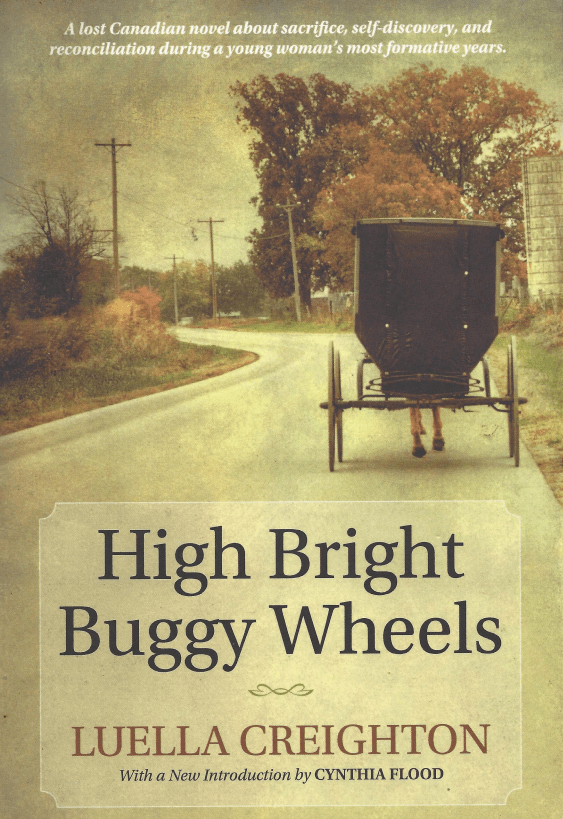
Credit: Brad Lackey/ Lookout Mountain Photography, OUP
This book was Luella Creighton’s first adult novel (she had published short stories in the 1930s) in her 50th year. This was long after she left Stouffville to become a school teacher in the countryside near Uxbridge, the next county east, and later the wife of a University of Toronto history professor, the famous Donald Creighton. She had lived in England and Paris before settling in Toronto and later Brooklin, north of Whitby, ON.6 These experiences were far away from Stouffville or Winnipeg where her wheelwright father had taken her about 1906, after five years with her maternal grandparents.
Her father had remarried in 1906, first taking Luella and his new wife to Winnipeg, then back to Stouffville around 1915. Cynthia Flood interprets the novel’s plot as a reaction to the actions of Luella’s step-mother. Flood described the step-mother, Mary Ann Stouffer, as standing “at the harsh end of the Mennonite spectrum.”7 War had broken out between Luella and Mary Ann. The step-mother tried to retrain her step-daughter to a stricter way of life. Luella lived in Stouffville only until she ran away to work in Toronto’s shirt factories at 18 and then to teacher’s college, which is what she wanted to do. A few years later she attended the University of Toronto. So, crammed into those “war” years, Luella Bruce formed her impressions of Stouffville Mennonites that, tempered some by calmer acquaintance, concocted her a story of justified rebellion over thirty years later.
The real Sam Goudie died in the year the book was published with horse-and-buggy theatrics by the first publisher McClelland and Stewart down the streets of Toronto. The book was a success, was reprinted, came out in an American edition (Methuen) and inspired a CBC radio drama.8
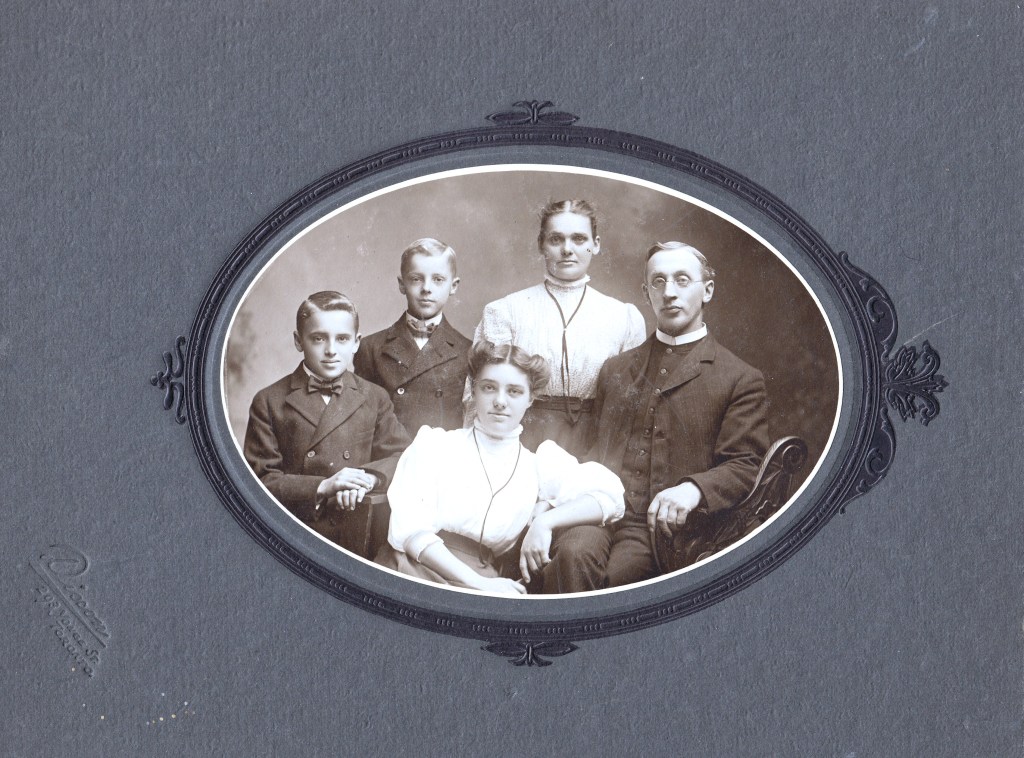
Courtesy Missionary Church Historical Trust
I wondered what about the Goudies could have suggested to Mrs Creighton to take their name for her narrow, bigoted and self-centred antagonist. It doesn’t look good. The Goudies lived in town from 1907. Goudie’s two sons would have been in the Stouffville high school at the same time Luella was, though she was slightly younger.9 The only Mennonite Church in town was the Mennonite Brethren in Christ congregation which met in a building they constructed in 1903 on Main Street after a revival, the only Mennonite church built in a town in Markham/Whitchurch for many years.10 Until 1903, the MBiC field of Markham consisted of about half a dozen rural appointments. With Stouffville, the circuit was divided in half, and the congregation became a new leading body in the denomination. In the novel, the Mennonites have a church building in town and others in the countryside, such as Lemonville, an actual MBiC location for a while. Sam Goudie was never the pastor of the MBiC in Stouffville, but he preached there often when not off on his Presiding Elder’s duties. Mary Ann Bruce may have been a Mennonite by origin, but in the 1921 census she was a Methodist, like her husband.
In the story, Simon Goudie was a student in an unnamed Bible college in the “city,” almost certainly patterned after Toronto Bible College which during Creighton’s time was situated very near the University of Toronto.11 Some Ontario Mennonites, both Ontario Mennonite Conference and MBiC, attended, according to student lists in the Toronto Bible College magazine The Recorder. Simon, though unhappy about some of the culture-conforming (non-Mennonite) aspects of the school, heard appeals for students to give themselves to foreign missions, which was very much an early emphasis of the non-denominational college. Without discussing anything with Tillie, he decides God has called them both to go to Mozambique, and at first Tillie accepts this as a possible future. This plot point is similar to that in Charlotte Bronte’s Jane Eyre, with the missionary St John Rivers expecting Jane to make a good companion for his missionary work.12
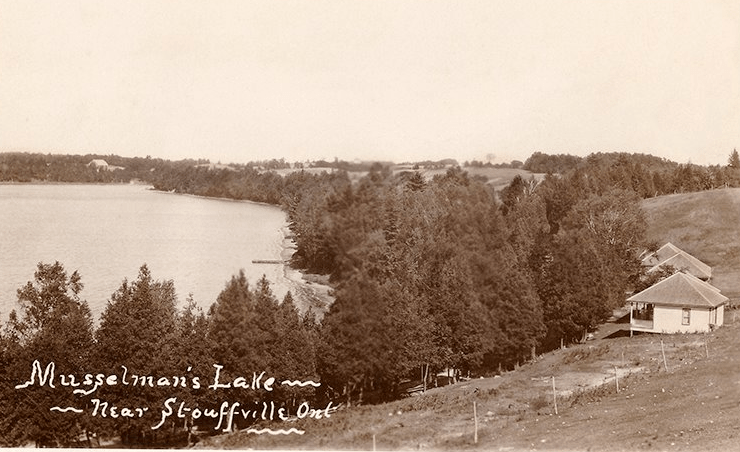
Tillie however has gone through several changes in herself since the first chapters. She has learned to sew and appreciate patterns, colours, textures and skill from a worldly dressmaker in the little town, “Kinsail,” that stands for Stouffville in the book.13 The geography of the real Stouffville is inverted at Kinsail: the lake and sandy soils are north in the real township, but south of the fictional village. This probably represents Musselman’s lake. A smaller lake nearby was known as Preston’s Lake but had clayey soils (Ivan Preston).
Tillie also has been taking piano lessons and has come to enjoy grander music than the gospel songs of her church. She plays for a wedding in a worldly church and enjoys the music, the finery and the dresses—which she helped make—that would be forbidden in her community. The young pharmacist who has settled in Kinsail and occasionally takes her for more drives in the country, represents “the city,” sophistication and the world, which repels and attracts Tillie. He smokes and drinks, he races horses, he sells perfumes! He takes Tillie to a big hotel in the city (patterned after the Royal York Hotel, Toronto), and she is entranced at the colours and shine and quality of the aesthetic experiences she has just started to appreciate. Clearly the wife of the professor loved all these things and wanted Tillie to learn to love them, too. There is definitely a woman’s perspective in most of the book that only occasionally, appropriately, I thought, shifts to the men’s.
The book tries to be understanding of the strict, orderly, productive world of the imagined Mennonite community (varieties are not represented in the book). Tillie’s father, Levi Shantz, is a very sympathetic character, who finally accepts his daughter’s choices as her own proper choices, though not his. It is clear that Tillie’s relation to God is closely connected to her relation to her father. Flood says fan letters to her mother really appreciated the father.14 In the end, though, the Mennonite world is rejected as gray, rigid, stultifying, condemning, as this genre will. Its orderly world is rejected for life filled with enterprise, pleasures of colour and design, pleasing tastes, smells, touches and sounds, with literature and imagination.
My own reaction to the well written novel was mixed. Flood’s account of how her mother composed the work is delightful—hanging plot points on a clothesline with clothes pegs! I enjoyed the well-observed descriptions of rural Ontario north of Toronto, and its small town life. I have lived in downtown Toronto and in Markham, worked on farms and served the church. I have attended both universities and Bible Colleges. However, I did not like the worldly attitudes of those who are depicted as living a wider life. They boasted, thought how to make a quick buck, lied and lived for themselves generally. I was rooting for the solid Mennonite qualities to show more than not, when the author denied them. I largely share the understanding of sin and Jesus’ sacrifice the Mennonites had at their best. There should have been more of grace, sure. There should be more acceptance of God’s goodness in creation, of course, but I am not sure I would like these worldly-wise villagers as fellow travelers to the new heavens and the new earth. Other readers, and Creighton assumed most of her readers would, may side with the wider world.15
The EMCC is not the subject of many stories in Canada, as far as I know, early or recent. Creighton’s novel almost includes the EMCC in a not all that flattering way. At the time, Mennonites wrote to the author, some complaining and some agreeing with her picture.16 I wonder what the missionaries in Nigeria thought of the book? At least they did not burn it.
Banner: from the cover of the 2013 Oxford University Press edition.
1The United Missionary Society (founded 1921) was the foreign mission of the Mennonite Brethren in Christ Church. In Nigeria, it continued the earlier work of the MBiC Foreign Mission Board (founded 1905.) Samuel Goudie was a founder of both.
2Beverley Lewis wrote a book, The Shunning (1997), of this sort that sparked a whole genre of multi-million copy sales “Amish” romance novels in the 21st century; Daniel Silliman, Reading Evangelicals: How Christian Fiction Shaped a Culture and a Faith (Grand Rapids, MI: Wm B Eerdmans, 2021) p 133-170. Stories of rebelling against the family/tribe/society/religion are staples of modern literature. “Be yourself, eh?”
3Luella Creighton, High Bright Buggy Wheels with an Introduction by Cynthia Flood (Don Mills, ON: Oxford University Press, 2013, originally 1951). McClelland and Stewart reprinted the novel, with another introduction, in 1978.
4Shantz was a very common name in Waterloo County, but rare in York County, where the story takes place. Two men by the name of Shantz were pastors at Stouffville in the early twentieth century, and another Shantz lead Emmanuel Bible School in Gormley and Stouffville, 1940-1944. Creighton could have known these things. Milton Bricker was pastor first of MBiC Stouffville then Markham 1911-1918, otherwise Bricker, a Waterloo name, is a rare name in York County Mennonites.
5 Www.goodreads.com/book/show/17616894-high-bright-buggy-wheels
6“Luella Creighton,” Wikipedia. Luella’s mother’s surname was Sanders, and her father’s Bruce. Luella seems to have honoured her mother by using it, as in the Wikipedia article.
7Cynthia Flood, “Introduction to the Wynford Edition,” Creighton (2013), p iv. The Stouffville area was home to hundreds of Stouffers over the 19th and 20th centuries.
8Flood, p iii.
9The Goudies’ daughter, Pearl, died of meningitis in 1910 on her 18th birthday.
10The Markham church, at Mt Joy, was 2 kilometres north of Markham village.
11Then on Spadina Rd near Bloor St. Greatly morphed, it is now Tyndale University and Seminary.
12Another reviewer noticed this too: https://indextrious.blogspot.com/2013/01/revivals-1-high-bright-buggy-wheels.html
13Stouffville was a typical small Ontario town, eg Jean Barkey, ed, Stouffville 1877-1977: A Pictorial History of a Prosperous Ontario Community (Stouffville, ON: Stouffville Historical Committee, 1977).
14Flood, p vi.
15https://leavesandpages.com/2015/06/12/the-worldly-world-calls-mennonite-drama-in-luella-creightons-high-bright-buggy-wheels/
16Flood, p iii.


 EMCC History
Leave a comment