At the close of our youth fellowship meeting in North Bay, a young man came dressed in a uniform of the US Army. Several in our group knew him and gathered around, amazed. He was Canadian, about 19 years old, but he was going to Vietnam shortly. I never knew what became of him. It was that time in this world’s history.
I don’t know about the other guys in our fellowship, but the American war in southeast Asia made me think long and hard about Christians and war. I was around 16, and I wondered if I could ever be called on to become a soldier and what I would do. By then I knew enough history of the EMCC to know that just a few years before, we had changed our doctrinal statement from opposition to war as a Church, to leaving the issue to the conscience of the individual. So we didn’t have guidance from the denomination anymore. I had grown up in a household where both my parents had worked for the Canadian Department of National Defence copying enemy Morse code, hoping to detect Atlantic U-boat activity. Saul’s valiant son Jonathan was my favourite Old Testament person. The ethics of war was new territory for me.

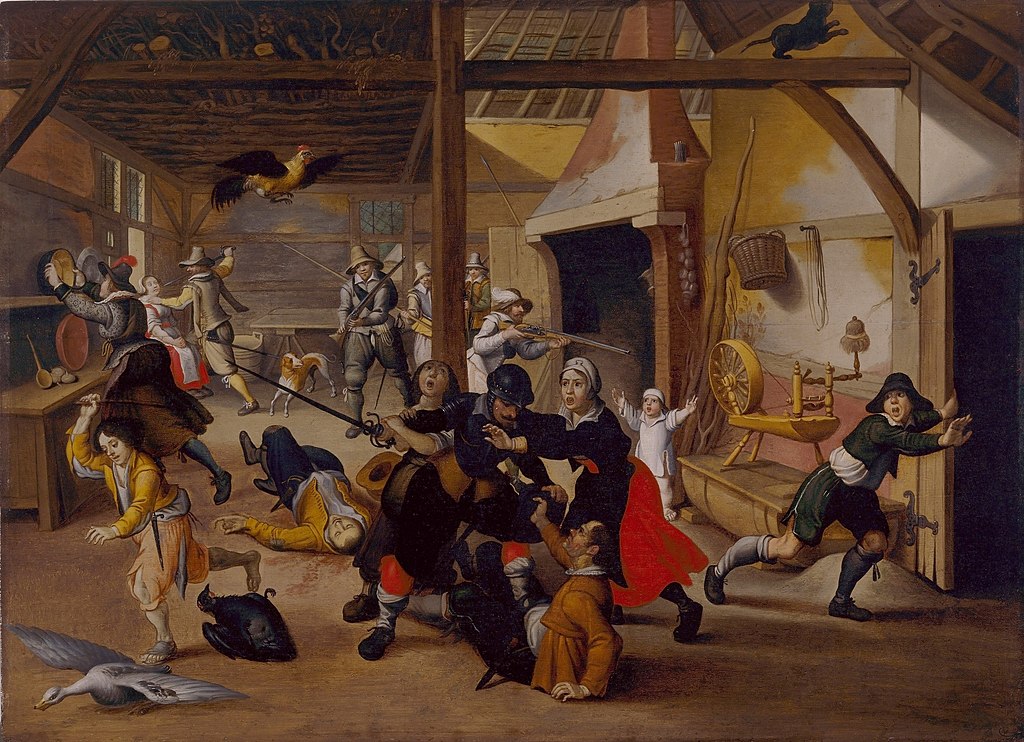
Augustana Book Concern, Wikimedia Commons, Public Domain.
By the time I was in university in Toronto and attending Christian Reformed chaplaincy services, I met American CRC draft dodgers, and they were decent young men. I enjoyed the hospitality of one and his wife on a Sunday afternoon. Ed was an artist, and his design of a simple red geranium for a greeting card has been a standard of beauty for me ever since. By then, I had sided with the dodgers, but probably couldn’t fully say why.
Pacifist or Non-resistant. In this set of blogs I may roam more widely in time. The Mennonite Brethren in Christ and the following United Missionary Church was a branch of the Anabaptist tradition. That movement formed during the Protestant Reformation (16th century),1 and the MBiC was, in the beginning of its organizational life, obviously, Mennonite2 and therefore, non-resistant in doctrine.3 They did not use the word “pacifist” of themselves, though outsiders did, because, being biblicists, MBiC members wanted to use “Bible language” and “pacifist” just didn’t appear in any English translation, and may still not, for all I know.4 The MBiC (in Ontario) did join a group in the Second World War era called the Conference of Historic Peace Churches,5 which was OK because the Bible definitely used the word “peace” in many important places, not least the Beatitudes, Matthew 5:9. There it is significantly joined with another word in “peacemakers” (είρηνοποιοι).6
I may as well confirm here my own conviction for non-resistant doctrine, which the MBiC/UMC taught as a denomination until 1962. I can still believe this in the EMCC because our statement, accepting individual conscience, allows me to promote my individual conviction about what the Bible teaches, while respecting those whose convictions about the Bible on government-run wars are different.7 My view has its problems, but I prefer them to the problems of state-sponsored violence and war. I cannot imagine Jesus commanding me to use a flame-thrower on a cave of enemy soldiers or to pillage a village, for instance. But the binding instructions come from Scripture, not my imagination or lack thereof.
The English term “non-resistance” derives from the “Sermon on the Mount” in the Authorized Version, Matthew’s first collection of Jesus’ teaching that the Lord probably taught and re-taught in many synagogues and fields in Galilee.8 In 5:39, Jesus says, “resist not evil….” (NIV still translates: “do not resist an evil person.” Person is supplied.) The Sermon has convinced many over the years that war is not compatible with Christian obedience, even those who have had no connection with Anabaptism.9 But the NT has other supporting lines of teaching that followers of Jesus would not fight in wars or use violence at other times.10 I will not go into them here. They are well set out in many Mennonite documents and reviewed by many Just War theorists who attempt to refute them.11 A careful defense of “just war” theology is provided by Daniel Bell.12 I want to document the MBiC commitment for many years to non-resistance, which faltered between the two world wars. A combination of many factors eroded MBiC/ United Missionary Church support for the doctrine which we can look at in a later blog.
Articles of Faith. When the newly-formed Reforming Mennonite Society merged with the older New Mennonite Church of Ontario in March 1875 at Snyder’s Mennonite Church, Bloomingdale, ON, to become the “United Mennonite Church,” they accepted as a doctrinal basis the Dordrecht Confession of 1632. This confession had become a standard teaching tool for baptismal candidates among North American Mennonites.13 Article XIV, “Of Defense by Force” dealt with revenge, resisting enemies, and enjoined the opposites, doing good and praying for enemies.14 Subsequent mergers of the United Mennonites in 1879 and 1883 did not mention the Dordrecht Confession, but included in the Articles of Faith of the MBiC was one on “Nonresistance,” later called “Self-Defense,” and even later “War, Peace and Self Defense.” The early article quoted Jesus’ words in Matthew 5:39, John 18:36 (“My kingdom is not of this world. If it were, my servants would fight…”), Romans 12:17 (“Do not repay anyone evil for evil…”), and Hebrews 10:34 (“…and [you] joyfully accepted the confiscation of your property…,” a frequent result of non-resistant life.)15 Later editions of the Discipline quoted even more passages of Scripture.
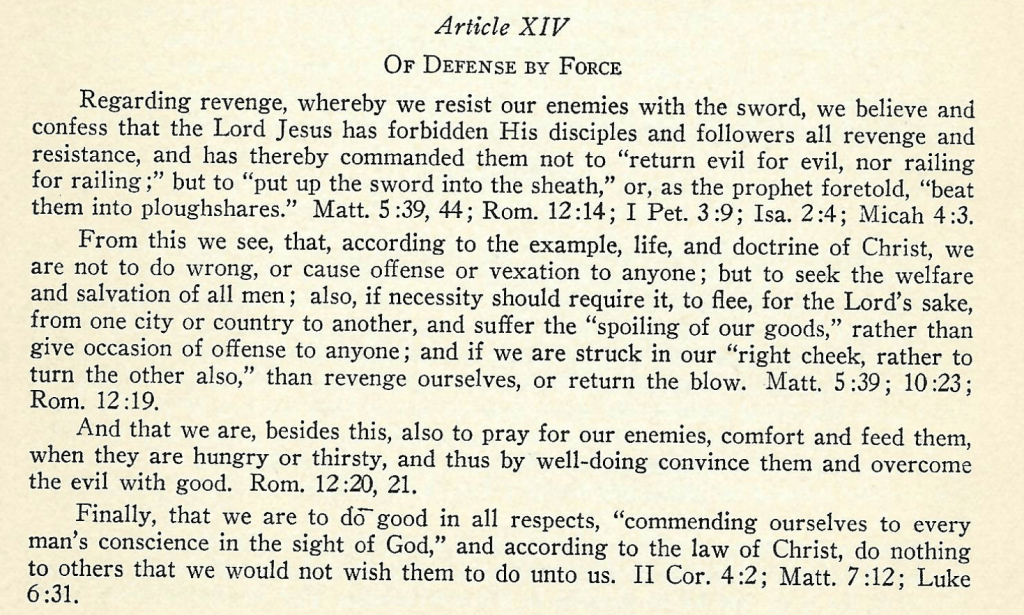
Credit: J C Wenger, The Doctrines of the Mennonites (1950) p 81
The church magazine, the Gospel Banner, printed articles condemning participation by Christians in war and violence from its start in 1878. Jacob Y Shantz was one of those writers, a prominent MBiC member from Berlin (Kitchener, ON.16 Others were Daniel Brenneman, Henry Goudie and H S Hallman.17 Another member of Bethany MBiC church in Berlin, Peter Shupe, published a song promoting peace, “Oh Why not have Peace instead of War?”18
With the attention of the Church on promoting evangelism and sanctification, non-resistance tended to become an acknowledged but, our historians say, infrequently-taught doctrine.19 Sam Goudie, a low-key international MBiC leader named non-resistance, however, among the distinctives of the Church.20
So until the second World War (until 1962 in fact), the official position of the Mennonite Brethren in Christ and the successor church, the United Missionary Church, was “Non-Resistant.”
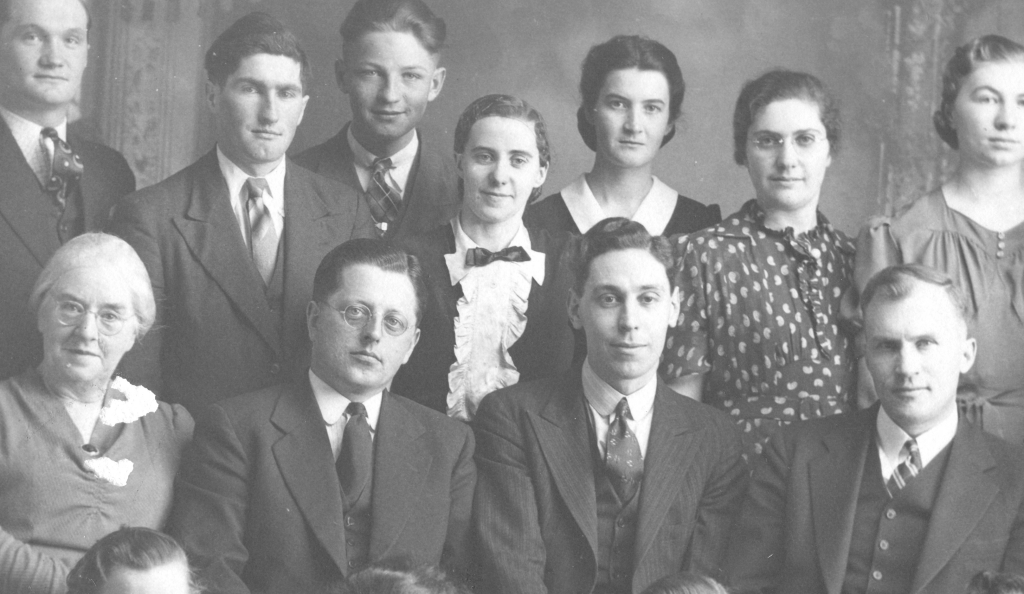
Banner: Staff of Emmanuel Bible School in January 1941: L to R: Maude (Detwiler) Warder, Percy G Lehman, Ward M Shantz, J Harold Sherk. Lehman and Sherk were active supporters of non-resistant teaching in the Ontario MBiC. Courtesy Missionary Church Historical Trust
1The branch of the Reformation called the Radical Reformation by some scholars. It had many varieties, from mystics, through those who were quite orthodox, to non-trinitarians. Useful general histories would be Cornelius J Dyck, An Introduction to Mennonite History: A Popular History of the Anabaptists and the Mennonites 3rd ed (Scottdale, PA/ Waterloo, ON: Herald Press, 1993), or Harry Loewen and Steve M Nolt, Through Fire and Water: An Overview of Mennonite History rev ed (Scottdale, PA: Herald Press, 2010).
2A whole issue of the Missionary Church Historical Society journal was devoted to the (US) Missionary Church and war, “Peace, War, and the Christian Life,” Reflections Vol 8:2 (Fall 2004). A good place to begin reflection on doctrinal changes concerning war in the Missionary Church/EMCC.
3Study of the Greek NT convinced members of the Bible study group under Reformer Ulrich Zwingli in Zurich, Switzerland, 1520-1524, that a believer would be non-resistant to enemies. A modernist Mennonite theologian, Gordon D Kaufman, believed “non-resistant” was a good word to apply to God, based on this saying of Jesus; Systematic Theology: A Historicist Perspective 2nd ed (New York: Charles Scribner’s Sons, 1978) p 219 n 9. Otherwise Kaufman shows little interest in the Anabaptist theological tradition in his book that I can see.
4Martin H Schrag, “Pacifism,” Beacon Dictionary of Theology (Kansas City, MO: Beacon Hill Press of Kansas City, 1983) p 379-380 and Guy F Hershberger, “Pacifism,” Global Anabaptist Mennonite Encyclopedia Online. 1959. Web. 8 Dec 2021. https://gameo.org/index.php?title=Pacifism&oldid=146661. Against “pacificism,” John H Yoder, Nevertheless: A Meditation on the Varieties and Shortcomings of Religious Pacifism (Scottdale, PA: Herald Press, 1971), eg p 107-108.
5Founded in 1935. Led by Quakers (Society of Friends), Tunkers (Brethren in Christ) and all sorts of Mennonites, Hutterite Brethren and Amish.
6Some Mennonites use the phrase “peace building” for some reason.
7“Articles of Faith and Practice,” adopted in the EMCC National Assembly in Toronto, 2013.
8 N T Wright, The New Testament and the People of God (Minneapolis, MN: Fortress Press, 1992) p 424. My classmates at Emmanuel Bible College in the 1970s, came up with this idea in response to the lecturer, who suggested that as a creative person, Jesus would use his illustrations and parables only once, hence, every variation had to be the product of the history of transmission. It was great to find someone of Wright’s stature support us, even though 25 years later!
9John Horsch, The Principle of Nonresistance as Held by the Mennonite Church 2nd ed (Scottdale, PA: Herald Press, 1939) is a brief early 20th-century review of post-Reformation non-resistant statements. Some examples: Martin Luther up to at least 1520 (he actually quoted the Sermon), and Leo Tolstoy; Horsch, p 12. To that group we may add Martin Luther King, Jr, and John Stott when a young believer.
10A recent collection of essays by Mennonite Brethren who are close theological cousins of the EMCC: John E Toews and Gordon Nickel, ed, The Power of the Lamb (Winnipeg, MB and Hillsboro, KS: Kindred Press, 1986). The MCHT has a random selection of pamphlets and monographs on the teaching of non-resistance, sometimes referred to by the positive phrase, the “peace position,” Box 8010 MCHT. Those near Waterloo, ON, can visit the vastly more comprehensive collection of materials at Conrad Grebel University College, part of the University of Waterloo, and of course, there is much online discussion.
11Eg John A Broadus, Commentary on the Gospel of Matthew (Valley Forge, PA: American Baptist Publication Society, 1886) p 118-119.
12Daniel M Bell Jr, Just War as Christian Discipleship: Recentering the Tradition in the Church rather than the State (Grand Rapids, MI: Brazos Press, 2009). He does not interact with Anabaptist biblical interpretation, referring to John Howard Yoder only for historical perspective.
13Jasper A Huffman, ed, History of the Mennonite Brethren in Christ Church (New Carlisle, OH: Bethel Publishing, 1920) p 53.
14As quoted in John C Wenger, Glimpses of Mennonite History and Doctrine (Scottdale, PA: Herald Press, 1949) p 223.
15All Scriptures unless otherwise mentioned are from TNIV (2005).
16Jacob Y Shantz, “Non-Resistance: Can a Christian Engage in Warfare?” Gospel Banner (April 1879) p 2 and “Can the Elect, or God’s Children do Military Service?” (December 1879) p 1. He contributed a dialogue on peace and war, “Peace and Good Will to all Men,” to the Gospel Banner (March 7 1893) p “158.”
17Henry Goudie presented an essay to the Canada Conference Ministerial Association in 1893 at Mannheim, ON, called “The Peace Question and our relation to it,” Gospel Banner (February 28 1893) p 8. Daniel Brenneman spoke on “Christianity and War Contrasted” at his own Ohio and Indiana Conference Ministerial Association, Gospel Banner (March 28 1893) p 8. The editor, Henry S Hallman, added his lead article, “Non-Resistance the Strongest Resistance,” Gospel Banner (August 1 1893) p 1.
18Sheet music in Box 7021A MCHT.
19Huffman, p 164, Everek R Storms, History of the United Missionary Church (Elkhart, IN: Bethel Publishing, 1958), p 231.
20In discussion of an essay read in the Ontario Conference Ministerial Association of 1924, “Ministerial Convention Minutes 1917-1948,” p 52-53, Box 6001B MCHT.


 EMCC History
Leave a reply to tomfulli Cancel reply