The more I learn about the denomination called the Evangelical Association (Evangelische Gemeinschaft), the more I thank God for it if only from the point of view of the Evangelical Missionary Church of Canada. Starting in Pennsylvania about 1800, a small zealous group looked for any community of German-speaking people to preach the gospel of Jesus Christ to.1 One of their Canadian ministers, J G Litt, said, “The Evangelical Association has often gone where it was not wanted, but never to where she was not needed,” (in J C Hopkins, ed, Canada: An Encyclopedia of the Country Vol 4 (Toronto: Linsott Publishing, 1898) p 127). Contact of the EvA with German-speaking Mennonites in Ontario from 1836 to at least 1875 led to some Mennonites desiring a story and assurance of salvation and a livelier expression of faith.2 The Evangelicals testified to their salvation experience and urged others to seek it, too. In Ontario, the Evangelical Association evangelized and made converts, organizing circuits and congregations, spreading from their initial sites in the Niagara peninsula and Waterloo County

Evangelical Album (Cleveland. OH: Thomas and Mattill, 1895) p 98. public domain
to the German settlers northwest to Port Elgin on Lake Huron, and in the 1860s to the Ottawa Valley, with a scattering of other congregations in outliers. After 1899, their missionary activities in western Canada raised up a new Conference from Winnipeg to Alberta (set up 1927).
Unfortunately, in the late 1880s, the Evangelical Association was split by a dispute over the powers of their bishops, and two groups resulted, neither of which continued to grow as they had together formerly. No formal split occurred in Ontario, but I have some small evidence that in some congregations, members stopped attending and chose other churches, such as the Steuernagel and Krauth families in Port Elgin, who switched to the Mennonite Brethren in Christ in town just at that time. A church growth study of membership in the conference might support this guess. The two parts reunited in 1922, and chose the name Evangelical Church. Apparently its growth resumed.
Although in the first decades of the MBiC, Evangelicals could visit MBiC conferences (for example, the Berlin 1900 General Conference welcomed several EvA pastors from Waterloo County,) Evangelical interaction with the MBiC decreased in the 20th century. In these years the EvC/ EUB in Ontario drew closer to mainstream and more liberal churches, the United Church of Canada in particular. Young men who attended more theologically evangelical or Wesleyan schools were discouraged by their leaders. This was the experience of Nathan Krampitz from the Chilliwack, BC, EUB. He and his wife Fern had long careers as missionaries in India with OMS.3 Ted Losch, from Mildmay, ON, who attended Emmanuel Bible College but also attended the more liberal Waterloo Lutheran Seminary (now Martin Luther University College) fared better with encouraging appointments.4
I have followed up the progress to 2019 of the 64 EUB congregations which joined the UCC in 1968. Since the 1980s, rural congregations across all denominations have generally done poorly in Canada (including the EMCC). Many such former EUB rural congregations have closed but so have large urban churches. Of the 64, 26 have discontinued, 5 changed their affiliations (4 to the EMCC),11 continued in merged UCC congregations, and 22 continue. St Timothy’s in Kitchener closed in 1990. Zion EUB/UCC in Kitchener, 1200 members in 1968—closed in 2015, as did Olivet (Kitchener) which had 350 members in 1968. In Waterloo city, Bridgeport and Emmanuel survive. The church in Stratford (around 350 in the 1960s) closed in 2006.
Where are they now? The remnant EUB/ Evangelical Church of North America still exists in the USA mainly in the US north west,5 but the large denomination of 900,000 members does not exist any more. The Evangelical Church merged in 1946 with another originally German-language North American denomination, the New Constitution United Brethren in Christ. Then just over twenty years later, the merged church, the Evangelical United Brethren, merged again: the American section with the Methodist Church there,6 and in Canada, its Canada Conference (Ontario) merged in 1968 with the United Church of Canada.7
Evangelical Church people. The EMCC is a merged church, too, formed in 19938 of the Missionary Church of Canada (the two Missionary Church districts in Canada) and the Evangelical Church in Canada.9 Eileen Lageer’s Commons Bonds is an account combining the two sides’ stories and the first 10 years together as the EMCC. Former EUB members whom I have met have impressed me as first-rate Christians. Since the background of the EUB is available in books, I will favour my personal acquaintance with people and congregations. I will survey some hymnbooks of the Evangelical Church in another blog.10
My growing awareness. I first became aware of the “EUBs” about 1967 when Bill Smith, pastor of the Eau Claire United Missionary Church near Mattawa, 45 km east of North Bay, ON, reported he was holding meetings at Petawawa, near Pembroke, farther down the Ottawa River valley. A sizable number of the large Pembroke EUB church (about 530 members) were not happy with the plan for the EUB in Canada to merge with the United Church. Their pastor warned them about the sheep-stealing minister

Emmanuel Bible College, Kitchener.
Missionary Church Historical Trust
from Eau Claire.11 At 14 years old, I was beginning to catch the difference between “liberal theology” and biblical evangelical Christianity. I hoped that Smith’s efforts to collect members of the Pembroke EUB would be successful. In an annual conference later I heard Bill Smith say that he had competed with the Free Methodists who also hoped to receive the EUB people. Since he had to preach in his own church Sunday morning, he could only reach Pembroke by the afternoon to meet with the EUB people, but that was all right with them, because it didn’t clash with their church services either. Evangelical Wesleyanism was the common denominator of all three groups, although the Christian and Missionary Alliance was also attractive, a near theological cousin.
Years later at the first year students’ retreat for Ontario Theological Seminary (now Tyndale Seminary), I met Reg Krock, a former member of the EUB and then EMCC Pembroke Church. In a conversation in 1986, he was happy to tell me all about the congregation and what happened to some of the members now scattered across Canada, such as Conrad Holtz, who became a Missionary Church pastor for some years, now a counsellor in Sarnia. Another was Dr Charles Nienkirchen, who had become a Christian and Missionary Alliance seminary teacher.12 I took notes, which I still have. On deputation as a missionary to Nigeria about 1992, I stayed at the home of a Pembroke member and later we met others at nearby Camp Mishewah, Round Lake, ON. Again, my experience with the church has always been a pleasure.
Meanwhile, the Ontario District of the Missionary Church had received other former EUB people and a nearly intact congregation (Wilmot Centre) from the EUBs in 1968-69, plus a few pastors who served in the Missionary Church with excellence. This all came to my attention when, stirred by Eileen Lageer’s classes on Church Growth at Emmanuel Bible College in 1980-81, I started digging into statistics of our smaller Canadian denominations.13 Again, under Dr Ian Rennie at OTS, I researched the smaller Free Church and Methodist bodies in Canada, and pulled together what little I could of the history of the Evangelical Association, among others. It gradually dawned on me then that the vague references to the influence of “evangelical Methodists” in our earlier church histories actually meant precisely the Evangelical Association.14 They were the church that Mennonites of The Twenty at Jordan, Ontario, joined in prayer meetings in the late 1840s (Canadian-German Folklore Society Vol 18 (2007), “Early Life and Times in the Twenty and Legacy of Samuel Fry”); they were the churches, in Waterloo County, that showed Mennonites how to conduct protracted and prayer meetings, bush or camp meetings. (Protracted meetings were evangelistic events that continued for days and weeks with no fixed end.) In the 1860s, it was the Evangelical Association congregation in Port Elgin that challenged the Mennonite church there to desire the same revival experiences the EvA was going through.15
I think there must have been many, who like Sam Goudie, occasionally attended Evangelical Association meetings. One 1903 Sunday night in Toronto, Goudie went to the EvA Toronto branch hoping to hear their Bishop Sylvanus C Breyfogel, who did not arrive, but he still stayed to hear the Reverends John Goetz Litt, Louis H Wagner (both raised in Berlin, ON) and Merrit I Comfort, a United Brethren pastor, instead.16
Disappearing from view. Due to the mergers in 1968, one cannot find any EUB congregations any more in Ontario, gone for 56 years (2024).17
Except not all!18 Grace and Salem in the Ottawa valley, by boycotting the UCC, were able to buy back their buildings and join the western Evangelical conference, but other congregations had to choose other paths if they wanted to stay with a theologically evangelical denomination. The Arnprior EUB church apparently joined the Wesleyan Church before the merger. Many members of the Pembroke church (started 1876) reorganized as First Missionary Church with Bill Smith’s help, the pastor I mentioned. In Wilmot Township, just west of Kitchener, the Wilmot Centre (ca 1838) congregation reorganized as a Missionary Church, and kept their building. EUB people in the Elmira area (Elmira 1856, Floradale 1877) assisted a 1968 Missionary church plant (Emmanuel) in that town, members of Olivet EUB helped in the start of Lincoln Heights Missionary (Waterloo) as others did later at South River’s Almaguin church, partly out of the rural Rye, ON, EUB church (1880).19

Photo courtesy Jack Hallman Album, Missionary Church Historical Trust
Scattered through the EMCC are former members of the EUB, who found the Missionary Church a home for worship. Preachers who joined were James W Gillings, Ted Losch, George Peck, and John Culp.
Looking back, I realize I had met former EUB members 1977-1981 in Evangel Missionary/Community Church, Kitchener, in the persons of Burton and Grace (Mohr) Eidt, and Nathaniel Ratz. Grace Eidt was one of the kindest and most gracious of Christians I have met, and she stayed that way through a long illness until her death. She wrote cheerful and prayer-filled notes to our family when we were in Nigeria. I still have songbooks Grace gave me from Mr Ratz, and other EUB relations.20 Others who formerly attended Zion EUB/UCC (Kitchener) were members at Bethany (Kitchener) EMC. And so on.
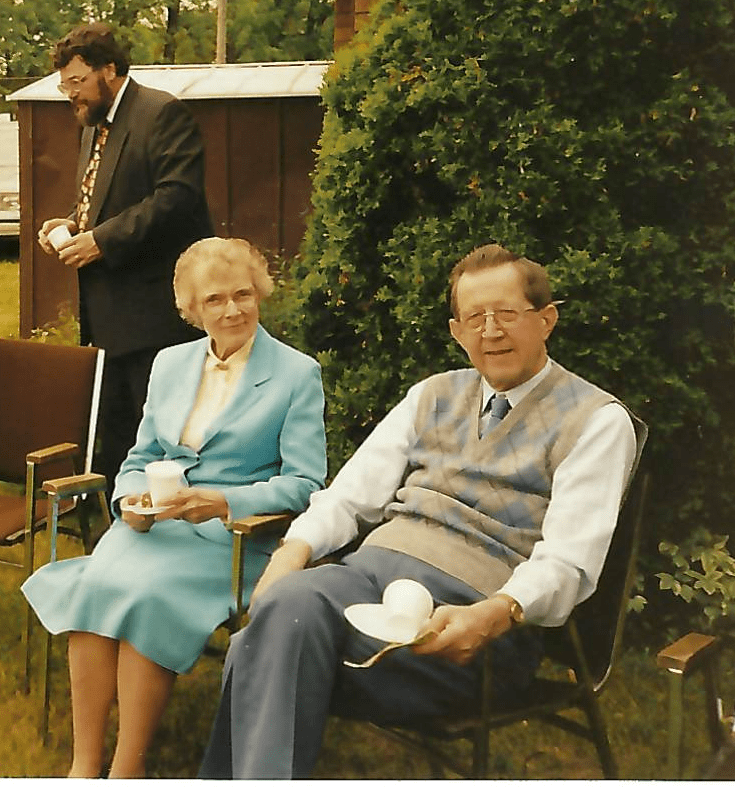
Of course, people who were members of churches that closed did not disappear. Wherever they joined, I believe they took good qualities of the Evangelical United Brethren with them.
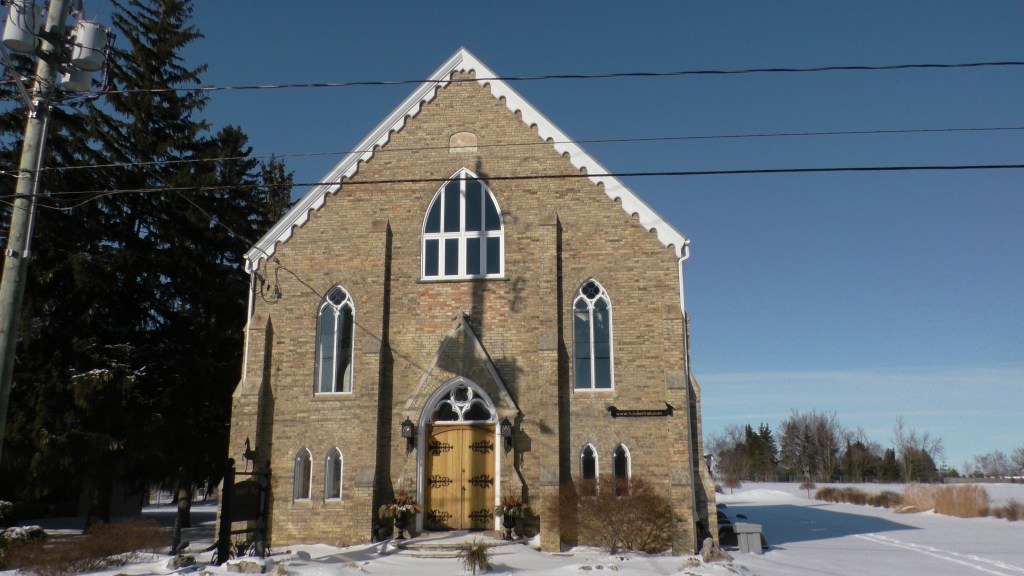
Thumbnail and banner photo of the Heidelberg, ON, EUB building is by Thomas Fuller, 2019.
1Several EvA/Church histories have been written over the two centuries. The Missionary Church Historical Trust has two German-language histories from the 19th century, an English version to 1845 of one of them, and two from the 20th century (1927 and 1942). The EvA was not alone; the United Brethren in Christ was also a witness to the Mennonites.
2Samuel J Steiner, In Search of Promised Lands: A Religious History of Mennonites in Ontario (Kitchener, ON/ Harrisonburg, VA: Herald Press, 2015) p 40. Charles S Gingerich found this to be so: “An Experiment in Denominationalism: A History of the Missionary Church of Canada, Ontario Conference, 1849-1918,” MA thesis, Wheaton College, 1994) p 21.
3Eileen Lageer, Common Bonds: Story of the Evangelical Missionary Church of Canada (Calgary, AB: Evangelical Missionary Church of Canada, 2004) p 142.
4Many in EUB leadership opposed the founding of Western Evangelical Seminary in 1947, a clearly evangelistic and holiness school; John M Pike, Preachers of Salvation: The History of the Evangelical Church (Milwaukie, OR: Evangelical Church of North America, 1984) p 170. Ted Losch (d 2024): “Know your Ministers,” Canada Evangel (November 1964) p 3.
5Its story to 1984 is told by Pike in Preachers of Salvation.
6Making the United Methodist Church in the USA today.
7This means the main archives of the Canada Conference of the Evangelical United Brethren are now kept in the Toronto archives of the United Church of Canada. I have not been able to visit that valuable source. Someone needs to.
8See EMCC History homepage blog “Formation of the EMCC” for the full outline from the 1840s to the present. David B Barrett, George T Kurian and Todd M Johnson, ed, World Christian Encyclopedia Vol 1, 2nd ed, (Oxford, UK: Oxford University Press, 2001) p 174, decided that the combined EMCC about 1993 had 10,342 adult members with 21,510 additional adherents. Canada East District started 1993 with 5658 members in about 70 congregations.
9Theodore E Jesske published Pioneers of Faith in 1985 for the Evangelical Church in Canada, the former Northwest Canada Conference of the EUB. The ECC had 46 churches from BC to Manitoba including the 2 rural congregations in the Ottawa Valley in 1993.
10EMCC History Blog “Music in the Early EMCC Part 4: the Evangelical Church.”
11Reg Krock, personal communication, February 12-13 1986, Toronto. He confirmed these details in a recent conversation, March 12 2024 in Kitchener.
12Dr Charles Nienkirchen, in a Calgary church, recounted his early experiences, https://www.youtube.com/watch?v=wLplMUE7pcw.
13On Eileen (Lageer) Warner, see a future EMCC History Blog, “Eileen Lageer Warner.”
14Eg Everek Storms, History of the United Missionary Church (Elkhart, IN: Bethel Publishing, 1958) p 219. Pages 35 and 222 do name the Evangelicals as influential. Jasper A Huffman, ed, History of the Mennonite Brethren in Christ Church (New Carlisle, OH: Bethel Publishing, 1920) has only one reference to the Evangelical Association, on p 41, unaware of its decisive influence on Bishop Albright, preacher Daniel Hoch and deacon Jacob Albrecht at The Twenty in the 1840s; Steiner, p 95-98.
15There will be a blog, “The Port Elgin Bible,” of a German Bible I found with a name and a date that are evidences of the EvA revival in Port Elgin around 1868-1873.
16Sam Goudie, “Diary,” December 6 1903. Courtesy Eleanor (Goudie) Bunker Family Collection.
17No United Brethren in Christ churches (New Constitution) remained to join with the Evangelicals in 1946 in Ontario. They had all joined the Canadian Congregational Churches in 1906, and thus all went with them into the United Church of Canada in 1925. Many Canadian reference books fail to understand this. The EUB churches in Canada were wholly Evangelical in origin.
18Lageer, p 192-193.
19“South River-Almaguin” File, Box 1204 MCHT.
20Noted in EMCC History Blog “Music in the Early EMCC Part 4,” especially notes 4 and 5.


 EMCC History
Leave a comment