One of the fascinating stories of the Evangelical Missionary Church of Canada in Ontario is the presence and influence of people and congregations of the former Evangelical United Brethren (EUB). The EMCC includes “Evangelical” in its name mainly because the Missionary Church of Canada merged with the Evangelical Church in Canada. The ECC was based in western Canada, but oddly it had two congregations in the Ottawa Valley in Ontario at Killaloe (Grace, started in 1875) and Augsburg (Salem, 1880). They were remnants of the EUB Canada Conference in Ontario. The debt of the EMCC to the Evangelical Association and the EUB is deeper than the recent merger.
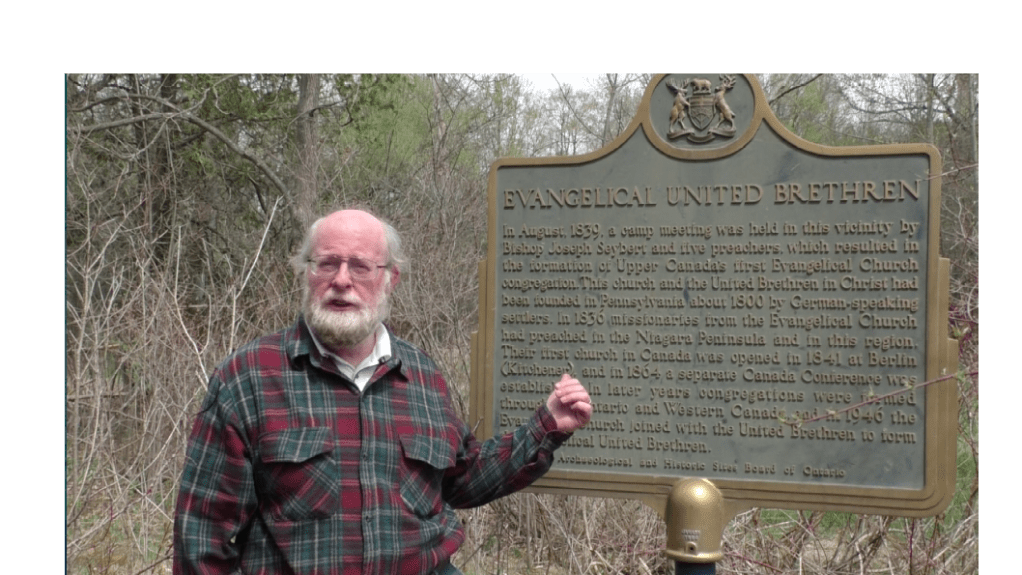
Screenshot from video by Thomas Fuller
Early individual connections. I have followed up hints wherever I have come across them as, for example, the Bolender great-grandfather of pastor/missionary Ivan Preston and the late EMCC President, Mark Bolender. Conrad Bolender (1837-1910) served the precursor churches to the MBiC as a minister, 1874 to 1884, before serving the Evangelicals 1884 to 1902.1 Conrad was born in Germany and farmed around Port Elgin, ON. How he became a Christian, whether through the Evangelicals or the Mennonites I don’t know. He was the secretary in German for the first Reforming Mennonite semi-annual meeting held in Port Elgin in 1874. Solomon Eby, who became a leading figure in that Mennonite revival movement in Ontario, hauled stone for the Evangelical’s building project in Port Elgin in 1868.2 That congregation challenged him to gain assurance of salvation during the next year when the EvA church experienced a revival which converted or renewed many.3 Daniel Brenneman, a leader of the American side of the MBiC in Indiana and Ohio also briefly considered joining with the Evangelicals after being disfellowshipped by his Yellow Creek Mennonite Church in 1874.4
A member of the New Mennonite Church in Markham since 1859, John McCauley (1840-1899), was a NMC preacher at Blair, ON, ordained about 1869. After he transferred to the Evangelicals in 1871, McCauley stayed in touch with the MBiC, the successor to the NMC, sending articles, greetings and a few testimonies over the years to the Gospel Banner. He served with the Evangelicals in Ontario and in many places in Iowa, USA.5
A little later in the USA, Silas Henry Pontius (b 1865) from the Elkhart, IN, area was an Evangelical minister for 5 years before transferring to the MBiC about 1894.6 The family of a prominent MBiC leader in Ontario, C N Good (1869-1967) were Evangelicals. He became a Christian through them and by his own testimony, restored from backsliding in the MBiC.7 Sarah Klahr (1875-1946) was from a devout Bruce County Evangelical family,8 and an MBiC city mission preacher from 1897, a founder of the St Thomas and Owen Sound missions, and later a Christian & Missionary Alliance missionary to Chile, Ecuador and Colombia.9

Courtesy Missionary Church Archives, Mishawaka, IN
I should also mention the Steuernegal and Krauth families, farming at Port Elgin, members of the Evangelicals, some of whom shifted to the MBiC about the time of a split in the Evangelical Association in 1891. One “C Steuernagel” was a preacher in the EvA. Another Steuernagel, who anglicized his name to Reuben Eby Sternall, was converted in the MBiC Chippawa Hill school house preaching point. He was preparing to be licensed by the MBiC about 1908 but in the Pentecostal crisis in the MBiC Ontario Conference that year, turned to that movement instead. He became a celebrated preacher in the Pentecostal Assemblies of Canada. Charles “Charlie” Krauth (1872-1955) served as a pastor in the MBiC 1892 to 1918 and a sister, Johanna (“Hannah”) Krauth was a city mission worker briefly (1901-1902) before marrying David Brittain, an MBiC preacher, in 1903.10

Courtesy Missionary Church Historical Trust
Going the other way, August F Stoltz (1866-1940) of Mannheim, ON, after working with the MBiC from about 1889 to 1897, served the United Brethren in Christ (some years in the UBiC mission in Sierra Leone), before serving the Evangelical Church Selkirk circuit on the Lake Erie north shore, 1921-1924, and retiring as an Evangelical Church minister to Kitchener, ON.11
Reviving some Mennonites. To the influence of the Evangelicals (alongside the United Brethren), we can trace the conversion, assurance of salvation and revival of Mennonites in Niagara Peninsula (Preacher Daniel Hoch, his bishop Jacob Gross and others) in the 1840s;12 and possibly Menno and Susan Bowman and numerous other Mennonites in Waterloo in the 1850s and 1860s. Evangelicals and UBiCs had held camp meetings in the Bloomingdale area, where the Bowmans lived. Solomon Eby and his church attended the EvA revival meetings in Port Elgin 1868-1870. The Evangelicals’ organizational structure was chosen by the Mennonite Brethren in Christ Church as it formed in the late 1870s and early 1880s.13 At least one Evangelical book was on the first reading list for young preachers authorized by the MBiC in 1882.14 The connections are many.
The Evangelical Association established in Canada. Some people heard advance EvA missionaries in Waterloo such as Christian Holl and Charles Hammer 1836-1837. Impressed, they wanted a camp meeting of their own and invited Evangelical Association Bishop John Seybert to come. An encouraging number were converted and so Seybert organized EvA classes in Canada in August 1839 at the end of that first camp meeting ever held in Waterloo.15 16 Seybert put these classes (basic units for congregations) at two sites in Waterloo County, in the care of two Hoffman brothers.17
That Waterloo camp meeting is commemorated by a provincial historical plaque hidden in the woods of the Laurel Creek Trails in the city of Waterloo, ON, between University and Lexington Avenues, as pictured above. A few years ago, one of my sons filmed me walking to the plaque and talking about the camp meeting but we didn’t complete the video. I couldn’t control the script, there was so much information I wanted to include! We also recorded video at historic Evangelical places such as Selkirk and Rainham (the cemetery remains) along the north Lake Erie shore.

Credit: Faith Centennial United Church, Selkirk, ON
Other classes/congregations simultaneously formed at Black Creek (Welland Co) and Rainham (Haldimand Co). American EvA missionary Joseph Harlacher was so vigorous in his few years in Waterloo (1840-1842) that he organized classes in about 12 locations, many of which survived for years; some still exist as United Church congregations or in merged churches.18 Harlacher ranged outside Waterloo, to Morriston (Puslinch Twp, Wellington County) and even as far as Vaughan Twp in York County.19 He helped to build the first EvA meeting place by chopping down trees on the lot the congregation bought in Berlin, on the north side of Queen St, where Church St meets it.20 Despite changes of the structure and moving to Weber St, the congregation was always known as Zion. It became a mother church in Ontario, founding new churches sometimes by sending out her own members, well into the 20th century. Harlacher was followed a year later for two years by Michael Eis and other assistants, who had already served in Canada on the Niagara frontier at Black Creek (1839-1841).
From Waterloo and from the missions in Niagara, arose a Conference of over seventy churches and missions in Ontario and another in Canada’s west, reaching a high of 10,375 members in Ontario plus 3,611 in the west by 1963.21 The Canadian census of 1961 credited them with 27,079 adherents.22
Areas of concentration. The Evangelicals spread throughout Ontario, basically where there were significant settlements of recent German origin, especially west and northwest from Waterloo County. Campden in Lincoln County (Niagara area) gained members from the nearby Mennonite community at Jordan/ The Twenty.23 They developed over ten other appointments in Welland and Haldimand Counties. In the area of Hanover in Bentinck (Grey Co) and in Saugeen, Carrick, Brant Twps (Bruce Co) and Howick Twp (Huron Co), another about ten congregations, the people were more directly from Germany, such as the Bolender, Krauth and Steuernagel families at Port Elgin. EvA preachers developed a further group of about 10 churches, mostly in southern Huron County.
The EvA had relatively short-lived classes in York and Ontario Counties.24 So far I have references to Kaiserville (at Steeles Ave) and Carrville (Cook’s Mills) at Bathurst St in Vaughan Twp;25 on the 3rd Line at Victoria Square, and Lot 7 Concession 6, in Markham Twp;26 and at Goodwood in Scott Twp (Ontario Co).27 It seems they were too late to catch many German-origin people in York County; the switch to English-speaking and the Methodists was already well underway by the 1840s and 50s. Paul Eller said the instability in Vaughan was due to the encroachment of Adventism around 1844, “and also to the refusal of the local congregation to countenance the use of the English language.”28
After 1865 EvA missionaries preached and organized churches in the Ottawa Valley, at about 12 places mainly in Renfrew County, plus two in the District of Parry Sound.
Where to find more information. Originally called the Evangelical Association (Evangelische Gemeinschaft in German), this Church in Canada went through many stages. Some of the history is summarized in Common Bonds, the 2004 EMCC history by Eileen Lageer, which I urge everyone to read or reread. By digging, one can find snippets of EUB history online, but it is not supported well on the internet yet.29 It deserves to be remembered. A history of the NW Canada Conference of the Evangelical Church/EUB is available called Pioneers of Faith by Theodore E Jesske (1985). The Missionary Church Historical Trust collection in Elmira, ON, keeps some Evangelical Conference journals, newsletters, systematic theologies, hymnbooks and histories. The EMCC national archives in Calgary also keep the records of the Evangelical Church in Canada, basically the former Northwest Canada Conference. Most of the EUB Canada Conference documents are in the United Church of Canada Archives in Toronto.
Despite the weakness in York County the EvA seemed well established in Ontario. Getz’ history of 1964 shows no overt sign of decline, though membership had been stagnant for some decades.
See the next blog for further appreciation of the EvA/EUB in Ontario.
1From MBiC Canada Conference minutes and Ivan and Donna Preston’s genealogy collection.
2Letter of Jacob Anthes, September 8 1868, library of the University of Waterloo, Special Collections. Anthes was the EvA pastor at Pt Elgin, 1868-1873. https://digital.library.uwaterloo.ca/islandora/object/uwdl%3A8ff3f598-8e40-4f2b-80d8-a26af42e1954#page/1/mode/1up
3Everek R Storms, History of the United Missionary Church (Elkhart, IN: Bethel Publishing, 1958) p 35.
4Samuel J Steiner, In Search of Promised Lands: A Religious History of Mennonites in Ontario (Kitchener, ON/ Harrisonburg, VA: Herald Press, 2015) p 136.
5J H Yeaggy, “Rev John McCauley,” Evangelical Messenger (April 26 1899) p 267.
6Jasper A Huffman, ed, History of the Mennonite Brethren in Christ (New Carlisle, OH: Bethel Publishing, 1920) p 260.
7Samuel J Steiner, (2012) GAMEO https://gameo.org/index.php?title=Good,_Cyrus_Nathaniel_%22C._N.%22_(1869-1967)
8Steiner, Promised Lands, p 635, n33. Klahr married fellow missionary Herman W Feldges from the MBiC Pennsylvania Conference in 1906.
9Everek R Storms, What God Hath Wrought: The Foreign Missionary Efforts of the United Missionary Church (Springfield, OH: United Missionary Society, 1948) p 114.
10Krauth family history is worth a further look, maybe in a later blog.
11MBiC Canada Conference minutes in the Gospel Banner; UBiC Archives, Huntington University, IN; and “Obituary,” Waterloo Chronicle (February 23 1940) p 4.
12Told fictionally in Barbara Coffman, “Samuel Fry the Weaver and Mennonites of the Twenty,” Canadian-German Folklore Society (Volume 8 1982).
13Steiner, Promised Lands, p 133.
14See future EMCC History Blog, “Probationer’s Reading Course.” The book was William W Orwig, Die Heilsfuelle [“Complete Holiness”] (Cleveland, OH: Evangelical Publishing, 1872). The MCHT does not have a copy of this book yet.
15Already an Evangelical-connected Sunday school started in Berlin in June 1837.
16Paul Himmel Eller, History of Evangelical Missions (Harrisburg, PA: Evangelical Press, 1942) p 100-103.
17J Henry Getz, A Century in Canada: The Canada Conference of the Evangelical United Brethren Church (Kitchener, ON: George C Spaetzel Publishing, 1964) p 6-8.
18Details of the physical sites of many of these in Waterloo County are documented in Rosemary Willard Ambrose, Waterloo County Churches: A Research Guide to Churches Established before 1900 (Kitchener, ON: Waterloo-Wellington Branch, Ontario Genealogical Society, 1993). By “churches” she means “church buildings.” About 20 congregations or classes are distinguished in that resource in the period covered, plus one in Peel County.
19In his memoirs, Seybert recorded preaching in Zion Lutheran Church in Concord, Vaughan Twp, in 1841, to promote an Evangelical class in the vicinity; quoted in Getz, p 48. Some of my Keffer ancestors attended that Lutheran Church, by the way.
20Ammon Stapleton, Flashlights on Evangelical History, quoted in Waterloo Region Generations, “Rev Joseph Harlacher,” and Eller, p 104.
21The valuable illustrated history of the Canada Conference of the EUB is J Henry Getz, A Century in Canada.
22Some census definition change must have happened between the 1951 census which reported 50,900 followers, and 1961. Statistics Canada is always fiddling with definitions and lumping various groups not otherwise listed separately.
23Recalled as the “remarkable ‘Mennonite conversion’”; Raymond W Albright, A History of the Evangelical Church (Harrisburg, PA: The Evangelical Press, 1942) p 412. Albright transmits an older report that misplaces The Twenty as “north” of Niagara Falls (it’s more or less WNW). Mennonites remember the story differently; Steiner p 95-98.
24Originally called the Home Circuit, from the “Home District,” an Upper Canada geographical name discontinued in 1849; Getz, p 11. Ontario County is now called Durham Region.
25Patricia Sommerville and Catherine Macfarlane, ed, A History of Vaughan Township Churches (Maple, ON: Vaughan Township Historical Society, 1984) p 222-224 and 251. This Kaiserville congregation existed through Joseph Harlacher’s work from 1840 until the 1870s when it was served by the Methodist Episcopal Church; the EvA appointment at Carrville from 1850 lasted under 10 years.
26Isabel Champion, ed, Markham 1793-1900 2nd ed (Markham, ON: Markham District Historical Society, 1989) p 165.
27Allan McGillivary, The Churches of Uxbridge-Scott ([Mt Albert,] ON: By the Author, 1978) p 53. Evangelical activity lasted from about 1860, perhaps as early as 1853, to perhaps the mid-1870s.
28Eller, p 104.
29Compared to the Conferences in the USA, the two EUB Canadian Conferences were small, and, as noted in the Annotated Bibliography in Lageer’s Common Bonds, p 358-359, three Evangelical/EUB official histories have very little to say about the Canadian church. Not listed there is Eller, History of Evangelical Missions, which does have a chapter, p 99-112, on the Evangelical Association mission to Canada. Getz’ book is the best of all for the EUB in Ontario so far.


 EMCC History
Leave a reply to tomfulli Cancel reply