
There is nothing new under the sun, according to The Preacher in the biblical book Ecclesiastes. Some EMCC congregations in recent generations created a staff position called the “minister of music,” though this was possible only in larger congregations. Now the custom has arisen in most EMCC churches to turn to gifted, musically competent members, maybe a guitar player or keyboard player and call them the “worship leader.” We might think this is an innovation. We would be wrong.
Here’s how local church ministry worked: in the Mennonite side of early EMCC circuits (I’m thinking of the generations 1875 to roughly 1945), preaching elders assigned by the Annual Conference stayed only one to three years, four in extraordinary situations. The early EMCC Conferences were structured to maximize evangelistic opportunities while they lasted. The preachers visited homes regularly, but nurture was designed to happen in “classes” and prayer meetings in homes, a Methodist small group system that was often led by local people including potentially women. Some readers might remember books by Free Methodist Howard Snyder which re-introduced them to the Church in the 1970s. Numerous “how-to” books have been written since.
Sunday teaching and worship was coordinated by the “pastor in charge.” For example, Elder Henry Goudie led his group of four preachers on the four-point Nottawasaga field in Simcoe County, Ontario, in 1886-1887. His probationer-preacher brother, Samuel Goudie, preached 80 times in this his first year alongside local preachers Augustus Baker (1846-1911) and Jared Beeshy (1851-1894). (Details from my book on Samuel Goudie, Hidden in Plain Sight.) Nevertheless, deacons, class leaders and local preachers provided the continuity of teaching and leading of prayer meetings and Sunday hymn and chorus singing. Sunday Schools were directed by local superintendents who coordinated the teaching, sometimes at rather different times of day than the preaching service. Preachers reported “visiting” Sunday Schools in their annual reports, because they did not direct them. Leadership in the local churches was diffused throughout and depended on local members. Of course such a system varied in quality according to the people available on the fields.1

Credit: Pexels public domain
On Sundays, many congregations, especially the larger ones, were led in singing, not by the preacher, but by a leader who might set the pitch for the tunes by voice. Amelia Conner at Bethany led music from the pew with her voice many years.2 At other places a tuning fork or pitch pipe was used by the leaders at Gormley, Stouffville,3 or on the Bethel field (New Dundee area).4 This custom was inherited from the Mennonite churches, which were led in congregational singing by a chorister or, in German, a Vorsanger.5
No musical instruments. The early EMCC also inherited the Mennonite distrust of musical instruments and choirs: they were considered avenues for pride, showmanship and worldliness.6 The MBiC Discipline stated the position:
“Seeing as we do the evil effects of musical instruments and choirs in our sister churches, and being desirous of warding off all that may retard the cause of Christ, it is not allowed to introduce either musical instruments or choirs into our regular church and Sunday School services…”7
This instruction remained in the Discipline (Methodist-style church constitution) until 1951!
Song leaders. The appointed pastor had charge of the conduct of meetings, and may have had to lead the singing, especially in the smaller centres. Song leading could also develop local talent. Our pastor in North Bay, Earl Pannabecker, asked young men in my age group to lead singing in the evening services when we were about 15, and I have been ready to speak in public ever since. Worship services in other churches where nobody stood to direct the singing always felt odd to me. So Altona had “an appointed song leader.”8 Banfield Memorial had Russell Raymer after 1933 until 1967.9 Vineland remembered Mrs Solomon Moyer (born ca 1859).10 In Gormley, David Hoover brought the hymnbooks; presumably he was a song leader as well.11 Enoch Mills led the singing in the Aylmer City Mission.12 We’ve already noted Bethany in Berlin (Kitchener) which had more than one song leader, Peter Shupe and probably H D Huber among them.13 I’ve mentioned Jesse Conner and especially his wife Amelia (Zeller) Conner.
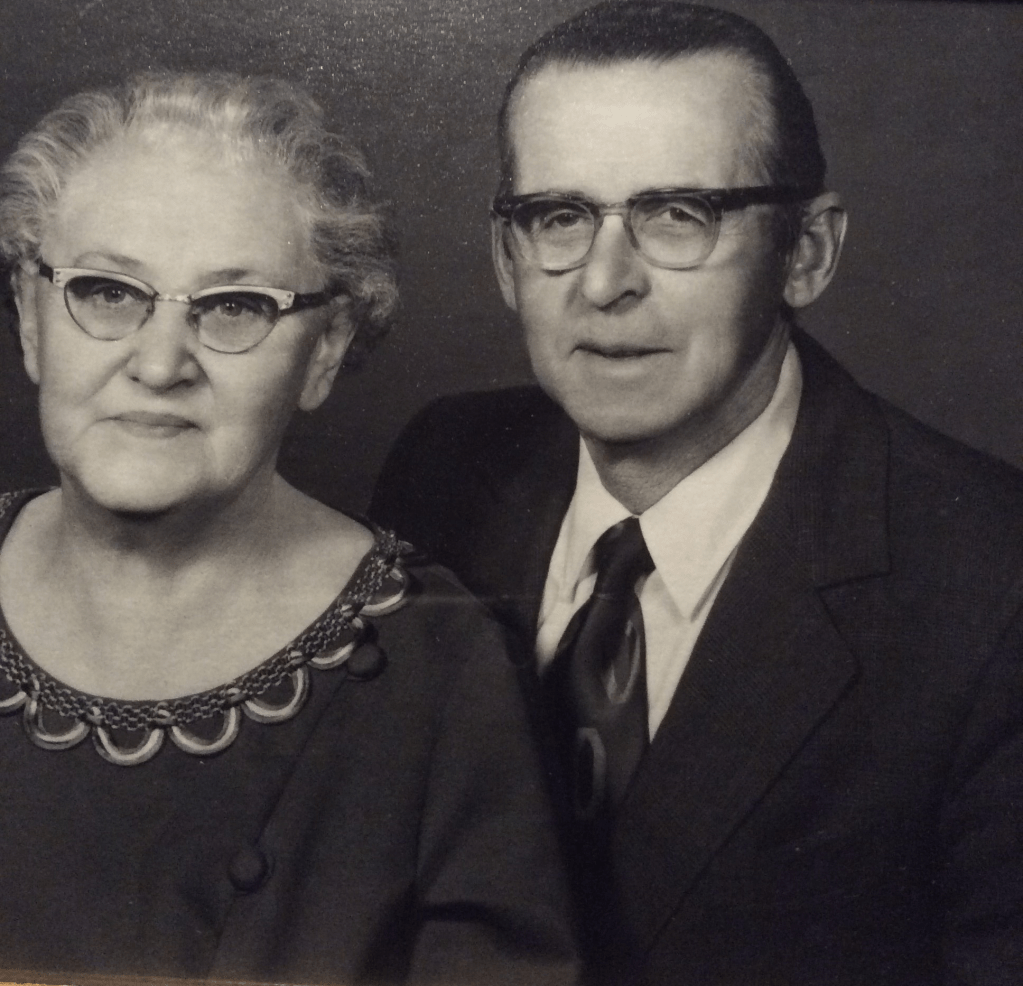
Courtesy Stouffer Family
Beside the song leader tradition on the Bethel circuit which included at New Dundee father Moses and son Emerson Bock, there were Eldon Sherk and Morris Shupe. Dan W Raymer in Mt Joy, Markham, led congregational singing there for 59 years, and in Stouffville, Noah Stouffer, who led the congregational singing for a generation from 1903, followed by his nephew Lambert Stouffer in 1931, followed by his son Bert Stouffer.
Pianos and organs. Rural holiness piety reinforced a suspicion of urban “respectability” in church services even though many members might have a piano or organ at home. It was not until 1916 that the MBiC General Conference allowed the individual Annual Conferences to decide how and when to permit musical instruments. Several local church histories refer to the Ontario Conference permission of 1922, clarified in 1924, for local churches to introduce musical instruments if two-thirds of the members voted for them.14 Some congregations in Ontario transitioned to the use of pianos or organs only in the late 1920s or the 1930s. The first instruments in Niagara and Waterloo were often pianos, but the churches in York County began with organs such as a foot pedal organ. At Altona they shared the building with the Christian Church on alternating Sundays. The Christian Church foot pedal organ was silent in the MBiC services until finally the Conference allowed it.15
Interestingly, the MBiC Nigerian mission field had a pump organ at the Jebba mission station long before they were allowed in North America, according to Cornelia Pannabecker. In her diary she mentions waiting for their field leader to come and repair the instrument in 1911, which they had had since at least 1907: “Diaries,” April 26 1907; July 2 1911; October 25 1911. The mission was not directed by the General Conference, but by a self-governing Board. I suspect that the first MBiC missionaries, Alex and Althea Banfield, who grew up in the Canadian Methodists in Toronto had no scruples about the use of musical instruments. Alex even used his coronet to attract listeners in Nigeria. (Clare Fuller, Banfield, Nupe and the UMCA (2001) p 13.)
Many local church histories not only name the main song leader, but then who played the piano, when it was finally allowed. They were important congregational pillars. Many of the keyboard players were women. In Vineland, Miss Ina Burkholder was the first pianist; in Breslau, Olive Zeller may have been the first organist, assisted by Erma Dedels. Another organist, Flossie Mader, accompanied an early quartet.16 Bertha Stouffer was the organist at Stouffville from 1934;17 and Bethany in Kitchener had many players. Ruth Brubacher is remembered playing the piano,1937-1968.18 Banfield Memorial in Toronto also had many players, among them Vera Embree, Olive (Bricker) Kitching on piano, and Olive (Erb) Tipp on organ.19 Salem (Spring Bay, ON, on Manitoulin Island) remembered Marvel (Sloss) Legge as their first organist in 1937.20
I remember chuckling to myself in a conference when a pastor of the Stouffville church said how he groaned when he first witnessed the congregation still using piano and organ when guitars and drums had become the norm. Ironically, the much-desired innovation had become old fashioned, in a denomination set against being fashionable.
“Special music” (quartets, trios and other ensembles) and choirs were other matters again, originally opposed by the MBiC. Such attention to individuals or small groups tended to pride and showmanship in the mind of the elders. Cultural assimilation patterns indicated performing groups would follow the introduction of musical instruments.21 They did.
Banner: Tabernacle (Tent ) evangelistic meeting staff with Evangelist Noah Detwiler illustrating some musical instruments allowed in these meetings: harmonicas, and something like a ukelele. Unknown location and year.
1Sunday schools, four-part singing and member-led home prayer meetings were some of the chief innovations that the early EMCC members in Ontario wanted, that set them apart from the Mennonite Conference of Canada. The Mennonites suspected them all leading to pride, disorder and introducing alien teachings into the churches. All possibly true! A generation later the Mennonite Conference in Ontario adopted all these practices.
2 Ward M Shantz, A History of Bethany Missionary Church 1877-1977 (Kitchener, ON: Bethany Missionary Church, 1977) p 50. Bethany did not even use a song leader in the earliest years, according to Shantz.
3Carolyn Ratcliff, ed, Historymaker: One Hundred Years of Faithful Ministry (Stouffville, ON: Stouffville Missionary Church, 2003) p [1].
4The Word for 100 Years: Gormley Missionary Church 1873-1973 (Gormley, ON: Gormley, 1973) p 10. Muriel I Hoover, A History of Bethel Missionary Church New Dundee, Ontario, Canada (New Dundee, ON: Bethel Missionary Church, 1978) p 58.
5Harold S Bender, Nanne van der Zijpp and Cornelius Krahn, “Music, Church (1956).” Global Anabaptist Mennonite Encyclopedia Online. 1957. Web. 4 Aug 2021. https://gameo.org/index.php?title=Music,_Church_(1956)&oldid=145762.
6The Wesleyan holiness Free Methodist Church (founded 1860) had a similar mistrust of showy music they perceived developing in Episcopal Methodist churches in the increasingly urban United States. The FMC had a parallel slow process of permitting musical instruments in the 20th century. Mennonites followed a path like them.
7The Doctrines and Discipline of the Mennonite Brethren in Christ Church (1924), p 37.
8Byer, p 4.
9F Arthur Sherk, Keeping Faith: A Centennial History of Banfield Memorial Church (Willowdale, ON: Banfield Memorial Church, 1997), p 33.
10Gillham, p 41.
11Gormley, p 10.
12Jean Pearce, ed, Aylmer Missionary Church 90 Years 1900-1990 (Aylmer, ON: Aylmer Missionary Church, 1990), p 3.
13See EMCC History Blog: “Music in the early EMCC Part 1: The Eldon Troxel Sherk Collection.”
14Hoover, p 58 and Shantz, p 50.
15Vineland in 1928, Gillham, p 41; Bethel New Dundee, year not stated, Hoover, p 58; Bethany in 1928, Shantz, p 51), Lillian Byer, ed, Altona Christian-Missionary Church 1875-1975 (Altona, ON: Altona Christian-Missionary Church, 1975) p 4; Markham, a pump organ, McDowell, p 22. Stouffville also had a pump organ in 1934; Ratcliff, p [1].
16Gillham, p 41. Ted Losch et al, Breslau Missionary Church 1882-1982 (Breslau, ON: Breslau Missionary Church, 1982) p [22, 10].
17Ratcliff, p [1].
18Shantz, p 51.
19Sherk, p 32, 31.
20Gordon Wilson, ed, House of God of Peace 1890: The 100 Year History of Salem Missionary Church (Spring Bay, ON: Salem Missionary Church, 1990) p 46.
21Noted in Cornelius Krahn and Orlando Schmidt. “Musical Instruments.” Global Anabaptist Mennonite Encyclopedia Online. 1989. Web. 4 Aug 2021. https://gameo.org/index.php?title=Musical_Instruments&oldid=102559.


 EMCC History
Leave a reply to samjaysteiner Cancel reply