
Theology really matters. Like a worldview, of which it is a major part, one’s theology, what you really believe about God, Jesus, the universe and everything, will direct your life choices, your love-life with God and creation. So this examination of the Mennonite Brethren in Christ / United Missionary Church Probationer’s Reading Course is not about a trivial administrative arrangement.
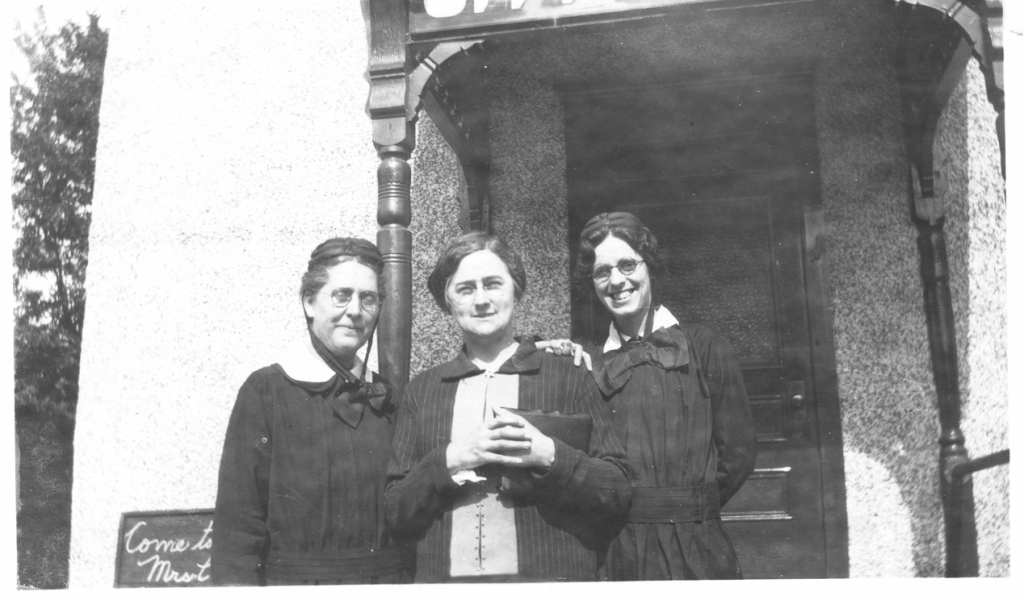
Every MBiC/ UMC General Conference from 1882 adjusted the Reading Course or debated it. In 1912, the Discipline of the MBiC published the version for probationers to follow in the next four years. As a sample, here it is from the Canada Conference Journal of 1915 (texts in the Missionary Church Historical Trust marked *):
Courtesy: Missionary Church Historical Trust
First Half of First Year.
1. [Bible] Acts of the Apostles*
2. Philosophy (Chap. 1-5). [of the Plan of Salvation: A Book for the Times by James Barr Walker, (various editions: eg 2nd ed Cincinnati, OH Cranston and Curtis/ NY: Hunt and Eaton, ca 1882), apologetics]*
3. [Benjamin] Field’s [The Student’s Handbook of Christian] Theology (Chap. 1-3). [1st ed (Melbourne, Australia, 1868); 2nd ed by John Christian Symons in London, 1870. (American ed: New York/ Cincinnati, OH: Phillips and Hunt/ Cranston and Stowe, 1887) English Methodist, d 1869 in Australia; Symons was a friend who included a “Life” of Field in his edition.]*
Second Half of First Year.
1. [Thomas K Doty’s] Lessons in Holiness. [1st ed 1881, 2nd 1882 (Salem, OH: Convention Book Store (later Chicago, IL: T B Arnold 1887, 1893, etc. Doty was editor of The Christian Harvester]*
2. [John] Horsch’s Church History. [A Short History of Christianity (Cleveland, OH: Self-published, 1903) German-born American Mennonite]
First Half of Second Year.
1. [Bible] 1st and 2nd Timothy.*
2. Philosophy (Chap. 6-12). [of the Plan of Salvation by James B Walker. See above.]*
3. [Benjamin Field’s The Student’s Handbook of Christian] Theology (Chap. 4-9). [See above.]*
Second Half of Second Year.
1. [Richard Baxter’s The] Reformed Pastor. [1656, various editions since then. MCHT has ed of 1862 edited by W Brown; English, Puritan]*
2. [Arthur Tappan Pierson’s ] Divine Art of Preaching. [(NY: The Baker and Taylor Company, 1892) American, Presbyterian]
First Half of Third Year.
1. [Bible] Gospel of Matthew.*
2. Philosophy (Chap. 13 to end). [of the Plan of Salvation by James B Walker]*
3. [David] Nelson on Infidelity. [The Cause and Cure of Infidelity] [various editions, one is NY: New York Tract Society, nd; American, probably Presbyterian]*
4. [John William] Fletcher’s Appeal [to Matters of Fact and Common Sense, or A Rational Demonstration of Man’s Corrupt and Lost Estate, 1772. Swiss-English Anglican/ Methodist pastor]
Second Half of Third Year.
1. [Benjamin Field’s The Student’s Handbook of Christian] Theology (Chap. 10-14). [See above.]*
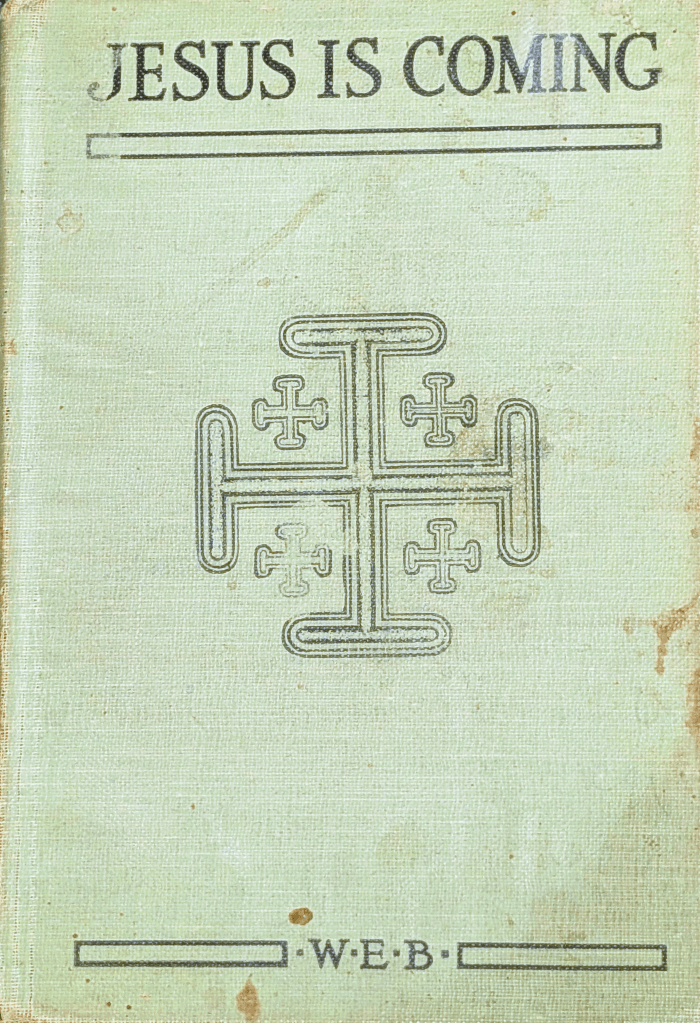
2. [William E Blackstone’s] Jesus is Coming. [(1st ed 1878, 2nd ed NY: Fleming H Revell; 3rd ed 1908) American, evangelist, premillennialist, Zionist]*
Courtesy: MCHT, C Fuller photo.
Notice there were no Bible Introduction texts, Bible College staples. The focus was on ministry.
Theology texts. I have been working on a more complete study of the Reading Course theology texts, continued by some notice of the theological text books the UMC/ Missionary Church/ EMCC Bible Colleges used. I hope to publish that some day, as I proposed in my book on Sam Goudie.1 Meanwhile take this as preliminary.
One thing we can say about the initial books chosen in 1882 for the Probationer’s Reading Course, is they selected from a surprisingly wide variety of denominational backgrounds, from Puritan, Methodist, Lutheran and Presbyterian writers. It is likely the committee took advice from somewhere which they modified. Most of the books were rather old at the time, though available in a recent reprint.
Some of them were very big books. Menno Simons and Methodists for core theology might be expected to be included, and the Evangelical Association author on holiness (Orwig’s Die Heilsfuelle-”The Fullness of Salvation”). However, I can’t imagine what they were thinking, listing en masse “Baxter’s Works” (possibly 23 volumes!) or Menno Simon’s Works (1070 pages of text in a modern edition) without specifying which parts to read! Some authors remained well-entrenched for decades (Doty, Walker, Nelson, Fletcher); others disappeared rather quickly (Mosheim, Lee, Menno Simons). The German list was not mentioned again, although “Zollner’s Seelenlehre” appeared for a while beside The Depravity of the Soul, for which I haven’t learned more. “Seelenlehre” is an older German term for psychology. For a time “psychology” was a topic in systematic and pastoral theology, but the modern science has displaced the older use.
These lists could be changed only by the General Conferences. While many titles in the first lists were quickly changed, as time went on it became almost impossible for one Conference (three to begin with in 1882, but seven by 1920), to persuade the others to alter the lists. Especially irking to the probationers who had to read and write exams on the books was the problem of books going out of print or not covering needs as the times changed (see comments in the Ontario Conference Journal 1936, p 41).
Divergence. Some Conferences were not satisfied by the theology books available (Methodist, Baptist, Nazarene) which did not quite fit the “Mennonite plus Wesleyan holiness” teachings favoured by the majority, or the Keswick theology/ Christian and Missionary Alliance leanings of the Pennsylvania Conference. Eventually Pennsylvania gained permission to have alternate texts that were more congenial to them, in the direction of Keswick or Welsh Revival writers and Moody Bible Institute fundamentalism.2 The Conference eventually separated from the rest of the MBiC and embraced a Reformed theology, though unusually retaining baptism of believers. They chose the name Bible Fellowship Church. Wayne Gerber writes more about them in Reflections Vol 2:2/ 3:1 (Fall 1994, Spring 1995), “Whatever Happened to the Pennsylvania Conference?”
Nevertheless, the MBiC Reading Course was the major theological, historical and practical academic training required for one to be ordained an elder or dedicated as an approved ministering sister for the first generations. It provided a measure of uniformity in doctrinal awareness throughout the binational denomination, although obviously, individual pastors would lean to their own preferences anyway.3 In Ontario, the approved ministering sisters had a few alternate books to read at times, With Christ in the School of Prayer by Andrew Murray being one, and Edgar P Ellyson’s Theological Compend (1909, Nazarene), in the place of Field’s Theology, being another for example.
Final Form. This last list was published in 1966,4 just before the merger with the Missionary Church Association. There were no longer any probationers in Ontario: all candidates for licensing were Bible College students.
FIRST YEAR
Old Testament Introduction—An Introduction to the Old Testament, E[dward]. J. Young. [(Grand Rapids, MI: Eerdmans, rev ed, 1960) American, Orthodox Presbyterian scholar]*
Systematic Theology—Exploring Our Christian Faith, (Chapters 1-14) W[estlake]. T[aylor]. Purkiser, Editor. [(Kansas City, MO: Beacon Hill, 1960) American, Church of the Nazarene]*
Sunday School Administration—How to Operate the (error: “a”) Sunday School [A Handbook of Practical Sunday School Methods (Grand Rapids, MI: Zondervan, 1961)], R [“Reg”]. O. Woodworth. [American, Baptist, Fundamentalist]
Homiletics—Power in Preaching, W[illiam]. E[dward]. Sangster. [(in North America: New York, Abingdon Press, 1958) English, Methodist]
Public Speaking—How to Speak the Written Word [: A Guide to Effective Public Reading, Mrs Nedra Newkirk] Lamar. [(NY: Fleming H Revell, 1949) American, Christian Science]
Denominational History—History of the United Missionary Church, E[verek]. R[ichard]. Storms. [(Elkhart, IN: Bethel Publishing, 1958) Canadian, United Missionary]*
SECOND YEAR
New Testament Introduction—Introduction to the New Testament, H[enry]. C. Thiessen. [(Grand Rapids, MI: Eerdmans, 1943) American, Dispensational Fundamentalist]
Biblical Theology—The Dawn of World Redemption [: A Survey of the History of Salvation in the Old Testament (London: Paternoster Press, 1951), US ed: 1952], E[rich]. Sauer. [German, Christian Brethren]*
Systematic Theology—Exploring Our Christian Faith (Chapters 15-28), W. T. Purkiser, Editor. [Nazarene, see above.]*
Pastoral Theology—New Testament Evangelism [: How it Works Today (Philadelphia, PA: Judson Press, 1952), [Arthur Crawley] Archibald. [Canadian, Baptist (career in the USA)]
Denominational History—What God Hath Wrought [:The Story of the Foreign Missionary Efforts of the United Missionary Church], E. R. Storms. [(Springfield, OH: United Missionary Society, 1948) see above.] *
Parliamentary Practice—Roberts Rules of Order. [latest edition]
THIRD YEAR
Biblical Theology—The Triumph of the Crucified [: A Survey of the History of Salvation in the New Testament (Grand Rapids, MI: Eerdmans, 1952), E. Sauer. [German, Christian Brethren, ed of 1954]
Christian Evidences—Therefore Stand [: A Plea for a Vigorous Apologetic in the Present Crisis in Evangelical Christianity], W[ilbur]. M. Smith. [(Boston, MA: W A Wilde, 1945), 1950 reprint, American, Presbyterian, Fundamentalist]*
Pastoral Theology—The Growing Minister [: His Opportunities and Obstacles (NY: Abingdon Press, 1960)], A[ndrew]. W[atterson]. Blackwood. [American, Presbyterian]
The Deeper Life—The Holy Spirit, J[asper]. A[braham]. Huffman. [2nd ed (Elkhart, IN: Bethel Publishing, 1944) American, United Missionary]*
Homiletics—Expository Preaching for Today, A. W. Blackwood. [(NY: Abingdon- Cokesbury, 1953), see above]
Biblical Archaeology—Archaeology and Bible History, J[oseph]. P. Free. [(1st ed, 1950, (Wheaton, IL: Scripture Press ed, 1959) American, Reformed Presbyterian]*
Comment: Somewhat as in 1882, there is quite a variety of sources for the 1966 texts. Quite a few come from the fundamentalist movement. Except for Purkiser, Storms and Huffman, the rest are not congenial to Wesleyan holiness theology and no hint of Anabaptism is evident. The category of holiness theology has become “Deeper Life.” World church history has disappeared, consistent with the way 20th-century North American evangelicals ignored it. Missions was assumed to be merely an extension of evangelism in North America. There is an emphasis on preaching (two books) and apologetics (evidences and archaeology). It is hard to fit a 4-year Bible College curriculum in 3 years!
The Rise of Bible Schools and Colleges. Henry Schlichter Hallman editorialized in 1892 about books he recommended ministers should have after ordination.5 Missionary Church histories rightly spend chapters on the struggle to introduce schools and colleges in the Missionary Church family in North America, mostly ignoring the reading course.6 Jasper Abraham Huffman was the only minister to have completed a college theological course of more than a year7 among the 120 leading elders profiled in the MBiC history of 1920. “Christian Higher Education” is the subject of a fat issue of the Missionary Church Historical Society’s journal, Reflections.8 Around 1920, young men and some women started attending non-Missionary Church Bible Institutes or Colleges and petitioning their Conference examining committees to accept credits in place of books.9 Major overhauls of the reading lists did happen. The success of Mountain View Bible College in Didsbury, AB (1926), Emmanuel Bible College, Kitchener, ON (1940), Bethel College, Mishawaka, IN (1947), and the MCA’s Fort Wayne Bible College from 1904, gradually left the examiners with less and less to do. When the UMC and MCA merged in 1969, the new Missionary Church Constitution made no provision for a Reading Course.
The Missionary Church Historical Trust has tried to collect copies of all the books listed for the Probationer’s Reading Course. These should have been retained by Bible College libraries, and I recommended this to the librarian at Emmanuel Bible College in the 1980s. Unfortunately numerous cullings of the collections had been going on and was still conducted over the years, and very few remained on the shelves as college course needs changed. The MCHT has roughly half of the listed books. What we manage to collect (without a budget so far) will enable future scholars to study what our church’s preachers read, were examined on and presumably preached throughout changes in denominational priorities 1882 to 1965.10
Theological fragmentation continues apace in American and Canadian evangelicalism and the EMCC in particular. I expect this will continue without a program of theological formation in place required by the EMCC.
Banner: “A Scholar in his Study” (detail) by Thomas Wyck, Dutch, 1650. Credit: Photo by Jens Mohr, Creative Commons, public domain.
1James Clare Fuller, Hidden in Plain Sight: Sam Goudie and the Ontario Mennonite Brethren in Christ (Eugene, OR/ Hamilton, ON: Pickwick Publications/ McMaster Divinity College Press, 2024) p 102.
2Henry C Theissen (1883-1947), who had a Mennonite background, is an interesting case. He was an early student at the Missionary Church Association’s Fort Wayne Bible College before becoming a teacher there for seven years in the 1920s. After he left as a result of the MCA’s dispute over Calvinist and Arminian themes, he taught at various schools including Wheaton College from 1935. His Lectures in Systematic Theology (1949) was published by Eerdmans after his death, which upheld a strong dispensationalism. Thiessen’s 1943 Introduction to the NT was on the UMC reading list from 1956. See comments in Dennis D Engbrecht and Timothy Paul Erdel, Crisis Moments in the Missionary Church: Lessons from the Past (Mishawaka, IN: Missionary Church Historical Society, 2023).
3The Gospel Banner’s frequent teaching articles by MBiC preachers and reprints was another strong force for unifying the theology of the Church.
4Ontario Conference of the United Missionary Church, Journal (1966) p 16.
5Henry S Hallman, “The Minister’s Library and How to Use it,” Gospel Banner (July 1 1892) p 2.
6Everek R Storms, History of the United Missionary Church (Elkhart, IN: Bethel Publishing, 1958) p 193-207; Eileen Lageer, Merging Streams: Story of the Missionary Church (Elkhart, IN: Bethel Publishing, 1979) p 127-165; Eileen Lageer, Common Bonds: The Story of the Evangelical Missionary Church of Canada (Calgary, AB: Evangelical Missionary Church of Canada, 2004) p 82-100.
7Course work done at United Brethren (Bonebrake University), Mennonite (Bluffton College) and Presbyterian (McCormick Seminary) schools.
8“Christian Higher Education: A Festschrift for Norman V Bridges” Reflections Vol 7 Nos 1 & 2, (Spring and Fall 2003).
9For example, Fort Wayne Bible College, Chicago Evangelistic Institute, Toronto Bible College, and Lorne Park College (Free Methodist).
10Assigned to Box 5510 MCHT.


 EMCC History
Leave a comment