
Sarah Pool applied to be a “probationer” in the Canada Conference of the Mennonite Brethren in Christ Church in March 1894. She was from Markham, ON, and was hoping to be a preacher in the MBiC.1 The first interview she had was to see if she understood the MBiC Discipline, the small document that governed the working of the MBiC. She would be examined on “morals” to see if she were entangled in the ways of the world or not. If she passed that (she did), she could be assigned as a helper or a tabernacle worker at the discretion of a Presiding Elder (Solomon Eby or Menno Bowman) or the Annual Conference. And in fact that year she was assigned as an evangelist along with several others. At the same time she began to read and be examined on the assigned texts during a three-year round of self-study. The MBiC had no Bible Schools. Sarah was a good student, passing her exams well, better than several of her fellow male probationers. She completed the course of readings and examinations in 1897, finishing 3rd in a group of 11 probationers. Sarah Pool was as fully academically qualified as any MBiC minster would be, except the MBiC would not go the next step of ordaining her.2
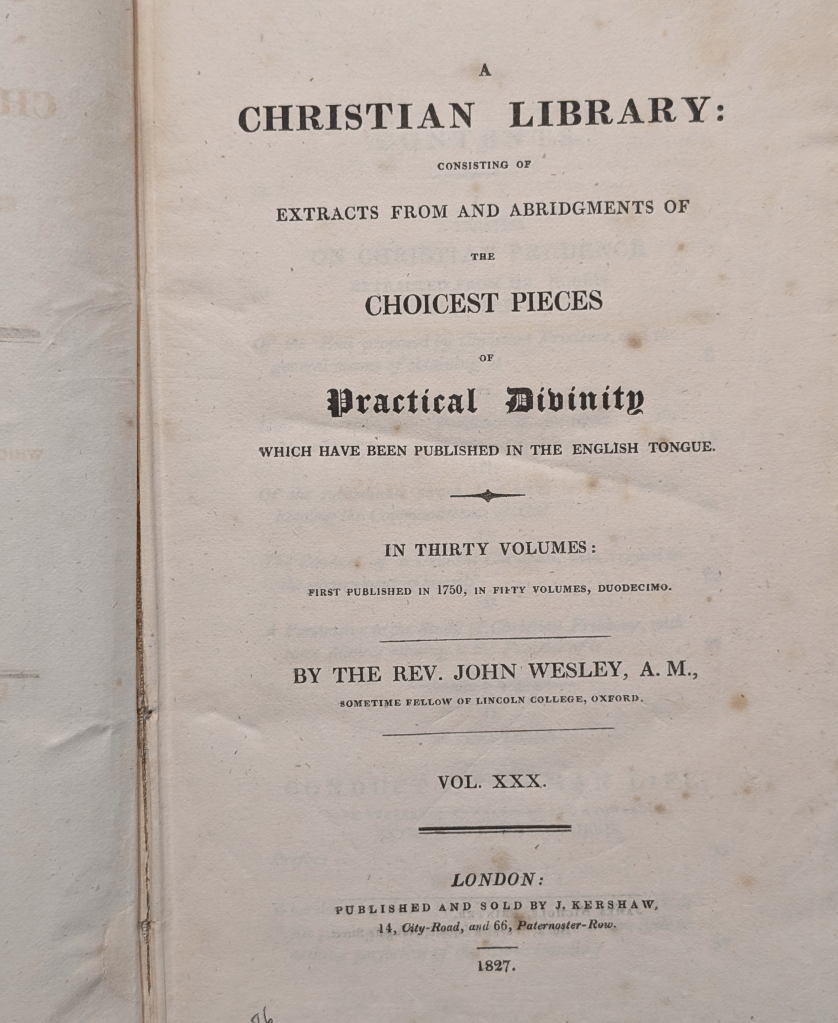
Practical Divinity in an 1827 edition. Courtesy: C Fuller collection
John Wesley started it. As early as 1744, Wesley started urging his “Assistants” to be reading for improving their preaching.3 He made a list of authors they should read, a mix of Greek and Roman classical writers, Church Fathers, more recent preachers’ sermons and German mystics and of course Methodist tracts of the time. It was quite a heavy program for men who were not university students. The next year he doubled the list and included English poets such as Spenser, Milton and Sir John Davies (1569-1626). Again in 1746 he changed the suggested list with many more devotional writings, biographies and Anglican doctrinal helps. He eventually condensed and published into 50 volumes (!), works of all kinds for his preachers, in addition to the ever-growing editions of standard sermons, hymnbooks, Notes on the New and Old Testaments and various tracts on controversial topics such as A Plain Account of Christian Perfection (1766, 1777). Eventually, the English Wesleyans required their candidates to read Wesley’s standard sermons and the Notes on the NT, and wanted to see a list of reading done, perhaps voluntarily selected. While a probationer, the preacher was “to present a list of the books read during the year” to the superintendent of the circuit.4
The Free Methodist Church formed in 1860, and inherited the American Methodist Episcopal Church ideas about ministerial education. Many in the MBiC considered them close theological cousins. Without institutions of their own, however, they prescribed a system called “home study” which swiftly became a 4-year program with examinations. The major theological work was Richard Watson’s Theological Institutes (1848). The gradual shift to college-based theological education by 1951 is very similar to the track of the MBiC/ United Missionary Church.5
The British Methodist Episcopal Church formed in Ontario from African-American Methodists who entered Canada to be free from American enslavement. They had a major organizing moment in 1859. Although the membership diminished after the civil war in the USA, many stayed on, even to the present day. The BME Discipline of 1913 set out a three-year course of study, much like the FMC and the EA, with heavy use of Methodist works (eg by John Wesley, Amos Binney and Daniel Steele, Nathaniel Burwash).6 I doubt the MBiC was much aware of the BME except in Wellington County and the city of Guelph, where African-Canadians were neighbours, and around western Simcoe and some parts of Gray Counties. Their plan of theological formation would commend them however.
The Evangelical Association when it organized in the early 19th century, also patterned after the Methodist Episcopal Church in the United States, continued Wesley’s custom. The EA, being German-speaking, was a big influence on the MBiC’s predecessors in Ontario. They had no schools at first, a lack they shared with the early Methodists.7 For a long time schools for preachers were in fact suspect. So they also started with lists of recommended readings, starting in 1846.8 By 1851, they appointed examiners in four areas: theology and the Bible, church discipline, grammar and rhetoric, and church history. In my copy of the 1939 Evangelical Church Discipline, the “Course of Study for Junior Preachers” still provided for people without much formal education, despite the number of theological institutions the EC operated. It was a four-year program, covering at least 35 books, 12 of which were electives to be chosen out of 20 listed.9 Unlike Wesley’s early lists, few of these Evangelical titles expose the candidate to literature or general knowledge; I suppose the Church assumed public education would have supplied that, unlike the case in Wesley’s time.10
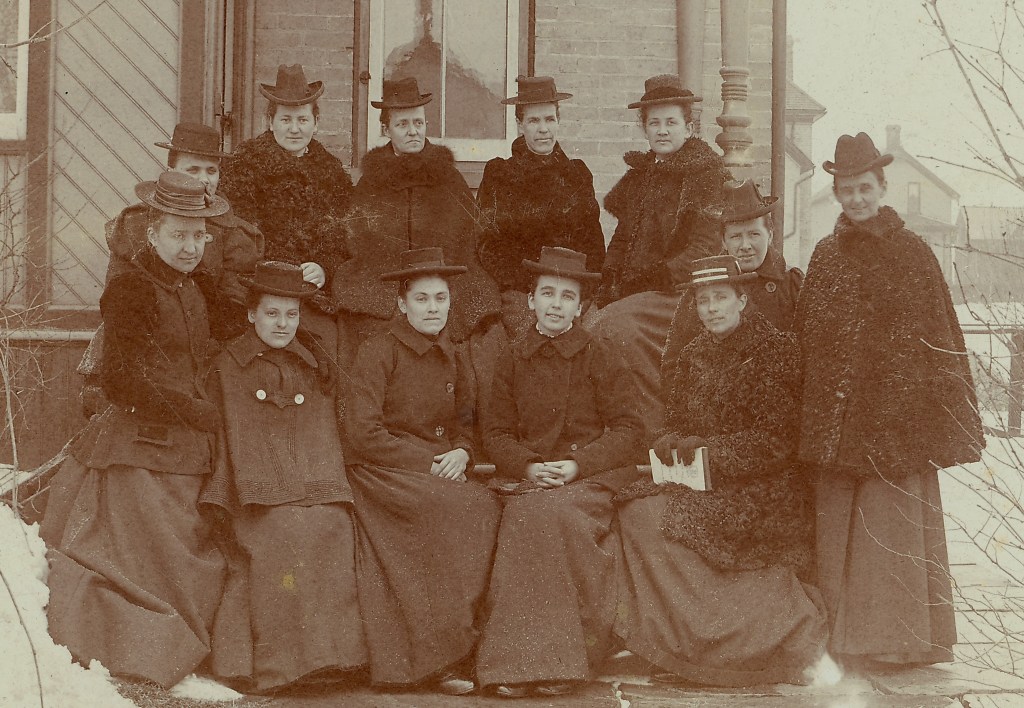
The predecessors of the MBiC, the New Mennonites, Reforming Mennonites, Evangelical Mennonites and the Swankite Brethren in Christ11 had no schools or colleges, and were suspicious of higher theological education in any event. Growing up Presbyterians, Sarah Pool and her sister Euphemia, also a licensed preacher, would have seen the Presbyterian path of college-educated ministers. In contrast, and like the MBiC, the first Canadian Methodist ministers began with very few books, and even though “self-improvement was mandatory, constant travel on horse back precluded a library larger than the Bible, Wesley’s Sermons, and a few Methodist tracts and biographies.”12 Canadian Methodists quite early were driven to raise up schools in their pioneer setting for their members or settlements, in conscious competition with the Anglicans and Presbyterians.13 Public schools in Ontario eventually were supervised by a Methodist minister, Egerton Ryerson. Methodists founded higher level colleges such as Upper Canada Academy (1836), which became Victoria College (1841). It federated with the University of Toronto in 1890.14
These school developments meant little to Swiss-South German Mennonites in Ontario.15 Eight grades of primary schooling satisfied their educational needs. Within the Evangelical United Mennonite Church (merger of the United Mennonite Church and the Evangelical Mennonite splinter group of Pennsylvania in 1879) there were however, some who wanted to improve the ministering brethren by self-study. The impetus came from the Canada Conference, meeting in April 1882.16 The General Conference of October 1882 approved a reading course proposed by the committee of William Gehman (Pennsylvania), David U Lambert (Indiana and Ohio) and Menno Bowman (Canada).17 This “Probationer’s Reading Course” plan was continued by the MBiC/ United Missionary Church until the 1960s, when formal education at Bible Colleges finally superseded it.18 The profiles of two of these three men show no more than “common school” (8 grades) education, and no schooling at all recorded for William Gehman (likely an oversight).19 Nevertheless, they made a useful selection for the initial reading courses, in English or German. At first these books were merely to be read but soon there were examiners and scheduled exams appointed to see that the books were paid attention to over a three-year schedule.20 Women preachers such as Sarah Pool read the same books at first, with slight divergence after 1902 when in Ontario, at least, a City Mission Workers Society was organized.21
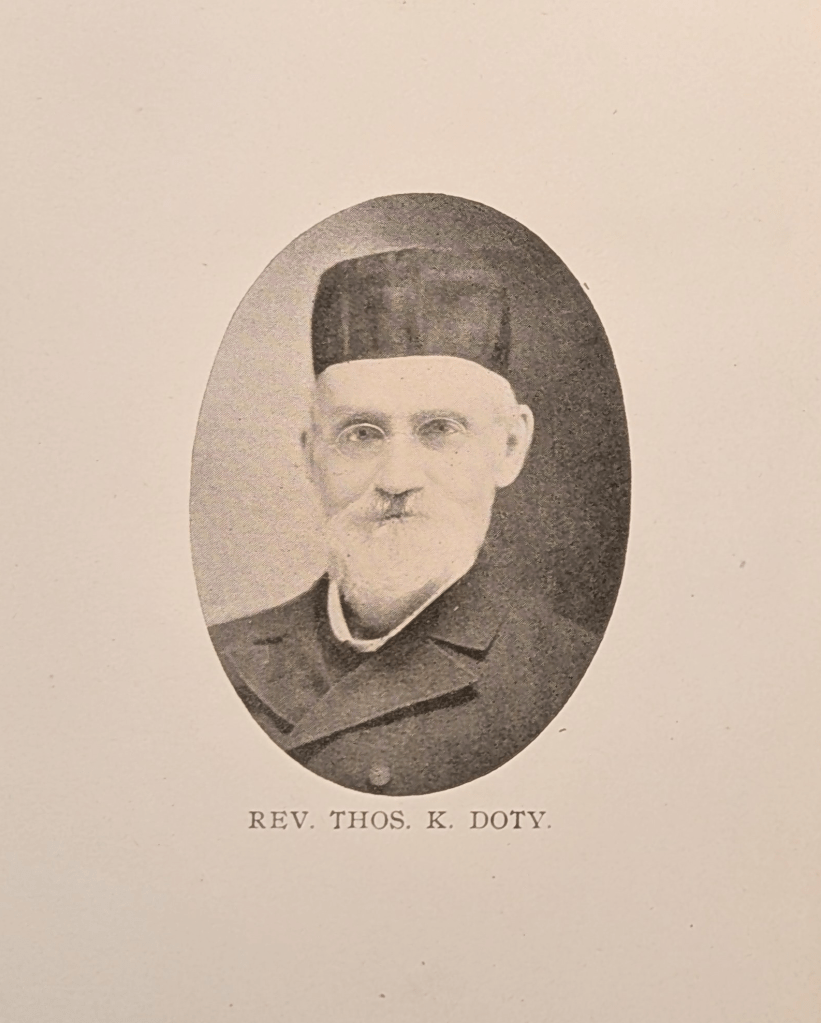
Courtesy: Doty, Lessons in Holiness (1893 ed), frontispiece portrait. MCHT.
Charles Gingerich suggests that the delay in reaching for formal theological education in the MBiC spared the Church from having to deal with the theological liberalism that was rising in nearly all the major denominations in Canada from Confederation onward.22 It meant the MBiC was mostly cheering from the outside when the fundamentalist/ modernist controversies broke out in the early 20th century.23 Gingerich concluded that the reading course list was evangelical and conservative. “At least four of the books stress conversion and the Holy Spirit in the believer’s life.”24 These were the twin pursuits of the MBiC.
Here is that first reading list in bold with my notes on them in square brackets:25 The MCHT has titles marked with an asterisk.*
English:
Bible [Authorized Version (KJV) of course]*
Mosheim’s Church History [Yohann Laurens von Mosheim (1693 or 1694-1755), Lutheran, Institutes of Church History, ed of 1755, originally in Latin, probably as translated by James Murdock, revised, in 1839. Sometimes titled Ecclesiastical History. Frequently reprinted, as is an earlier translation by Archibald Mclaine.]
Lee’s Theology [Luther Lee (1800-1889), American Methodist, Elements of Theology: An Exposition of the Divine Origin, Doctrines, Morals and Institutions of Christianity (New York: Miller, Orton and Mulligan, 1856), 2nd ed 1882]
Philosophy of the Plan of Salvation [James Barr Walker (1805-1887), American, probably Presbyterian, 1st ed 1855, 2nd ed, reprint ca 1882, apologetics]*
Nelson on Infidelity [David Nelson MD, (1793-1844), American Presbyterian, Cause and Cure of Infidelity, 1841. “Infidelity” here means unbelief.]*
Finney’s Lectures on Religion [Charles G Finney (1792-1875), American revivalist, professor at Oberlin College, Lectures on Revivals of Religion 2nd ed 1868 or later reprint]*
Lessons in Holiness [Thomas K Doty (19th century), American holiness author, editor, 1st ed, Salem, OH: Convention Book Store, 1881, 2nd ed 1882, later,1887, 1893]*
Depravity of the Soul [I have not been able to learn more about this title]
Menno Simons’ Works [Menno Simons (1496-1561), Dutch Anabaptist, Complete Works [in English], ed A E Funk, Elkhart, IN: John F Funk, 1871; MCHT has a later ed]*
Fletcher’s Appeal [John William (Jean Guilliame) Fletcher (1729-1785), Swiss-English Anglican/Methodist, Appeal to Matters of Fact and Common Sense, or, A Rational Demonstration of Man’s Corrupt and Lost Estate (1772)]
Baxter’s Works [Richard Baxter, (1615-1691), English moderate Puritan; works collected in 23 volumes in 1830]
The German course was similar and although some of these were mentioned with English names, a German edition must have been meant:
Holy Bible [Luther’s translation]*
Mosheim’s Church History [German version from Latin original]
Buck’s Theological Dictionary [Charles Buck (1771-1815), English Independent; his 1802 dictionary was translated into German by Joseph Ehrenfried from an American edition, heavily edited, between 1817 and 1837.]
Heilsfuelle [William W Orwig (1810-1889), American, Evangelical Association, Die Heilsfuelle: Heiligung und Volkommenheit nach Maasgabe der Heiligen Schrift “The Fullness of Salvation: Sanctification and Perfection according to the Bible” (Cleveland, OH: Evangelical Publishing, 1872)]
Menno Simons’ Works [German edition, Die vollstandigen Werke “The Complete Works” (Elkhart, IN: John F Funk, 1876)]

Courtesy: MCHT.
Bunyan’s Pilgrim’s Progress [a German translation such as Pilgerreize zur seiligen Ewigkeit, roughly “Encouragement for Pilgrimage to a Blessed Eternity” (1878)]*[Bunyan’s book was later used for preacher’s preparation in Nigeria under the UMS.]
Baxter’s Works [see above. Many were translated into German in Baxter’s lifetime.]
MBiC General Conferences kept tinkering with the reading lists. Next post will take account of some of the changes and what they meant.
Banner: Rotunda of Knox College (Presbyterian), Toronto. Collegiate Gothic, 1915. Another world from the early EMCC. Credit: Knox College website.
1Clare Fuller (2016), “Pool, Sarah Ann, 1862-1913), https://gameo.org/index.php?title=Pool,_Sarah_Ann_(1862-1913)&oldid=133259
2Some of this reluctance is described in two EMCC History blogs of September 2024, “How to Kill a Program of Women in Ministry.”
3John Lenton, John Wesley’s Preachers: A Social and Statistical Analysis of the British and Irish Preachers who Entered the Methodist Itinerancy before 1791 (Paternoster, 2009, reprint Eugene, OR: Wipf and Stock, 2015) p 124.
4Matthew Simpson, ed, Cyclopedia of Methodism rev ed (Philadelphia, PA: Louis H Everts, 1880) p 617-618.
5Leslie R Marston, From Age to Age A Living Witness: A Historical Interpretation of Free Methodism’s First Century (Winona Lake, IN: Light and Life Press, 1960) p 547-553.
6The Discipline of the British Methodist Episcopal Church of Canada (Toronto: William Briggs, 1913) p 229-231.
7Raymond W Albright, A History of the Evangelical Church (Harrisburg, PA: Evangelical Press, 1942) p 217.
8Albright, p 214.
9Doctrines and Discipline of the Evangelical Church 1939 (Harrisburg, PA: Evangelical Publishing House) p 262-265.
10The 1923 EC Discipline reading list required a candidate to read US and world history before applying.
11See EMCC History home page “Formation of the EMCC” to review the groups that merged to form the Evangelical Missionary Church of Canada.
12Semple, p 233. Also John Carroll, ed by George Webster Grant, Salvation, O The Joyful Sound! The Selected Writings of John Carroll (Toronto: University of Toronto Press, 1967) p 161.
13Neil Semple, The Lord’s Dominion: The History of Canadian Methodism (Montreal, QC/ Kingston, ON: McGill-Queen’s University Press, 1996) p 212-213.
14Semple, p 96.
15One of the earliest New Mennonite preachers, Christian Troyer Jr (1796-1883) was probably illiterate.
16Jasper Abraham Huffman, ed, History of the Mennonite Brethren in Christ Church (New Carlisle, OH: Bethel Publishing, 1920) p 214.
17 General Conference Minutes 1882, reference in Huffman, p 214.
18The Missionary Church Association accepted Fort Wayne Bible Institute/ College, founded 1904 under their president Ramseyer for their pastoral training, and so never followed a reading course of study.
19Huffman for Gehman (1827-1917): p 235 and p 100-102; Lambert (1851-1896): p 251; Bowman (1837-1906): p 226.
20Huffman, p 215.
21See EMCC History “City Mission Workers Society (Ontario)”, May 18 2024.
22Charles S Gingerich, “An Experiment in Denominationalism: A History of the Missionary Church of Canada, Ontario Conference, 1849-1918,” p 80; MA thesis for Wheaton College Graduate School, 1994, under Dr Mark Noll.
23I hope to post a blog about the relation of the early EMCC and fundamentalism as a movement later.
24Gingerich, p 83.
25Huffman, p 214-215.

 EMCC History
Leave a comment