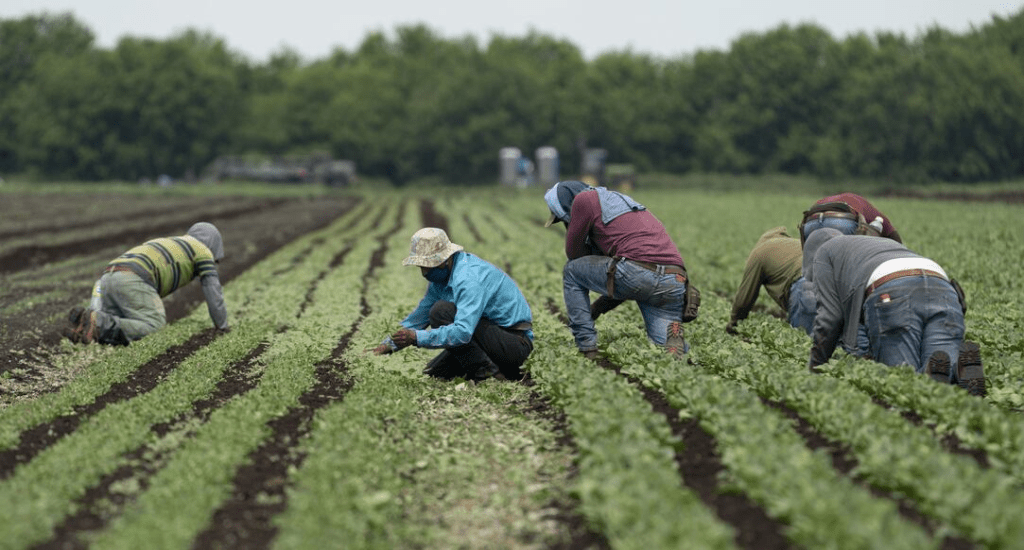
During an Emmanuel Bible College choir tour in 1978 or 1980, a fellow choir member and I were billeted in the Vineland, ON, home of Be and Mary Ann Schlabach. They were wonderful hosts, but little did I know what astonishing ministries this couple were or were later to be involved in, blessing migrant farm workers in particular.
In 1966, Canada implemented a program—the Seasonal Agricultural Workers Program (SAWP)—to admit new classes of temporary workers to Canada. The reasons for the new program had a complicated political, racist and economic history.1 Most of the workers who were hired as farm labourers arrived in the early spring and left in the fall. Whether true or not, it has long been stated that Canada needed to import summer labour because Canadian workers were increasingly unwilling to take on the strenuous tasks many crops needed.2 Whatever the reason for the start of the program, we have been told that, certainly in Ontario, many farms whose fruits and vegetables Canadians enjoy now could never be successful without them.3 Indeed, I was told that by an Ontario farm manager from the Niagara peninsula in 2024. And I saw the disarray caused to a blueberry farm my family visited when labourers the farm depended on were denied exit visas from Mexico during the COVID-19 pandemic.
Beland “Be” Schlabach (1927-2006) grew up in Guernsey, Saskatchewan, and Vineland, ON, a son of an Amish-Mennonite farmer-pastor. Exploring an urge to serve God, he attended Eastern Mennonite College in Virginia, and then spent a year at Emmanuel Bible College in its early years in Kitchener. There he met Mary Ann Fretz from Markham,4 and married her in 1957. For a time they and their growing family attended Evangel United Missionary Church.5 About 1963 the family moved back to the Vineland area at the suggestion of Paul Fretz (later a Missionary Church missionary in Brazil) where the couple bought from Paul’s father Willis Fretz, and managed, a small grocery store named “Clover Farm.”6 They happily fitted into the Vineland United Missionary/ Missionary Church for many years.7
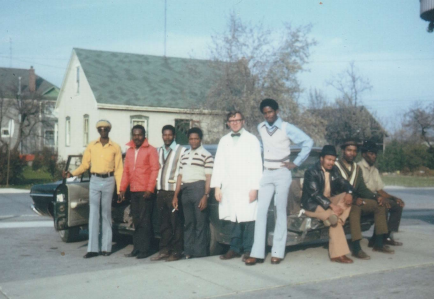
Photo courtesy Schlabach family.
In 1966, they started meeting the labourers who were in Ontario for the first time. They built friendships with the young men and gave them much needed credit for their shopping at the store and free delivery. Mary Ann wrote, “Beginning in 1966, we started serving Jamaican farm workers from our store and God put a special place in our hearts for these hard working men.”8 Be and Mary Ann visited workers at the Smith Farm at Vineland, invited workers to their own home, and to their church.9
This is how things continued until the Schlabachs sold their store in 1972 and Be took a job with M B Foods in Virgil, ON, closer to Niagara Falls. They continued their service to nearby farm workers, however. Then in 1990, a farm worker on his bicycle in the evening was killed and Barbara Somerwil, a church secretary from Niagara-on-the Lake, ON, who came across the police on the scene, became concerned about the circumstances of the workers and their families back in Jamaica. In 1992 she with a Rev Alan Barnes of the Jordan United Church helped start the Caribbean Workers Outreach Program-Niagara,10 which brought together a number of churches in the Niagara Peninsula to give more systematic attention to the offshore workers in their midst.11 They modeled their approach on the CWOP in Norfolk County, which helped foreign workers on tobacco and potato farms around Simcoe, ON.12 By 2012, about 11 churches (including Vineland Evangelical Missionary) in the western area of the Peninsula and about 20 drivers were ferrying around 100 workers, out of the hundreds of SAWP labourers in the region to Sunday church services.13 Often these were evening services, because many workers at the peak of the harvest season worked 12 hour shifts, seven days a week.
Be and Mary Ann started right in as drivers for CWOP-Niagara. “We met Reverend Barnes, and he asked if we could be drivers, and we said, ‘Yes, my husband’s just retired,’ so we both got in, right to our elbows, right away. Before I knew it I was treasurer for the association, until I passed that on a couple of years ago.”14 She served as program coordinator after that and was credited as being a “driving force” in the CWOP.15 Besides welcoming the men as they arrived, they hosted evenings at their house, with sing songs, prayer and meals. The Schlabachs drove the men to malls and dollar stores before they returned to the Caribbean to buy inexpensive goods and gifts for their families. They and other volunteers took them to medical appointments. CWOP members scoured garage sales and thrift stores looking for helpful items. Be found and repaired bicycles for the men to use. [Be also became a volunteer and board member for the Christian Salvage Mission based in Hamilton, ON, and frequently helped with projects for Stayner Camp undertaken by the Seniors in Service (later called OASIS—Older Adults Still in Service) of the former Canada East district of the EMCC.16]
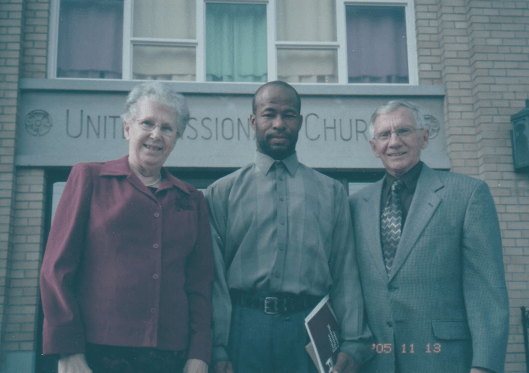
Photo courtesy Schlabach family.
In response to a request about their experience in 2002, Mary Ann wrote, “Again, Be and I look forward to hosting a Jamaican minister as we bring 2 up each spring (one in May, one in June) to minister in services as well as Be drives them out to the men on the farms in the evenings, pray and read the Bible with them.”17 The Schlabachs traveled to Jamaica to visit the men and their families. Mary Ann made about six trips in all, and encouraged others in the program to do the same. Someone claimed there could hardly be a community in Jamaica where the name of “Sister Mary Ann” was not known.18 The CWOP-Niagara organized a cricket match each year with the workers playing a game familiar from the Islands. They also hosted domino games. With friendships built over many years, Christian helpers had opportunities to be comforts in troubled times. Jim Juhlke, a volunteer alongside the Schlabachs, said, “Any pastoral care that has been done has been done by we the lay people. You go down and comfort them and console them…We’ve had some sad incidents take place, and that’s part of the job. It helps realize that not only we love them, they love us.” Mary Ann especially knew this when her husband died, hit by a car on the highway in May 2006. “They were around me, surrounding me with support. They were dropping in all summer long.”19
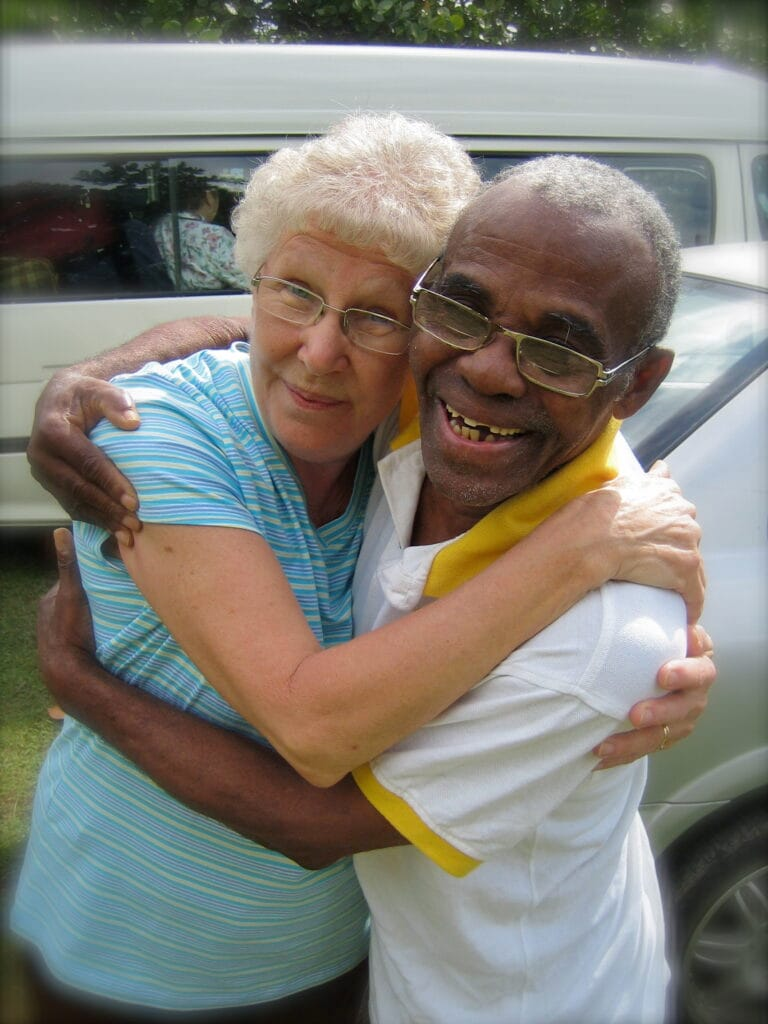
The CWOP-Niagara has received a fair share of local media attention. Mary Ann herself has been recognized for her long role, even after her husband’s death. In 2017 she received a Rotary Club Paul Harris award for her 50-plus years of serving at a CWOP service of thanksgiving at Mountainview United Church.20
Another church in Vineland that got involved in CWOP-Niagara was highlighted in a survey of notable Canadian churches, Southridge Community Church. Southridge-Vineland grew out of a Mennonite Brethren congregation in St Catharines, ON. Even here, the church could not be profiled without bringing in Mary Ann, then 79.21 The church contacted Mary Ann for help in 2013, and still in 2026, as I write, for the Vineland campus, the outreach to seasonal workers remains core.22
Why Christian Response is Important. Despite the valuable and humane and Christian work the Schlabachs, the CWOP and Southridge Church and others do, the position of migrant foreign workers in Ontario can be traumatic. Although the growers/ farmers claim they follow government guidelines for pay, housing and medical attention to their temporary workers (and many of them do),23 there are numerous allegations of neglect and exploitation by Canadian employers.24 “Allegations” is legalese for “unproven in court.” The federal government is quite aware of the potential for abuse, and has money and programs to redress it.25 The problem is inadequate monitoring, according to Patricia Paddey and Karen Stiller.26 In fact most of us would accept the testimony of most of the workers as true if we knew them: nannies in family homes, servers in fast food franchises, in factories as well as farm workers.
Agriculture has been shifting to big operators for quite some time. Small family farms are not that common any more. Profit is king. Even the “Smith Farm” the Schlabachs used to visit had 65 foreign workers at a time. In 2023, 20,000 people were in the foreign workers programs for work in the fruit and vegetable sector in Ontario alone from such countries as Mexico, Jamaica, Trinidad and Tobago, Barbados and the eastern Caribbean Islands.27 The Canadian welcome to migrant workers has declined since the old fears of “they’re taking away our jobs” and “they’re plugging up the housing market,” have made a come back in Canadian politics. Yet during the pandemic just four or five years ago, most Personal Support Workers (PSWs) in Ontario were recent comers or temporary workers from Jamaica, Philippines and Nigeria. Many of our seniors were dependent for life, literally, on these people, largely women.
Amnesty International warned of the exploitation. The United Nations has expressed concern, calling the Canadian system open to slavery conditions.28 If you don’t like either of those organizations, there is Citizens for Public Justice, that has a strong Canadian Christian basis for its many years of advocacy in many fields. In 2024, a report prepared for the CPJ described some of the practices allowed by the current form of the SAWP, and also the Temporary Foreign Workers Program (launched in 1973 for hiring in “food processing, the care system, construction and hospitality” sectors in addition to agriculture), as allowing abuse.29 These TFWP workers came from places such as Mexico, India, Philippines, Guatemala and Jamaica (representing 70% of the work permits granted in 2023.)
The Growers Association allowed that “undocumented workers or those who lack legal work status makes them vulnerable to exploitation,” and of course state they do not support any employer who does that. Nevertheless, advocates point out that certain aspects of the program invite abuse: workers cannot change employers once they arrive, can have their contracts canceled or changed by employers, are under pressure to keep working even if they are injured or sick and so on.30 Workers are sometimes exploited by agencies that charge fees to find them employment in Canada.31
Some Canadian churches recognize the situation of offshore workers, to others they are invisible.32 Jane Andres of Niagara-on-the-Lake, ON, had her eyes opened and she developed musical concerts as a way to thank and give back to the migrant workers she came to know.33 Mennonite, Baptist, Anglican, United, Missionary and other churches worked together on this project. During the early years of the pandemic, a United Church retreat centre, Five Oaks near Paris, ON, offered their facility as an isolation centre for migrant farm workers.34 Be and Mary Ann Schlabach had their eyes opened in 1966 and did what they could as well for over 50 plus years. They did so without fanfare or fuss. Churches are full of people who do similar service for Christ with no thought of recognition.
Daniel and Anne-Marie (Elliott) Chapple, EMCC World Partners non-resident missionaries to Mexico, have a role similar to the churches and people I recall here. When not in Mexico, they help some Hispanic-speaking migrant workers and immigrants in Ontario get Christian gospel instruction and worship.35 They cannot do this without making many valued friends.
May such people and churches increase!
Banner: Seasonal farm workers. Credit: Ivanoh Demers, Radio-Canada, May 17 2024.
1Edward Dunsworth, Harvesting Labour: Tobacco and the Global Making of Canada’s Agricultural Workforce (Montreal, QC and Kingston, ON: McGill and Queen’s University Press, 2022) p 3-4.
2As stated by, for example, Ken Forth, a grower representative, Dunsworth, p 8. Dunsworth gives statistics of various sectors of farm labour 1966 to 1981 that contest this rationale, p 239.
3“Canada’s migrant farm worker fact and information sheet,” More Than a Migrant Worker, September 25 2023. More Than a Migrant Worker is an initiative of the Ontario Fruit and Vegetable Growers’ Association. https://www.morethanamigrantworker.ca/news/canadas-migrant-worker-fact-and-information-sheet/
4“Samuel Howard Fretz,” https://www.findagrave.com/memorial/20415127/samuel-howard-fretz ; Lorraine Roth, “Family of Levi D Schlabach and Magdalena Schultz,” 2010; https://amishmennonitesofcanada.com/93-schlabach/
5Mary Ann Schlabach, “Beland Schlabach January 24-May 26 2006,” eulogy.
6Donna (Schlabach) Unrau, “Another Member Response,” Friends of Lincoln’s History (February 22, 2021) p 3; https://friendsoflincolnshistory.ca/wp-content/uploads/2023/10/FLH-Newsletter-February-2021.pdf .
7Be and the two daughters are casually mentioned in the history of the Vineland church; Skip Gillham, ed, Vineland Missionary Church 1881-1981 (Vineland, ON: Vineland Missionary Church, 1981) p 40, 41 and 43. Their outreach as a couple to migrant workers is not mentioned, treated as a personal effort, not a congregational effort, I imagine. Some years the church budget did provide some support, according to Donna Unrau.
8Schlabach, “Beland.”
9Alexandra Heck, “Celebrating 25 years of unity at Mountainview Church,” Grimsby Lincoln News (June 8 2017) https://www.niagarathisweek.com/news/celebrating-25-years-of-unity-at-mountainview-church/article_5c33b49d-6057-52b3-8cd2-48d19d80cec9.html.
10At first a project of the United Church of Canada Niagara Presbytery, and the United Church of Jamaica and the Cayman Islands; testimonies of Carl and Joseph, two workers known to Mary Ann and Be around 2002.
11Grimsby Lincoln News, “A celebration of service,” (May 31 2012). https://www.niagarathisweek.com/life/a-celebration-of-service/article_b831fe5b-55e0-5207-a4f9-67f0665a7051.html.
12Jane Andres, “Looking back: building bridges instead of barriers,” Niagara-on-the-Lake Local (February 8 2023) p 4-5. https://www.notllocal.com/local-news/looking-back-building-bridges-instead-of-barriers-6489995
13Mary Ann was quoting about 3000 workers in a letter to Jim McDowell, March 19 2002; MCHT, Box 6500, “Schlabach file”.
14“A celebration of service.” (May 31 2012)
15Sue Foster, “5 decades of kindness,” Lincoln News (June 2017).
16Schlabach (2002).
17Schlabach (2002).
18Andres, “Looking back…”
19“A celebration of service.”
20Heck, “Celebrating 25 years…”
21Patricia Paddey and Karen Stiller, Shifting Stats Shaking the Church: 40 Canadian Churches Respond (Mississauga, ON: World Vision Canada, 2015) p 238-242.
22“Anchor Causes,” https://southridgechurch.ca
23“Canada’s migrant farm worker fact and information sheet.”
24For example, Migrant Workers Alliance for Change, “Migrant workers and Ontario: Briefing note for Members of Provincial Parliament,” (2015); Amnesty International, “ ‘Canada has destroyed me’: Labour exploitation of migrant workers in Canada,” 2025; https://amnesty.ca/wp-content/uploads/2025/01/AMR_20_8872_2025-EN.pdf
25Citizenship and Immigration, “CIMM-Migrant Support Program-February 7 2024.” Modified May 6 2024. The MWS program gave grants to 110 community organizations for “upon-arrival services to support migrant workers to learn about and exercise their rights.” How many of these supports survive government budget cuts is a constant concern.
26Paddey and Stiller, p 242, referring to the Canadian Council for Refugees; “Migrant Workers—the issues,” 2025; www.ccrweb.ca/en/migrant-workers-issues.
27“Canada’s migrant farm worker…”
28Comments by Tomoya Obokola, Special United Nations Rapporteur on Contemporary Forms of Slavery, in September 2023.
29Asvini Uthayakumaran, “Canada’s Disposable Workforce: Addressing Abuses Against Migrant Workers,” (2024).
30Amnesty International, “Canada: Temporary visa programme enables abuse [of] migrant workers, treating them as disposable, report finds,” 30 January 2025; https://www.amnesty.org/en/latest/news/2025/01/canada-tfwp-abuse-migrant-workers/
31Migrant Workers Alliance for Change, “Migrant workers and Ontario…”; https://www.migrantworkersalliance.org/wp-content/uploads/2015/12/Migrant-workers-and-Ontario_Oct2015_MPPBriefingMemo.pdf
32Paula Duhatschek, “How a monthly church service is helping Ontario migrant workers stay connected with their faith,” CBC, September 1 2018; https://www.cbc.ca/news/canada/london/migrant-worker-ministry-london-catholic-diocese-1.4772017
33Stephen Bedard, “Christians Welcome Migrant Workers Through Concert,” Faith Today (July/ August 2013) p 12. You can learn more about the experiences of the workers in Andres’ blog series, https://bbniagaraonthelake.com/author/applewood/
34Robert White, “Retreat centre used for migrant workers’ isolation,” Faith Today (July/ August 2020) p 12-13.
35https://www.emcc.ca/videos/v/gwpw2025-interview-with-dan-chapple?rq=Dan%20Chapple

 EMCC History
Leave a comment