All societies offer food for their members, but not all societies use cookbooks. They are popular cultural products.1 And any new or used book store in North America will have a large selection.
Missionary Churches and Missionary Church women have produced cookbooks: individuals, Women’s Missionary Societies, congregations and districts. I cannot provide even a sketch of a history of church cookbooks,2 but I want to reflect on the production of EMCC church cookbooks and solicit help from my readers. The Missionary Church Historical Trust needs donations of EMCC cookbooks!
When I left for university (1971), my mother gave me a small sewing kit to deal with buttons. When I finally moved out of the family home (1977), she gave me a cookbook. I still have them both. The cookbook was one she owned before she married in 1949, a 21st edition [reprint, I think it means] of the 1905 Blue Ribbon Cook Book, published by the Winnipeg, Manitoba, Canada, Blue Ribbon Manufacturing Company, “Prepared Especially for Everyday Use in Western [ie homesteading] Homes.” It even has a section on cooking over an open fire. The book has followed me on all my re-locations, and to Nigeria and back. It is battered, stained and nibbled by cockroaches (for the spattered shortening on some pages).3 As in most well-used cookbooks, it has favourite recipes copied from other cooks’ recipes. A second book we used as a family in Nigeria was the Mennonite Central Committee More-with-Less Cookbook by Doris Janzen Longacre (Scottdale, PA/ Waterloo, ON: Herald Press, 1976.) Now we use a 25th Anniversary edition.
Courtesy: Brad Ullner.
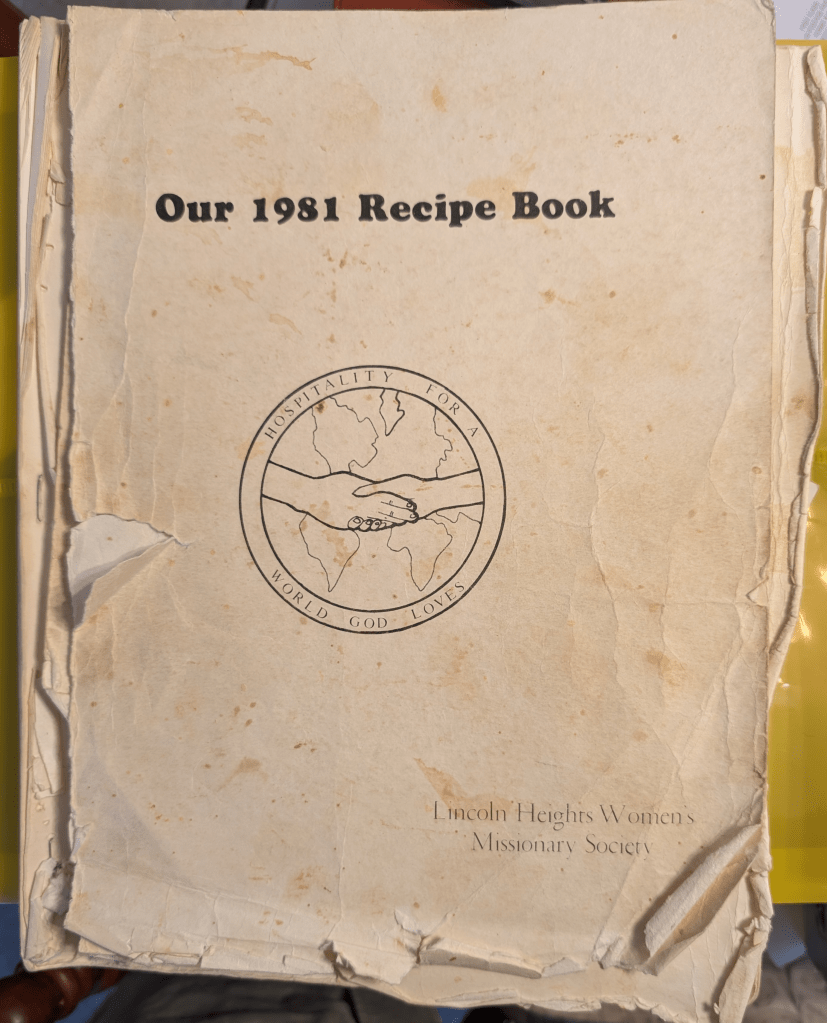
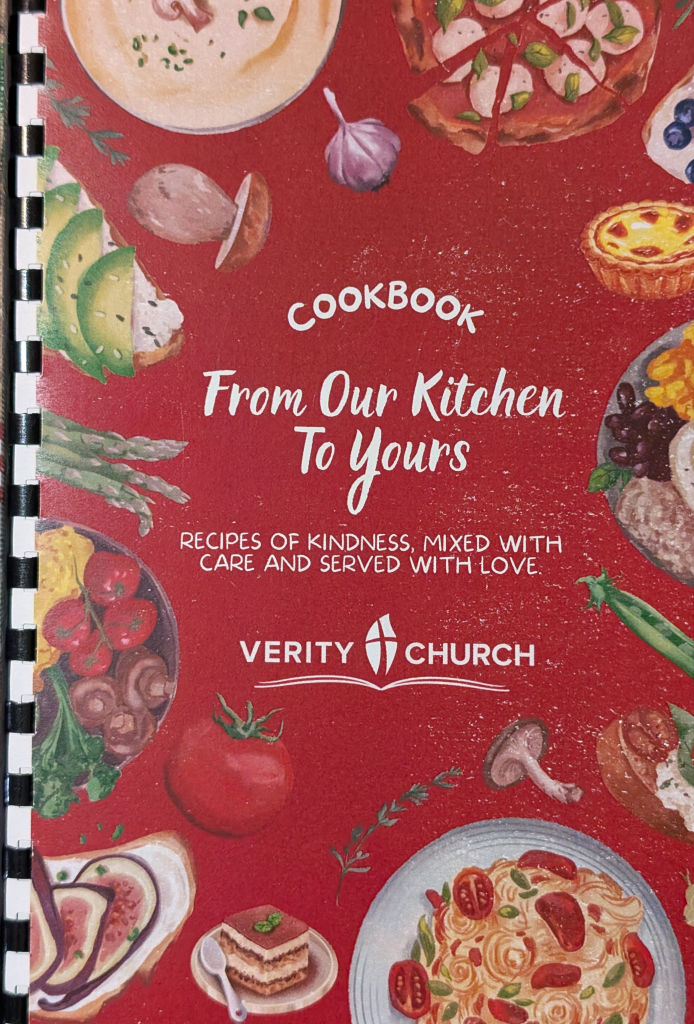
The Trust. The Missionary Church Historical Trust has very few cookbooks. The “problem” for donating cookbooks, of course is, people are still using them. The MCHT has one called The Hawaii District Women’s Missionary Society Cookbook (no date), by Dolores Sousley and others. It has a specialty cookbook by a nurse, a former member of Evangel Community Church, Kitchener.4 There is a photocopy from 1981 of a Lincoln Heights Missionary Church (Waterloo) WMS book called Our 1981 Recipe Book produced on a Gestetner copying machine and stapled. Finally, there is one from 2025 with plastic ring binding from Verity Community (EM) Church, Waterloo, produced on the church’s own colour photocopier. It is called From Our Kitchen to Yours. And so far that’s it.
I am convinced there have been numerous cookbooks produced by Ontario EMCC congregations and I am starting to hear about them.5 Why they have not been collected by the Trust in the past is a reflection on the curators’ blindness to the work of women especially, and I have been the curator now for about 15 years. “Archives” are supposed to be the sum of the products of an organization.
Courtesy: Susan (Brown) Thomson
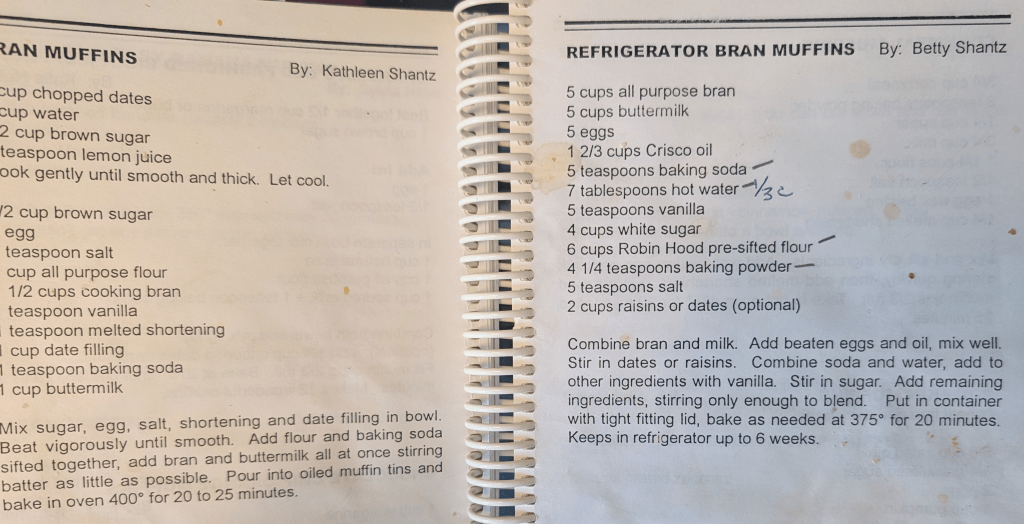
Cookbooks are first, guides to good cooking, of course. Next, they are cultural or historical artifacts.6 This came strongly to me when I talked over the items in the 1981 Lincoln Heights cookbook with the donor, Brad Ullner. He had grown up in the church and had stories about most if not all of the women who supplied recipes and their families. My brother said the same, commenting on the names in the St Catharines church cookbooks. Brad’s copy, which shows signs of heavy use, was his mother’s, and has one of her cookie recipes.7 I was surprised to see a recipe from one of my sisters, which reminded me that she attended Lincoln Heights when she was studying at Emmanuel Bible College.8 As is common, there are recipes clipped from the Record (Kitchener city newspaper), copied by hand from others, or even photocopied from handwritten recipes stuffed inside the covers. An additional surprise was a 1986 Christmas greeting card with 12 “Lincoln Heights Missionary Church Coffee Hour” recipes stapled inside. Neat idea. The cookbook also has line illustrations maybe by a WMS member, some poems and wise proverbs. Typically, there is no editor or statement of responsibility other than the WMS.
Courtesy: H & C Fuller
Two church cookbooks. Verity Community Church (Waterloo) is a merger of Lincoln Heights and Evangel accomplished in 2020, days before the COVID-19 lockdowns in Canada. The merger is a story for another day. The 2025 cookbook illustrates many things, some of them in contrast to the 1981 book. First, there has been no WMS/ EMCC Women’s organization in Ontario since 2011. This new book is a product of a recent Verity outreach started just in 2025 of something called a Ladies’ Drop In on a week day morning. But while the cookbook idea was theirs, (actually Shirley Littlejohn’s), it was open to anyone in the congregation to submit recipes, and they came from men (25%) as well as women. The 1981 book contained recipes from the women, but only one from a man.9 I asked and learned who in 2025 did the collecting (Judy MacKenzie), who did the copy editing (Terri Saunders), and who joined in the photocopy production (Parker Meginbir). So now it is on record!
Fund-raising. The 2025 book was a fundraiser specifically for a missions team project to Guyana in support of a YWAM missionary, Kim Cook, sent from Lincoln Heights with support continued by Verity. I haven’t learned the reason for the 1981 book yet. Fund-raising has been the most common purpose of church cookbooks for over a century and a half.10 The new cookbook illustrates the growing multicultural population of the Waterloo Region with recipes from Trinidad, China, Ecuador, Mexico, Guyana, Hungary, Colombia, and Nigeria. Even some of the recipes submitted from long-term Canadians have an international “flavour.” One of the pleasures of a church cookbook, is the contributors get to see their names in print. The 1981 cook book is fairly Euro-Canadian, with women’s surnames British or German, with one French-Canadian. The recipes represent standard delicious Euro-Canadian fare. The 2025 book credits many recipes to the internet.
Given the Wesleyan holiness and Mennonite rejection of worldly ways, fund-raisers in particular, I suspect balancing the church budget by selling anything under congregational sponsorship would have been condemned by Mennonite Brethren in Christ leadership.11 I have not seen any condemnation of selling church cookbooks specifically, however. MBiC women had not organized in women’s societies across the Conferences until the 1930s and 40s, anyway.12 Missionary Church women in rural areas might be involved in their communities’ Women’s Institutes.13 New Dundee and Wilmot Centre women were well represented in the several New Dundee Women’s Institute’s cookbook editions, Homemaker’s Delight, for example.14
Church members of course made an income by raising and selling crops, typically, and gave contributions to the class steward for the work of the church (buildings, pastors, missions and so on). In the Mennonite pattern, there were no Sunday morning tithes and offerings collected in boxes or plates in the first generations, no offering times in the worship service at all, in fact.
When Henry Schlichter Hallman was editor of the Gospel Banner (1888-1908), he devised a calendar with scripture texts printed for each day which the congregations (preachers usually) were expected to sell as a way of additional revenue (for the Gospel Banner, I assume).15 Preachers and City Mission Workers likewise were expected to be asking for subscriptions to the magazine as well, and reporting how many gained monthly. So they weren’t against selling things as such in church-related activities. (But certainly not on the Sabbath). It is a small step from such official selling to raising money by selling a cookbook.

Meanwhile, enjoy your meals. Give thanks for cooks, and to God who blesses good creation work.
A reminder: Contact the MCHT if you have an EMCC church cookbook to donate!
Banner: Cooking skills passed on from one generation to another. Credit: Katerina Holmes, free image via Pexels.
1https://en.wikipedia.org/wiki/Cookbook
2Here’s an interesting place to start: https://12tomatoes.com/fundraiser-cookbooks-history/
3Exactly as in https://sandychatter.wordpress.com/battered-tattered-stained-pages-in-a-church-cookbook/
4Mia (Troop) Collins, photos by Sampson Nordquist, Simple Allergy Solutions: Traditional North American Recipes for Families Dealing with Multiple Allergies (Kitchener, ON: By the Author, 2011).
5Bethany EMC (Kitchener, ON) published Our Treasury of Tastes (1994). Bethany Community (EM) Church, St Catharines, ON, produced at least two, in 1989 Bethany Cooks and 2002 The Best of Bethany; personal communication, Mark Fuller, January 15 2026.
6https://digex.lib.uoguelph.ca/exhibits/show/tried-tested-true/community-cookbooks
7Beatrice (Schwartzentruber) Ullner. Brad is her son.
8My sister Ellen (Fuller) McFaul was surprised, too, as she had not lived in Waterloo for some years by 1981. Someone obviously enjoyed her Camp Mishewah oatmeal chocolate chip recipe when she was camp cook!
9The 1994 Bethany (Kitchener) recipe book has about half a dozen male contributors. Mrs P G [Esther] (Dommer) Lehman (b 1902 in Michigan), wife of a former Bethany pastor is credited with a recipe, though she left Bethany long ago. Another case of transmission through the generations.
10All three of my sister’s church cookbooks (two Zion United Church from our father’s home congregation in Watford, ON, one from a Convention Baptist friend) were clearly fund-raisers. See also https://12tomatoes.com/fundraiser-cookbooks-history/
11EMCC History series of 4 blogs on “Non-conformity,” in August 2024.
12EMCC History, “Women’s Missionary Society/ Ministries 1,” January 10 2026.
13In Ontario, founded in 1897 in Stoney Creek; https://fwio.on.ca/meet_the_fwio.php or see the next note, p i.
14We have Homemaker’s Delight No. 4: 100thAnniversary 2007 (New Dundee, ON: New Dundee Women’s Institute, 2009). In Nigeria we inherited an earlier edition or two from Ontario missionaries.
15Sam Goudie occasionally noted in his diary that he was out some days selling calendars, sometimes with his children. The MCHT has no copies of any of these calendars (yet).

 EMCC History
Leave a comment