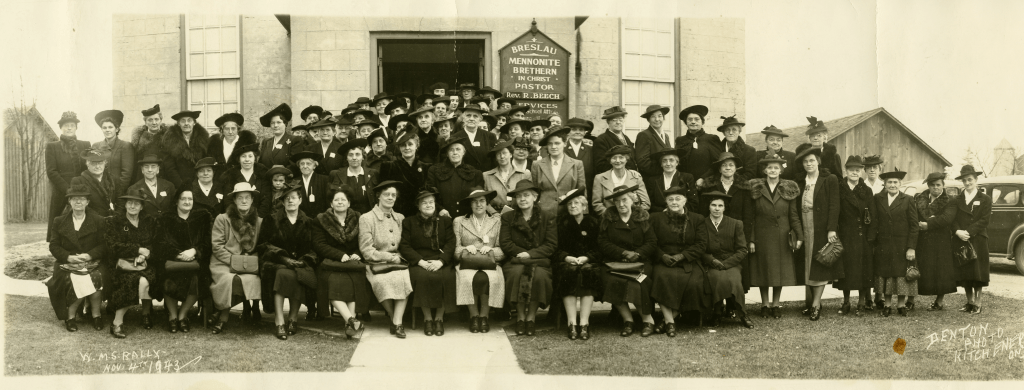
Officially, the denominational Women’s Missionary Societies (WMS) of the Mennonite Brethren in Christ Church began Conference by Conference in 1937. That was the year the United Missionary Society, the mission board of the MBiC, urged the Conferences to allow women to organize Conference-wide societies.1 The full story is much bigger than that, of course.
The situation. Women in Christianity have experienced both greater freedom and continual suppression as believers. Some Churches intensely debate the issue of “women in ministry” these days and I will not review it here.2
In the 19th century in North America, frontier conditions, awakenings and Methodist revivals, Enlightenment thoughts of freedom, societies for improving social conditions and a host of other influences, encouraged Protestant women to become more active in church life. Following the 1860s, women organized mission boards to support and send women to mission fields.3 Concurrently, deaconess orders were invented to provide a “calling” (vocation) for Protestant women.4 I am not here talking about Women’s Auxiliaries, ladies’ aid societies or altar guilds, for sprucing up the equipment and pleasantness of the church buildings (a worthy function all can appreciate),5 female City Mission Societies, deaconess societies or even women’s missionary sending agencies. I’m talking about societies of regular church women who promoted missions by money, study and prayer, which came in the later 19th century to many denominations in North America.6

Credit: Sigsworth, The Battle was the Lord’s (1960) p 251.
Of the Churches most influential on the MBiC, the Evangelical Association had WMS groups from1880. They began as young women thought of ways to support the EA’s first single female missionary to Japan in 1877, Rachel Hudson.7 The Free Methodists, by some counts also a close relation to the MBiC, started organizing Women’s Foreign Missionary Societies in Ontario in 1891-92.8 The FMC was a more centralized denomination than the coalition of Conferences MBiC, and the FMC’s General Conference mandated women’s missionary societies throughout their whole Church in 1894. (They had a foreign mission Board already in 1874.) John Sigsworth does not describe the activities of the WFMS at a local level apart from fund raising and sponsoring revivals, however, many young Free Methodist missionaries had been members of their women’s societies, so presumably much prayer and missionary education was going on. Perhaps it was another strong influence on the Missionary Church tradition, the Christian and Missionary Alliance (now just “The Alliance Canada” in Canada). A B Simpson designed the C&MA as a missionary support organization, and so in theory it did not need the women to organize separately for missions.9 A branch/ congregation was the support group. C&MA women might need to organize for other ministries, but not missions. There was a missions prayer meeting by women in 1914, authorization to organize in 1929, but an official name (Women’s Missionary Prayer Fellowship) and continental structure only arose in 1961-65.10
An Anomaly? We can ask why the MBiC delayed, and come up with suggestions.11 Mennonite archivist and historian Samuel J Steiner suggested that the MBiC encouragement of women in various ministry roles left them ample opportunities to be involved in the missionary work of the denomination without specialized societies.12 The Canadian Brethren in Christ (Be in Christ since 2017) never seem to have allowed women to organize in women’s missionary societies, but gradually opened the door to ordination instead. Their women, as elsewhere, offered themselves for missionary work from the start in 1898, anyway, beginning with Hannah Frances Davidson.13 In contrast, the Free Methodists gave liberty to their female ministers quite early, but also promoted Women’s Missionary Societies.
Or you could suppose that the development of women’s missionary societies was a later step in the institution-building of a relatively new denomination, as Charles Gingerich proposed,14 since official mission support for a member began only with William A Shantz going to faraway China under the C&MA in 1895 and a mission sending structure 10 years later. (It involved only three Conferences at first.)
Possibly the rural nature of the Ontario MBiC slowed the establishment of WMS societies? Or perhaps the narrowing room for ministry in North America for MBiC women in the 1930s turned women’s or leaders’ thoughts to ways of involving women in the UMS (especially finances)? The slow death of the City Mission Worker’s Society (canceled finally in 1946) overlaps just six years with the rise of the WMS in Ontario. Women will find outlets for serving God, even if hindered. I speculate that perhaps the reluctance of Mennonite churches to divide their community by encouraging age or gender-based organizations was behind the slow adoption of women’s congregational and Conference societies. Perhaps we can point to the non-innovative style of leadership the President of the United Missionary Society, Sam Goudie, gave at the General Conference level (chair of the General Conference Executive Committee from 1912 to 1943) or as President of the UMS (1922 to 1939). Yet he was a motivator for the founding of the mission society in the first place. Or probably a combination of these factors? I am not decided.
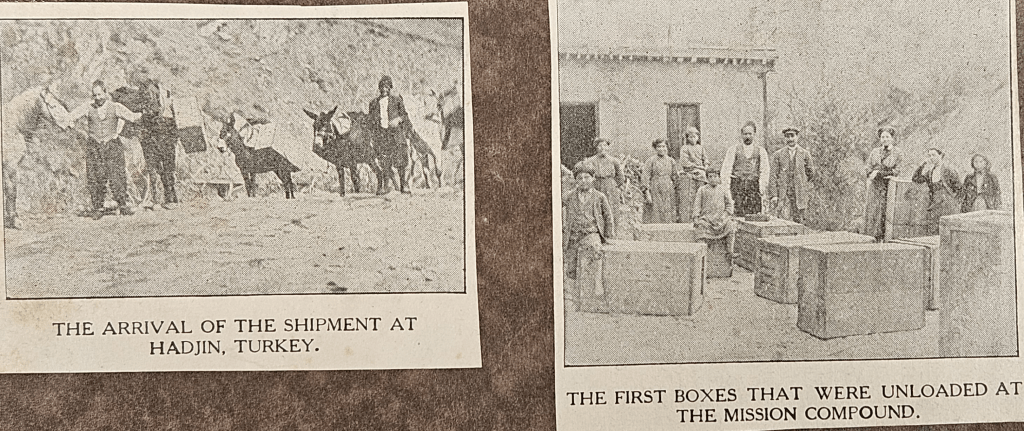
donated partly by MBiC women.
Courtesy, Levi and Fannie Raymer Collection, MCHT
Early efforts. For my book about Sam Goudie, I continued gathering evidence for women organizing themselves in the Conference fields to support missionary activities.15 In Ontario, I found a group or two organized to aid the Berlin Orphanage as soon as it was announced in the mid-1890s, or to send material aid to Turkish Armenia for the orphanage work of the United Orphanage and Mission Board, from about 1898.16 Some evidence suggests women’s groups in Ontario did organize to provide aid to MBiC-related rescue missions (Beulah, Hope) in Edmonton, Alberta, from about 1909 or later. World War I involved most women’s groups across Canada, often along denominational lines, to gather or sew medical supplies for military casualties or war relief. It is not clear that such groups (“Red Cross sewing circles”) organized permanently or for wider purposes. A “Sewing Circle” in New Dundee organized with a president in 1922.17
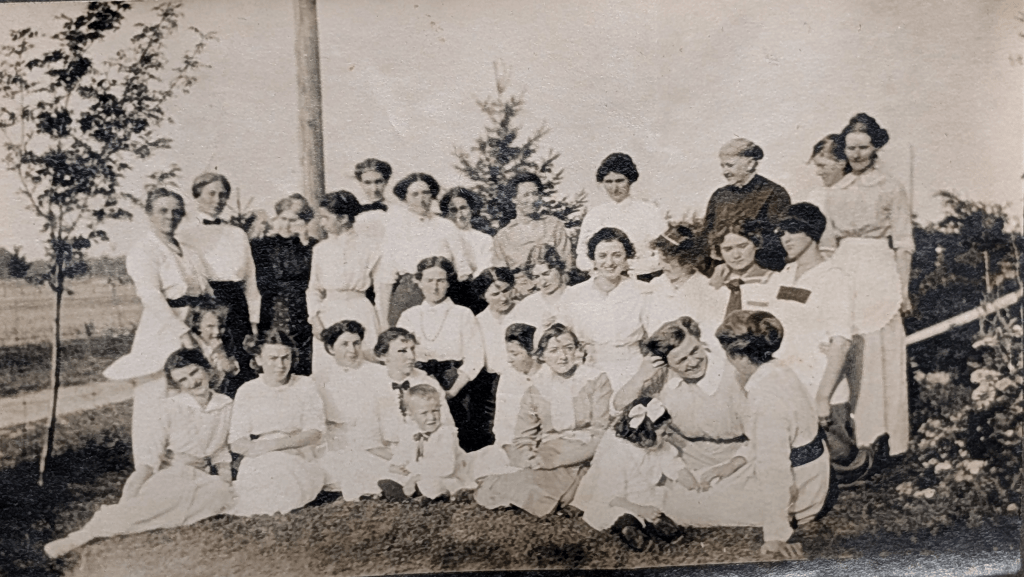
Courtesy, Levi and Fannie Raymer Collection, Missionary Church Historical Trust
The WMS model. Fully formed models of a “Woman’s” or “Women’s Missionary Society” in other denominations had been functioning for over a generation in the neighbourhoods of most MBiC fields. The women could not miss knowing them. And in Alberta in the 1920s, a number of MBiC churches started forming such groups, and they linked to start a Conference-wide society.18 The society formed at Stayner, ON, in the home of Fannie Raymer in 1924 was one of the first in Ontario to adopt a “WMS” plan.19 The records of Hespeler, ON, MBiC suggest they also formed a WMS in 1924.20
Still it is a mystery to me that it was not until 1937 that the Board of the UMS acted, Sam Goudie having been President since 1922. The move occurred at the instance of “courageous women” (phrase from a program suggestion, Anonymous, “A W. M. S. Sketch of Our Heritage” ca 1985) from Ontario and other Conferences and through board member Cyrus N Good. The Board recommended the formation of Conference-level WMS leadership to encourage organizing at the local level. Even so, since the UMS was not directly accountable to the MBiC General Conference, but to the individual Conferences through Conference-nominated board members, it could not directly instruct the Conferences to form Conference-wide WMS executives. In Ontario it was not until 1939 that this occurred. The WMS in Ontario was immediately popular and immediately became effective in missionary study, missionary support and prayer. Local WMS groups spread to most of the congregations within a few years, and popular regional rallies became a feature of the district for over 50 years. Many women leaders were encouraged and became known. Many study materials were prepared and learned through the whole denomination. Many women knew the story of the missions of the Church and general missions history. They did raise money: they financed building the hospital in Tungan Magajiya, northern Nigeria, and supplied various key medical supplies; they supported missionary families financially; they stocked “missions cupboards” that clothed and warmed missionary families with quilts and groceries; they collected and published missionary newsletters (eg Corner to Corner from 1974 to 1995). I will sketch some of this history in a second part. The sad thing is, much of this shared missions-related activity has almost completely disappeared.
In the Missionary Church Association, founded and organized only in the United States, the main missionary support (finance) groups seems to have been the Sunshine Makers, a children’s auxiliary started by Macy Garth Ramseyer at a convention in 1902. and the Gleaners for older children, in 1915. Their annual Acorn Banks collection plan was very popular.21 Until 1945, though they had numerous missionaries under other mission agencies, the MCA had no mission fields of their own.22 This may account for the apparent lack of a WMS-like organization until 1954.23
Nevertheless, the women in individual congregations did organize themselves for missions support. Eileen Lageer reports numerous MCA churches which specialized in sewing for orphanages, canning for Bible Schools, “missionary trunks,” (same idea as the cupboards), and prayer.24 With the 1969 merger with the United Missionary Church, the WMS carried on.
The gradual changes, and reasons for the disintegration of the WMS in Ontario after 1990, is an important study that is still to be done. Put a gloss of “change is not all bad” face on it if you will, but the loss of missionary structures may not be a story with much to celebrate.25
I want to finish this post celebrating the Women’s Missionary Societies of the Missionary Churches. As a male, I was not very involved or aware of all the activity going on since my family joined the United Missionary Church in the mid-1960s. I am not qualified to write a history of the WMS, which has been attempted briefly in eastern26 and western27 Canada already. There are knowledgeable women who participated in the societies who would do far better than someone who wasn’t there. As I see it, the WMS and successors did a credible job of acquainting women (and often men) in the church with the personnel, history, needs and opportunities of the MBiC/UMC and Missionary Church mission fields.
Banner: First Ontario MBiC WMS Rally at Breslau, ON, November 5 1943. Courtesy, Missionary Church Historical Trust.
1UMS Board Minutes of June 1937; in Everek R Storms, What God Hath Wrought: The Foreign Mission Efforts of the United Missionary Church (Springfield, OH: United Missionary Society, 1948) p 155.
2I comment on some of the issues in EMCC History blogs, especially “Women Preachers Part 1” (February 4 2024) and “How to Kill a Program of Women in Ministry Parts 1 and 2” (September 22 and 29 2024).
3For example, see https://en.wikipedia.org/wiki/Women%27s_missionary_societies; Ruth A Tucker, “Women in Mission: Reaching Sisters in ‘Heathen Darkness,’” in Joel A Carpenter and Wilbert Shenk, ed, Earthen Vessels: American Evangelicals and Foreign Missions, 1880-1980 (Grand Rapids, MI: Wm B Eerdmans, 1990) p 251-280.
4Forthcoming EMCC History “Deaconesses” for more information.
5Brian Clarke, “English-speaking Canada from 1854,” in Terrence Murphy and Roberto Perin, ed, A Concise History of Christianity in Canada (Toronto: Oxford University Press, 1996) p 287-290.
6Women’s missionary sending agencies was a function of some denominational “WMS” organizations, but not in the early EMCC.
7Paul Himmel Eller, History of Evangelical Missions (Harrisburg, PA: Evangelical Press, 1942) p 22-25, 201.
8John Wilkins Sigsworth, The Battle was the Lord’s: A History of the Free Methodist Church in Canada (Oshawa, ON: Sage Publishers, 1960) p 53-54.
9Amazingly, the official centennial history of the Alliance has only one unexplained reference to women acting together; Robert L Niklaus, John S Sawin and Samuel J Stoesz, All for Jesus: God at Work in the Christian and Missionary Alliance Over One Hundred Years (Camp Hill, PA: Christian Publications, 1987), p 244.
10Samuel J Stoesz, Understanding My Church 2nd ed (Camp Hill, PA: Christian Publications, 1983) p 162-163.
11Some mentioned in my biography of Sam Goudie, Hidden in Plain Sight: Sam Goudie and the Ontario Mennonite Brethren in Christ (Eugene, OR/ Hamilton, ON: Wipf and Stock/ McMaster Divinity College Press, 2024), during his time as a president of the United Missionary Society, p 268-272.
12Samuel J Steiner, In Search of Promised Lands: A Religious History of Mennonites in Ontario (Kitchener, ON/ Harrisonburg, VA: Herald Press, 2015) p 647, n 48.
13Davidson with 4 others. See also E Morris Sider, Be in Christ: A Canadian Church Engages Heritage and Change (Oakville, ON: Be in Christ Church of Canada, 2019) p 342-343, 389.
14Charles S Gingerich, “An Experiment in Denominationalism: A History of the Missionary Church of Canada, Ontario Conference 1849-1919)” MA Thesis for Wheaton College, 1994. Review EMCC History Page “Formation of the EMCC.”
15In addition to Everek R Storms, History of the United Missionary Church (Elkhart, IN: Bethel Publishing, 1958) p 188-191.
16EMCC History, “Mennonite Armenian Mission Parts 1-4,” in October 2024.
17Mrs Moses Toman (nee Karcher), obituary, Gospel Banner (August 2 1951) p 15.
18Storms, (1948) p 155-156, amplified in Storms (1958) p 188-191.
19Edward N Chester, Great is Thy Faithfulness: Stayner Centennial 1890-1990 (Stayner, ON: Stayner Missionary Church, 1990) p 11.
20WMS file, Hespeler #2, Box 1007 MCHT.
21Walter H Lugibihl and Jared F Gerig, The Missionary Church Association: Historical Account of Its Origin and Development (Berne, IN: Economy Book Concern, 1950) p 107-108.
22Lugibihl and Gerig, p 105-111.
23Eileen Lageer, Merging Streams: Story of the Missionary Church (Elkhart, IN: Bethel Publishing, 1979) p 175.
24Lageer, p 173-174.
25The disintegration was denomination- and Canada- wide, and points to changes in culture in an assimilating church body. The Missionary Church Historical Trust collection has many records at local, district, and international levels that could support such or many other studies of the WMS. As with the denomination’s names, the WMS went through numerous name changes after 1969: Missionary Church Women, Missionary Women of Canada, Women’s Ministries, EMC Women, each with decreasing involvement in international missions.
26Debi (Souris) Snider, “Women’s Ministries of the Evangelical Missionary Church of Canada” (2011); Anonymous, “Missionary Women Canada 1939-1989-Presidents-Canada East District” (1989).
27Mrs Ira Stauffer, (1976); Jean Maconochie, ed, Missionary Women of Canada 1931-1991.

 EMCC History
Leave a comment