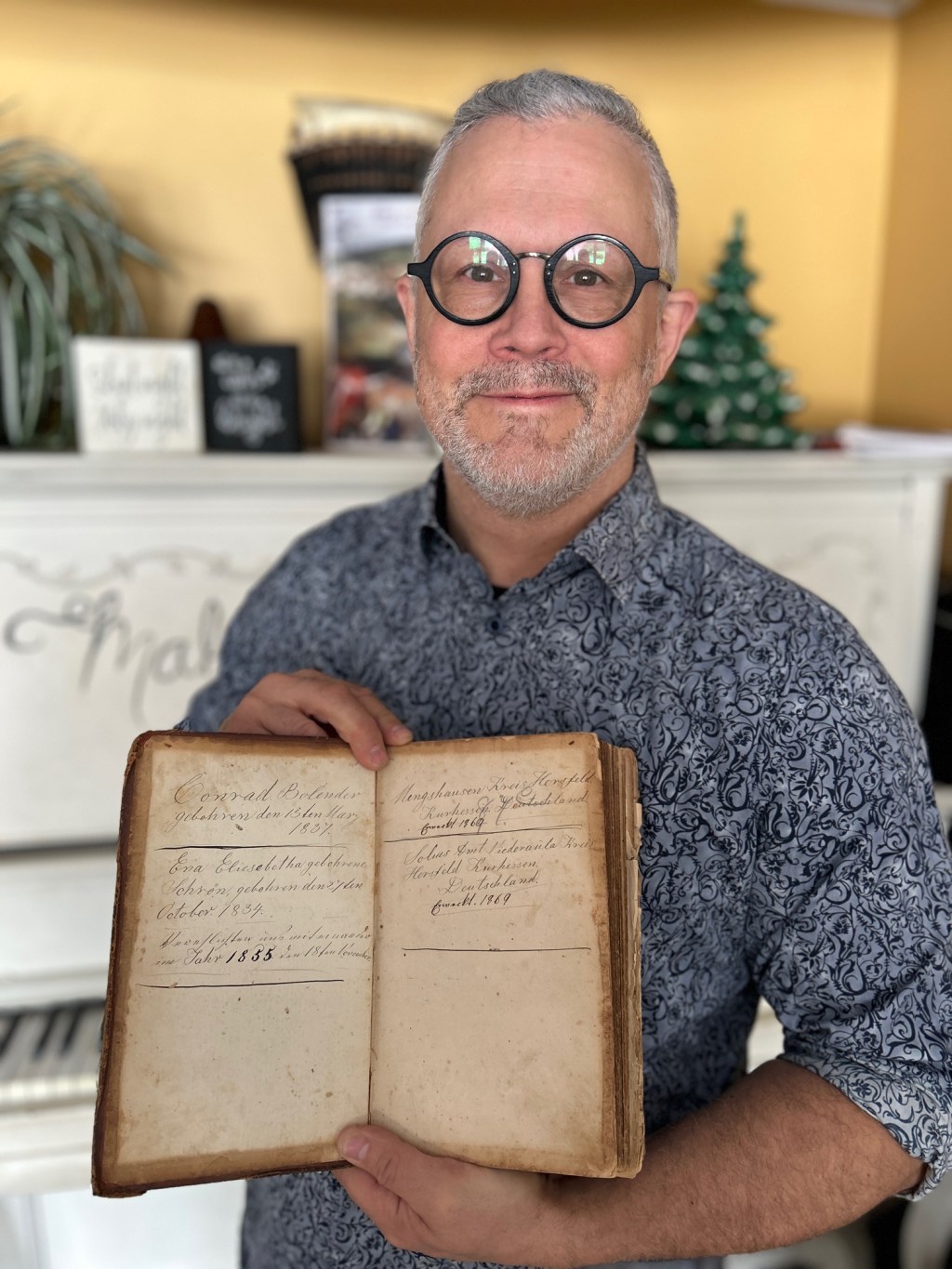
Sometime in May 1873, a man called Henry Schneider/Snyder of Port Elgin, Bruce County, Ontario, bought a Bible. It was a copy of Martin Luther’s German translation of the Bible, published by the British and Foreign Bible Society and printed in Frankfurt, Germany, in 1872.
I know this because in 2014, when I was working in a thrift store in Kitchener, I saw this big Bible in the recycle bin. We often received old Bibles, even German Bibles, which had outlived their usefulness as working Scriptures. Few people will pay even the small price for a used Bible, and fewer still care for tattered copies. Christian thrift stores often give away good copies for free, though they may sell the best.
I pleaded with my manager to let me take this Bible from the recycle bin, outside the usual policy, and I am so glad she allowed me to.1 This Bible represents a remarkable event for the Evangelical Missionary Church of Canada and the Missionary Church USA as well.
And Port Elgin is an important place in the history of the early EMCC for several reasons. (Yellow Creek Mennonite Church, near Goshen, Indiana, is another.) The EMCC of today is a merger (1993) of the Missionary Church of Canada, and the Evangelical Church in Canada. An awakening in the Evangelical Association congregation in Port Elgin in 1868-1873 led directly to an awakening in the Port Elgin Mennonite community in 1869. That Mennonite awakening was part of what led to the formation of the Mennonite Brethren in Christ Church (1883) of both Canada and the United States, and therefore to the Missionary Church in North America.2

Courtesy: Missionary Church Historical Trust
A second reason relates to the Mennonite preacher at Port Elgin, Solomon Eby (1834-1931), ordained by Bishop Joseph Hagey from Waterloo in 1858. Eby gained an assurance of salvation in that very awakening,3 as did his father, Martin Eby, the deacon of the congregation.4 Eby was a chief organizer of the Reforming Mennonite Society in Canada (1874) when he and sympathizers were expelled or left the Mennonite Conference of Canada, and gave forceful leadership to the new group through mergers and expansions, into the first decade of the 20th century.
The Land. Similar to the situations all over Canada, title to land in Bruce County was gained from the First Nations (Ojibwa (Chippawa),5 and Algonquin), by the British Crown piece by piece, often by fraud, mainly by 1836, with adjustments up to 1856.6 Canadians of European descent have to live with this. When the land was acquired it was surveyed over a few years and Saugeen Township was created along the lowest reaches of the Saugeen River to its mouth at Lake Huron. Lots were offered for sale by 1851.7

The first European settlers in Saugeen were Scottish and English, mainly from earlier settlements in Ontario.8 Next, German settlers started arriving from Waterloo County in 1852-53, (some sources say 1854) and they seemed well-to-do in comparison to the others.9 For example, Benjamin Paul Shantz from Freeport, Waterloo, bought 600 acres, then 200 more, bought a sawmill, built a grist mill and had a share in the harbour improvements.10 Some settlers came directly from Germany or via Waterloo, such as the Thede family from Strasburg. Eby’s family bought land in 1853 or 1854, coming from Wilmot Township, Waterloo County. German settlers also arrived in other Bruce County townships (Carrick and Arran), Huron County (Howick) and neighbouring Grey County, mainly in Bentinck Township. Some families flourished, some moved away. In the 1881 Canada census there were 97 Ebys listed in all of Bruce County, many of them children.
The Churches. The Evangelical Association followed up German settlers and by 1868 listed appointments at Elmwood, Hanover, Chesley, Bentinck, Brant and Walkerton in their “Bentinck Mission” straddling the Bruce and Grey Counties border.11 Apparently members in Saugeen had not yet been served by the EvA, but they were encouraged by the appointment of Jacob Anthes (1836-1874) to be their first pastor with his wife Magdalena Striker (1840-1914) in 1868, transferred from the Bentinck Mission where he had been stationed 1867. That year the Evangelical members in Port Elgin resolved to construct a stone and brick building for worship.12 One of the teams of horses called on to help haul stone was operated by Solomon Eby.
By 1866, Port Elgin already had five congregations with buildings: Presbyterians were probably the first to have organized,13 followed by the United Brethren in Christ,14 Wesleyan Methodists, Mennonites and the Church of the New Jerusalem (Swedenborgian).15 The Mennonite community organized in 1858—by 1861 they built a meeting house on Ben Shantz’ farm 1.6 kilometres east of the town.16 The UBiC, Mennonite, EvA and the New Jerusalem people were mainly of German descent. There were also Lutherans and German Catholics. Although Robertson’s History of the County of Bruce is biased in favour of Scots and the Presbyterians (Robertson’s background), it is still evident in his lists of political leadership, that people of German background did not often rise to prominence. Mennonites of course, did not join secret societies or the military, networks of influence. Some Mennonites did make a mark in business: Benjamin P Shantz,17 Samuel Bricker18 and his son David, for example.19 Henry Hilker, born in Heidelburg, Germany, was a United Brethren in Christ business man.20
Anthes encouraged a Christ-ward movement in the German-speaking community in Port Elgin and the Bentinck Mission. In letters to his relatives back in Waterloo County, he mentioned the progress of the awakening/revival, sometimes naming people or families who were converted. He said that all the German-language churches were touched. To me it is especially interesting that when he was sick in January or February of 1869, he trusted Solomon Eby enough to call on him to preach for him. Anthes reported that several Mennonites were converted by Eby’s sermons! By March, Anthes could count 50 people converted.
Eby’s story of conversion or assurance of salvation in December 1869 is often mentioned in Missionary Church histories, and must have come from his own testimony.21 Mennonite historians are reluctant to regard Solomon’s experience as one of conversion, as that would deny the Christian experience of Mennonites who did not participate in the awakening. Eileen Lageer would at least describe the change of all but two members of the Port Elgin Mennonite Church as coming “into a new experience in Christ.”22 This ambiguity is similar to John Wesley’s “heart-warming” experience that he later interpreted, not as his conversion, but as his assurance of salvation.
The connection of Evangelicals and Mennonites in Port Elgin and Southampton in Saugeen Township, the neighbouring village, did not end with Solomon Eby’s awakening. He led his congregation into Methodist-style protracted and prayer meetings, leading to the conversion or reaffirmation of many of the members. Bishop Hagey came up from Waterloo to baptize the first group of (mostly young) converts.
Anthes was re-assigned to the EvA field at Sebringville, Perth County, in 1870, but the awakening/revival in Port Elgin did not end. Henry Schneider bought his Bible in 1873, as did another man, who later served both in the Mennonite Brethren in Christ and the Evangelical Association, Conrad Bolender (1836-1910). That year the railway arrived in Port Elgin.
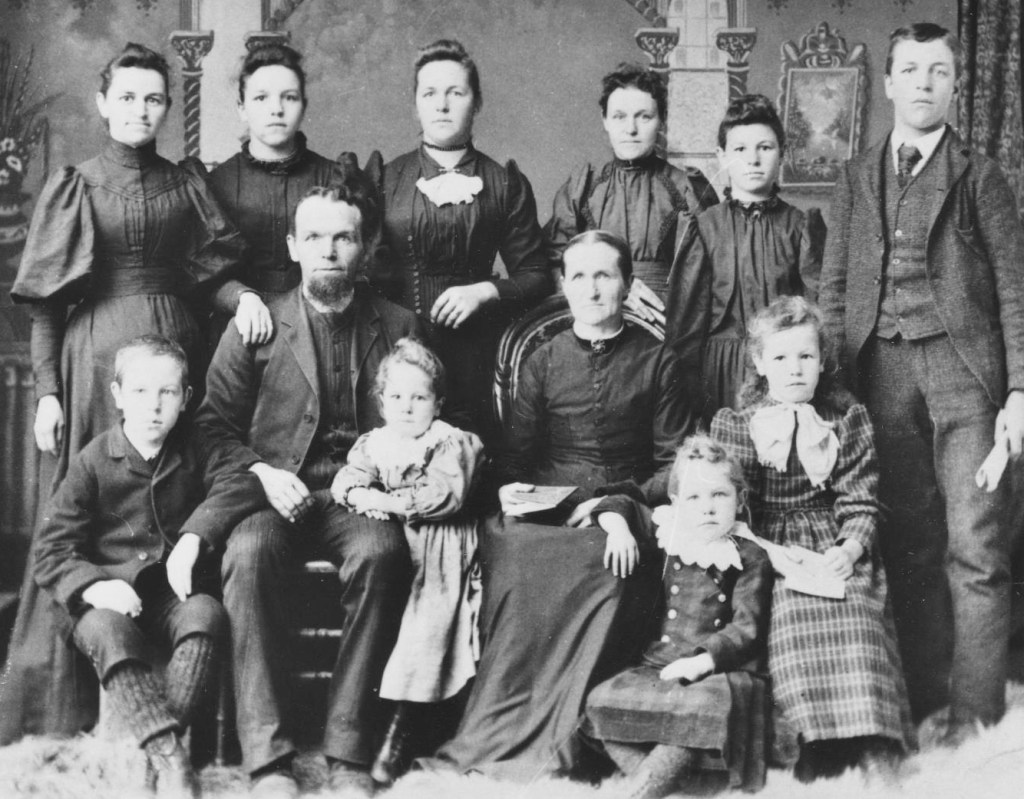
probably in a Waterloo studio.
Courtesy: John Quanz
Schneiders. I was stymied at first when I looked in the Canada census of 1871 for Henry Schneider because it is almost a German equivalent of “John Smith”: a common name. But eventually I found descendants of the family, and they were very happy to reclaim the Bible. Jacob Anthes recorded in his letters that members of a Schneider family came to Christ during his time as their pastor.23 Henry S Schneider needed a Bible because people who follow Jesus love to know him through his Word. The Schneiders moved to the Wallace and Palmerston area of Perth County in 1877 and one of them married a Quanz. They were members of the Wallace 6th Line Evangelical (later EUB) Church, (now Wallace United.) Thus Walter Quanz remembered seeing his grandfather reading from the German Bible, and the Bible has now come to John Quanz, Markham. John has written a wonderful account of the Schneider family with photographs, including one of the Bible, which you would like to read.24
Bolenders. Conrad Bohlender/Bolender/ Bolander arrived in Canada from Hersfeld, Kurhessen, Germany with his parents. In the Canada census of 1871, he listed himself as an Evangelical Association member. He, too, bought a German Bible in 1873.
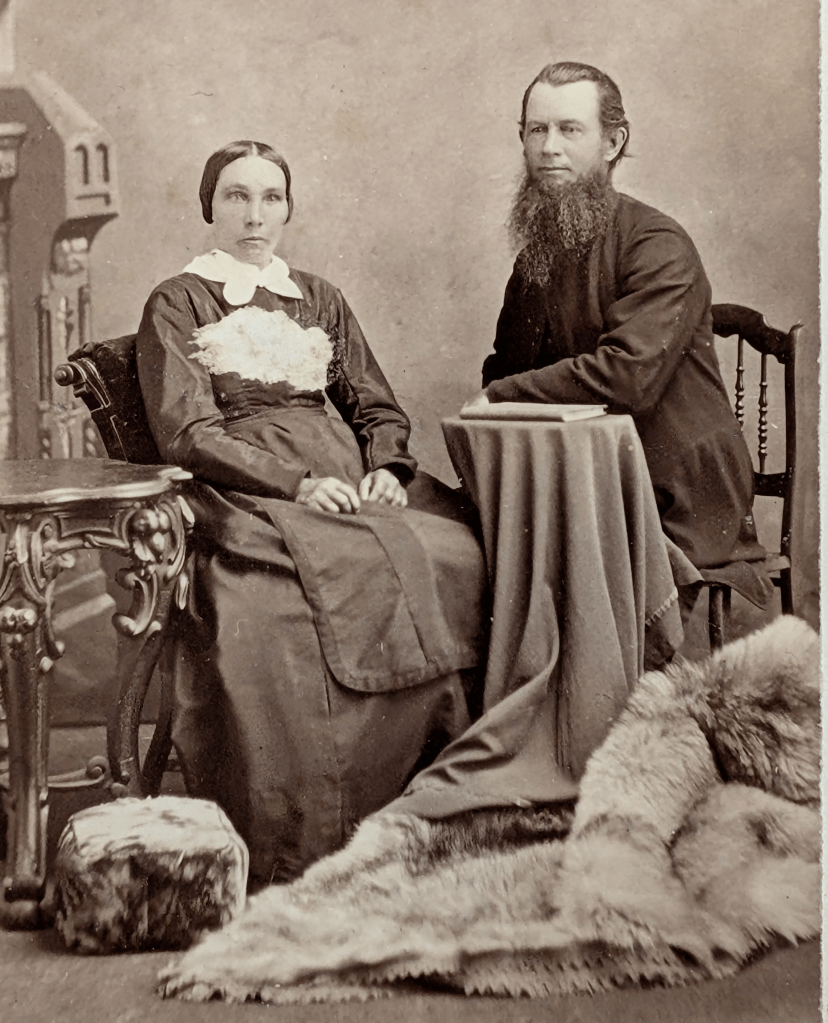
W V Green studio photograph.
Courtesy: Ella (Tremaine) Chester Collection, MCHT.
However, he was the German-language secretary for the Reforming Mennonites at their first semi-annual meeting held in September 1874 in Port Elgin.25 In a few years he became a probationer and then an ordained minister of the MBiC, serving at nearby Brant (1876-77), Elmwood (1877-1879), on the Maryborough mission (which included Wallace) with Amos Eby and Bernard Kreutziger as helpers, the Woolwich mission (Waterloo) each for a year. It is not clear where he went next,26 probably Markham as a helper, then back to Elmwood another year, then Wiarton for a final year in the MBiC, 1883-1884. In 1884, he transferred to the Evangelical Association and served a number of churches, where I do not know except that around 1894 or so he was reported as living in Pembroke, ON, in an area with several rural EvA congregations.27 Conrad’s first wife Eva Elizabeth Schroen, also born in Germany, died in 1891, and he married Magdalena (Eby) Thede, a sister of Solomon Eby, widow of Rev Joseph Thede, an EvA minister, in May 1894.28 She died in 1905, back in Port Elgin where they had retired in 1902.
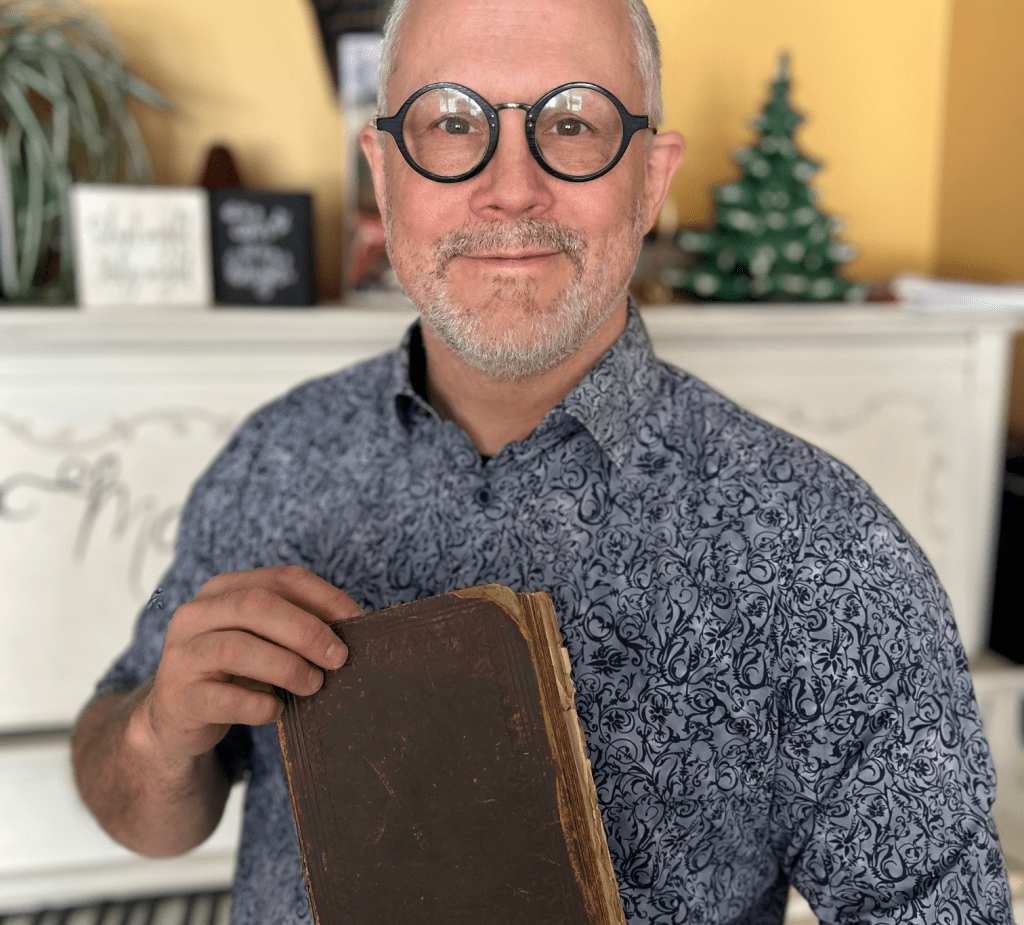
Courtesy: Stephen Preston (S Preston Photo)
Conrad died a bit mysteriously about November 26 1910. His body was found, clothed, upright and frozen, on the Port Elgin breakwater. A letter to his family describing the problems he was concerned about “more or less imaginary,” according to his family, was found in the pocket of his winter coat which he had left behind at his sister’s house when he went for a walk and did not return.29 The newspaper guessed he had committed suicide in a depressed mental health crisis. Yet he had been a much appreciated minister.
From his descendants came Mark Bolender, who was an EMCC president and pastor of leading congregations in Ontario and Alberta, and Ivan Preston, pastor in Ontario and missionary to Mexico.
This post is not a history of the Port Elgin EM Church (now called Saugeen Shores Community Church), but it witnesses through two German Bibles to an awakening in Port Elgin that influenced generations.
Banner: Stephen Preston, a descendent of Conrad Bolender, holding his German Bible of 1873. Courtesy: Ivan and Donna Preston and family. Photo by Stephen Preston.
1Some of this post was originally published in the Newsletter—Kitchener BfM [Bibles for Missions] December (2014-#5); used with permission.
2EMCC History Page “Formation of the EMCC,” for more of the story.
3 https://www.biographi.ca/en/bio/eby_solomon_16E.htmlSamuel J Steiner (rev to 2025), “Eby, Solomon,” Dictionary of Canadian Biography Vol 16
4Obituary in Gospel Banner (June ? 1891) p16.
5Known properly as Anishnaabek Nation.
6Neil Semple, The Lord’s Dominion: The History of Canadian Methodism (Montreal and Kingston: McGill-Queen’s University Press, 1996) p 170.
7Norman Robertson, The History of the County of Bruce (Toronto: William Briggs, 1906, reprint by J M Dent & Sons, 1960) p 1-9. This is a settler’s version of events.
8Robertson, p 489-492.
9Robertson, p 492.
10 https://generations.regionofwaterloo.ca/getperson.php?personID=I20137&tree=generations. Benjamin P Shantz’ first wife, Lydia Kolb, died in 1862, and he remarried, to Margaret Swinton of Port Elgin, in 1863. They moved to Missouri in 1864 or 1865, taking the youngest children with them and he died there in 1868.
11J Henry Getz, A Century in Canada (Kitchener, ON: Canada Conference of the Evangelical United Brethren, 1964) p 11.
12https://uwaterloo.ca/centre-for-german-studies/events/anthes-papers
13Robertson, p 505-507.
14Robertson, p 505, mentions the United Brethren sponsored a school in Port Elgin 1880-1882, led by Abraham B and D B Sherk, both well-known Freeport, Waterloo County, people.
15Robertson, p 507.
16Isaac R Horst, “Mennonite Settlement in Port Elgin,” Ontario Mennonite History, Vol 15, No 1 (April 1997) p 1. There is a unique photo of the Shantz farm from 1866, stumps and all, in the Waterloo Region Generations website.
17Heather Robertson, The History of Port Elgin (np, 1975) p 6-8. One of his sons, Benjamin Kolb Shantz, a carpenter, married Mary Eby from another line of Ebys, and one of B K Shantz’ sisters, Catharine Shantz, married Solomon Eby!
18Robertson (1975) p 11.
19Robertson (1906), p 501, n2. David Overholt Bricker was a member of the first town council, however, as was Hilker.
20Canada census 1871 and Robertson (1906) p 497.
21Jasper A Huffman, ed, History of the Mennonite Brethren in Christ Church (New Carlisle, OH: Bethel Publishing, 1920) p 41, 56; Everek R Storms, History of the United Missionary Church (Elkhart, IN: Bethel Publishing, 1958) p 36; Eileen Lageer, Merging Streams: Story of the Missionary Church (Elkhart, IN: Bethel Publishing, 1979) p 18; Eileen Lageer, Common Bonds: Story of the Evangelical Missionary Church of Canada (Calgary, AB: Evangelical Missionary Church of Canada, 2004) p 18. All these accounts seem to depend on one original version.
22Lageer (1979) p 21.
23Anthes’ letters. Henry’s was the only Schneider family in Saugeen in 1871.
24http://www.southjacksonville.org/Ch09.1-HenrySSchneider.pdf
25The first page of minutes in English mention him in Storms, in the photographs after p 62.
26The 1881 Canada census found him at Saugeen/ Port Elgin in the spring.
27The MCHT has Evangelical United Brethren Canada Conference journals starting 1920. The Pembroke note is in Ezra E Eby, A Biographical History of Waterloo Township and other townships…(Berlin, ON:1895) p 604.
28Magdalena “Lena” Eby’s first husband, Joseph Thede, was another Evangelical member, born in Strasburg, Germany. A Thede family genealogical website transmits a story that maybe he drowned ca 1880. He was a farmer in the 1871 Canada census, but the history of the EUB Canada Conference lists him as a preacher.
29Unidentified local newspaper clipping, “Sad Death,” from 1910 (probably the Port Elgin Times), a copy preserved in the files of the Ivan and Donna Preston family.

 EMCC History
Leave a comment