
Enjoying worship includes feelings about the physical surroundings: often, the building. This is a luxury; for many of our brothers and sisters in the world, persecution takes away any choice in the matter.
I have not seen anyone else collect and reflect on the origins of their denomination’s worship halls. In the EMCC, we usually celebrate the buildings we constructed; perhaps other Churches do the same. In practice, however, we have also rented and bought from a wide variety of available real estate. Here are some. Plunge in!

Courtesy: Riverside Evangelical Missionary Church.
Methodists/ UCC. The Stayner appointment (started about 1873) bought an available Methodist Church building on the west end of town constructed between 1862 and 1889 in 1890, and then moved it to the east of the town in 1894.1 Another Methodist building, this time a former Primitive Methodist one built between 1877 and 1884, was used by the Stouffville church for services on the 4th Line of Uxbridge Township for a number of years. The building itself was torn down in 1917.2 The Pikes Bay meeting point on the Bruce Peninsula was permitted to meet in a Methodist building around 1895.3 When a congregation was started in 1968 in Elmira, it was able to buy in 1971 the former Wesley United Church building, built as recently as 1959.4 That meeting place became available when the Evangelical United Brethren merged with the UCC in Elmira and constructed a new larger space for themselves. Another UCC building was bought at Bright’s Grove in 1981, north of Sarnia, and used until closing in 1996.5 The Riverside Missionary Church, Toronto, should be mentioned here, because when Riverside joined the EMCC in 1983, they had an unaltered grand old Methodist building with a U-shaped “Sunday School” auditorium with gallery from 1903. Hubert Ryan wrote about the complex history of the church buildings on the site, which goes back to 1865.6 In the brief life of the Elk Lake Missionary Church (1984-1988), we rented their building by the kindness of the local UCC, for $1 a year, where I served for 13 memorable months 1987-1988.

Courtesy: Missionary Church Historical Trust. Photo from about 1984.
Presbyterian buildings were not forgotten: Huron Chapel in Auburn, ON, bought a Presbyterian building (constructed in 1923), which they used until constructing their own building in 2002. In Sudbury, the Canada East District bought (1981) a former Presbyterian building, constructed in 1959, if I remember rightly, in the Baby Boom times in Canada, when many denominations were constructing new places in the suburbs. The recent church planting in Guelph, having first rented space at the local Jesuit Centre and then 114 Lane St, a “bungalow” style church building used by the Seventh-Day Adventists, bought the former Chalmers Presbyterian Church building, a Gothic Revival heritage site, constructed in 1871, in 2005.7 Heartland Community Church, Clinton, ON, also rented and then bought a red brick Gothic and Georgian-window church building.8
Former Baptist buildings have also been bought by young Missionary Church groups: New Dundee, when planting the Plattsville church in 1956, bought a Gothic Revival Baptist building constructed in 1885, which had not been used as a worship hall for nearly 20 years, but renovated back to that use.9 Sarnia had outgrown their own first building (Parkview, 1952), and so bought the former Emmanuel Baptist building in 1976,10 which they expanded in 1990. The Lindsay Bethel congregation (begun 1973) bought a square-front red brick Baptist building. When that structure was built I do not know. When the Chinese Evangelical Missionary Church in Sudbury was able, they bought the former Berean Baptist Church meeting hall on Ontario St, around 2017. Their former site on MacLachlan St is now part of an apartment complex.
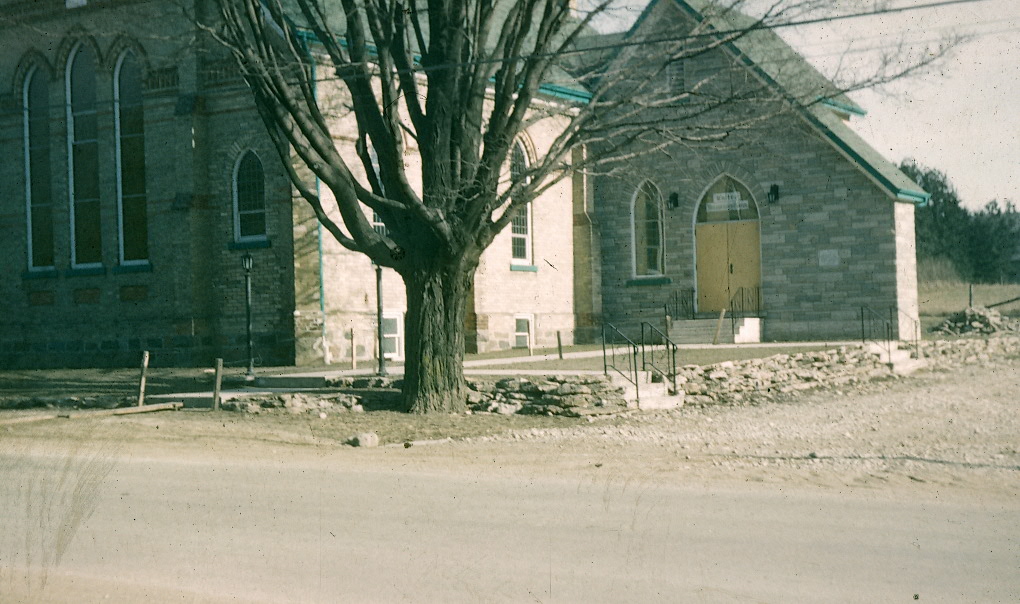
Two additions since then. Courtesy: Sider Photo Collection, MCHT.
Unknown former owners. In London, Ontario, the Missionary Church started in 1973 in a school;11 they built a first phase in 1977 (Westminster Park on Southdale Rd). Conditions changed and afterward they bought a building at 250 Hamilton Road which has glasswork above a later entrance reading “Gospel Chapel”.12 In its final years, the congregation was known as Shepherd’s Heart. This effort closed in 2001, and the latter building sold to Grace Community Church in 2006, and is now owned by Faith Gospel Chapel, an Ethiopian church.
The Stratford city mission began in mission halls, but in 1922 they bought 122 Downie St, a building that from photographs looks suspiciously like a former church meeting place with rounded Georgian-style windows, whose, I do not know. It could have been a business. They used that site until building a new place in the 1950s. The Toronto East End Mission on Parliament St sold their row house hall and bought a small church hall on Jones Avenue about 1913.13 They changed their name to Grace Chapel in 1936 when Sam Goudie was their pastor. I don’t know yet who built or when that hall was constructed.14 The United Missionary Church congregation moved to their new building in the O’Connor Hills suburb in Don Mills, Toronto, in 1962. Several Barrie church planting efforts (Faith, Victory Acres, New Beginnings Fellowship, and now Hope City), have also used former church buildings, one of which looked much like Lakeshore in North Bay.15 Hope City uses a retail-type corner office complex.

Unusual Solutions. The Angus church planting effort (1988), initiated by the Stayner congregation seems to have used a renovated gas station toward its closing in 1999.16 The McAdam church in New Brunswick, renovated a theatre.17 One of the Haitian congregations in Montreal (Elim) in the 1980s bought a triplex building and used one floor for their church services.18 I have already referred to the willingness of EMCC congregations to rent current or occupy former secret society halls (Stayner 2nd Line—Grange Hall, Banfield—Foresters Hall on Brunswick Ave, then Wychwood (Oddfellows) Lodge on Vaughan Rd19) when convenient. In 1946, Calvary Church in Owen Sound, up to that time known as Beulah Mission using their own building constructed in 1903, bought the former city Armories (Canadian armed forces building). They sold their former meeting hall to the local Jewish community as a synagogue. Brunswick Avenue “Bethel Chapel” also sold to a synagogue.20
Still others. Lakeshore Church in North Bay was able to extend to the nearby town of Callander in 2002, and bought a fairly new Brethren Bible Church building to help the new membership along.21 The only instance I know of EMCC purchasing a Roman Catholic building was in 2003, helping the River’s Edge Community Church (begun 2002, now independent) in Montreal, assisted by Centre Street Church, Calgary, and many work teams from Country Hills EM Church, Kitchener.22 The former St Augustine’s of Canterbury Church was a Cathedral.23
A building with the longest list of former owners might be the meeting hall of the former Wellesley Missionary Church (1992-2001). Their wooden frame building was constructed by the German Swedenborgians in 1858, used for a long time by a Union arrangement of Presbyterians and Methodists and then by the UCC until 1965. Zion Mennonite Church used the building, then a Pentecostal group, then an Independent Holiness Movement group (which became the Missionary Church affiliate). When the Missionary Church congregation dissolved, the building was rented, then bought by still another Pentecostal group, last I heard.24
Not quite as complex, but just as curious was the building used in Hespeler. The Hespeler appointment developed (1898) from the old New Mennonite congregation in Blair, a rural village on the west side of what is now the amalgamated (Preston, Galt, Hespeler) city of Cambridge, ON. At a time they used a hall on Adam Street, which the Salvation Army bought in 1922. That year, the MBiC bought the former Evangelical wood frame church building of 1863 and met there until the 1990s.25 The building was sold to a Chinese Alliance congregation while the EMCC congregation was proposing a new style of land use in the area. Zoning problems led to the collapse of the plan and the congregation, as I understand it, unfortunately.

Courtesy: Sider Photo Collection, MCHT.
When buildings are bought or rented from others, not much can or needs to be done to alter the fundamental architecture. Some were white wooden-sided or wooden frame buildings (Hespeler, Wellesley, St Clair in Sombra, Elk Lake). Many rural ones were “rural Ontario vernacular Gothic” (Effingham—used by Vineland in 1944,26 Stayner, Paisley, the first Mindemoya building). Those bought in the small towns would almost always be some version of what I class together as “Gothic Revival”: Plattsville, Sarnia, Auburn, Lindsay, Clinton, Guelph Royal City, the Berean Baptist building in Sudbury). A few newer buildings bought are “modern” bungalow-style (Callander Bay, the first building in Sudbury, some in Barrie, a former one story retail structure for église lapêche, Wakefield, QC27). Others used or acquired schools (Tavistock, Faith Missionary–Ottawa, Mattawa, Triumph Chinese—Toronto, Upper Thames, Chesley).
This catalogue of acquired meeting places for early and current EMCC congregations is by no means complete, but suggests the willingness of the EMCC to adapt, spend money, save money, and attempt great things for God. I do not blame the denomination for trying to be all things to all people. Maybe (definitely) we could be wiser, but I honour all the pastors, congregations and district and national leaders for doing their part in offering the gospel to more people in more places as they had the people and means to do so. Tabernacle meetings, city missions, church extension, church planting, living missionally, following the way of Jesus, café churches, and other notions have come and perhaps have gone as theories and programs, regretfully without always satisfying the goal to glorify God well. But sometimes they do.
All Canadian churches that love the Lord Jesus Christ, the EMCC included, must follow him in fruitful times and drought times. I remember the saying of Dr Ian Rennie, my church history professor at Ontario Theological Seminary (now Tyndale Seminary), that when the Church is living in recession, times needing new awakenings, Christians must pray, be faithful, and offer their service to Christ and his Church, not growing weary in well doing. Such is the need of the Canadian Church today.
Banner: A church building used ca 1980s in Barrie, ON: Signboard seems to read “Faith Missionary Church.” Courtesy: MCHT.
Addendum to “EMCC church buildings Part 4”
Tavistock Missionary Church (1988) used a school (Tavistock Public) and other sites until 1999 when they moved into their new building.28
1Edward Chester, Great is Thy Faithfulness: Centennial Celebration Stayner Missionary Church 1890-1990 (Stayner, ON: Stayner Missionary Church, 1990) p 2-3; and “Stayner History of Centennial United,” (2006).
2Allan McGillivray, The Churches of Uxbridge-Scott ([Zephyr,] ON: By the Author, 1978).
3Charles Gingerich, The Peninsula Pilgrims: A History of Bethel Church (Lion’s Head, ON: RDP Graphics, 2007) p 25.
4“Emmanuel Evangelical Missionary Church History 40th Anniversary 1968-2008.” File in MCHT Box 1201.
5“Bright’s Grove Church Closes,” EMCC Eastern District Communiqué (Vol 39 No 2 Mar/ Apr 1996) p 1; MCHT Box 1005.
6Hubert Ryan, History of Riverside Church (Toronto: By the Author, 2003) p 2-7.
7https://wcma.pastperfectonline.com/Archive/4A0EB4E2-E1EF-4275-847F-323792431250
8Judging by photos on the internet and in the MCHT.
9https://plattsville.church/about
10[Grant Sloss] “Sarnia Relocates,” Ontario Dispatch (Vol 20, No 8, October 15 1976) p 1. “Sarnia Evangelical Missionary Church—Church Profile,” May 6 2000, p [3].
11[Grant Sloss], “London Pastor Installed in Impressive Service,” Ontario Dispatch (Vol 20 No 8 October 15 1976) p 1.
12London files in MCHT Box 1004.
13EMCC History, “The Strange Case of the MBiC East End Mission,” April 26 2024.
14A Toronto real estate group in 2020 when it was for sale estimated it was built about 1950. How wrong they were! https://www.blogto.com/real-estate-toronto/2020/11/toronto-home-still-operates-church-sale/
15Barrie files in MCHT Box 1201.
16Angus MCHT Box 1026.
17“McAdam Missionary Church Presents,” [bulletin] (early 1995), MCHT Box 1018.
18Glenn Gibson, “Special Extension ‘Over and Above’ Project,” Canada East Communiqué (October 1987) p 7.
19F Arthur Sherk, Keeping Faith: A Centennial History of Banfield Memorial Church (Willowdale, ON: Banfield Memorial Church, 1997) p 18, 38-39.
20Ellis Lageer, “EMCC Pastors’ Data 1850-2005,” (2005). MCHT Box 2510.
21John Inthof, “Thirty Years of Ministry for John and Jenn Inthof,” https://callanderbaychurch.ca/2020/05/12/30-years-of-ministry-for-john-jenn-inthof/ .
22Eileen Lageer, Common Bonds: Story of the Evangelical Missionary Church of Canada (Calgary, AB: Evangelical Missionary Church of Canada, 2004) p 246, 342.
23Lorenzo Della Foresta, “Unplugging the Church from the Modern Matrix,” emcc.ca (Fall 2004) p 11.
24Files in MCHT Box 1030.
25Rosemary Willard Ambrose, Waterloo County Churches: A Research Guide to Churches Established Before 1900 (Kitchener, ON: Waterloo-Wellington Branch Ontario Genealogical Society, 1993) p 50, 56.
26Skip Gillham, ed, The Church on the Hill: Vineland Missionary Church 1881-1981 (Vineland, ON: Vineland Missionary Church, 1988) p 9.
27G Keith Elliott, “Our Church in Quebec: Eglise de LaPeche,” emcc.ca (Fall 2001) p 7.


 EMCC History
Leave a comment