The Evangelical Missionary Church of Canada in Ontario, throughout its history, has made use of buildings constructed by others. We have few unique architectural needs, if any, so we can adapt a worship space fairly easily. In this two-part post, I will look at the gaps, the schools, the halls, and begin the record of buildings bought from other denominations. Next post I will continue that review and note a number of unusual church building sources the EMCC has used and some we are still using. I am not analyzing the architecture so much as asking what were they using, and who built them?
Co-construction. I have already mentioned the practice in the first generation of constructing a worship hall with other denominations.1 Except for the Blair meeting hall (1852) and New Dundee (1862), both built with German Baptists, and the Dixon Hill building (1863) built with the Christian Church, I don’t know of any photographs of these sites. The New Mennonite Church mainly used homes, schools and barns. I mentioned in my post about New Mennonite Church preaching locations that many are not known.2
Unknown locations. The problem persists in the United Mennonite, Evangelical Mennonite and Evangelical Mennonite Church era (1875-1883). Under the Mennonite Brethren in Christ Church, Bright Mission, which included New Dundee, we have no information where the worshipers met in short-term appointments at Pinehill, Blandford, Innerkip, Burford, New Hamburg, Baden or Poole. Where they met at “Bright” itself is not even recorded. In New Dundee village they rented a school house sometime in 1870-1878. Mennonite Brethren in Christ supporters met in Mannheim, just SW of Berlin (Kitchener) in Wilmot Township for a few decades, but where is not plain to me. I have seen a reference to a “building” sold in 1960, but have no idea where it was.3 The Elmwood field included at times places known as Allan Park and Dobbington, at both of which I do not know what sort of buildings were used or exactly where. Shrigley had a meeting at Proton Centre for a while—no info on the building used. These are just a few of those with no documentation yet. Former EMCC pastor Glenn Menard tried very hard to locate the exact sites of many Ontario Conference church meetings, and photographed many of the existing ones, but much more could be done.4 The Missionary Church Historical Trust (MCHT) is preparing a database of such records.
School Houses. I assume the Church in using one-room school houses, rented the buildings for Sunday use only. Few photographs of such early locations have been preserved.
While the MBiC Canada Conference (later called the Ontario Conference) was building up and preparing a Michigan district to become the Michigan Conference in 1896, they used, among other places, several schools in Michigan: Foster’s, Lanning and Miller’s. Missionary Church historians in Michigan will have to search for traces of those places if they wish.
In Ontario, Port Elgin opened a branch in a school house at Chippawa Hill, across the road from the Saugeen First Nations reserve for many years, and another one known as Sang’s School House. Mt Pleasant (Singhampton) began in Morrison’s School House in 1896 until they constructed their own building across the road two years later.5 Stouffville operated a Sunday School at a school at Mongolia6 in Markham Township a number of years.7 On the Bruce Peninsula, Hayes/ Hay’s School was used at Cape Chin 1899-1936 and shared with an Anglican group alternately.8 Manitoulin used a school called “Bock’s,” named after a prominent family in the church.9 The Sunnidale Township field also used Cain’s S H a few years, and possibly another called Spicker’s. Kilsyth (later renamed Squire) appointment south of Owen Sound had a branch at Van Dusen’s S H. Probably only local memory will be able to pinpoint these locations, if at all. Most of these school houses were used just a few years before either a congregation coalesced and a building was acquired, or interest receded.
Courtesy: Glenn Menard Collection, MCHT.
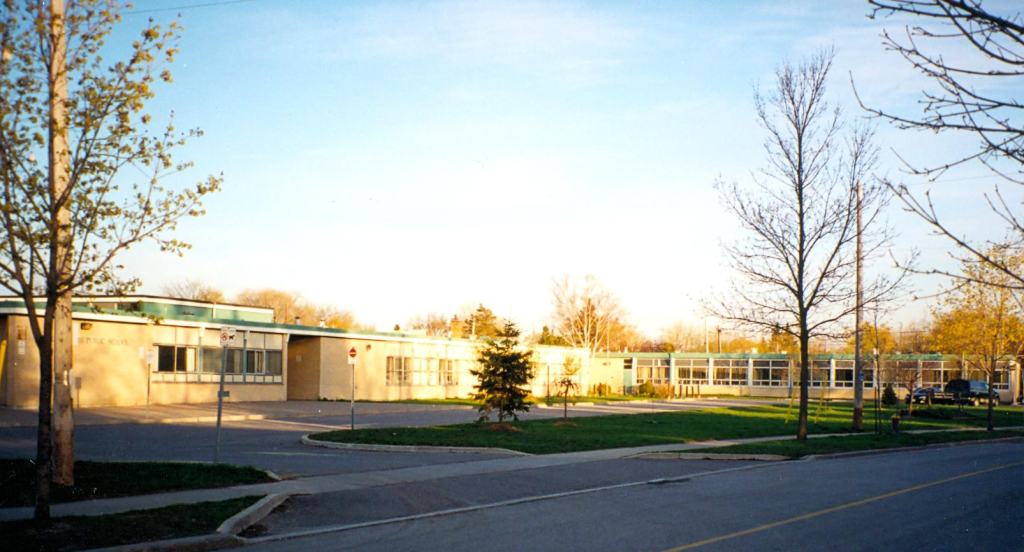
In more recent times, what became Lakeshore Church in North Bay began in 1960 when Earl and Holly Pannabecker rented space at Tweedsmuir Public School for 2 years, a few blocks from my family’s house. Most of that school building, including the auditorium, is demolished now and the rest used as a vet clinic. The Richmond Hill church planting used Beverley Acres Public School during its few years which ended when they merged with Banfield Memorial in 1972.10 The London church also began in a school (1973).11 Beechwood Missionary Church, which became Trinity EM Church, started out for ten years (from 1980) in Keatsway Public School, Waterloo,12 as had similarly the other Waterloo church, Lincoln Heights. It briefly met at Lincoln Heights PS right across the road from the eventual building (1965-1966).13 The second Mattawa church planting effort (1984-1993) met in a school most of its life.14 Toronto West Rouge (1967) began in a school as did, I believe, Toronto Redemption (1980s). West Rouge went on to lease space in a mall, which was an attractive solution for a meeting place for some.15 A second church planting in Brampton, known as Crossroads Community Church, met at a secondary school for over 3 years until the former Missionary Church property (Northwoods) became available when zoning requirements prevented the sale of that original site.16 The Ontario District’s Winnipeg, Manitoba, church planting used a school there for part of its life.17 Upper Thames EMC in Mitchell rented one school (2002) and eventually bought a vacant one (2011) as a permanent worship centre.18 Chesley EMC likewise bought a vacant school, even though school boards don’t like to sell off land, it being so hard for them to acquire land later.19
There is a reluctance in Ontario for school boards to rent to religious groups now. This resource may be at an end.

Poster: Billy Graham’s film Oiltown, USA came out in 1953.
Courtesy: Sider Photo Collection, MCHT
In the City Mission era in Ontario (roughly1897-1951), the Conference leaders or the City Mission women themselves found small halls or even houses with large rooms they could convert with benches or chairs, a pulpit and a stack of songbooks into preaching sites. Many were upper floors of businesses on main streets of the small towns they entered: Wairton, Woodstock, Southampton, Collingwood, Owen Sound, the earlier missions in Winnipeg,20 St Thomas, St Catharines, Aylmer, Stratford, Listowel, Petrolia, an earlier mission in Guelph, and Port Hope original site21 all used mission halls, sometimes for years.22 Three Toronto missions, two started by men (Brunswick Avenue and Parliament St, though women carried it on)23 and one by women (Toronto Junction, on Dundas), used halls or just available houses.
City missions, with their readiness to use store-front-type buildings, fit into the spectrum of rural and small town Ontario culture in its time period. Many Evangelical Missionary Church people have urban and middle class aspirations now and would avoid the inconveniences and cultural distance of such ministry sites, as Glenn Gibson implied in a study of EMCC members attitudes in the 1990s.24 Some charismatic movement groups embrace a “counter the majority” character and tolerate the image homes or store-front locations suggest to some. These days, EMCC congregations rent to others, mostly newcomer ethnic congregations, and they put up with our priorities.25
Ecclesiastical real estate. The Ontario/ Canada East District could also help establish new congregations by buying or loaning funds to a local group to buy a church building from other denominations. In at least two cases congregations actually bought an unused building, dismantled it, and used the materials for a new meeting place: the Manitoulin Island appointments, led by pastor Dow Sargeant, dismantled a vacant United Church structure at Snowville in the 1940s. The church people used its materials (1949) at Mindemoya when Clarence Hunking was pastor, for the first United Missionary Church site in that village after years of meeting in homes.26 The new Paisley congregation (1952) under Alf Rees, bought the former Orange Hill United Church building at Gorrie, ON, originally a Methodist New Connection hall built between 1855 and 1874 and rebuilt it in Paisley in 1953.27
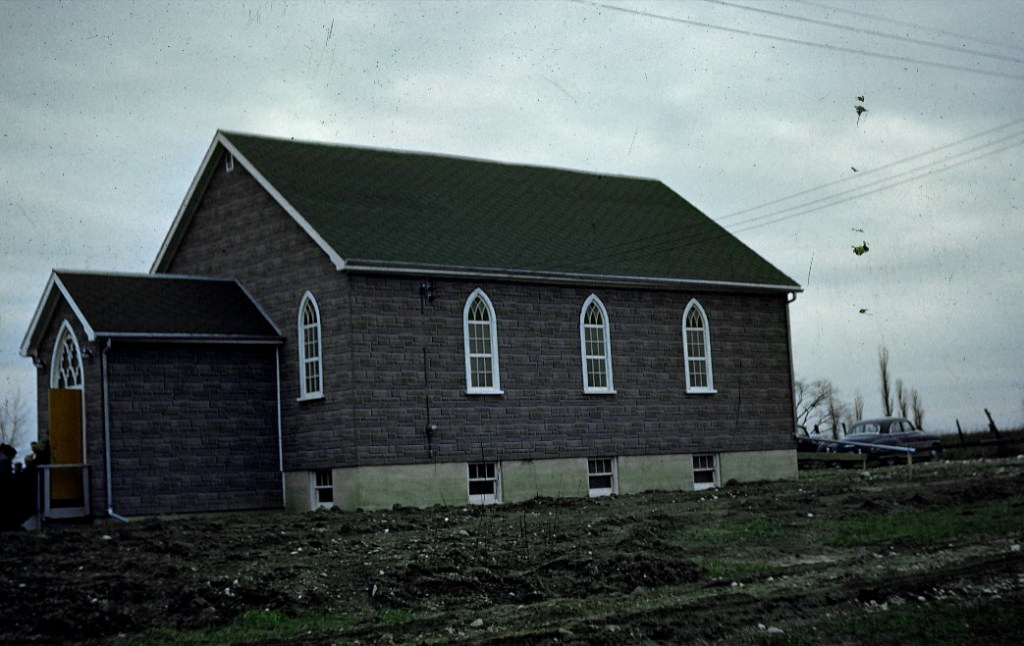
Long before those two ventures, the rural Elmwood field, from about 1875 shared, then bought, a United Brethren in Christ building there. It was finally sold off (1948/9) when the membership shifted to the nearby town of Hanover (congregation started 1901), where they had bought another former United Brethren in Christ building in 1904. This was their building until 1961, and in 1963 a new church building was constructed.28 Still another former United Brethren building was bought in Listowel in 1926, by then owned by the newly merged United Church. That structure was built in 1886, but was redundant to the merging of Presbyterians, Methodists and Congregationalists in 1925.29
Next blog we will continue recovering if we can, the origin of buildings bought for worshiping Missionary Church groups—some ecclesiastical, some rather unconventional.
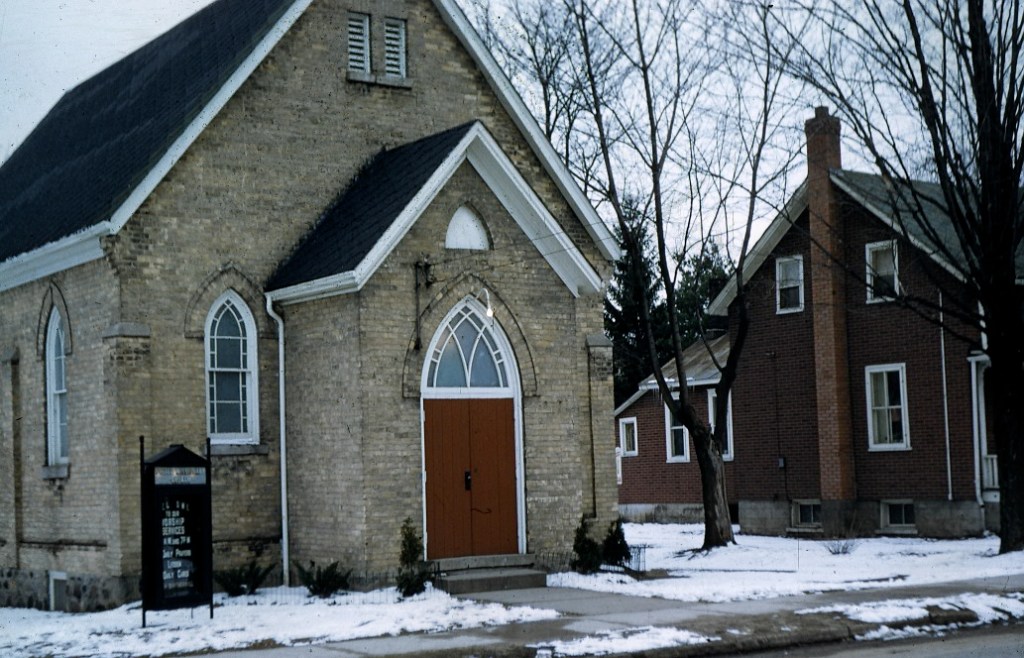
Banner: Hanover UMC ca 1953, former United Brethren in Christ building of 1886, bought by MBiC in 1904, a modest Gothic Revival meeting place. Courtesy: Sider Photo Collection, Missionary Church Historical Trust.
1EMCC History, “EMCC church buildings Part 2: Built, bought or rented,” June 21 2025.
2EMCC History, “New Mennonite Church of Canada West and Ohio,” May 8 2024.
3The Wilmot Township Centennial history does not list an MBiC meeting house, nor does Rosemary Willard Ambrose, Waterloo County Churches: A Research Guide to Churches Established Before 1900 (Kitchener, ON: Waterloo-Wellington Branch Ontario Genealogical Society, 1993).
4Glenn Menard Collection, Missionary Church Historical Trust, Boxes 1101-1103.
5Clare Fuller (2022), GAMEO, https://gameo.org/index.php?title=Mount_Pleasant_Evangelical_Missionary_Church_(Singhampton,_Ontario,_Canada)
6Trevor Watson, “Mongolia,” in Canadian-German Folklore “Pioneer Hamlets of York” (Vol 6 1977) p155.
7Carolyn Ratcliff, Historymaker: One Hundred Years of Faithful Ministry (Stouffville, ON: Stouffville Missionary Church, 2003) p [11].
8Charles Gingerich, The Peninsula Pilgrims: A History of Bethel Church (Lion’s Head, ON: RDP Graphics, 2007) p 47.
9Gordon Wilson, ed, The 100 Year History of Salem Missionary Church (Spring Bay, ON: Salem Missionary Church, 1990) p 11.
10J Arthur Sherk, Keeping Faith: A Centennial History of Banfield Memorial Church (Willowdale, ON: Banfield Memorial Church, 1997) p 56.
11Nicholas Wilson Public School; brochure of Westminster Park MC when Bill Richardson was pastor, MCHT Box 1004.
12Ruth Morris, Upon This Rock: A History of Trinity EMC (Waterloo, ON: Trinity EMC, 2000) p 10.
13Zack Thornton, (2012), “The Story of Lincoln Heights Evangelical Missionary Church,” with help from Al and Brad Ullner and Kathy Duncan, p [1-2].
14Glenn A Gibson, “Mattawa Church Closes,” Canada East Communiqué (Nov/ Dec 1993) p 4.
15MCHT Box 1003.
16John Hedegaard, “Crossroads Church Finds a New Home!” EMCC Eastern District Communiqué (Vol 37 No 1 Jan/ Feb 1994) p 1.
17Peter Gibbins, “South St Vital Church,” Canada East Communiqué (Vol 27 No 2 Feb 1983) p 7.
18Ralph Van Oostveen (2012), “Upper Thames Celebrates Grand Opening.”
19David Oppertshauser, personal communication.
20EMCC History, “What Happened to the Manitoba Mission? Parts 1 and 2” May 25 and June 1 2024.
21Margaret Etcher Theriault, Hazel’s Story: A Life of Faith (By the Author, 2022) p 25. Hazel Hill, Margaret’s mother, called the hall “dreary and drab.”
22More details in EMCC History, “Women Preachers in the MBiC Part 3: Sarah McQuarrie,” March 30 2024.
23EMCC History, “The Strange Case of the MBiC East End Mission,” April 26 2024.
24Glenn Gibson, “Urbanization in a Rural Denomination: A Study of Pastoral and Congregational Values in the Missionary Church—Canada East District,” Ontario Theological Seminary class paper, 1992.
25I don’t know of any effort to tally the number of EMCC congregations renting to other groups.
26Wilson, p 25, 27. Photograph of the dismantling in “Palmerston and Wallace MC Sargeant Commemoration” album, 1970, MCHT Box 6010.
27Carol A McCulloch, ed, History of Immanuel EMC: Celebrating God with Us Through 60 Years of Ministry (Paisley, ON: Immanuel EMC, 2012), p 13.
28Everek Storms, “The Church that Love Built,” Emphasis (July 15 1980) p 18-19.
29Jenny Versteeg, Guarding the Deposit: A History of the Listowel Evangelical Missionary Church 1925-2025 (Listowel, ON: For the Author, 2025).


 EMCC History
Leave a comment