
Somehow I inherited through my grandfather, William James Oliver, a family Bible set of two volumes, printed in Boston in 1856. He inherited them from one of his great-grandparents, Philip Wade and his second wife, Susan. The spines have gone, and the cheap paper streaked various shades of brown, but the family name, “Philip & Susan Wade,” in gold letters still adorn the covers. Any number of Canadian families may have one of these big books if they have ancestors that go back to the 19th-century in North America. I take care of other Bibles passed down, including, from my Keffer forebears, Martin Luther’s Das Neue Testament printed in Halle, Germany, in 1804. That volume is a simple text with cross references. The big Family Bibles are something else.
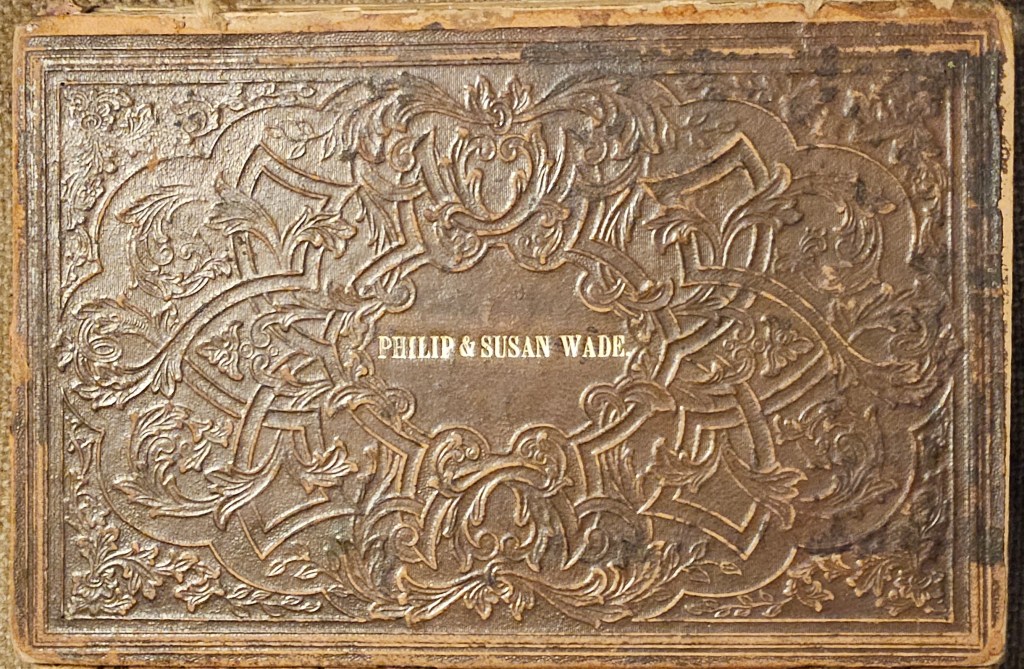
Bible salesmen roamed North America in the later 19th-century selling—well, Bibles.1 The Bible salesman trope has become a caricature in American media,2 but not in Canada, I think, for reasons I will mention later. Few Euro-Canadian pioneers had many books, but, if they were Protestants, they could be persuaded to buy a Bible. It was (and still is) one of the “means of grace” to read and study the Bible for oneself, with one’s family, and in Church settings.3 Adding the family names to the cover was a small extra charge. These heavy books (up to 7 kg) were not handy for personal Bible study, but stationed on a table for family Bible reading, an excellent custom, and so some of them are well used.
Like Pulpit Bibles. Many churches used to obtain a pulpit Bible for public reading, continuing the instruction of James I of England (actually started by Henry VIII) that there shall be a Bible provided in all the churches in his realm. They were so big they needed their own lectern to support the book. They were available for the admirable discipline of the many Bible readings mandated in the Book of Common Prayer liturgy. According to Alister McGrath, the original meaning of “Appointed to be Read in Churches” (my emphasis) as printed on the title page of many editions, was that the translation was designed to be readable out loud in public.4

In the United Missionary Church in North Bay, there was a large open Bible displayed on the communion table in front of the pulpit for many years. I never saw anyone read from it, or comment about its significance, though. Evangel Missionary Church, Kitchener, followed the same custom when I attended in the late 1970s, as did Lincoln Heights in Waterloo (Brad Ullner) up to 2020. Sometimes I secretly changed the pages to a different passage, but nobody seemed to notice.
Who Published Family Bibles. Printing of the Authorized Version was controlled by the Crown in the United Kingdom and for some time in its colonies. In England, consequently, the printing privilege (cum privilegio) and therefore a monopoly was granted to certain presses, in London, and at the Oxford and Cambridge University Presses.5 In Scotland, Collins in Glasgow had the royal privilege for Bibles.6 In the United States after their Revolutionary War it became legal for anyone to publish editions. It was expensive to produce at first, but selling Bibles could be big business.7 One of the favourite editions for Bible salesmen, because it made a good profit, was the family Bible with notes, indexes, Bible dictionaries, illustrations, and the optional pages for family records between the testaments. Many editions would include the Apocrypha. A local second-hand book store I visited recently had six huge 19th-century family Bibles for sale: three of them were American. One was an American Catholic edition, the other two bore the name of an American publisher in Philadelphia. One was published in England, and two others were published, one in Paris, ON, and the other in Toronto. The “publisher” on the title page could simply be the agency that retailed the books.
Not in Canada? None of these huge family Bibles were printed by the main providers of Bibles in Canada in the 19th century, the Canadian auxiliaries of the British and Foreign Bible Society (BFBS). All BFBS Bibles were printed in England. These 14 auxiliaries set up the Canadian Bible Society in 1904 and held a colonial relation to the BFBS, which continued to call itself the Parent Society.8 Scripture production in Canada really only began when the Canadian Bible Society became independent of the BFBS in 1961.9
The BFBS, by a policy going back to its formation in 1804, did not publish any Bible with notes or commentary that could be taken as confessional, sectarian or denominational. Consequently, family Bibles were not sold by the Bible Societies. The Bible Society was quite willing to sell Bibles at cost or even a loss to the destitute. They were peddled by traveling colporteurs, an institution that got its name from the activities of the French auxiliary of the BFBS from 1820.10 The Bible Society employed the colporteurs and often emphasized in the annual reports their selfless arduous labour. The word is not widely used in the USA and I had to teach my (American provided) computer dictionary to recognize it.

In the USA, Bible sellers were just called salesmen. Some of them were agents of the American Bible Society. The ABS also limited itself to publishing Bibles without “note or comment,” so they had competition from entrepreneurs printing the Bible. (That policy changed in 2001; https://theconversation.com/how-the-american-bible-society-became-evangelical-97525.) In the later part of the 19th century with railroads criss-crossing the continent, colporteurs and even the Bible salesmen were less necessary, and when large department stores started emphasizing mail-order shopping, such as Simpsons and Eatons in Canada, the Bible Societies felt the competition keenly.11 Like Amazon today, the department stores could buy in bulk, obtain lower prices per copy and undersell competitors. The family Bible did not disappear, but the demand changed.12 Roman Catholics were encouraged to read the Bible after the Vatican II Council in the early 1960s. Not surprisingly, in the USA, Catholic Bible salesmen appeared and were followed in a 1969 documentary called “Salesman.” Christian ministries and even American presidents make money from the KJV, as the Bibles cost a few dollars to make, but can sell for ten times the cost.
Bibles in the Trust. The Missionary Church Historical Trust has a few family Bibles, apart from some smaller personal Bibles used by ministers or missionaries.13 The family Bibles are typically big and heavy, old and fragile now because many were poorly made with cheap paper. They take up valuable space in our packed MCHT room in Elmira, ON, but each has a tale to tell. The family Bibles can hold unique family information and of course physically link us to earlier generations of the EMCC.
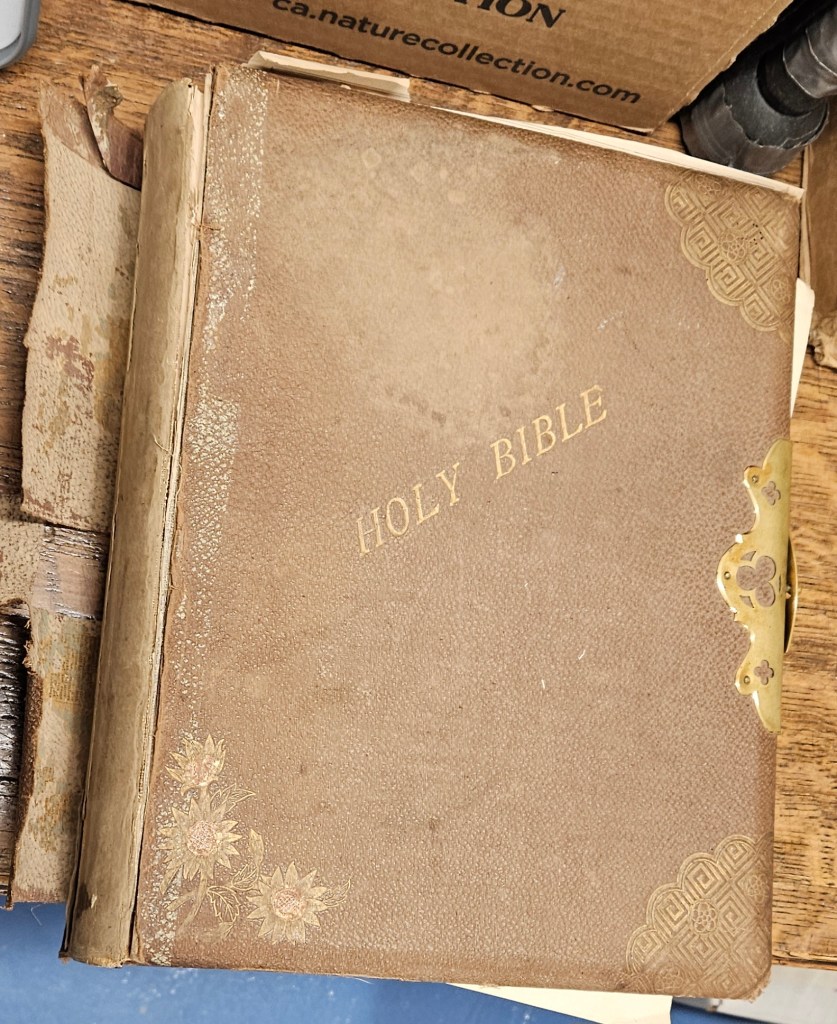
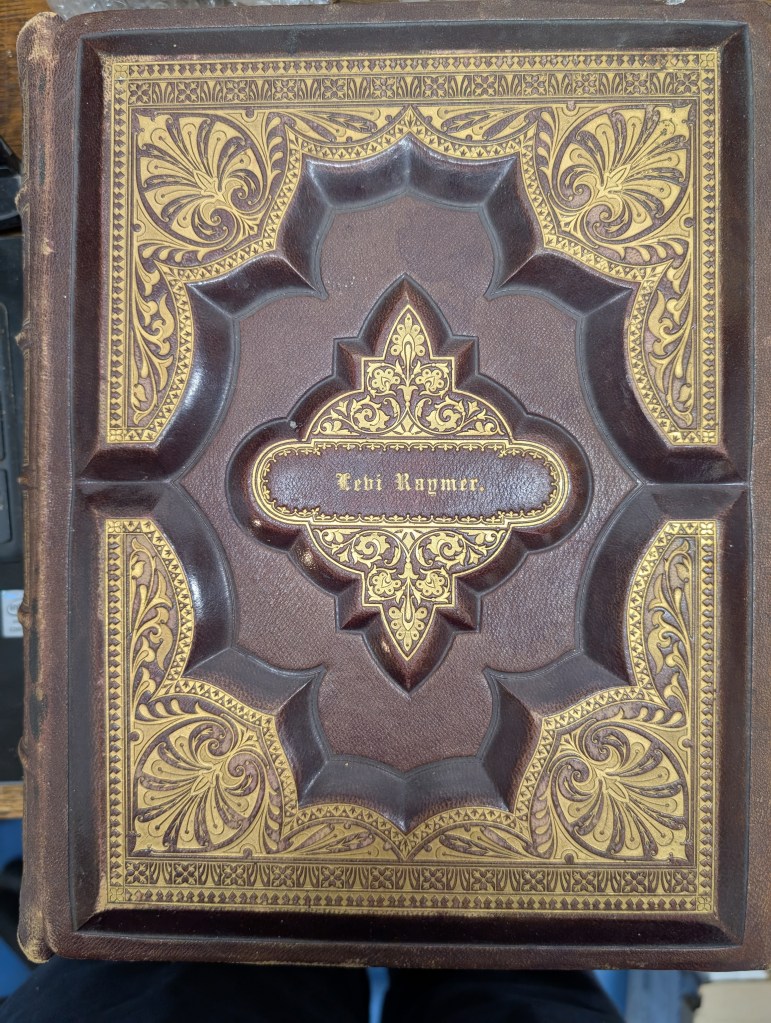
Among our treasures are the family Bibles of 1) Fannie and Levi Raymer (Sunnidale/ Stayner, ON); 2) the Hood family of the MBiC in Wallace/ Palmerston; 3) the Gimbel/ Lutz Family; and 4) the Christina (Shirk) Weber Family.
The Raymers’ Bible is an A J Holman & Sons Bible from Philadelphia, one of the most prolific Bible publishers. The 1881 Raymer Bible was up to date: the NT was the Revised Version of 1881.
The Hood Bible, copyright in the USA in 1879, was provided by Oberholtzer and Co, Berlin, Ontario.
Christina Weber’s Bible was published in 1876 by Collins of London and Glasgow, with minimal extras, basically a family register and the Psalms of David in metre for singing. She gave her Bible to her niece, Mrs Edith (Sherk) Kaster of New Dundee. Before her marriage to Moses in 1902, an MBiC elder,14 Christina Shirk was at some point a Markham Methodist, judging by the Quarterly ticket given her in 1887 and pasted in the Bible.
The Gimbel/ Lutz Bible was a Martin Luther German edition printed by the Evangelical Association printer in Cleveland, OH, in 1876. This branch of the Gimbels, though mostly Presbyterians at Freeport, ON, had an Evangelical Association connection through descendants (Waterloo Generations website).
Nelson Raymer, a grandson of Levi and Fannie, owned a thick basic text Die Heilige Schrift, Luther’s translation, printed in 1802 in Halle, Germany, its 228th printing. I don’t think this copy was used personally by Nelson, as he collected other old books in German which the family donated to the MCHT, including a hymnbook, Die Gemeinshaftliche Lieder Sammlung published by Benjamin Eby in Berlin, Upper Canada (4th ed 1849).
Did other Mennonite families buy these huge Bibles? Yes, they did. It is not clear from the descriptions of Bibles processed by the Mennonite Archives of Ontario whether they were these large Bibles I am talking about, but some of them evidently were.15 Mostly the MAO retained or copied only the genealogical pages from the Bible (they would be too bulky to keep unless they were rare editions). Though many Mennonite families might have German or English Bibles, these big family Bibles might be seen as worldly, especially if they had the family names in gold lettering on the fancy covers. The Hood family in Wallace Township, Perth County were of English origin, and perhaps did not inherit the attitudes of the Waterloo Mennonites. It has photographs of family members printed on metal, unfortunately unidentified and maybe unrecoverable now.
The sample size is too small to really make generalizations about the early EMCC and the family Bibles. If any readers have information about Bibles known to you, I would gladly publish more stories about them.
Banner: “Publisher” Oberholtzer and Co, Berlin, Ontario, 1879. Courtesy: MCHT
1Harry Briley, “Old Family Bibles,” [Livermore Heritage Guild Monograph] gives a reasonable catalogue of features such Bibles might have. https://www.lhg.org/Documents/General/LHGBiblesP1RevJ.pdf
2https://usreligion.blogspot.com/2008/05/where-have-all-bible-salesmen-gone.html
3“Means of grace” are commonly listed, for individuals, as family and private prayer, Bible reading, attendance at Christian worship, participating in the Lord’s Supper, fasting, giving to those in need, and such actions:
https://www.umc.org/en/content/the-wesleyan-means-of-grace
4Alister E McGrath, In the Beginning: The Story of the King James Bible and How it Changed a Nation, a Language, and a Culture (New York: Doubleday, 2001) p 206.
5McGrath, p 294.
6Stuart Wayne Barnard, “Religious Print Culture and the British and Foreign Bible Society in Canada 1820-1904,” PhD dissertation, University of Calgary, 2016, p 302. https://ucalgary.scholaris.ca/server/api/core/bitstreams/2cea37c5-f912-4caa-b502-f1943ae92823/content
7https://www.nytimes.com/1973/06/10/archives/bible-salesmen-i-feel-healthy-i-feel-happy-i-feel-terrific-bible.html
8Edward C Woodley, The Bible in Canada (Toronto: J M Dent and Sons, 1953) p 103-112.
9It is a long story; Gerald E Benson and Kenneth G McMillan, To the Ends of the Earth: A History of the Canadian Bible Society (Toronto: Canadian Bible Society, 1998) p 84-87.
10Barnard, p 190.
11Barnard, p 303.
12The Fuller family has a 1955 Bible published in Chicago of this 20th-century type presented to a UMC minister (Arthur Walsh) in Kitchener in 1968. What is quite revealing about differing attitudes to war (Mennonites would never touch this) are the Family Information pages providing detailed forms for the military service record of up to four family members.
13Some personal English Bibles and Testaments in the collection were owned by Elder Peter and Martha Cober, one time City Mission Workers Myrtle (Lageer) Good and Edith Raymer, Hazel (Warder) Priddle, wife of Rev Ray Priddle, and missionaries Edna Pridham and Edma (Fusee) Brubacher. The MCHT has many Bibles in Nigerian languages used by UMS missionaries there.
14Weber’s profile to 1920 is in J A Huffman, History of the Mennonite Brethren in Christ Church (New Carlisle, OH: Bethel Publishing, 1920) p 272.
15Family Bibles inurl:https://uwaterloo.ca/mennonite-archives-ontario/catalogs/archives

 EMCC History
Leave a comment