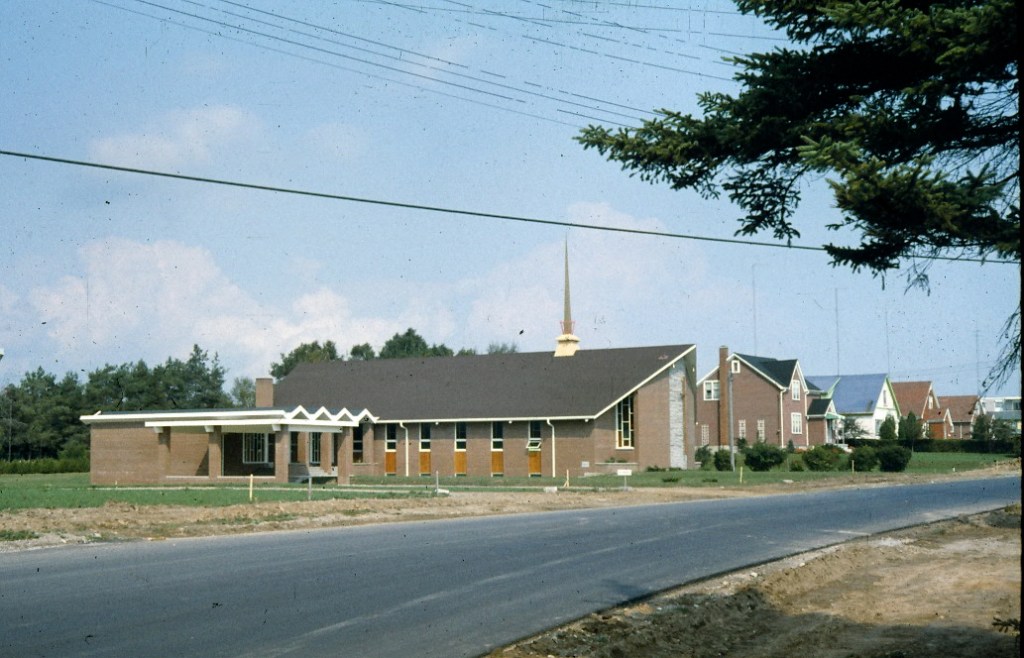
When the 1960s opened, EMCC congregations started building worship spaces that firmly turned away from the Gothic ideal that had dominated Canadian church buildings since the 1850s. I should mention that in Ontario, the EMCC almost never used the white colonial style church building used by Baptists, especially in the USA, or used classical pillars. I can’t think of a single example. I have worshipped in dozens of church buildings in Canada and Nigeria (and a few in the USA), but until I started this series I rarely paid much attention to the architectural style if I did not worship there over many years.
The baby boom was starting to fill the churches, and the United Missionary Church in Ontario was finally turning to the cities. Not that the early EMCC had built many Gothic structures—Banfield Memorial (1947) on Vaughan Rd, Toronto, comes to mind as about the only one that used windows and inner arches with pointed spires inside and out. Many buildings of the 1950s had a few windows in the Gothic style.1 but many smaller churches still built with rectangular windows and ordinary house-like roof lines.2

Courtesy, Missionary Church Historical Trust.
Most of the worship spaces were actually quite plain, in small halls with flat plastered ceilings and walls and pulpits in small shallow niches, or even just standing out from a flat back wall, perhaps paneled to head height in dark wood. Many had Warner Sallman’s 1940 “Head of Christ”3 as the only decoration apart from bouquets of flowers in season.

“Christ at Heart’s Door” and a few ferns.
Pre-1964. Courtesy MCHT.
I will look at the buildings the UMC/ Missionary Church / EMCC bought from other groups (and they were many) in a later blog.
The new style of the 1960s was the laminated-beam roof that still said “reverent space” but could be filled with whatever meaning the congregation added from there. Listowel UMC (on Davidson Ave-1963),4 built in the new style spreading across Ontario that even Anglican5 and Baptist churches6 used. Some examples are Toronto-St Clair-1950s, Toronto Grace Memorial-after 1962, Stayner UMC-1963, Hanover-1963, Stouffville-1968, New Dundee Bethel-1968, Pembroke’s First Missionary-1969, and Waterloo Lincoln Heights-1970.)

Courtesy: MCHT
A few buildings used coloured-glass window panes in a few basic colours (Kitchener Evangel, Waterloo Lincoln Heights, Hope Chapel, Collingwood) that a later generation thought made human skin look ugly, but the earlier one did not think so, apparently. A few churches inherited stained glass windows (Plattsville, Hespeler) when they bought a ready-made structure, others added a modest stained-glass window or two (Toronto Banfield Vaughan Rd, Kitchener Bethany, Stratford Elgin Memorial.7

(Linwell Rd) in the 1950s. Courtesy: MCHT.
North Bay’s Lakeshore church building (first phase 1964) was somewhat unique in that the building, by home builder Robert Shantz, who had been raised a Mennonite in Waterloo, designed a somewhat typical long nave meeting hall but with a low ceiling. Not a hint of a high ceiling to raise the gaze. As the church grew, the building grew out rear-wards (2nd phase 1983).
After the 1970s most newer church buildings in the EMCC followed the trend of “open interior” architecture. Two churches even built gymnasiums (“multipurpose meeting spaces”) as their worship halls: St Catharines Bethany Community-1979 and Kitchener Country Hills-1989.8 Worship spaces in smaller congregations tended to look like large living rooms: some examples are Waterloo-Trinity-1990,9 Paisley-Immanuel-1989,10 the reconstructed Stayner auditorium-199011. The meeting spaces tended to be square, and placed the worship leading (preaching, instruments) in one corner. This allowed a somewhat closer and more rounded congregational arrangement than the old long nave that encouraged spectators rather than participants. These building plans needed more land than a small city lot.

Larger worship spaces tended to become like theatre stages12 with the possible danger of again reducing the congregation to spectators, a danger worship leaders work to overcome by immersing the worshipers in sound and body motions, call and response quasi-liturgies and so on. There has been debate about whether people like darkened auditoriums or like curtains open and lights all on. It seems the generations can’t decide.13 Some of the EMCC congregations which built these wider church spaces have been: Sarnia new auditorium-1979,14 Kitchener Faith-King St-1979, Hanover new auditorium-1980, Stratford Elgin Missionary-1985, Markham Missionary on Major Mackenzie Dr-1987,15 Palmerston EMC 1988,16 Toronto-Banfield Memorial-1988, Lion’s Head Bethel-1997, St Catharines Bethany Community-most recent addition early 2000s,17 Listowel EMC (on Tremaine Ave) 2003,18 Stouffville Eastridge-2004, There is little attempt to imitate historic church architecture. The floor layouts remind one of bungalows. Accessibility is everything and provincial building codes require it as well!

Richardson and Richardson just call these architectural designs “Modernist.”19 Many of them can be quite beautiful to the eye. Most churches in the EMCC, with few wealthy patrons, have always been constrained by budgets to just reach functionality.
Space to meet together and clear communications are the main preoccupations, reflected in complex sound and light systems. When Dr Tom Dow taught us homiletics at Emmanuel Bible College around 1980, we had to project our voices—there was no guarantee we would have adequate sound systems. I first preached in small buildings that had no microphones at all (Sudbury, Elk Lake). Some buildings have excellent acoustics—the Listowel Davidson Ave laminated-beam building was said to be superb for choirs. But times have changed, everybody uses mics, even in small rooms. The gymnasiums generally have atrocious acoustics, until engineers are called in to install sound-dampening panels. My engineer brother calculated the needs of his church hall, but at first only half of his recommended paneling was installed. With not much improvement, the church solved the problem by purchasing the recommended surface area of panels after all.
Followers of Jesus Christ worship God whatever the space used, but as I have barely hinted, our worship spaces say things about us and to us. Much of Canada has a cold continental climate much of the year, and a short possibly very hot summer. We need shelter if we are to meet without distraction. In addition Christians usually build what they are culturally comfortable with and can afford. This is not always true in the two thousand years of our history or in every place. To this day, some countries can make it very dangerous for believers to meet in any place at all. We stand by grace and live for peace.
Banner: Kitchener Faith UMC ca 1965 on Fergus Ave. Courtesy: MCHT.
1Eg Stratford Charles St-1953, St Catharines Church Rd (Linwell Rd)-1954.
2Gospel Centre, Eau Claire (1955).
3https://en.wikipedia.org/wiki/Head_of_Christ
4Jenny Versteeg, Guarding the Deposit: A History of the Listowel Evangelical Missionary Church 1925-2025 (Listowel, ON: For the Author, 2025), p 27 (exterior), 30, 41 (interior).
5Eg Holy Trinity Anglican, Wilson Avenue, Kitchener-1965.
6I’ll find an example.
7Now just “Elgin Missionary.”
8https://www.countryhillschurch.ca/about-us
9Willis Hunking, in Ruth Morris, ed, Upon This Rock: Trinity Evangelical Missionary Church 1980-2000 (Waterloo, ON: Trinity EM Church, 2000) p 26-28, 31 (interior photo).
10Carol A McCulloch, ed, Immanuel Evangelical Missionary Church: Celebrating God With Us…Through 60 Years of Ministry (Paisley, ON: Immanuel EM Church, 2012) p 36.
11You will notice I avoid calling the worship space a “sanctuary,” which I take to be an alien theological concept to the EMCC, though often used.
12The McAdam Church in New Brunswick actually renovated a movie theatre!
13Carolyn Arends, “Purpose over Preference,” in Faith Today (Nov/Dec 2018) or https://renovare.org/articles/purpose-over-preference.
14“Sarnia Evangelical Missionary Church: Church Profile-May 6, 2000,” accessed from Church website, no longer available, p [3].
15https://markhammissionary.ca/about/our-history
16https://www.palmerstonemc.com/history
17History wall in the Bethany Community Church hallway, an excellent 125th anniversary project.
18Versteeg, p 67 (interior).
19Peter Richardson, Douglas Richardson and John de Vissers, Canadian Churches: An Architectural History (Richmond Hill, ON: Firefly Books, 2007) p 391-393.


 EMCC History
Leave a comment