The Church exists whether we use buildings or not! Our heavenly Father knows when we need them. Nevertheless, the “medium is the message,” as Canadian media theoretician Marshall McLuhan said. Worship spaces convey meanings in addition to the words spoken in those spaces, as architects continually insist.1 As Tiffany Robinson recently wrote in Faith Today, “Do the differences between these worship spaces actually matter? Well, yes and no.”2 Buildings shape communities, as communities shape buildings.
Here I will talk about the buildings used and constructed by the earliest decades of the Mennonite Brethren in Christ stream of the EMCC in Ontario. Similar accounts could be written of other Conferences and districts of the Missionary Church. Our buildings convey meanings. Evangelical Association buildings (some of which became part of the merged EMCC in 1993) are possibly better documented, but I will have to look at that later. Many were pictured in the Evangelical United Brethren Canada Conference history of 1964.3
I am not an architect, so my comments on church buildings are impressionistic and amateur, in the original sense of “one who loves,” at best. Years ago I found a book, published by the former Ryerson Press, which appreciated Canadian church architecture with black and white photographs of actual church buildings in Canada and plan drawings to depict what purposes the builders had in making their designs. I left it in Nigeria, of doubtful use there, but maybe some students will find it and think about building choices they might make in their careers as pastors. At this level everyone is a player. Send me your thoughts! Remember: Buildings Are Not The Church!
Church versus buildings. Please consider that most of our church historians confuse a church (meaning a congregation) and a church building (meaning, of course, a physical structure of, say, wood or brick). The first use is biblical. English “church” and Scots “kirk” both come from the Greek adjective “kuriakos” meaning “of the Lord.” Most languages that borrowed from Greek used “ekklesia,” meaning “assembly.” I know many say it means “called out ones” but that is an etymological fallacy, to equate the word origin with the word meanings as used. The use of “church” for a building is a long standing custom in English (église in French, igregia in Portuguese, similarly in most languages for that matter. Hausa in Nigeria has produced ikilisiya as well as ekklesiya). But this is not biblical if only because none of the first generations of Christians, and therefore not until long after the writing of the New Testament, constructed places for the community to meet. They met outdoors, the colonades of the temple in Jerusalem, their homes,4 catacombs (in Rome), rented commercial spaces,5 or possibly modified their homes to accommodate larger meetings.6 They certainly did not call their meeting places “the house of God.” Specially constructed buildings began in earnest only after Constantine issued his Edict of Toleration legalizing (not establishing, there’s a difference) Christianity and started funding construction of imperial basilica-style meeting places, in AD 314. With impressive buildings came the custom of transferring language for the Temple in Jerusalem in the Old Testament to Christian meeting places.

Credit: Kilbourn, ed, Religion in Canada (McClelland & Stewart, 1968) p 14-15.
Early EMCC worship spaces. The precursors to the MBiC in Ontario, the New Mennonite Church, 1852-1875, were a few hundred members scattered over several counties in Ontario. They met in homes, but they also shared structures with others. EMCC History looked at the New Mennonites and where they met for worship in a couple of blogs. The MBiC formed after the first generation of Mennonite settlement, and usually did not use log school rooms or log church buildings, the way earlier groups had to, except in Didsbury, Alberta in 1894, which was a pioneering situation. Our history books concentrate on buildings wholly owned by the denomination, but that gives a severely skewed picture of what was used by the Church. Many places used for worship were temporary sites: homes, barns, school houses, community halls, and rented church buildings of other denominations, and they did not usually document those much. Most local church histories have a lot of memories of their own self-constructed church buildings, how they built them and renovated them. We spend a lot of time in our buildings, so the wealth of detail, and even affection, is not surprising.
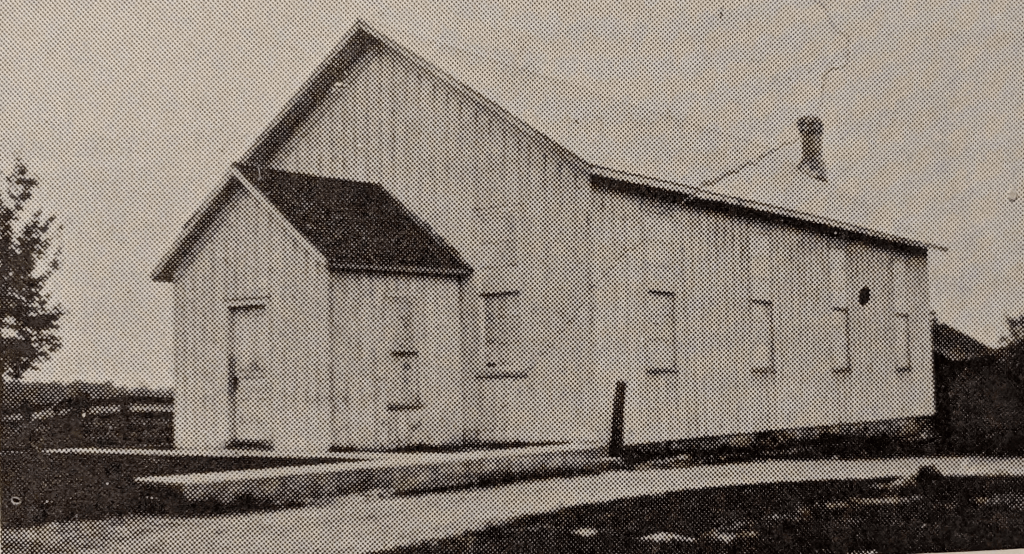
The first builders in the MBiC were Mennonites and reflected the church architecture they were familiar with—basically the plain meetinghouse developed in Pennsylvania by Anabaptists who emigrated from Europe where generally they had not been allowed to construct places of worship.7 The Pennsylvanians adapted the plain English Quaker meetinghouse, with a few features possibly brought from South Germany or Switzerland.8 The first buildings of the new Mennonite groups in Blair, Dickson’s Hill, Port Elgin, Wallace, Berlin, Breslau and Vineland were of this type. I have not yet found a picture of the Roseville Union building constructed with the local Evangelical Association about 1854, or the Sherkston building (both demolished long ago).

But in the New Dundee area, southwest of Kitchener, the NMC had a share up to 1870 in a building constructed in 1862 with German Baptists. Later the MBiC rented a vacant Christadelphian building and also a school house in the village9 before they built “Bethel” in 1878 on land bought from the Wendell Hallman farm NW of the village.10
They shared a “union” building with the Evangelical Association west of Roseville, as I mentioned, and another with a Baptist group in Blair, both from perhaps 1854, before building their own in 1872. United Mennonites, 1875-1879, shared a union building in Puslinch with several German-speaking groups (Brethren in Christ, German Baptists and the Mennonite Conference) from 1875;11 shared a building in Gormley (York County) with Methodists from 1873; and rented a Grange Hall (agricultural improvement association) on the Second Line, Nottawasaga Township, south of Stayner sometime before 1886. On other Stayner area appointments, they used school houses, lodge halls (eg the Hemlock Temple), even though they opposed membership in secret societies themselves. At Altona, for 100 years, the United Mennonites and successors shared a building constructed with the Christian Church congregation.12

Lest We Forget. In the first few years the United Mennonites briefly used Mennonite Conference meetinghouses such as Eby’s in Berlin, in Port Elgin, Bruce County,13 at Brotherston, Wallace Twp (Perth County), Snyder’s (Bloomingdale) in Woolwich (Waterloo Co) [This was constructed by Menno Bowman in 1872 with bricks he made himself. Photo in Everek Storms, History of the United Missionary Church (1958), after p 62.] Schmitt’s (Edgeley) in Vaughan (York Co) though this arrangement stretched on until about 1923, Jordan in Louth Twp (Lincoln Co) 1850-1870,14 and so on. Many Mennonite trustees were accommodating in this, even though the New Mennonites and Reforming Mennonites were leaving the Mennonite Conference and had caused them some pain.15 This generosity should not be forgotten.16

As the history books say, our “first” NMC building was constructed, again with others, at Dickson Hill between Stouffville and Markham in 1863.17 The partner group, a Christian Church congregation, no longer used it after 5 years, handing possession over to the New Mennonites.
The next building was constructed at Port Elgin in 1875, the first under the United Mennonite Church. Mt Joy, north of Markham village, was constructed in 1877. The first years to about 1885 saw new constructions in the Mennonite plain style. After that many rural church buildings were constructed in wood frame, in simple rectangular shape, but with Gothic-inspired arched windows, even if nothing else of the complex “Gothic” pattern was included. I call this the “rural Ontario vernacular Gothic,” if you will. Hundreds of these were built all over rural Ontario by most of the denominations in wood, stone or brick. By then all the pointed windows meant was, “This is a church meeting place.”
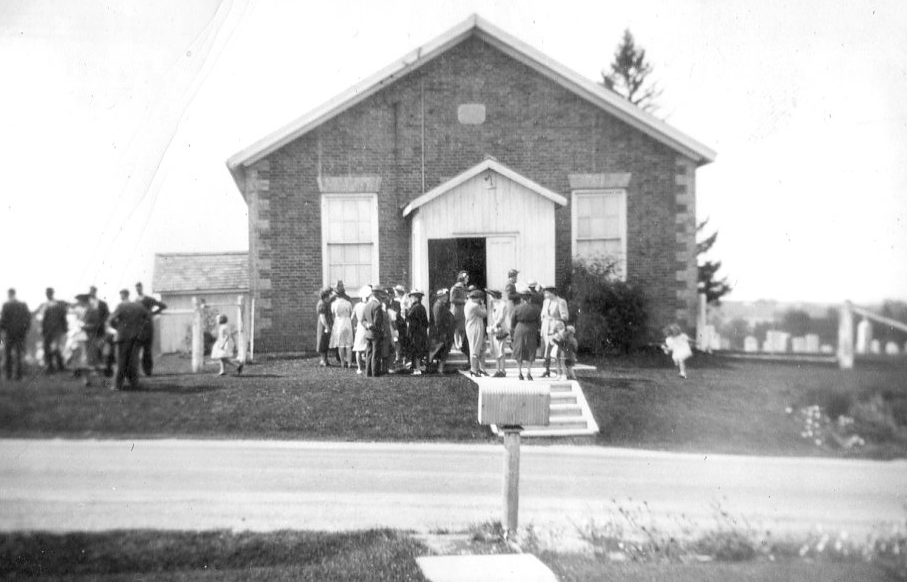
Banner: Dickson Hill New Mennonite Church building in 1940, constructed with the Christian Church 1863, replaced in 1952. Courtesy: Missionary Church Historical Trust.
1Peter Richardson, Douglas Richardson, and John de Visser (photographs), Canadian Churches: An Architectural History (Richmond Hill, ON: Firefly Books, 2007) p 16. Another beautiful book is Marion MacRae and Anthony Adamson, Hallowed Walls: Church Architecture of Upper Canada (Toronto: Clarke, Irwin, 1975). I use some of its categories. Its history of Anabaptists is a bit wobbly.
2Tiffany Robinson, “Why Our Worship Space Matters,” Faith Today (March/April 2025) p 42-45.
3J Henry Getz, ed, A Century in Canada 1864-1964 (Kitchener, ON: Canada Conference of the Evangelical United Brethren, 1964) p 38-45 has photos of 70 EUB buildings in Ontario, 63 current in 1964. The MCHT also has a photo album of many EUB church buildings in an unfinished project started by John Emerson Hallman 1958-1963, donated by his daughter, Jean (Hallman) Morby, Box 5031.
4Commonly mentioned in Paul’s letters, eg Romans 16:5, I Corinthians 16:19, Colossians 4:15, Philemon 2.
5Larry Hurtado (2013), https://larryhurtado.wordpress.com/2013/11/20/where-did-earliest-christians-meet/ This is a review of a book with a complaint about modern application of the term “house church,” but it does survey the evidence of the spaces early (to ca AD 300) used for worship.
6Dura-Europos, Syria, ca AD 240. https://en.wikipedia.org/wiki/Dura-Europos_church
7Cornelius Krahn, “Architecture,” Mennonite Encyclopedia, Vol 1, p 147.
8Barbara Draper, “The Effect of Revivalism on Worship in the (Old) Mennonite Church of Waterloo Region,” Ontario Mennonite History 17:1 (1999) p 1-6 has many descriptive comments about Mennonite meeting house architecture in Waterloo Region, and the shift to “church” buildings after 1900, positions of doors and pulpits, benches to pews, hints of Gothic features and so on. Very instructive.
9“Children of Zion;” 1967 Historical Committee, More than a Century in Wilmot Township (Wilmot Township, ON: New Hamburg-Wilmot Township Centennial Committee, 1967) p 54.
10Wendell Hallman was a Tunker (Be in Christ Church) preacher, married to a sister of Samuel Schlichter, the leader of New Mennonites in the New Dundee area. One of his sons, Henry Schlichter Hallman, was an MBiC elder and for 20 years editor of the Gospel Banner.
11Leonard Chester, “A History of Puslinch Community Brethren in Christ Church” (1969) http://www.clarksoftomfad.ca/PuslinchCommunityBrethreninChristChurch.htm
12Lillian Byer, ed, Altona Christian-Missionary Church 1875-1975 ([Altona, ON: Altona Christian-Missionary Church], 1975) p 1.
13Isaac R Horst, “Mennonite settlement in Port Elgin,” Ontario Mennonite History Vol 15 No 1 (April 1997) p 1. The building Solomon Eby first served in was built on the Benjamin Eby farm, “about a mile from the lake,” in 1861. The United Mennonites left the old building for the Mennonite Conference members and built their own building in 1875, but until that happened, I suppose they shared the original meetinghouse. Eby was disfellowshipped early in 1874.
14A James Rennie, Louth Township: Its Past and People (Louth Township, ON: 1967) p 51.
15Ward M Shantz, A History of Bethany Missionary Church (Kitchener, ON: Bethany Missionary Church, 1977) p 5.
16Partially recognized in a ceremony between Bloomingdale Mennonite Church and Breslau Missionary Church in 2004; Samuel J Steiner (1996), “The Effects of the 1870s New Mennonite Division on Bloomingdale Mennonite Church,” and Dennis G Bells (2004), “Bloomingdale Mennonite-Breslau Missionary: Two Paths, One Purpose;” Box 7201 MCHT.
17Eg, Everek R Storms, History of the United Missionary Church (Elkhart, IN: Bethel Publishing, 1958) p 33.


 EMCC History
Leave a comment