
the United Missionary Church of Africa Part 1
This background to UMCA worship patterns is excerpted from an essay I wrote for a conference in Ilorin, Nigeria, in November 2019. The convener, Rev Professor Samuel Ango, a UMCA scholar and former provost of UMCA Theological College and the Theological College of North Nigeria, Bukuru, kindly granted me permission to re-use material from that essay.
1. The United Missionary Church of Africa (UMCA) was started by the holiness-Mennonite mission organization from Canada and the United States. The mission’s interest in holiness was defined in the Wesleyan teaching that, by an experience subsequent to conversion, a believer’s heart could be purified from wrong motives to serve God with “perfect love.” Originally preached by John Wesley, the Methodist doctrine of holiness had undergone a few modifications in 19th century American Methodism. One was a belief that sanctification should be instantaneous and another that it was identical to the baptism with the Holy Spirit (a theology introduced by John Fletcher). “Entire sanctification” or “perfect love” was not assumed to remove errors of knowledge or the possibility of sinning again.1 Pheobe Palmer introduced some changes through her preaching and editing of the magazine Guide to Holiness and other works.2 Her version of holiness was the variety the Mennonite Brethren in Christ (MBiC) adopted rather than Wesley’s directly.
2. When the young missionaries of the MBiC were posted to Nigeria 1905 until 1955 (when the UMCA was organized), they naturally introduced to Nigerians the worship patterns they had experienced in their North American Church. It was probable that due to the small numbers of the mission staff and their limited education (few went past 8 years of primary school until the 1940s), they would introduce personal preferences to the Nigerian church. It was even more probable that the Nigerian environment—natural and cultural—would select some North American worship patterns and introduce indigenous ones. To understand the worship patterns the mission introduced, it is necessary to understand what they themselves inherited from their Mennonite and Methodist background.
3. North American Mennonite Worship in Mid-1800s. The first members of the MBiC grew up in churches that followed the worship patterns of Mennonites and Tunkers. John C. Wenger, a Mennonite theologian and historian, writing in 1961 of the Mennonite churches in Indiana and Michigan, described what he regarded as typical about 1860:
“The regular worship services were deeply impressive. After the singing of possibly two German hymns one of the ministers would make the “Opening,” a sort of preparatory message to get the audience into a reverent and worshipful mood. This was followed by a silent prayer. The deacon would read a chapter from the German Bible, after which another hymn was sung. Then came the main sermon which was followed by the “Testimonies,” which were brief statements by the other ordained brethren as they remained seated, that the message was sound and in harmony with the Word of God. The minister who preached then arose and expressed appreciation for the testimonies and the added thoughts which they contained. He then called the congregation to another kneeling prayer. This time he prayed an audible prayer which always concluded with the Lord’s Prayer, the Unser Vater as it is called in German. After another hymn the congregation arose for the benediction which one of the ministers pronounced.”3
Wenger might call this “impressive,” but others called it “formal,” meaning by that, “little emphasis on the spiritual life of the individual…leaving little opportunity for expression of the religious feeling.”4
4. Public worship. Public worship can be examined under several headings, such as frequency, singing and music, orders of service, architecture, liturgy, preaching, prayer and use of Scripture. It has been the subject of much discussion in recent decades in most Christian traditions.5 As to official statements concerning MBiC public worship, the MBiC Disciplines contained, as the first section under “General Rules for Our Society,” this simple paragraph:
“We recommend, that the time [at the start of a service of worship] be properly occupied by singing and prayer, to the edification of those assembled, until the time of opening service. The minister may read a portion of God’s Word, and at his direction, the congregation may arise and sing and then kneel in united prayer; after prayer a verse or two may be sung, then preaching, prayer, singing and benediction.”6
One can see the resemblance to the Mennonite service Wenger described. These recommendations (not commands) allowed great freedom to the conduct of worship, which is what the framers intended. The Spirit should not be confined to a set order. Numerous reports in the denominational magazine, the Gospel Banner, of other MBiC services, show they expected much more: “demonstrations of the Spirit,” in shouting praises, weeping for sins confessed, jumping (up and down, I think they meant) and other expressions of emotion in response to the Holy Spirit. In the smaller meetings, both men and women were expected to testify regularly. The missionaries who were sent to Nigeria remembered and missed the meetings they used to enjoy in their homeland. Cornelia Pannabecker went to Nigeria in 1906 and reported to the 1907 Canada (that year renamed “Ontario”) Conference:
“While not privileged to meet in worship with God’s children, yet the Lord does not forget us. It is encouraging to read and hear of revivals in other lands and souls yielding to God. We long for that time to come upon this land also.”7
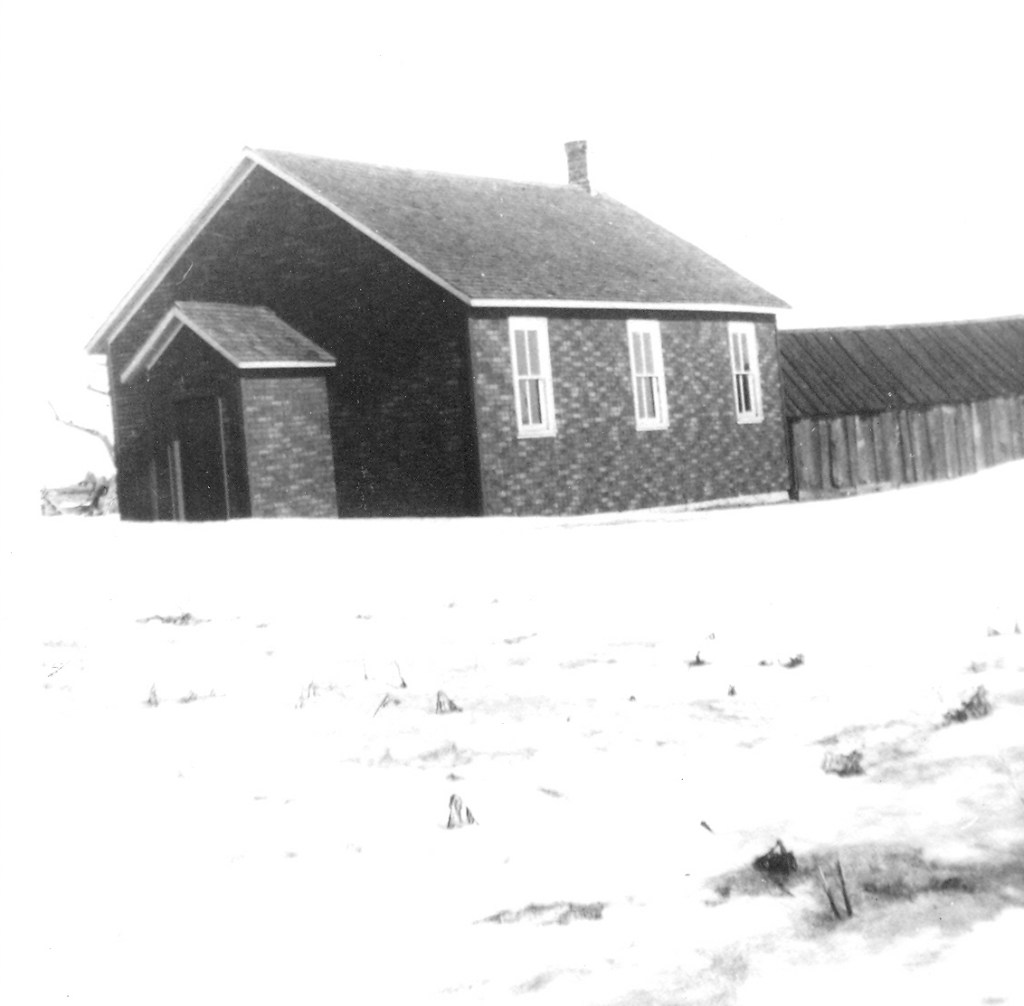
Courtesy: Missionary Church Historical Trust
5. Frequency of meeting. Although the urban Swiss Brethren of Europe in the 1520s urged frequent meetings—three or four times a week8–rural North American Mennonites often met once every two weeks, sometimes even once a month. From their own revival perspective later, MBiC historians mentioned this frequency as evidence of decline in Mennonite spirituality.9 In the more densely populated Mennonite settlements in Pennsylvania or Waterloo County, Ontario, this criticism is not quite fair, as one meeting house might be open one Sunday, but another within easy reach of a Mennonite family by a horse and buggy ride, would be open another week. In the strong community sense of the Mennonites, the regional community was the congregation, not merely those who met at one location. Of course, some meeting houses served more isolated locations where this pattern of attendance was unavailable. The MBiC itself faced this problem on its early scattered circuits which could not always provide weekly services, and became open to the same criticism. To their credit, I have never seen other Mennonites point out the inconsistency. However, where they could, the MBiC held services weekly, with at least one or more home prayer meetings per week, and in their city congregations and missions, two or even three times on Sunday and three or more during the week. One central Sunday meeting would be counted as the main worship service. They practiced protracted revival meetings once or twice a year, which could last from two weeks to two months with daily preaching services 6 days out of seven.
6. Communion and baptism. For the 16th-century Swiss Brethren and southern German Anabaptists, the Lord’s Supper and believer’s baptism were important observances of the church. While little information about the frequency of observance of the Supper is known, it may have been weekly in the beginning, before persecution and execution of their ministers scattered the early Anabaptists.10 In North America, my evidence is that Mennonites in the 1860s in Markham, Ontario, observed the Lord’s Supper two times a year.11 In the MBiC, baptism of believers was shifted from being a duty of the bishops to that of the ministers in charge of a congregation or a field (a geographically close group of meeting points), so they could take place whenever necessary, such as after an evangelistic series or at the end of a camp meeting. In Ontario and elsewhere, Mennonite bishops were not monarchical leaders of huge dioceses, but served small districts. Bishops of a subgroup of the Mennonites, the Amish, might serve just one congregation alongside its preacher.

Credit: BiC Historical Society, April 28, 2011
7. Methodist worship. When some Mennonites of eastern North America adopted revivalist ways from the Methodist movements, they copied a pattern of quarterly observance of communion, that is, every three months. Although Evangelical Association Disciplines, which the MBiC copied, had a simple form for the observance of the Lord’s Supper,12 the MBiC Discipline had none, and into the UMC and Missionary Church era, still none, even though the Manuals included a form for baptism. We will investigate this later. In recent years, with no quarterly meeting regulations at all since the 1950s, monthly observance gradually became common in Ontario. According to my informal poll at the April 2019 EMCC National Assembly in Toronto, out of about 30 pastors and delegates interviewed, nobody knew why so many congregations had gone to once a month observance plus a few more at times such as Good Friday or New Years Day. Historically, Calvin’s Geneva Reformed churches observed communion monthly, as did many American Baptists. Two EMCC churches were moving from observing the Supper every 6 weeks to once a month, and one to once a week. A fascinating article on British public congregational worship trends (non-Anglican) from 1965 to 2005, different but yet strangely similar to changes in North American and even Nigerian worship patterns, is found in a study by British historian David Bebbington.13
8. John Wesley. Quarterly communion was not the practice of John Wesley. As long as he lived, Wesley insisted that his societies meet at any time other than the main worship service of the local Church of England parish. He himself attended the Anglican Eucharist services on average every 4 or 5 days, in later life, every other day.14 Wesley loved Anglican worship, and considering it the best in the world. He had studied other liturgies, so his bias was at least well informed.15 Most Western European and Eastern Orthodox worship patterns revolve around weekly observance of holy communion, (the table, breaking of bread, Eucharist, Roman Catholic “mass”).16

Credit: Wikimedia Commons. Library of Congress CN
9. American Methodist practice. When the American War of Independence (1775-1783) disrupted relations between Great Britain and its American colonies, Wesley ordained two men to supervise the societies there. He gave them a standard of unity (the Twenty-Four Articles of Religion,17 based on the Anglican Thirty-Nine Articles), a standard of proclamation (his standard Sermons and Notes on the Bible), and a liturgical standard, the Sunday Service, based on the Anglican Book of Common Prayer.18 However, both in England and in the United States, Wesley’s liturgy for his societies were set aside soon after his death in 1791. Of particular interest for the worship practices of the MBiC, who took their worship patterns to Nigeria, are those of American Methodism. Canadian Methodist churches experienced a strong direct influence from English Methodism, but as the MBiC was in closer contact with German-American Methodism in both the United States and Canada, the American revivalist practice was the stronger pattern for them, even in Canada. Because of the legally established Church of England hierarchy in England, Methodist leaders in England were called superintendents rather than bishops.
10. The superintendent who stayed in the USA, Francis Asbury (soon “Bishop”), was not as committed to the Anglican liturgy as Wesley was. He had become a Christian apart from his Church of England home parish, and the evangelistic meetings he experienced became the model and were paramount for the Methodist Episcopal Church he led. The medium of conversion often is the “message.” Asbury and Thomas Coke, the other superintendent, organized the MEC at a preachers’ Conference in Baltimore, Maryland, on Christmas Day, 1784.19
11. Thus evangelistically-oriented services, including the Sunday worship of North American Methodist societies, became the norm and the aim of the MEC, not worship for its own sake or observance of a liturgy of the Lord’s Supper.20 Evangelists were the MEC’s models. Imitating the holiness movement, the MBiC followed. The Evangelical Missionary Church of Canada and the Missionary Church Inc in the USA believe this evangelistic aim is the constant thread through all the changes the churches have undergone.21
Music and Order of Services in MBiC Worship
12. Music.I have covered music in the early EMCC already in “EMCC History.”
13.Free Church order of services. Hymnbook editor and musicologist Donald Hustad has traced the origin of the typical North American “free church” (non-liturgical) worship service to the modifications made by famous evangelist Charles Finney22 to church worship in the service of evangelism wherever he went in the 1820s, 30s and 40s. Everything was stripped away to produce the strongest appeal for conversion. Finney was not a Methodist, but his methods were copied by nearly every Protestant tradition. The MBiC officially assigned his Lectures on Revivals of Religion (probably the 1868 edition) as a textbook that beginning ministers were required to study for ordination 1882 to 1888.23 Hustad does not give sufficient attention to Methodist church worship patterns in my opinion, but the result is much the same: the liturgical traditions of the European churches were set aside.
14. In the Nigerian Mission. One of the first tasks many missionaries set about was to introduce vernacular songs to the groups that met under their direction. They translated hymns or composed simple songs. Alex W Banfield, Emma Hostetler, Florence Overholt, and Cornelia Pannabecker all worked in the Nupe language. Willis and Marion Hunking later produced Nupe choruses.24 Pheobe (Brenneman) Ummel composed in C’Lela and Hausa; Virgil and Betty (Best) Pollock provided worship songs for the Bariba.25 Missions to the Yoruba were well underway before the Mennonites arrived, so they used the Baptist hymnbook already developed, but for the Nupe, Kambari, Bariba and Lelna (Dakarkari), new songs had to be provided. MBiC missionaries reproduced the gospel song and chorus tradition they knew.
15. Drums. Much has been said about the missionary prohibition of drums in African worship in the early days.26 The evidence from the MBiC mission is meagre. Instead, drumming was used to attract audiences in Igbeti.27 Willis Hunking, who was assigned to Nigeria in 1945, told me that the Rev Daniel Olaleye Taylor, the first Nigerian ordained by the United Missionary Society, discouraged using drums in UMCA worship, not the UMS.28 It is possible Taylor was taking his cue from his Anglican background, or following hints from UMS missionaries. The issue is not so straightforward. In the 1990s, I saw a traditional practitioner protesting to young Ebira Christians of ECWA, that the drumming style they were using “belonged” to a certain god, and they would have to sacrifice a goat to atone. The young people confidently rejected the claim, saying they were using the drums to glorify Jesus. On another occasion, the wedding of a Nigerian relative of mine was nearly stopped because the evening before, a drumming style was played that the UMCA Nigerian elders considered devoted to traditional worship, and incompatible for Christian witness.
Continued next blog.
Banner: Opening of Jiyade, Kwara State, Nigeria UMCA church building, Aug 10 1991, Jide Adelowo and friend on keyboard and guitar. Credit: Dr (Mrs) Lambo.
1John Wesley, Christian Perfection (1777, many editions).
2“The altar sanctifies the sacrifice,” was her saying, based on Romans 12:1-2; Charles Edward White, The Beauty of Holiness: Phoebe Palmer as Theologian, Revivalist, Feminist and Humanitarian (Grand Rapids, MI: Francis Asbury Press, 1986) p 125-144.
3Quoted in J Howard Kauffman and Leland Harder, Anabaptists Four Centuries Later: A Profile of Five Mennonite and Brethren in Christ Denominations (Scottdale, PA/ Kitchener, ON: Herald Press, 1975) p 65.
4Everek R Storms, History of the United Missionary Church (Elkhart, IN: Bethel Publishing, 1958) p 30.
5For North American evangelicals, the work of Robert Webber and James F. White in the USA come to mind.
6Taken from The Doctrines and Discipline of the Mennonite Brethren in Christ Church (New Carlisle, OH: General Conference Executive Committee, 1924) p 29.
7Letter to Canada Conference, 1907, from Shonga [Tsonga], Nigeria; Canada Conference Journal 1907, p 45.
8Kauffman and Harder, p 65.
9For example, Jasper A Huffman, History of the Mennonite Brethren in Christ Church (New Carlisle, OH: Bethel Publishing, 1920) p 36; Storms, p 30.
10Peter C Erb, “Anabaptist Spirituality,” in Senn, Frank C, ed, Protestant Spiritual Traditions (Wahnah, NJ: Paulist Press, 1986) p 94.
11“Minutes of the New Mennonite Society of York County,” 1862-1879; in the collection of the Missionary Church Historical Trust, Kitchener, Ontario, Box 1010. This agrees with evidence as to frequency in Cornelius Krahn and John D. Rempel (1990), “Communion,” in Global Anabaptist and Mennonite Encyclopedia Online (GAMEO). Accessed April 21, 2019.
12In the earliest edition available to me, Doctrine and Disciplines of the Evangelical Church (Cleveland, OH: Evangelical Church, 1923) p 90-92, the service consists mostly of two prayers, the first one with all worshipers kneeling.
13David Bebbington, “Evangelicals and Public Worship, 1965-2005,” Evangelical Quarterly 79.1 (2007): 3-22. Accessed April 11, 2019.
14F Dean Mercer, “The Liturgical Vision of Primitive Methodism,” in Felix W-L Sung, ed, In the Church and in Christ Jesus: Essays in Honour of Donald N. Bastian (Mississauga, ON: Light and Life Press Canada, 1993) p 129.
15Mercer, p 127.
16Simon Chan, Liturgical Theology: The Church as Worshiping Community (Downers Grove, IL: InterVarsity Press, 2006) p 63-66.
17Later increased to 25 Articles.
18Mercer, p 136.
19Mercer, p 132-135.
20Worship has no “use” other than glorifying God, according to Chan, p 53-54.
21Websites of both denominations emphasize following Jesus by obeying the Great Commission (making disciples from all nations, Matthew 28:18-20) in their opening statements of “Who We Are.” Accessed April 11, 2019.
22Donald P Hustad, Jubilate II: Church Music in Worship and Renewal 2nd ed (Carol Stream, IL: Hope Publishing, 1993) p 228.
23Removed from the list by the 1888 MBiC General Conference.
24Willis and Marion Hunking, Enya 4 Dana [“Four Choruses”] (Self-published, nd).
25James Clare Fuller, “We Trust God will Own His Word: A Holiness-Mennonite Mission in Nigeria 1905-1978,”[MTh thesis for McMaster Divinity College, Hamilton, Ontario, 2003] p 163, notes 50 and 51. Accessible online.
26For example, Emmanuel Olusola Fasipe, “The Use of Indigenous Musical Instruments in Traditional Christian Worship of the Yoruba, Nigeria,” Ethnodoxology (2022) Vol 10.
27Funmilayo Elizabeth Oloyede, “A History of the United Missionary Church of Africa in Igbeti 1919-1980,” BA Project, University of Ilorin (Ilorin, Nigeria, 1990) p 45.
28Fuller, p 163, notes 55 and 56.

 EMCC History
Leave a comment