
The first members of the Mennonite Brethren in Christ Church in the very end of 1883, were practically all from the Mennonite Conferences, and had therefore grown up worshiping in the North American/ Pennsylvania Swiss-South German style.1 John C Wenger provides an affectionate reconstruction of the pattern he knew in his book Glimpses of Mennonite Doctrine and History. It will be useful to quote it. Just remember that Swiss-German Mennonites in North America did not sing in four parts until the 1890s:
“The Mennonite “meeting-place” is a plain structure without steeple, bell, organ, altar, or works of art. Emphasis falls on worshiping God in the heart…The worship service is simple and dignified, not demonstrative or emotional. The congregations sing four-part music, unaccompanied by any instrument; the worshipers kneel for prayer; the sermon is simple and earnest with a constant appeal to the Bible in support of the message.”2
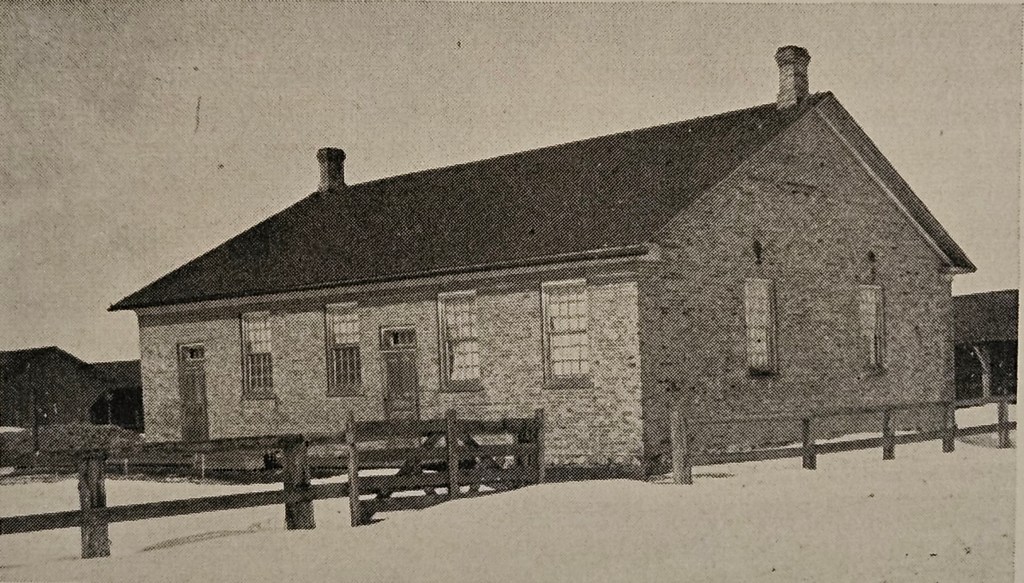
Worship in the closely-related Tunkers (name of Brethren in Christ in Canada until 1933) in the 19th-century has been described by E Morris Sider as involving preaching, of course, but also “volunteer prayers, [congregational] singing and testimonies.”3 There were no solos, quartets or choirs and no instruments until the 1950s.4 Hymnals for the BiCs first appeared in 1862, and roughly every generation thereafter. A big annual local event was the BiC “love feast.” Communion was observed twice a year, a pattern they shared with Mennonites.
The MBiC also recommended simple stages of a worship service in the Discipline, which under “General Rules/ Section I.2,” was unchanged from early days until past 1943:
“We recommend that the time be properly occupied by singing and prayer to the edification of those assembled, until the time of opening of service. The minister may read a portion of God’s Word, and at his direction, the congregation may arise and sing and then kneel in united prayer; after prayer a verse or two may be sung, then preaching, prayer, singing and benediction.”5
This instruction was supplemented with instructions for “Special or Protracted Meetings,” “Prayer and Fellowship Meetings” and “Quarterly Meetings,” which included the washing of the saints feet and communion quarterly, following the Methodist custom in North America.6 At a Conference level, the MBiC “Camp Meeting” was the big annual event. The MBiC began with 4-part singing, and only allowed instruments in the 1920s. Most congregations adopted them by the 1930s.7
How far the pretty minimal instructions for the “General Service” were followed, I have no idea. In my experience, Disciplines and Constitutions can be quietly and increasingly ignored until at some point alternate views become acceptable and changes are made in the documents. Sometimes they can be of rather major doctrinal issues such as whether Washing of the Saints’ Feet is an ordinance of the Lord or not, or whether non-resistance is the biblical doctrine with respect to the Christian and warfare. On smaller matters, variation of observance from the Constitution can be trivial until fixed by the Conference. I heard it myself in an Annual Conference, when someone asked if a certain provision was to be viewed as in force, or was to be considered “historical.” The parliamentarian of the Conference affirmed that the provision was to be viewed as historical, at least in his opinion, and he was a former district superintendent (Ward Shantz)! As I understood it, he meant the provision was the view of the Conference some years before, but open to variable interpretation or revision, or even could be ignored.
In the case of the “General Service” provisions, widely differing practices could be construed as following the “recommendation.” By the 1951 Discipline, the General Conference added some Scripture verses before the first paragraph,8 and slightly modified the general instructions. The worshiper on entering the “house of God”9 is still urged to engage in “silent prayer before the Lord,” as people gather, but no longer was kneeling mentioned at this point, though it continued to be recommended later in the section. The next paragraph continued:
“We recommend that services open promptly as announced…Congregational singing should be considered an important part of worship. Since kneeling in prayer is both scriptural and a reverent prayer attitude, we recommend that in public worship our congregations kneel together in prayer.”10
In recent years some people imply only singing is worship. It is certainly part of it, but here are a few other worship customs:
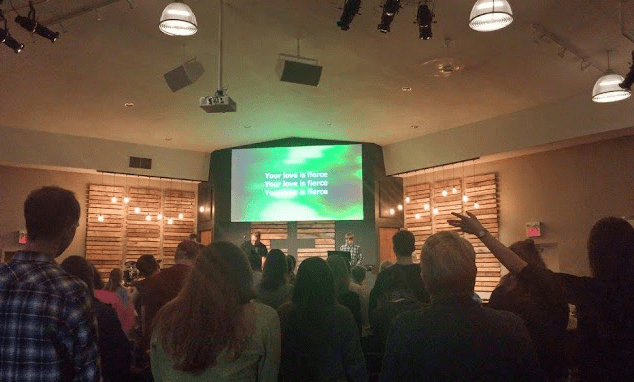
Credit: Listowel EM Church Facebook
Lifting Holy Hands. This is an example of a changing practice. Pastors could imitate Jesus in Luke 24:50 in lifting up their hands in blessing the congregation at the end of worship, maybe with Aaron’s blessing (Numbers 6:23). But where did the recent practice (in terms of generations) of everybody lifting hands in congregational prayer and praise come from? It is unevenly practiced in evangelical churches, and even discouraged by some. I remember charismatic preachers in the 1970s telling us that people in the Bible did it (mentioned about three times), and so we could/ should, too (I Timothy 2:8, specifically connected with “holy men”). They taught us choruses: “I lift my hands, Lord, unto Thy name (2xs), My lips shall praise Thee, thus will I bless thee, I will lift up my hands unto Thy name.” (Psalm 63:3-4 KJV)11 And another one was like it, “Come bless the Lord, O ye servants of the Lord, who stand by night, in the house of the Lord, Lift up your hands in the holy place, and bless the Lord, and bless the Lord.” (from Psalm 134:1-2 KJV)12 Search the internet for images of “people worshiping” and you will see plenty with a single person or a congregation lifting hands, or a liturgical church altar area.
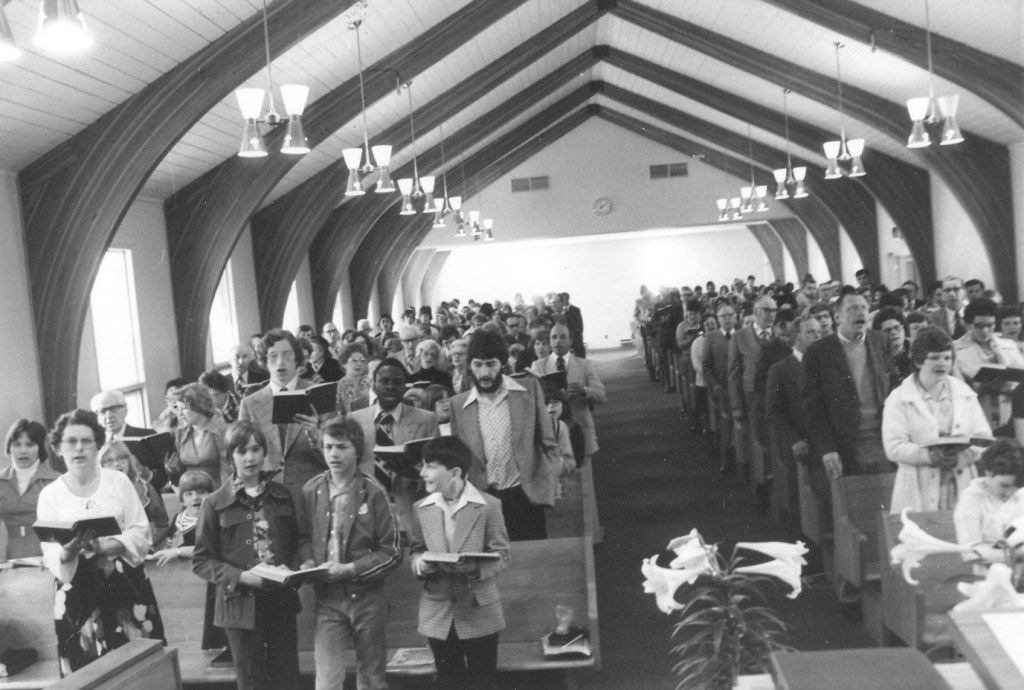
Courtesy: Missionary Church Historical Trust
The Kneeling Habit. My experience in the United Missionary Church began suddenly at Easter time of 1965 when my family began attending the Lakeshore UMC in North Bay. I do not remember kneeling in a morning service. But by August, in an evening service, I and others knelt in prayer at the front of the church auditorium at one of the benches specially made for that purpose. We were responding to the invitation to confess our sins and call on Jesus for his forgiveness and salvation. At other times, the members were invited to kneel at the front in evening services for various requests, personal and congregation-wide. (I was glad the steps to the platform were carpeted!) Some prayer meetings involved kneeling at our pews or chairs as well. It is easy to see this custom in the Bible, though bowing down is far more common.
At my university college, an Anglican-based one, I joined the evensong chapel service before supper and often used the kneeling devices attached to the pews in front. It was different, but not that much, from our practice in Lakeshore. A number of Anglican churches continue to kneel at various points in the service, of course. I don’t know about all of them.13 As I get older, it is harder to kneel, even harder to get up! Yet I do it occasionally. Sitting to pray is, as many have noted, a strange practice in the Bible, rarely mentioned, if ever. And does anyone pray looking up to heaven (eyes open), as Jesus did, Mark 6:41? Many African churches do!
Tithes and Offerings as Worship. Readers will observe that no mention of a time of offering or announcements, so visible in my experience, appeared in the Discipline recommendations. I met the joking saying, “Where two or three Missionary Church members gather, there shall be an offering.” Talking about money in church is, of course, a sensitive subject. At the start of the EMCC denominations, they adopted the Evangelical Association pattern of having “stewards” who visited members at their homes to ask for donations or pledges. This meant there was no congregational offering time in the worship service. Early on, boxes were urged to be placed at the doors for missionary offerings, however.14 Gradually the transition to a salaried pastorate grew because the MBiC assigned elders to itinerate, that is, move every few years from one field to another: they could neither accumulate farm lands nor businesses to support themselves in the old rural Mennonite pattern. The introduction of offering plates, offering envelopes and budgets were significant changes, noted by earlier Missionary Church historians Huffman and Storms,15 but so firmly in place as not to be remarked on in Lageer’s two books (1979, 2004).
The Bible is known to teach tithing in the Old Testament, and recounts special offering occasions. The New Testament assumes tithing was known and Jesus once referred to it operating in the Jewish community, but the practice is not clearly taught to New Testament congregations. Paul had several opportunities to teach tithing to the congregations he wrote to, but instead talked about generosity, cheerful giving, proportionate giving and supporting elders, especially those who gave time to teaching and preaching. How the money was to be collected is only hinted at when he gave instructions for a special collection for the poor of Jerusalem (“each first day of the week”). This has been extrapolated to regular offerings in the worship services of the Lord’s Day ie Sunday. (1 Corinthians 16:1-2)

Courtesy: Missionary Church Historical Trust
By the time my family arrived in Lakeshore, the pattern was established of an offering time, ushers passing offering plates through the pews, then returning to the front, where the pastor prayed, or someone called to do so, and we sang the doxology “Praise God from Whom all Blessings Flow.”16
In Nigeria’s United Missionary Church of Africa church services, they often celebrate offering times with worshipers singing and walking or dancing to the front, pew by pew, to place whatever is offered in baskets or bags. This may take some time. In UMCA Theological College Chapel in Ilorin, Nigeria, Rev Dr Olutola K Peters did the best job of integrating offering time as a part of Christian worship that I have seen.
In Canada, where we have suffered from financial embarrassments by embezzling pastors or money-begging TV preachers, some congregations downplay the offering time. A Chinese Missionary church I knew announced offerings at the end of the service as for members only. The pandemic altered giving patterns in my congregation, for a while shifting everything online, and still urges as an alternative, pre-authorized bank withdrawals. It is hard to infuse this practice with worship! Having returned to personal attendance, we may use any of the new forms or an offering box in the foyer, all designed to reduce physical contact with a contagious disease, but also to minimize references to money.
Announcements as Worship. Many see announcements as an awkward interruption to “real” worship. Again, I was impressed by the way Rev Peters in Nigeria framed the announcements as “God’s work among us.” All communities have their corporate life to arrange—they are not merely “housekeeping” matters, although explaining the location of the washrooms is a little hard to spiritualize! Accessibility is however a matter of respecting all those made in his image. It is Kingdom of God business.
In liturgical churches, all kinds of other actions are worship elements: processions, sounds, incense, litanies, certain motions of the hands or other body parts, all of which can be assigned meaning. Really there is no end of the possibilities. When I was drawing up my free church worship services, I was frustrated to only have singing, scripture reading, praying and preaching in my regular repertoire. I will reflect on the Lord’s Supper as worship in a later blog.
Banner: Interior of Stayner Mennonite Brethren in Christ Church. Courtesy: Missionary Church Historical Trust
1In the blogs about MBiC to EMCC church buildings, I describe the North American Mennonite “plain” buildings.
2John Christian Wenger, Glimpses of Mennonite Doctrine and History (Scottdale, PA: Herald Press, 1947) p 114.
3E Morris Sider, Be In Christ: A Canadian Church Engages Heritage and Change ([Oakville], ON: Be in Christ Church of Canada, 2019) p 126.
4Sider, p 370.
5The Doctrines and Discipline of the Mennonite Brethren in Christ Church ([New Carlisle, OH]: General Conference Executive Committee, 1924) p 29.
6As printed in the MBiC Discipline (1924), p 29, 30 and 44.
7See EMCC History Blog “Music in the early EMCC Part 3: Song leaders and musical instruments.”
8From Psalm 122:1 and Hebrews 10:24-25.
9I will be looking at the notion that a building used for Christian worship is a “house of God” in a later series in “EMCC History.”
10The Doctrines and Discipline of the United Missionary Church ([Elkhart, IN]: General Conference Executive Committee, 1951) p 26-27.
11“Thy loving-kindness is better than life,” Hugh Mitchell and Jon Drevits (1956, 1980).
12“Come bless the Lord, all ye servants of the Lord,” paraphrase and music by Phil Lawson Johnston (1975).
13Kneeling was a boring painful chore for the participatory researcher who visited a Free Methodist church in Alberta as related in William E Mann’s Sect, Cult and Church in Alberta (Toronto: University of Toronto, 1955) p 13.
14The Pennsylvania Conference, in 1882; Everek R Storms, What God Hath Wrought: The Story of the Foreign Missionary Efforts of the United Missionary Church (Springfield, OH: The United Missionary Society, 1948) p 150.
15Jasper A Huffman, ed, History of the Mennonite Brethren in Christ Church (New Carlisle, OH: Bethel Publishing, 1920), p 155-156, Everek R Storms, History of the United Missionary Church (Elkhart, IN: Bethel Publishing, 1958) p 229-230.
16“The Doxology,” the concluding verse from Thomas Ken’s hymn “Awake, my soul, and with the sun,” in, eg,The Hymnary: of the United Church of Canada (Toronto: The United Church Publishing House, 1930) #529/ #544/ #525. Ken added his doxology to all three of his morning, evening and midnight hymns. My memories of United Church practice, though fuzzy, suggests similar elements at offering times.

 EMCC History
Leave a comment