When I was a church-planting pastor under the Home Mission Board, I planned and led many worship services, generally imitating the patterns in the Missionary Churches I knew (mainly Lakeshore in North Bay, Evangel in Kitchener and Riverside in Toronto). For example, I adopted from Lakeshore our pastor Harold Boadway’s habit of reading a psalm in every Sunday morning service. Otherwise, I did not study worship theology or liturgy. I confess I foolishly avoided the pastoral theology classes offered at Emmanuel Bible College because I was prejudiced against the teacher, to my harm. It took me a long time to realize my sinful attitude. Another mistake I have only recently recognized was, I planned almost all of these services entirely on my own.
Another blog will outline the history of Evangelical Missionary Church of Canada worship practices, such as kneeling, lifting hands, offerings including more on the role of music.1 Here I reflect on some common notions of worship floating around. Do you find yourself here?
I have watched and worshipped, as most of you, my readers, have. I am not a worship specialist. “Corporate worship,” as distinguished from personal devotions, means different things to different people in the EMCC. Remember the phrase “worship wars”?2 Members come from various traditions and experiences and listen to a wide variety of Bible teachers who tell them what worship is. The EMCC tradition, a “free church” tradition,3 has had little to say about biblical worship as such. From time to time the Mennonite Brethren in Christ Church and the United Missionary Church provided forms in the Disciplines and later the Constitutions and Manuals. Those rituals (rarely called that—the idea is foreign to the free church tradition) were most visible at baptisms and dedication of children because out came a mysterious little book and the preacher read words. No explanation was given where these words came from or by whose authority. With minimal explicit liturgy and explanation of it, I judge, the Church has been open or vulnerable to every wind of doctrine and exciting new practice.4
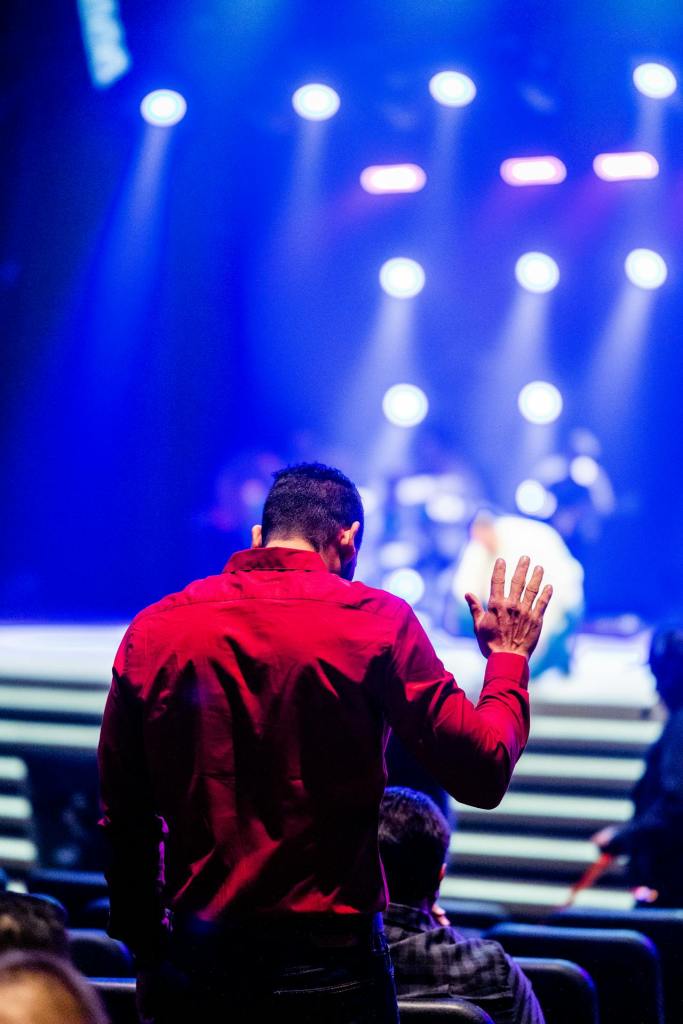
Credit: Caleb Oquendo, Pexels, public domain
Public worship is one of the most practiced sectors of theology believers encounter. Every week we implement what someone believes, like it or not!
The EMCC has had definite public worship patterns, however, beginning with a Mennonite pattern, which I will also sketch in a later blog. “Free church” has never been “free” in the sense that it had no form at all. The earliest MBiC members experienced the revivalism of their German-speaking neighbours:7 the United Brethren in Christ, the Evangelical Association or the widespread English-language environment of the Methodist Episcopal Church (in the USA) or some similar form in one of the branches of Methodism in Ontario. I have a little book given me by George Brooks, called “Wesleyan Liturgy” on the cover with “forms”–some quite long– for “Baptism of Infants,” “Baptism of Such as are of Riper Years,” “The Lord’s Supper,” “Ordination of Ministers,” “Solemnization of Matrimony,” and “The Burial of the Dead.” Finally, there is a long “Renewal of the Covenant,” with which the preacher was to charge each congregation in their care annually, securing members’ signatures to give themselves to God. (The Liturgy or Formularies of Services in Use in the Wesleyan Methodist Church in Canada (Toronto: 1867). The MBiC Disciplines likewise had a section called “Forms”–very brief– for Baptism, Dedication of Children, Quarterly Meetings (feet-washing, communion), Marriage, Funerals, Dedication (of church buildings), Ordination of Probationers (ie to be an elder), and of Deacons. (Discipline of 1924, p 43-52).
Evangelical Church Disciplines I have seen do not specify a worship pattern, but “An Order of Service” was included in an edition of The Evangelical Hymnal.8 In the 20th century, the UBiCs recommended this familiar order of service: 1. Hymn, 2. Scripture Reading, 3. Song, 4. Prayer…all kneeling, 5. Hymn, 6. Monetary offering without song, 7. Announcements, 8. Sermon, 9. Hymn, 10. Benediction.9 This pattern has been jokingly called the “hymn sandwich” by British evangelical Michael Griffiths.10 In more recent generations the EMCC has assimilated to more “free church” worship patterns, such as playing music while someone prays. The revived Mennonites (1850s-1883) that formed the core of the Mennonite Brethren in Christ (1883-1947) added Methodist-style revivalism in prayer and camp meetings that modified their worship experience.11 Revivalism focused its energy on the evangelistic service, and the MBiC added holiness conventions.
Feelings. I do not define true or successful worship as achieving a feeling, though many seem to.12 Somewhat matching this, Karl Barth as a young preacher learned his congregations wanted to “meet God,” whatever they meant by this.13 Early in my experience in the United Missionary Church, I heard people remark that they “felt” or “sensed” the Holy Spirit present in a church meeting.14 In the youth group we sang, “I’ve got the joy, joy, joy, joy, down in my heart…And I’m so happy, so very happy…” That was sometimes very difficult to sing. At summer open-air services, we sang the very 1960ish chorus, “God’s not dead/He is alive (3X)…I feel him in my hands [clap clap]/ I feel him in my feet [stamp stamp]/ I feel him all over me.”15 (It was the decade of the “God is dead” non-theology.) If these lyrics are not exactly what you sang, don’t worry, there are many similar songs and versions out there. The EMCC and its predecessor churches desired emotional meetings. They accused the “cold” worldly churches as well as their Mennonite parents of missing the mark. The MBiC said of the Mennonite Church in the 1860s and 70s that there was “no opportunity for expression of the religious feeling.”16
Moved, changed. My point is that for many Christians their worship has to include a thrill. We cannot point to one theologian, evangelist or church leader for promoting this. Strong feelings that occur in religious meetings have been around a long time. Techniques to produce ecstatic feelings also exist, and not just among Christians. (footnote 17). Sufis (Muslim mystical orders) have their zikrs to chant or whirl to, as do some Jewish Hasidic groups. Long before the Pentecostals with their tongues-liturgies, in the evangelical stream we can pick out the Pietists of the 17th-18th centuries who expected “heart-felt” experiences when they met God in prayer and praise. Again this was in contrast, they believed, to the formal services of their Lutheran parish churches.18 The first generation of Moravians in Herrnhut, Saxony, in Germany, also practiced very emotional worship. Some people equate the feeling with a direct experience of the Holy Spirit at work.19 John Wesley reported in 1738 that he felt his heart “strangely warmed” as God gave him assurance that he was accepted as a child of God.20 Numerous others have tried to replicate his experience. Some people report feeling “liquid love” flowing over their bodies or some similar phenomena as they searched for God’s power or holiness or presence or whatever to remake or take over their lives. Charles Finney (d 1875), the New York evangelist of the 19th century, reported this of an experience he had in 1821.21 I suspect Finney was not the first nor last to use it.
Wesley was correct in expecting feelings to normally show up in a person’s response to an Almighty, all holy, all cleansing, all embracing, all pardoning, God. He knew, however, that “transports of joy” were given or not given by God “according to the counsels of his will.”22 The generation of New England Puritan Jonathan Edwards and Arminian Anglican John Wesley called these experiences the Christian “affections.”23 Anyone familiar with the “Four Spiritual Laws” will recall that illustration showing Feelings as the caboose of the train which is powered by Faith and Grace. A modern train at least in Canada doesn’t need a caboose, or coal, so the illustration is losing force, but you get the point. The clash between those primarily connecting to God by feeling and those moved by proclamation of gospel truth continues. Enjoying both seems hard to maintain. Typical is Christian and Missionary Alliance systematic theologian George Pardington who wanted it to be clear, by quoting Frederic W Farr, another C&MA-related teacher, that theology, assumed to be “in the head,” does not equal one’s real religion (meaning relation to God) “in the heart.”24
The Canadian Methodist Nathaniel Burwash, converted in an emotional revival meeting,25 always maintained a place for feeling in his description of true worship, even though a University of Toronto College president:
“It would appear to be this form of religious exercise…that is referred to as “the fellowship” in connection with the other means of grace…distinguished…by its warm religious affection and earnestness; and its usefulness as a means of grace depended most directly upon the presence and power of the Holy Spirit…Its whole power lies in the genuineness of its emotion and affection, its hearty and spontaneous expression, and the presence and power of the Holy Spirit in both speakers and hearers. These lacking, it becomes the most empty of forms…”26
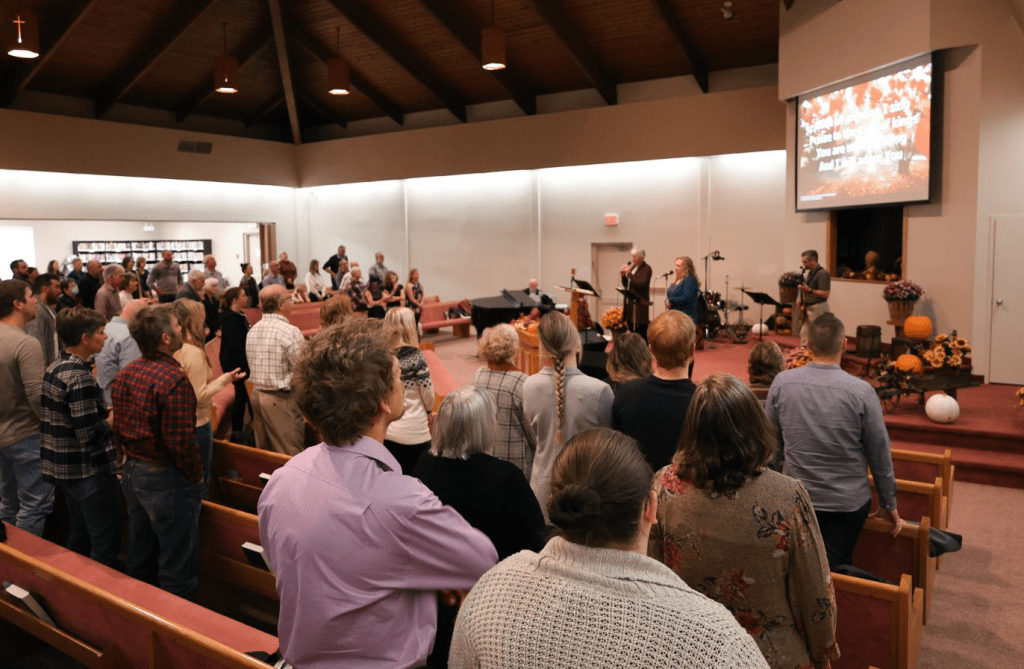
Credit: Palmerston EMC Facebook
In his long discussion of actions done “in church” that is, when assembled (I Corinthians 11-14), the apostle Paul uses the verb “worship” only once (14:24), of an outsider being impressed by intelligible prophesying in the gathering, being convicted of sin, falling down and “worshiping.” Nevertheless, Paul described people in assemblies praying, prophesying, singing, teaching, praising, speaking in tongues (with interpretation), as well as remembering the Lord in the Lord’s Supper and collecting offerings (I Cor 16:2).27 To Timothy he adds public reading of Scriptures (I Timothy 4:13), among other possible activities assumed to be parts of Christian worship.28 He does not teach how to cultivate feelings, but clearly feelings (eg “singing to God with gratitude in your hearts,” Colossians 3:16) were expected. While Millard Erickson’s brief definition is objective: “Worship. Offering of homage, honor, and praise to God,”29 mere words of “praise to God” without motions of the heart (emotions, mind and will) to praise would soon be ludicrous in Christian terms.
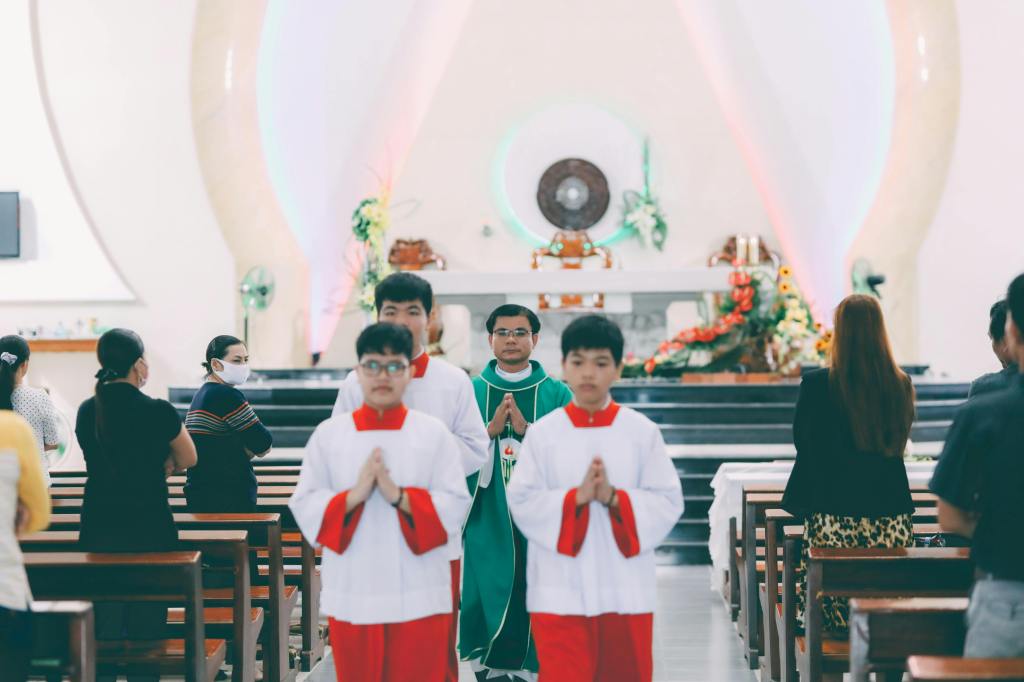
Banner: “Priest and Altar Servers Performing a Christian Ceremony in Church” Credit: Huynh Van, Pexels, public domain.
1I examined hymnbooks in EMCC History Blogs “Music in the Early EMCC” Parts 1 to 4.
2Gareth J Goossen, Worship Walk: Where Worship and Life Intersect 2nd ed (Breslau, ON: Make Us Holy Publishing, 2014) p 3 refers to “bitter battles…over the ‘best’ style in worship.” See also John G Stackhouse Jr, Church: An Insider’s Look at How We Do It (Grand Rapids, MI: Baker Books, 2003) p 15-17 on worship music conflict.
3Defined as Free Church or Frontier Worship by James F White, Protestant Worship: Traditions in Transition (Louisville, KT: Westminster/John Knox Press, 1989) p 80-81, 171-172. Thanks to Jim McDowell for bringing this book to my attention. Donald Hustad, Jubilate! Church Music in the Evangelical Tradition (Carol Stream, IL: Hope Publishing, 1981) p 158 refers to the “revivalist” or negatively, the “Non-liturgical” church worship pattern.
4For a summary of the groups that merged to form the present Evangelical Missionary Church of Canada from the 1840s to the present, see EMCC History home page: “The Formation of the EMCC.” It is the foundational blog.
7Samuel J Steiner, In Search of Promised Lands: A Religious History of Mennonites in Ontario (Kitchener, ON/ Harrisonburg, VA: Herald Press, 2015) p 143.
8The Evangelical Hymnal (Cleveland, OH: Evangelical Publishing, 1921) p xxiv.
9Origin, Doctrine, Constitution and Discipline of the Church of the United Brethren in Christ 1945-1949 (Huntington, IN: U. B. Publishing Establishment, 1945) p 143.
10Michael Griffiths, Cinderella with Amnesia: A Restatement in Contemporary Terms of the Biblical Doctrine of the Church (London: Inter-Varsity Press, 1975). Published as God’s Forgetful Pilgrims in the USA, where the reference is to pages 127-129.
11The Evangelical Church in Canada which formed in western Canada from 1899, a descendant of the Evangelical Association, had it own worship pattern which I do not know enough about to include here.
12Bruce Wilkinson (The Prayer of Jabez fame) declared at a conference on preaching at Heritage College and Seminary, Cambridge, ON, (ca 1998?) that people need to leave the worship service changed, or what were they meeting for? It is true “being changed” is not the same as “moved by feelings,” but he seemed to mean both.
13Karl Barth, The Word of God and the Word of Man (New York: Harper and Brothers, [English translation] 1928, another edition 1957).
14For examples of emotion at work, see Eileen Lageer, Common Bonds: Story of the Evangelical Missionary Church of Canada (Calgary, AB: Evangelical Missionary Church of Canada, 2004) p 14, 49.
15Who wrote this first is unclear. It could be just “traditional.” One respondent to a lyric search site online in 2007 claimed her husband, Rev E F George, wrote it “many years ago.” I first met it through a Salvation Army song leader at outdoor services about 1970. Not to be confused with the recent Daniel Bashta song with similar title.
16Jasper Abraham Huffman, ed, History of the Mennonite Brethren in Christ Church (New Carlisle, OH: Bethel Publishing, 1920) p 36-37.
17https://en.wikipedia.org/wiki/Ecstasy_(emotion)
18See EMCC History Blogs coming up, “Piety: Heart and Head,” and “EMCC Pietists.”
19Technically called “immediate,” that is, without mediation of any entity, somehow not including the human body.
20John Wesley, The Journal of the Rev. John Wesley Vol 1 [Everyman’s Library] (London: J M Dent, n d) p 102.
21Charles Grandison Finney, Memoirs of Rev. Charles G Finney (New York: A S Barnes, 1876) p 20.
22Wesley, p 102.
23Eg Jonathan Edwards, A Treatise Concerning Religious Affections (1746). Some of the congregation held on to the pillars of the building while Edwards was simply reading his sermon on “Sinners in the Hands of an Angry God.”
24George P Pardington, Outline Studies in Christian Doctrine (Harrisburg, PA: Christian Publications, 1926) p 341.
25Marguerite Van Die, An Evangelical Mind: Nathanael Burwash and the Methodist Tradition in Canada, 1839-1918 (Kingston, Montreal: McGill-Queen’s University Press, 1989) p 48-51.
26 Nathanael Burwash, Manual of Christian Theology on the Inductive Method Vol 2 (London: Horace Marshall & Son, 1900) p 367.
27Compare the four activities in Acts 2:42: devotion to the apostle’s teaching, to fellowship, to breaking of bread and to prayer.
28For example, note the paragraph headings using “worship” supplied by the NIV editors at I Co 11:2, 14:1, 14:26.
29Millard J Erickson, Concise Dictionary of Christian Theology (Grand Rapids, MI: Baker Book House, 1986) p 184.

 EMCC History
Leave a comment