
Years ago, researching other things in the Gospel Banner, I noted letters to the editor about “self-denial.” It sounded like a Mennonite Brethren in Christ Church institution of some sort which had not survived by that name into the era I first knew in the UMC/Missionary Church, the mid-1960s. It was also not mentioned so far as I had noticed, in Everek Storms’ 1958 History of the United Missionary Church, which I had read as early as 1970.1
The correspondents seemed to be making suggestions about what to do with money saved during a period of time when they literally “denied themselves” purchases, mostly food, I supposed, and saved the money for church projects. I did not follow up the references at that time.
As I read the Bible I eventually came across the phrase “deny yourselves” or something similar in the Law of Moses: Leviticus 16:29, 31; 23:27, 29, 32; Numbers 29:7, NIV. More well-known were the words of Jesus: Matthew 16:24 (parallels in Mark 8:34, Luke 9:23) that his followers “must deny themselves, and take up their cross [Luke adds “daily”] and follow me” (NIV). Jesus’ words did not apply to one day, but to a person’s whole lifetime. The word in Greek basically means “refuse,” as in “refuse to agree to some statement or action.”
In the Old Testament, the phrase is associated with the Day of Atonement, and was historically understood to mean “fasting (from food).” In Leviticus, “denying oneself” is immediately followed by instruction to do no work, and chapter 23 threatens to “cut off” (from citizenship in Israel) whoever does not deny themselves on that Day. Numbers 29 mentions the practice on the Day of Atonement again. “Self-denial” could be counted among one of the ascetic practices nearly every religion, and even non-religious people recommend, for various purposes.2 The word “ascetic” means “abstaining from pleasure.”3 The Israelite community did not practice many ascetic customs until the Exile. The Law of Moses called for only one day of fasting a year. Protestants are usually not very interested in ascetic practices; most of an article in a major dictionary on Ethics fends off suggestions that such practices earn salvation, an old concern, instead of dealing positively with the discipline.4 Fasting is getting more attention in Protestant groups today.
Leviticus 10:8, prohibiting alcohol to serving priests, follows right on from the disastrous offering of unauthorized fire by Aaron’s oldest sons, as if alcohol was a factor. From that point levitical priests were not to drink alcoholic things before doing their work at the tabernacle/ temple. Nazirites were a special case of abstinence from any product of the grape vine, which surely hinted at the potential for harm from alcohol (Numbers 6). The family of the Rekabites, who submitted to an ancestor’s requirement that they not live in cites or drink wine (Jeremiah 35, 2 Kings 10:15-16) may be a clue there were other voluntary ascetic practices in Israel.
Checking the internet, I have been amazed to see an immense discussion and counter buzz about modern self-denial—some very enthusiastic about it, slogans and all: “Self-denial, not self-fulfillment,” and others proposing alternatives, contrasts and outright rejection: some offer meditation to “conquer self-denial,” others offer therapy to overcome self-denial understood as self-hate.
Currently I do not know how widespread self-denial fund-raising was observed in the MBiC, but I think I know where the idea came from. Those churches that practiced abstinence during Lent could easily take up self-denial language and still do. Both Reformer John Calvin and Puritan Richard Baxter wrote books urging self-denial as Christian piety. John Wesley included a sermon “Self-Denial” in his volume of standard sermons for Methodist preachers.5
Credit: Susan Bond (2012).
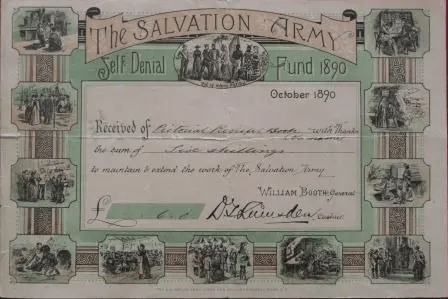
The Salvation Army arrived in the United States in 1880 and in Canada in 1882 and quickly made their presence known in all the towns and cities they could. Their practices including fund-raising became well-known, too. A holiness mission close to the MBiC in theology, the Salvation Army made appeals—lasting a week—for funds from the public, to help finance their benevolent works. They called it a “Self-denial Week” or “Appeal.”6 This custom began in 1886, barely 4 years before writers to the Gospel Banner suggested it in the MBiC. Holiness writers certainly urged self-sacrifice or entire consecration of a person’s life to serving Christ, as American Methodist Randolph Foster said, “Be patterns to all of denying yourselves, and taking up your cross daily,” but not normally as a fund-raising technique.7
By 1892, MBiC Presiding Elders, at least in Ontario, were setting the time period for self-denial and announcing it in the Gospel Banner. Henry S Hallman reported that Solomon Eby and Menno Bowman were announcing the week of March 20 to 27 1892 as the week for the observance in the Canada Conference. A correspondent’s concern that perhaps self-denial had been forgotten suggests it had been on-going for at least a few years. They did not seem to be advocating a week of fasting. It was refraining from some consumables, so that the money saved could be donated.8 They did not even seem to be linking the self-denial to a spiritual discipline. The MBiC could have, and regularly did recommend simplicity of life in non-conformity to the world taught by the Apostle Paul in Romans 12:1-2 and Mennonites and holiness people generally.9 As Mennonites, they may have been unwilling to appeal to the general public, since they rejected fund-raising by raffles, fairs, yard sales and such, but preferred cheerful givers (2 Corinthians 9:7) from among the believing community (3 John 7), ie for them in their own denomination, generally. They also listened to Jesus about not publicizing their giving to the needy (Matthew 6:1-4). In the 1890s, the Gospel Banner was critical of some of the Salvation Army’s fund-raising methods. Sometimes it was the sources of the money the MBiC did not like.10 General Booth is said to have declared he would take money from the devil, in his usual startling fashion.11
In the 1890s, as Charles Gingerich has shown, the young denomination was attempting to establish the usual departments of North American churches.12 They had a conference structure, Sunday Schools, vigorous tent preaching ministries, frequent revival meetings in their mainly rural fields, a lively church magazine, pastoral training through a reading program, benevolence, and were stretching as much as they could to open new home mission conferences (districts) in North America. One thing they were conscious of lacking was a foreign mission program. They raised funds for other missions,13 and one senior evangelist, Eusebius Hershey, voluntarily voyaged to Liberia to preach to Africans there (1889-1890), only to die of malaria. The self-denial plan was promoted to help supply money for all these efforts,14 which Hallman enumerated in an editorial.15

Credit: Susan Bond (2012), “The Salvation Army’s ‘self-denial fund’”
I suppose it was something slightly more serious than giving up a coffee for a week or a month and donating the savings to charities,16 but it is the same idea. I have not traced the self-denial plan far in the Gospel Banner, but more serious sacrificial giving for missions was needed a few years later, as the young church actually started supporting its own missionaries. “Sacrificial giving” seems to be the preferred language in the Missionary Church. In 1895, William A Shantz of Breslau, ON, went to China with the Christian and Missionary Alliance mission with the Canada Conference’s backing. In 1896, Euphemia Guy wrote “Self-Denial Again.”17 Sarah Pool (from Ontario) and Calvin Snyder (Pennsylvania) went to China in 1897, and Herman L Weiss and his wife Kate (Zacharias) from Pennsylvania, to Chile in the same year, all under the Christian & Missionary Alliance. More followed to serve under other missions.18 The first attempt at a denominational mission involved three districts in 1905, needing support for mission staff for everything from travel to paying “native” teachers. MBiC missions had chronically weak finances all the way until mid way into the Second World War.

Courtesy: Missionary Church Historical Trust.
The MBiC began as a rural denomination that had practically no expenses except locally erecting a building, and keeping it repaired and warm on Sundays in winter. Soon they used congregational stewards to collect funds in cash and kind for preachers, outside of the worship service time. Even during the First World War, the MBiC in Ontario raised far below the target of $10 a member for war relief to the Red Cross and the Non-Resistant Relief Organization.19 Gradually, the MBiC/ UMC became a church that ranked with the highest giving groups in North America per member.20
I used to see references in the Church magazine claiming Missionary Church members’ per capita donations placed the Church in the top half-dozen churches.21 I don’t think that has remained true, as congregations struck out with their own plans and drifted from district and denominational unity into congregationalism, and members into individualism in the latter part of the 20th century. Due to the fragmenting of reporting, even the big research organizations seem to be giving up tracking denominational donations per capita.
Charitable donations for any kind of charity per tax-payer is tracked by government revenue agencies, however. Ron Sider commented on the dropping rate of American donations to 2005.22 For Canada the median income of donors in 2022 was $71,250 CDN, but the median donation was $380 (0.5%). The average donation was $2308/ year however, reflecting large donations skewing the distribution.23 People over 65 gave the most, per capita, close to the average. Only 17.1% of Canadian taxpayers reported donating anything to charities.
Self-denial is certainly needed as much as ever in the North American churches, for re-aligning devotion to necessary things in following Jesus.
Banner: Anonymous young man refusing. Credit: Monstera media, Pexels, public domain.
1Everek R Storms, History of the United Missionary Church (Elkhart, IN: Bethel Publishing, 1958).
2Vincent L Wimbush, “Asceticism,” in Adrian Hastings and others, ed, The Oxford Companion to Christian Thought (New York: Oxford University Press, 2000) p 45-46.
3Alex Bisset, ed, The Canadian Oxford Paperback Dictionary (Don Mills, ON: Oxford University Press, 2000).
4 Howard W Tepker, “Asceticism,” in Carl F H Henry, ed, Baker’s Dictionary of Christian Ethics (Grand Rapids, MI: Canon Press (Baker), 1973) p 40-41.
5John Wesley, edited by Nathanael Burwash, Wesley’s Doctrinal Standards, Part I: The Sermons, with Introductions, Analysis and Notes (Toronto: William Briggs, 1880), p 479-486.
6Sarah Bond, (2012), https://sofii.org/article/the-salvation-armys-innovative-fundraising-from-a-century-ago-and-a-lesson-in-how-to-say-thank-you-properly
7Randolph S Foster, Nature and Blessedness of Christian Purity (New York: Lane & Scott, 1852) p 204.
8Henry S Hallman, “Self-denial Week,” Gospel Banner (Vol 15:6 March 15 1892) p 8; A Lover of God’s Cause [from Ontario], “Self-Denying System,” Gospel Banner (June 1 1891) p 9.
9See EMCC History Blogs on Non-conformity and worldliness.
10H S Hallman, “[editorial],” Gospel Banner (November 26 1895) p 8.
11https://salvationist.ca/articles/2010/02/high-stakes/.
12Charles S Gingerich, “An Experiment in Denominationalism: A History of the Missionary Church of Canada, Canada Conference 1849-1918,” MA Thesis, Wheaton College, 1994.
13See EMCC History Blog “Missionary Stirrings in the New Mennonites,” and Everek Storms, What God Hath Wrought: The Story of the Foreign Missionary Efforts of the United Missionary Church (Elkhart, IN: Bethel Publishing, 1948) Appendix 1, p 149-152.
14Peter Shupe in a Gospel Banner 1890 issue not extant, but referred to in the letter by A Lover of God’s Cause (June 1 1891) p 9.
15H S Hallman, “Where the Money is Needed,” Gospel Banner (March 14 1893) p 9.
16After 30 years drinking tea, John Wesley gave it up and donated the money saved to the poor, but then, he gave up most of his income for ministries anyway.
17Mrs Euphemia (Pool) Guy, “Self-Denial Again,” Gospel Banner (February 25th 1896) p 5.
18Listed by Storms (1948) p 137-147.
19See EMCC History blogs on “Non-resistance.”
20Gospel Banner (April 16 1895) p 8 reprinted a table of giving in various North American denominations. The MBiC was beginning to compare themselves with other Churches
21Hinted in Storms (1958), p 260.
22Eg Ronald J Sider, The Scandal of the Evangelical Conscience: Why are Christians Living Just Like the Rest of the World? (Grand Rapids, MI: Baker Books, 2005) p 20-22.
23https://www150.statcan.gc.ca/t1/tbl1/en/tv.action?pid=1110013001

 EMCC History
Leave a comment