Religious radio? Sunday afternoons when I was young my family sometimes turned on the Rod and Charles Show on CBC Radio. It was a comedy program. Apologies to all those religious broadcasters out there, but we never listened to religious broadcasting. And anyway, the Canadian Radio and Telecommunications Commission (CRTC) or whatever its ancestors were called, did not allow religious radio stations in Canada after 1934.1 (Two exceptions in Newfoundland were allowed because they had their licenses before the province became part of Canada in 1949.) I suppose there were religious programs, tastefully ecumenical or mainstream, but not as in Alberta, where American-style Christian radio stations operated in the 1920s and 30s before regulation.2
Regulation in Canada was partly spurred by wranglings of rival Christian personalities on air in Alberta in particular, but also in Toronto.3 Also in Canada, because bandwidth is limited by physics, radio was considered a public good, like the air we breathe, not commercial property. Canada developed a hybrid regulatory model, partly European, partly American. In the American model, radio frequencies were definitely considered commercial. The Canadian government established the Canadian Broadcasting Corporation, the CBC, in 1936.
Even when we became members of the United Missionary Church in North Bay in the mid-1960s, we did not change our listening habits much, that I remember. Sundays we went to church morning and evening and in the afternoons often went for family walks—I especially enjoyed ones in the fall to the fire tower at the top of a hill in Widdifield, north of the city. We just did not have the radio on much except for the CBC weather and news, and I continued in the same habit.
Our grandmother, who lived with us, was pretty well confined to the house and she did listen to people like Pastor Perry F Rockwood and the “The People’s Gospel Hour” from Truro, Nova Scotia. A proud fundamentalist if there ever was one. And my grandmother was a die-hard Anglican! Weird.
Since the sudden beginning of broadcasting in the early 1920s, radio has been popular. Christian preachers and churches quickly realized it could be used for promoting the gospel and their own preaching in particular. Paul Rader at his new Chicago Gospel Tabernacle, Chicago, is said to be the first, in 1922.4 Fundamentalists and Pentecostals who felt at ease with advertising culture all jumped on the new technology.5 I think Mennonites, including the Mennonite Brethren in Christ with their aversion to public display and rejection of show business, turned away from radio’s gravitation to entertainment.6 The MBiC could enjoy “hot gospel preachers,” but they continued to reject the trappings of the stage and cinema. (I’ll explore the opposition of early Evangelical Missionary Church of Canada to film in later blogs.)

Golden Jubilee ceremony, July 1 1936, in Stanley Park, Vancouver.
“CRC” stood for Canadian Radio Commission.
Credit: City of Vancouver Archives, Picryl, public domain
Christian radio programs became the podcasts of the day. Many churches and ministers wanted in on it. Aimee Semple McPherson was a good example of the entertainment style many of them followed. She went on the air in 1924 in Los Angeles on her own radio station: http://www.calendarlive.com/movies/reviews/cl-movie000049748jul19,0,3619391.story Prophetic Baptist preacher William Aberhart began broadcasting in Alberta in 1925 on his own station and continued broadcasting until 1943.7 He was Social Credit premier of the province from 1935. Moody Bible Institute started radio programming in 1926. In Toronto, Oswald J Smith agreed to help the Gerrard Street East tabernacle about 1926. They already had a Sunday 5 pm radio broadcast on CKNC, but the church was struggling with debt. In a half year, preaching mainly on missions, Smith had a 100-voice choir and 40-piece orchestra performing and had the debts paid. It was so entertaining, Smith was approached by another radio station (CKCL) to broadcast the morning service of the newly re-branded and relocated The Peoples Church. Smith called the evening show “The Back Home Hour.”8
It took almost a generation for denominations to get into radio as Churches. Sociologist William Mann noted that though Albertan United Church ministers urged their denomination to get involved, a centralized Church like theirs (similarly Anglicans, Baptists and Presbyterians) could not act without study and commissions and balancing priorities and so on, that they missed the opportunities that entrepreneurial leaders took.9 The Free Methodist Church in the USA, a generation later, claimed to be the first to implement a nation-wide Church radio broadcast in 1944. Their program, the “Light and Life Hour,” soon propelled Myron F Boyd to national prominence in holiness circles, at least. Lutherans had their Layman’s League program since 1930, and Mennonites also explored radio in the 1940s.10
United Missionary Church radio. So it was not until the 1950s that the United Missionary Church in Ontario was comfortable enough with radio to use it as routine. It was the period of “church extension.” By then, UMC congregations were used to gospel trios, quartets and choirs, using musical instruments, dramas and other platform devices. North Bay was the target of a very specific bit of gospel radio programming in the 1960s. Our congregation was a new one, started by Earl Pannabecker, who had pioneered churches in Wasaga Beach, Eau Claire, Mattawa, and in 1960—North Bay. An enterprising man.11 He helped me become follower of Jesus, too.
To help publicize the United Missionary Church efforts in North Bay, the district sponsored a Christian radio program on a North Bay radio station from 1959 to 1966. It came about as a result of a new Ontario Conference committee proposing a weekly 15-minute program in 1954 for the Hamilton area, calling it “The Missionary Hour.”12 In fact, the committee was only able to buy time on stations in Wingham and Oshawa with hope to do the same at Orillia and Chatham by conference time in 1955.13 They had a lot to learn about the business, recording music in Kitchener, but producing the program in Gormley, ON. In 1956 they managed to broadcast on CHUM, Toronto, and CKNX, Wingham.14 Ontario preacher Clarence Hunking, with a strong clear voice, was a large part of the programming. This picture continued until 1959. The Committee switched from Toronto to a station at Richmond Hill and hoped to add one in Kitchener, but the Conference recommended purchasing time on CFCH in North Bay “in a true missionary emphasis.”15 As it turned out they could only afford the North Bay station, with mixed results. Pastors in Mattawa and North Bay reported many were listening, but no letters in response in 1960-1961! Established radio ministries counted on hundreds and thousands of letters—and contributions—per month. Church attendance, though growing at Lakeshore UMC North Bay and small but stable in rural Eau Claire, was still less than 100.16 That situation continued in 1962 so that the Committee recommended closing the effort in favour of broadcasting Quinton J Everest’s “Your Worship Hour” from South Bend, Indiana, a leading United Missionary Church pastor. His radio work, started in 1933, was independent of the denomination.17
The Conference was uneasy with discontinuing the broadcast in the North Bay area, and continued it, though, as often happens, revenues did not support it sufficiently for the committee to recommend continuing in 1963, but again the Conference disagreed18 and at last finances were donated to help it.19
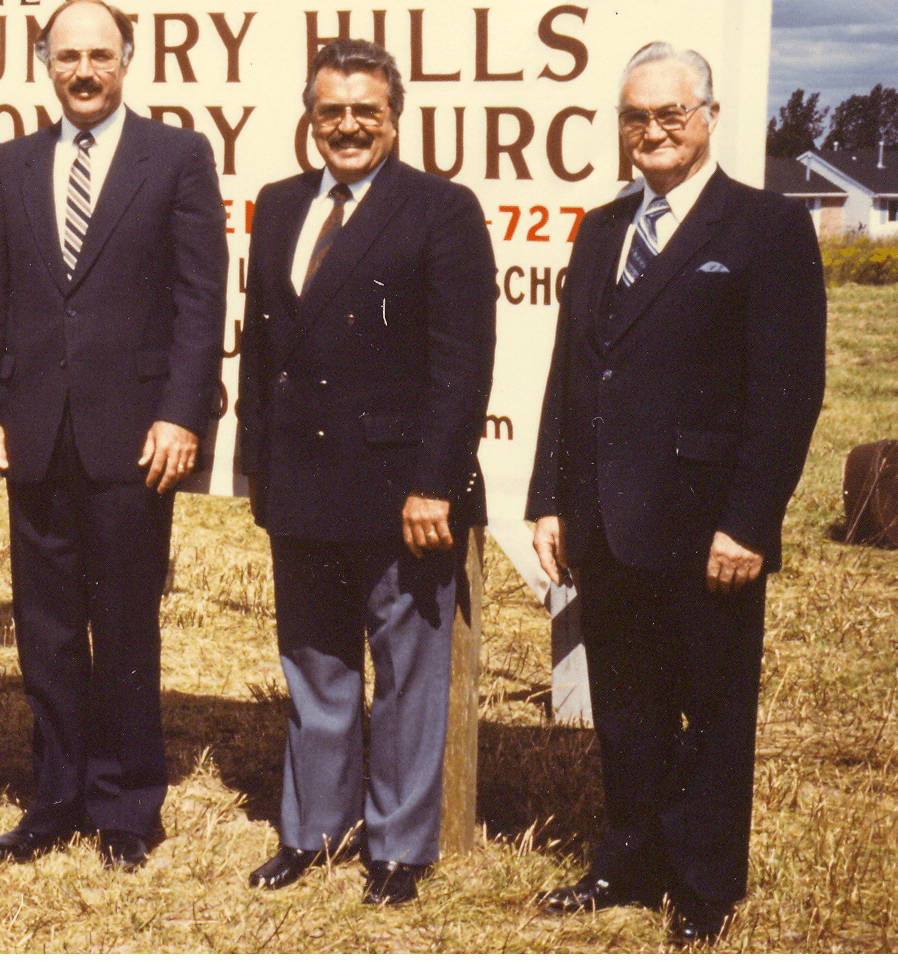
Courtesy: Missionary Church Historical Trust
Besides broadcasting in the north, the Radio Committee bought time on CHUC, Cobourg, ON, on the north shore of Lake Ontario to support the Colborne and Port Hope churches’ area until 1965. It could be, that as those congregations were to the east of the main UMC membership, it was thought they could use the publicity. Also that year an individual paid for “The Missionary Hour” to play on CJWR Blind River in the Ottawa River valley, covering both the Mattawa area to the north and the Petawawa and Pembroke areas further south. “Spot announcements” were paid for on a Pembroke radio station in support of the Eau Claire pastor, Bill Smith, meeting in the area with discontented Evangelical United Brethren members, as told in my blog “The Evangelical United Brethren Connection Part 2.” This continued into 1968, and was extended to South River, south of North Bay, where another congregation was forming with Pannabecker’s involvement.20
In 1966, the Ontario Conference placed the Radio Committee under the Home Mission Board, and subsidized the broadcast of a radio program called “Youthtime,” in North Bay and Brampton.21 This effort originated at Stouffville, ON, directed by Baptist Ken Campbell, then a youth evangelist.22 Future district superintendent Ed Prosser seems to have had a part in this production as well. I do not remember listening to the program, but when the local station dropped it from its schedule, I have been told that my mother, among others, wrote the station to ask them to retain it.
A wider story. As I started to research this radio effort of the Ontario Conference, I thought that this was the whole story, but I was wrong. Gradually I realized that many United Missionary Church pastors and churches had already been producing radio programs for their local listening area—mostly Sunday morning worship services, but sometimes specially recorded programming. “The Voice of Calvary,” from Calvary UM Church, Owen Sound, Ontario, was perhaps early but typical. They started in 1940 on station CFOS.23 By 1946, the MBiC in the USA and Canada listed radio broadcasts in the Gospel Banner in many locations, and Quinton Everest’s growing efforts developing a wider network. By then, Everest was preaching on 7 stations, plus his “Sunrise Meditations” in South Bend, IN. I will look at “Your Worship Hour” in a later blog. Beside Owen Sound, there were also “Gospel Meditations” (Springfield, OH), “The Sunday School Hour” (Ft Wayne, IN), “Church of the Air” (Wingham, ON), “Gospel Herald Society Gospel Hour” (Harrisburg, PA), and “The Gospel Four” (Sunbury, PA).24
The MCHT has manuscripts of radio messages from Ontario UMC preachers Ward M Shantz from 1954-1957 when Shantz was president of Emmanuel Bible College, and from Arthur Walsh who spoke on CKKW-AM (1966).25 But I have seen casual references to still other local church use of local radio stations.

This call sign was first used by T T Shields’ Jarvis Street Baptist Church 1925-1933.
Credit: Gilbert A Milne, Archives of Ontario. public domain.
In the 1950s, however, a new technology had quickly become the darling of home entertainment, television. UMC pastors could become involved, as Walsh did, who preached on CKCO TV in Kitchener 1956-1964. The North Bay ministerial association in the late 1960s developed a TV Bible quiz program that my church’s youth group competed in. Many churches probably benefited from the free community cable TV slots provided by Rogers TV in Ontario as the Chinese Sudbury Missionary Church did in the early 1980s.
TV was and is much more expensive on which to buy time, but lucrative, just as radio was, if the hosts could capture a market. The 1950s saw radio preacher-turned televangelist Fulton Sheen (1951), Rex Humbard (1952), Oral Roberts (1957), Billy Graham (who used TV specials instead of hosting a regular program) from the 1950s, Robert Schuller (1970), and others. But that is another story.
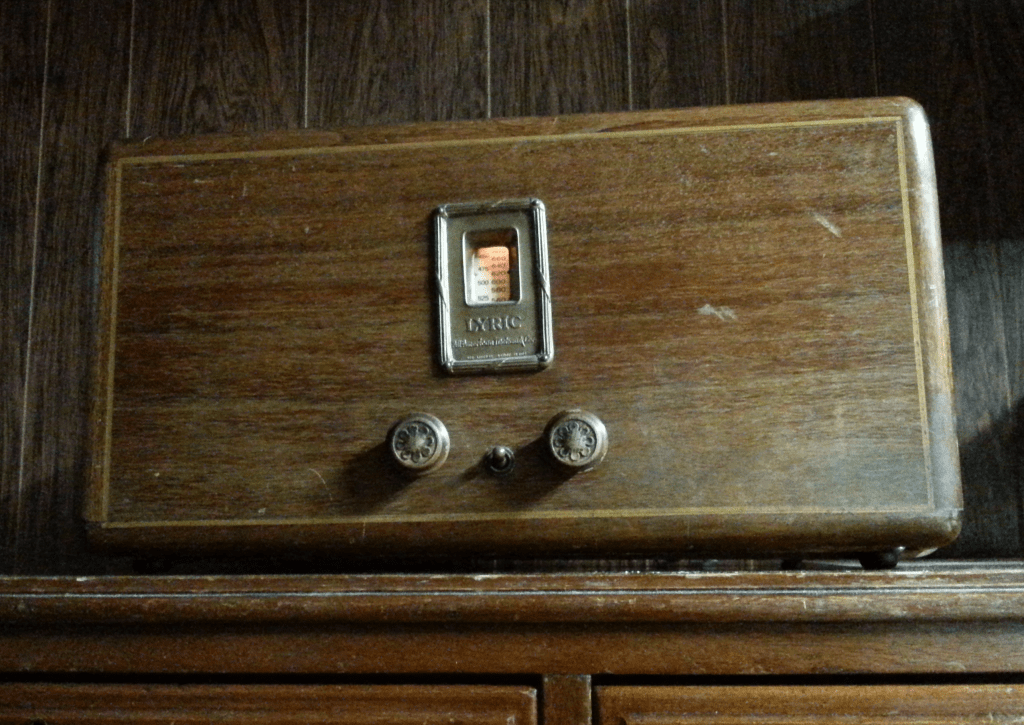
Banner: A 1927-1929 Lyric (Chicago company) AM radio set, restored to working order. This model 606 was built in Toronto. Courtesy: Mark Fuller, electrical engineer, 2025 photo.
1Mark Faassen, “A Fine Balance: The Regulation of Canadian Religious Broadcasting,” Queen’s Law Journal 37:1 (2011) https://journal.queenslaw.ca/sites/qljwww/files/Issues/Vol%2037/8.%20Faassen.pdf
2William E Mann, Sect, Cult and Church in Alberta (Toronto: University of Toronto Press, 1955) p 4, 118-129.
3Mark G McGowan (2008), “Air Wars: Radio Regulation, Sectarianism and Religious Broadcasting in Canada, 1922-1938,” Historical Papers, Canadian Society for Church History. https://historicalpapers.journals.yorku.ca/index.php/historicalpapers/article/view/39154/35500
4https://reachbeyond.org/our-history/1922-paul-rader-first-religious-broadcaster
5W E Warner, “Radio,” in Stanley M Burgess, Gary B McGee and Patrick Alexander, ed, Dictionary of Pentecostal and Charismatic Movements (Grand Rapids, MI: Zondervan Publishing, 1988) p 753-755.
6Donald Hustad, Jubilate! Church Music in the Evangelical Tradition (Carol Stream, IL: Hope Publishing, 1981) p 18-19. Hustad cautioned about the spectator and entertainment pull of radio and TV as media, p 137.
7Mann, p 22.
8Lois Neely, Fire in His Bones: The Official Biography of Oswald J Smith (Wheaton, IL: Tyndale House, 1982) p 186-187.
9Mann, p 129.
10Leslie R Marston, From Age to Age a Living Witness: A Historical Interpretation of Free Methodism’s First Century (Winona lake, IN: Light and Life Press, 1960) p 487. I don’t know how Marston would explain his statement. Perhaps because it was a “Layman’s League” venture? Mennonites had individual efforts from 1936, denominational from 1945: https://gameo.org/index.php?title=Broadcasting,_Radio_and_Television
11Glenn Gibson, “The Undertakings of an Undertaker,” Emphasis (May 1986) p 12-13. Glenn Gibson interviews November 1985, Box 9025 MCHT.
12“Committee on Radio” report, Ontario Conference Journal 1954, p 42-43. The first committee members were Harold G Boadway, Everek R Storms and Clinton E Bell.
13“Report of the Committee on Radio,” Ontario Conference Journal 1955, p 36-37.
14“Report of the Committee on Radio,” Ontario Conference Journal 1956, p 28.
15“Report of the Committee on Radio,” Ontario Conference Journal 1959, p 27-28, 32, 34.
16“Report of the Committee on Radio,” Ontario Conference Journal 1960, p 29, and 1961, p 32.
17The “hour” was really a half-hour; Everek R Storms, History of the United Missionary Church (Elkhart, IN: Bethel Publishing, 1958) p 256. More on Everest: Malinda Mae (Yoder) Everest, My First Ninety Years (For the Author, 1999) p 86-89, 112-114, 116-117, 122-124, 139-146; Everek Storms, “One Man Under God,” Gospel Banner, Vol 86:4 (February 14 1963) p 6-9, 11, 13, 15.
18“Report of the Committee on Radio,” Ontario Conference Journal 1963, p 35.
19“Report of the Committee on Radio,” Ontario Conference Journal 1964, p 30.
20“[Report of the] Home Mission Board,” Ontario Conference Journal 1967 and 1968, p 31 and 25, respectively.
21“[Report of the] Home Mission Board,” Ontario Conference Journal, 1966, p 32.
22“Evangelistic Team at Gormley UM Church,” The Liberal, [Richmond Hill, ON] Thursday Feb 18 1964, p 12.
23Calvary Echoes Vol 1 No 1 [1946?] p 5.
24Gospel Banner (Feb 14 1946) p 15.
25Shantz: Box 6001; Walsh: Box 6006, MCHT.

 EMCC History
Leave a comment