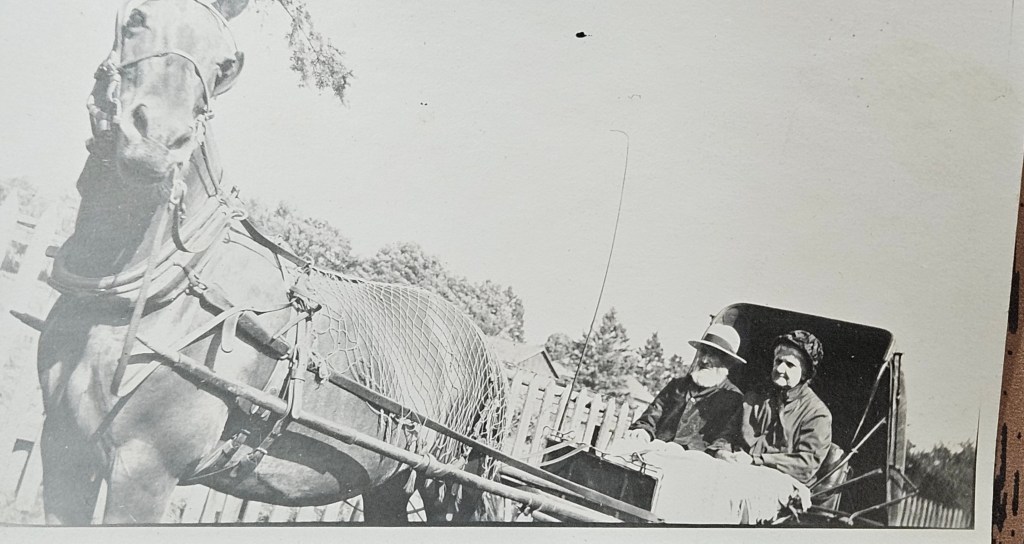
Like Priscilla and Aquila in the Bible, Levi and Fannie Raymer stand out as married disciples of Christ in the history of the MBiC in Ontario. What they left behind intrigues me.
First, Fannie Raymer (1844-1927) left a short manuscript history of the Ramer/Raymer family as she knew it.1 Sometimes referred to as “Fanny,” she herself normally spelled her name “Fannie.” The family in Markham anglicized their German name (probably Roemer) either as Ramer or Raymer. She was a Raymer and married a Raymer, a large clan of Pennsylvania Dutch (Swiss/ German) origin in York County, Ontario, mainly in Markham Township.2
It is not their ancestry that draws my attention, though, it is their Christianity.
In the 1861 Canada West (that is, Ontario) census for Markham, York County, a John Raymer, 41, Inn Keeper, reporting his church as the Church of England, has Sarah—occupation Land Lady—as his wife. In the household is a son of 18 years, the oldest of seven at home, called Levi. Sarah, 33, was a Hoover (originally Huber) by birth, another wide-spread Pennsylvania-Dutch family in York County. She was Levi’s step-mother.
This Levi Raymer, writing a letter to a historian in 1915, tells us that he and his parents became members of the New Mennonite Society in 1863.3 The New Mennonites organized in York and Ontario Counties4 in the 1850s led by Mennonite preachers Christian Troyer and Abraham Raymer, and were joined by John Hoover Steckley about 1860.5 They allied with the New Mennonites in Niagara and Waterloo, whom we have seen in earlier blogs. It is almost certain that the itinerant preaching of one of these three men led to the conversion of members of Levi’s family. Part of the Markham Mennonite revival is told in a video under the YouTube channel name “Ontario Church Stories,” filmed and edited by Thomas Fuller in 2016.
By the 1871 Canada census, Levi was a farm labourer in Whitchurch Township (immediately north of Markham), 28, married to Fannie, 27, listing themselves as Mennonites. They had three children: John, 4, Sarah, 2, and Elijah, one month old. “Fannie” was really Veronica, but in their families, most Veronicas became nicknamed Fanny or Fannie.
Ten years later, the couple are no longer in York County, but homesteading in Sunnidale Township in western Simcoe County, south of Georgian Bay, with more children. There is no record of the New Mennonite Church having a congregation organized then in Sunnidale or Nottawasaga, the neighbouring township to the west, but NMC preachers made brief tours to nurture its scattered members in places like Nottawasaga.6 In 1875 the NMC united with the Reforming Mennonites, a brand new Mennonite renewal society formed the year before. Within a year, 1876, the United Mennonite Church, Canada Conference recorded Nottawasaga membership, with family names such as Powers and Raymer.
Levi and Fannie had moved to Sunnidale in 1873.7 Their farm was barely cleared, and took years of work to improve. Levi became a cornerstone of the Nottawasaga field, and then the Sunnidale field, as it became when the membership in the two townships grew and the circuit divided. The field chose him as one of their class leaders and as a steward.8 The duties of “class leader” in the MBiC are not well described, but included leading a “cottage” prayer group, a prayer group in members’ homes. In early Methodism, a class leader gave a fair level of weekly spiritual care to a group of disciples.9 Stewards were people who collected offerings for field finances, hall rentals, if they used them, meeting house construction, upkeep, and increasingly, support for the circuit preacher’s family. In the early EMCC, the worship service did not include offering times.
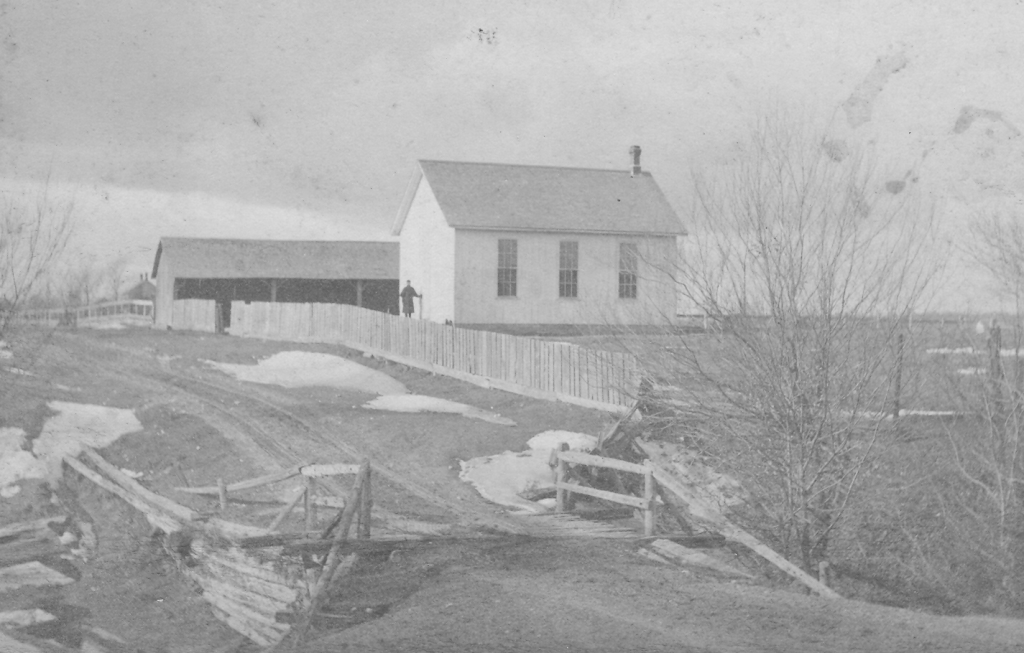
Courtesy, Missionary Church Historical Trust
Levi served as the delegate from the field at several annual conferences.10 He represented the appointments which for a long time were centred at meeting places known as Glencairn, at the south end of Sunnidale, Sunnidale Corners in the middle on what is now Highway 26, and Ebenezer at the north end of the township. Normally, the Raymers attended at Ebenezer, but Fannie’s diary notes them or some family member occasionally going to another site, especially Sunnidale Corners. As a delegate, Levi also helped station the preachers of the Ontario Conference. Fannie and Levi hosted prayer meetings and boarded preachers for their field, attended Quarterly Meetings (Levi “never missed” according to his obituary), volunteered on church work bees, took turns cleaning the church hall, visited neighbours and supported annual protracted meetings, or “revivals” as they later came to be called. The Raymers were big supporters of Sunday School as well. The year the Canada Conference Sunday School Convention met in Stayner, 1904, Fannie was the secretary of the Convention, and her record has survived in the family collection.11
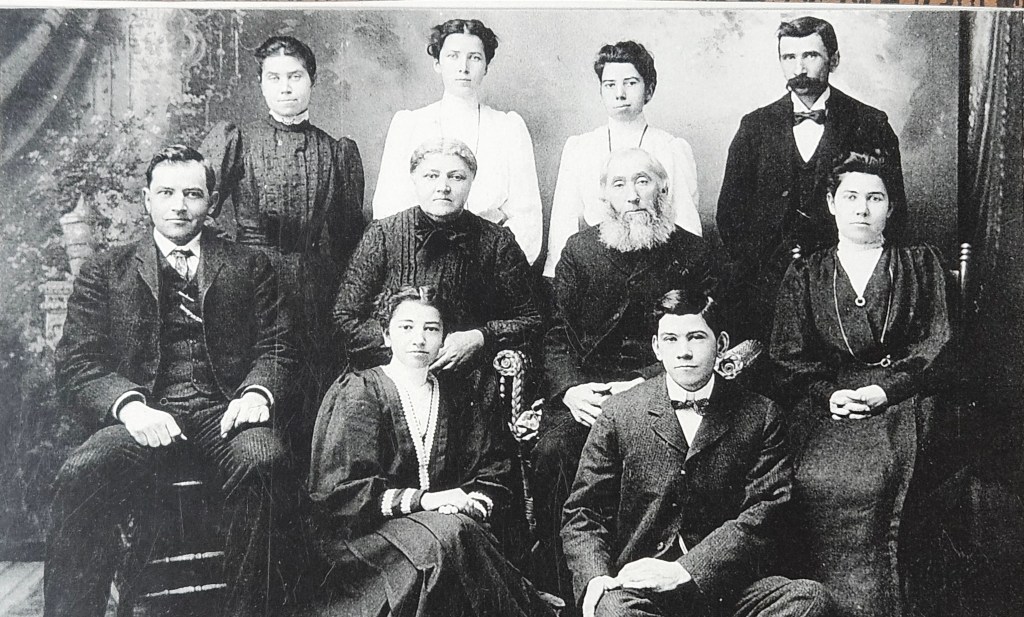
Courtesy Raymer Family Collection, Missionary Church Historical Trust
Fannie Raymer kept farm diaries in newsprint school exercise books that objectively recorded the weather, the sale of farm products, farm work, including her own field work, visitors who came for tea or stayed overnight, church and community life. The amount of visiting amazes me, familiar as I am with urban life from over a century later, but perhaps average in the rural places of Ontario.12 I would love to see her diaries published. Her spelling is unique, but her record is pretty clear. I don’t know when she started keeping diaries, but the volumes supplied to the MCHT begin in 1893 and reach 1922, with a few gaps, and with some years taken over by a daughter (1904), probably Louisa (1881-1959), and again sometime between 1919 and 1922. Louisa continued a diary series of her own from 1922 to 1941 and again 1952 to 1956. The MCHT collection has photocopies of the diaries from 1893 to 1907.
Fannie probably was behind a scrapbook of clippings, cards and a few documents of Raymer relatives and MBiC church people and places from the church magazine, the Gospel Banner. She added photos of MBiC missionaries as they started to be sent to China, Chile, Armenian Turkey and Nigeria from 1895, as well as clippings about other missions. Family members added a few items after her death.
The Raymer family13 donated a valuable photograph collection to the MCHT, mostly recording Raymer family, relatives, and friends (Freys, Siders, Atkinsons and others) in social moments before and after the senior Raymers sold the farm and moved into Stayner in retirement. The collection includes some almost incidental snaps of church affairs, an occasional pastor, or camp meeting informal moments. Apart from some studio photos such as the family portrait, it seems to me the women of the family were the main photographers, as women and women at work feature well. Most photographs are well notated by the family in several hands, but there are tantalizing omissions.
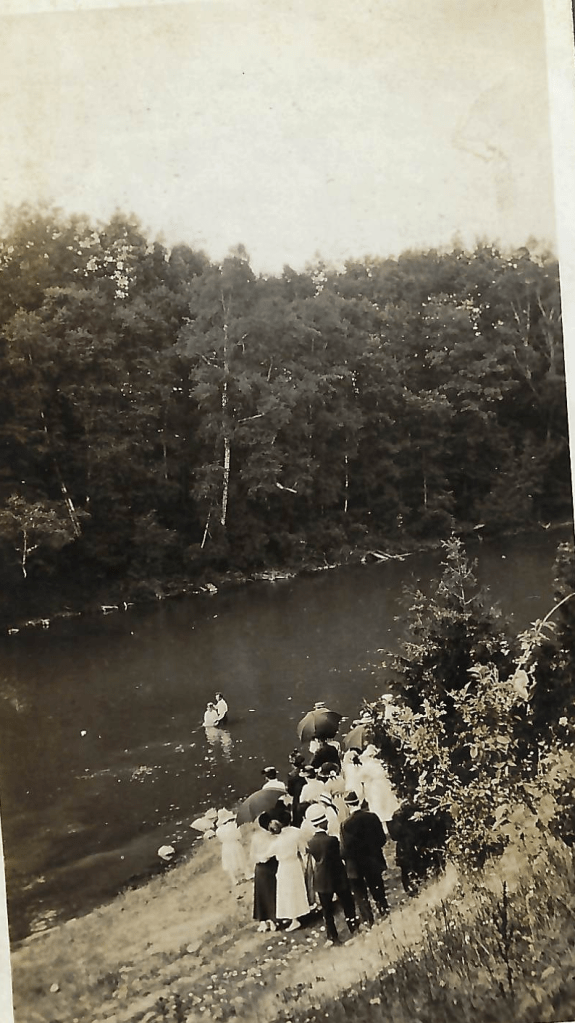
Courtesy: Raymer Family Collection, Missionary Church Historical Trust.
One photograph I like shows a baptism in a river, probably the Nottawasaga, but unfortunately it is undated and without identifications.
By the 1921 census, the senior Raymers were living in Stayner with two daughters. Interestingly, they now describe their national origin as “Dutch,” a common response of many German-background families to the census after World War I.14
Levi and Fannie moved to Ontario Street, Stayner, after their Sunnidale Rd house burned down. Fannie hosted the organizing meeting of one of the first Women’s Missionary Societies in the Ontario Conference there in 1924, when she was already 79 or 80.15
Levi died at home, 83 years, 10 months and 2 days old, on December 7 1926. Fannie followed him less than a year later. They had sojourned 53 years in Sunnidale and Stayner. The three ministers of the Nottawasaga and Sunnidale circuits, William Brown, Elmer Moyer and helper Ernest W Harvey officiated at Levi’s funeral, along with Presiding Elder Milton Bricker, himself Levi and Fannie’s pastor in earlier years. The church conducted the service at the Ebenezer church building, where burial took place.
There are many such solid Christian couples in the early EMCC as in other Churches. This outline gives barely a taste of their witness.
Banner: Levi and Fannie with horse and buggy, August 1921. Courtesy: Raymer Family Collection, MCHT.
1Fannie Raymer, “History of the Ramer Family,” MS (dated 1912-1915), Box 6050 MCHT. It also exists an undated copy, probably in her daughter Louisa Raymer’s handwriting, called “History of the Raymer Family.”
2There is in Box 6050 MCHT, a genealogical chart by N E Wideman, “The Ramer Family in Canada,” nd. See also https://books.google.ca/books/about/The_Ramer_Raymer_Family_in_Canada.html?id=AZBpAAAAMAAJ&redir_esc=y
3Levi and Fannie Raymer, Letter of July 31 1915, in Jasper A Huffman, ed, History of the Mennonite Brethren in Christ Church (New Carlisle, OH: Bethel Publishing, 1920) p 39.
4Ontario County is now called Durham Region.
5See profiles of all these men in Global Anabaptist Mennonite Encyclopedia Online (GAMEO.)
6Quotes from reports in Oberholtzer magazines in the “Mennonite Brethren in Christ Church” file, Mennonite Archives of Ontario, Conrad Grebel University College, Waterloo, Ontario.
7Fannie Raymer, “Ramer Family,” (1912) p [11].
8“Obituary,” Gospel Banner (December 30 1926) p 14.
9I have a book for class leaders with advice and outline of duties originally from American Methodism: John Atkinson, The Class Leader: His Work and How to do it, with Illustrations of Principles, Deeds, Methods, and Results (Toronto: Samuel Rose, 1875).
101883, 1902, 1908, 1910…
11Box 6050 MCHT has a photocopy.
12Chapter on visiting in Frances Hoffman and Ryan Taylor, Much to Be Done: Private Life in Ontario from Victorian Diaries (Toronto: Natural Heritage/ Natural History, 1996) p 135-150.
13Mostly through the great grand daughters Marilyn (Raymer) Cole and Ruth (Raymer) Scott, children of Nelson, son of Elijah, son of Levi and Fannie.
14In 1911 they were of “German” descent.
15Edward N Chester. Great is Thy Faithfulness: Stayner Centennial 1890-1990 (Stayner, ON: Stayner Missionary Church, 1993) p 11.

 EMCC History
Leave a comment