Beniah Bowman had a new job from October 1918: he was elected to the provincial legislature as the honourable member for Manitoulin in a by-election for the United Farmers of Ontario, (UFO—changed in connotation now!) He was their first elected member, followed by another UFO candidate 5 months later. The local UFO chapter “acting solely on their own initiative” nominated an “independent candidate in the person of Beniah Bowman, an old-time settler [sic!].” “Bowman went at his campaign with a will, advocating among other things: direct legislation, civil service reform, abolition of patronage, and public ownership and operation of all utilities.”1
The Conservative Premier William Hearst ridiculed Bowman’s candidacy. Perhaps someone had told him Bowman came from the Mennonites, who were not even allowed to vote in federal elections because of their non-resistant teaching during the war. A TVO Today article mentioning Bowman overlooked this point.2 Hearst asked how could a “farmer,” (he did not say Mennonite) have the right to make laws that others were dying to uphold (the war had a few months to drag on.) I think Bowman was representing farmers first and foremost as his rejection of a non-farmer UFO leader (lawyer William Edgar Raney) in 1924 demonstrated. The family also had to protest that they were of Swiss descent, not German, in those volatile days around World War I.3
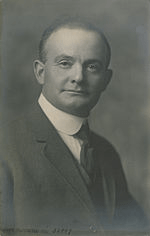
Credit: Archives of Ontario
Obviously, the UFO represented farmers upset by Conservative party neglect of the rural sector and the usual scandals of those in power.4 Bowman was re-elected in the 1919 election and was rewarded with a provincial cabinet post in 1920 in the coalition government of Ernest Charles Drury. I don’t know how he reconciled his political job with his assignment as a helper on the MBiC field. Recognition as an MBiC helper ended in 1920 anyway.5 For at least a couple of years he was an MBiC preacher and a politician.

Courtesy: Catherine Bowman scrapbook, Missionary Church Historical Trust
As Minister of Lands and Forests,6 Bowman was in charge of such things as setting up investigations into the conduct of the Conservative government toward lumber companies,7 assessing returned soldiers in pioneering farming colonies in northern Ontario,8 licensing logging companies and the new pulp and paper mills. For over half a year he had also been the minister for mines. Bowman’s son Marven remembered trips with his father by rail to see gold mines in Timmins and silver mines in Cobalt.9 Bowman also signed the Williams Treaty on behalf of the provincial government in 1923 between the Crown and Mississauga and Chippewa First Nations, probably because many of their lands had been of interest to logging companies, though largely cut by then. This flawed Treaty has come back into recent news with a newly renegotiated result.10
The Drury government lost to the Conservatives in mid-1923, but Bowman was re-elected and continued to serve on many standing committees. He stayed with the UFO “rump” until 1926 even when most of the returned members jumped to the new Progressive Party. That year he shifted to the federal UFO and was elected to the Algoma East riding, serving until 1930. His “maiden” House of Commons speech in 1927 addressed concerns of northern Ontario residents about a long-proposed “Georgian Bay Canal” but was more about cheaper electricity for northerners. It reads as a calm political representation by a seasoned speaker.11 In his only other major speech in a tariff debate on April 11 1929, he upheld the interests of Canadian farmers, both east and west, with carefully chosen research, without attacking anyone.12 One of Bowman’s federal colleagues in the UFO was Agnes McPhail from Port Elgin, ON, (MP 1921-1940), famous for supporting the five women who pressed for recognition of Canadian women as persons.13 E C Drury and Agnes McPhail were both members of the Dominion Patrons of Husbandry (The Grange), a secret society supporting farmers, in fact Drury had been the national leader.14 It is likely they asked Bowman to join, though as a Mennonite he should have declined. Marven Bowman, Beniah’s son, shed his parents’ Mennonite heritage. He joined the military cadets, tried to enlist in the Second World War and later led the Rosicrucians in Toronto.15
Switching to the Liberal Party for the 1930 election, Bowman was not re-elected and that ended his public political career. The family started to experience financial difficulties. Beniah lost money in a business investment and they lost their house in Toronto.16 The family returned to the farm at Long Bay and for three years his son Marven managed it.17
It looks as though investors made Beniah president of the Blind River Pine Co using his reputation to try to raise capital around 1936. They bought a failing lumber company at Blind River in the District of Algoma which nevertheless employed 54 people at a state-of-the-art sawing and planing mill. The new company was prevented from raising its capital purely from stock offerings, a risky device, by a public regulator.18 Others (McFadden Lumber Co) took the mill, which operated for another 33 years.19
I have not run across reflections by Bowman which witness a clearly Mennonite/holiness mindset. The Owen Sound Sun Times described Bowman as completely honest, a characteristic often absent in politicians, many believe. That may have been journalistic bravado, but Beniah’s loyalty to UFO principles suggests something. A Manitoulin newspaper described his political campaign (probably for the 1923 election) as being among the cleanest in the Island’s history.20 Bowman’s son Marven said his father “enjoyed the reputation of being a non-smoker, non-drinker, industrious…,” which could have described a number of serious-minded men in Ontario, but there is no hint of being a Grange member.21 MBiC Elder Percy Lehman probably supplied the information for Bowman’s Gospel Banner obituary. It described Bowman as one who “always maintained an active interest in spiritual matters and witnessed a good profession.” During his illness, he “suffered greatly, and with much patience at the last.”22 While I would describe the characterizations as kind, they are not proof of MBiC membership at the time.

Beniah is on the right, back row.
Courtesy Catherine Bowman scrapbook, Missionary Church Historical Trust
When Bowman died at 55 while in the Toronto area for the winter in 1941, he had been in ill health for some years. The funeral was in Toronto,23 officiated by the MBiC’s Percy G Lehman and Sam Goudie, which certainly looks to me as if he kept some kind of MBiC affiliation despite his government life and Ottawa residency.24 Marven claimed Goudie had been instrumental in bringing his parents together. Lehman, described in the Stouffville obituary as Bowman’s former pastor, had served the Manitoulin Island churches 1930-1934, and was near Toronto as the pastor at Markham in 1941. Goudie, retired, lived at Stouffville. Bowman’s family buried him in Hagey (Mennonite) Cemetery in Preston, ON,25 where his mother’s family, the Baers, had lived. He was survived by his wife Mary “Minnie” (d 1969) and his one child, his son C L “Marven” Bowman (d. 2002).
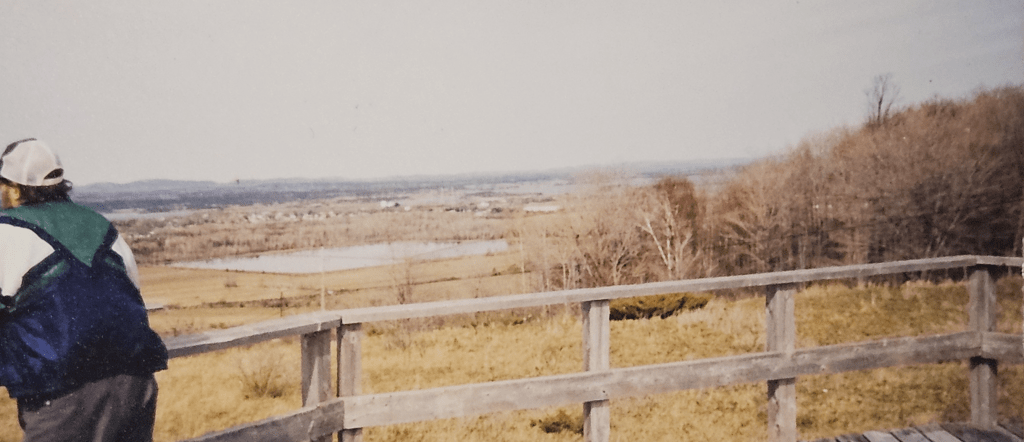
Banner: On Little Current tower hill, Manitoulin Island, 1998. Courtesy Fuller Family Collection
1Louis Aubrey Wood, A History of Farmers’ Movements in Canada (Toronto, Ryerson Press, 1924) p 329.
2Jamie Bradburn (2018), https://www.tvo.org/article/the-year-the-ufos-came-to-power-in-ontario
3Marven Bowman, “Memoirs of Charles Lloyd “Marven” Bowman,” (Gore Bay, ON: By the author, 2000) p 16.
4Detailed in such accounts as Robert Craig Brown and Ramsey Cook, Canada 1896-1921: A Nation Transformed (Toronto: McClelland and Stewart, 1974) p 144-161, 315-320.
5I cannot find Beniah or his family in the 1921 Canadian census yet, either in Toronto or on the island.
6“And of Mines.” It was part of his portfolio November 1920 to June 1921; Jesse E Middleton and Fred Landon, The Province of Ontario 1615-1927 Vol 2 (Toronto: Dominion Publishing, 1927) p 1348.
7https://www.newspapers.com/clip/25743775/xgraves-bigwood-13/
8https://www.internmentcanada.ca/articles/20/1920-01-24-SDS-Will-Weed-Out-Soldier-Settlers-at-Kapuskasing.pdf.
9Bowman, p 19A.
10https://www.thecanadianencyclopedia.ca/en/article/williams-treaties
11https://parl.canadiana.ca/view/oop.debates_HOC1601_01/1235
12https://www.lipad.ca/members/record/28ba6355-2989-493b-abe0-6aae6a4ccb2b/2/
13Tabitha de Bruin (2008), https://www.thecanadianencyclopedia.ca/en/article/agnes-macphail. ;
14Marcia L Masino, (Retrieved April 2023) “The Secret Farm Philosophy,” Escarpment Magazine https://www.escarpmentmagazine.ca/community/the-secret-farm-philosophy/.
15Obituary in a personal communication from Bowman family to Shirley Baker, November 15 2002, in Box 6041 MCHT.
16Most of the years in politics, the Bowmans maintained a house at 9 Northcliffe Blvd, Toronto; Bowman, p 20.
17Bowman, p 25-26.
18“Blind River operations are held up,” Financial Post, June 27 1936, p 1, referenced in Wikipedia.
19Matt Bray and Ernie Epp, ed, A Vast and Magnificent Land: An Illustrated History of Northern Ontario (Thunder Bay, ON/ Sudbury, ON: Lakehead University/ Laurentian University, 1984) p 78.
20Unidentified clipping in Shirley (Cochrane) Baker Collection album, Box 6041 MCHT.
21Bowman, p 15.
22“Obituaries,” Gospel Banner (June 12 1941) p 13-14.
23At Morley Bedford’s Funeral Parlors, at its site in North Toronto.
24The MBiC had no church in Ottawa, but did have two in Toronto and 6 more just north of the city.
25“Pastor officiates at Bowman funeral,” Stouffville Tribune, April 17 1941, p 5.

 EMCC History
Leave a comment