In early 1915 Turkish nationalists turned on Armenians in Turkey and began to exterminate them.1 The desire was not new, but the plan implemented to exterminate was. Generally, men and boys 12 and up were disarmed, conscripted, put into labour camps and soon killed, then women and children were “deported,” or offered opportunity to convert to Islam. Some women were married into Muslim families and remaining children assigned to Muslim homes (about 100,000 to 200,000.) Many Armenian women were sexually assaulted before being killed. At first Armenian Catholics (about 140,000) were exempt from the deportations,2 but in the end all Armenians of whatever denomination were rounded up. At first American and German schools and orphanages were also exempted, but when the male Armenian staff were called away, and the institutions were unable to function, the authorities removed the children so the foreign staff didn’t know what was happening to them. Then the authorities confiscated the facilities for “war purposes.” Between 1915-1918 up to one and a half million Armenians from all across Turkey were massacred, marched to their deaths or forced to concentration camps and left to starve. Our mission books say 100,000 Armenians (there may have been 200,000) remained in the French mandate territories of Syria (Lebanon and Syria of today) after the break up of the Ottoman Empire. If this were true, well over a million died on the way to exile.3 Greeks in Turkey, well over a million, were also persecuted and deported to Greece in an exchange of populations, mainly after the Turkish Revolution of 1923.4 I am simplifying the story for this short blog format.
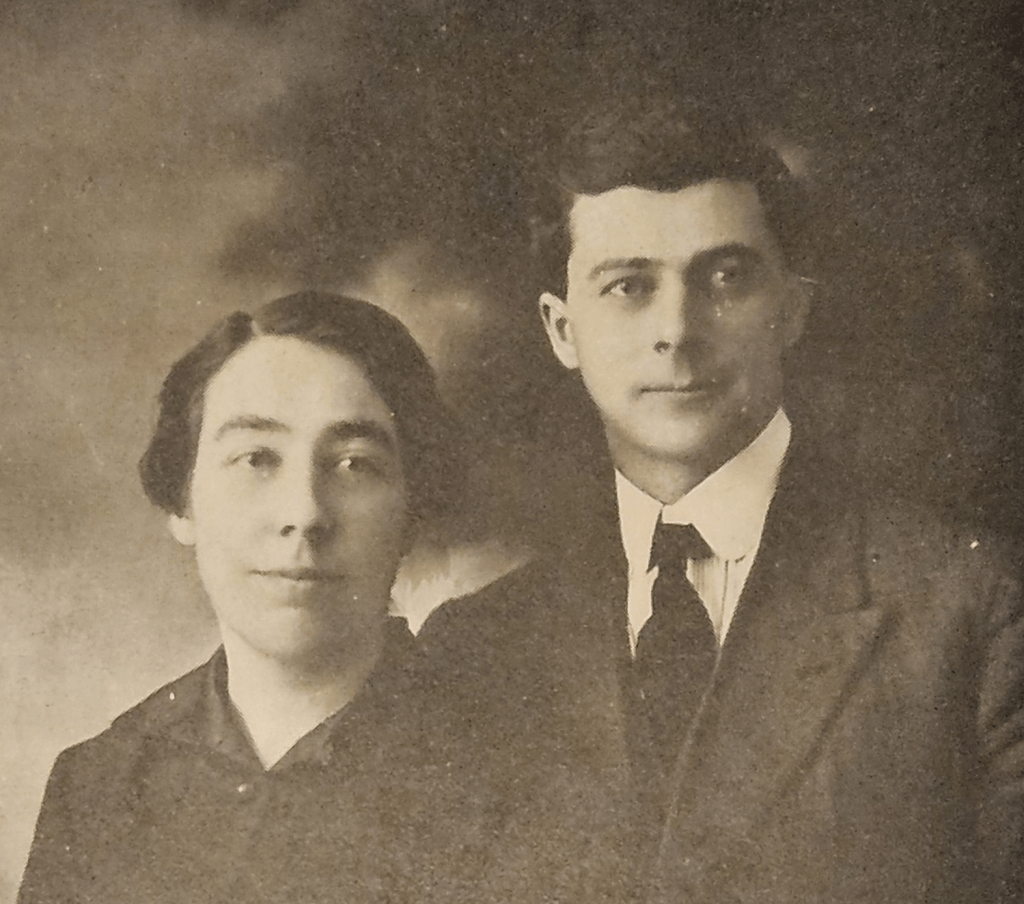
Credit: Blanche Eby, At the Mercy of Turkish Brigands (Bethel, 1922) opposite p 1.
At the war’s end, UOMS staff Daniel Eby, appointed the superintendent, his wife Blanche (Remington), and Katherine “Kate” Bredemus5 returned to re-establish the mission’s institutions, because Armenians had returned to take up homes in Hadjin again. They were unable to reopen the orphanage in Everek.6 Turkish aggression revived to eliminate any remaining Armenians in the new Republic. The Young Turks had decided the Armenians were a threat to the national security of an ethnically pure Turkish state. Not long afterward, the Turks turned on fellow Muslims, Arabs, the Circassians and the Kurds. “National security” is a concept wonderfully adaptable to justify many evils nations perpetrate, east and west, north and south, to this very day.
Hadjin was under intense seige for 8 months from March 1920, and by the end the city was destroyed, abandoned, and its people fled or killed. The UOMS and American Board staff caught in Hadjin escaped death through pure providence, as they were captured, robbed, and rescued by friend and foe alike several times.7 The UOMS relocated their efforts to Syria and Lebanon. Bredemus moved to Cyprus to care for refugees there until 1924, and back in the USA she edited the mission newsletter until 1938. Daniel together with Blanche,8 set about building congregations with some Armenians they had known, in the major cities where Armenians settled: Aleppo, Beirut, Damascus,9 Jerablus (ancient Carchemish), Latakia, Alexandretta (Iskanderun) and nearby Kirik Khan, Baghdad, Cairo, Tripoli, and on Cyprus.10 Dorinda Bowman from Michigan returned to join them until 1931. She supervised a printing press in Aleppo that produced great quantities of magazines and booklets in Turkish and Armenian.11
The desperate condition of all kinds of refugees in the Middle East after the war led to a massive relief effort in Iraq, Syria and Lebanon, led by a coalition called Near East Relief. The UOMS steadily received boxes of relief supplies through the NER from 1920 onward. (UMS Yearbook 1930, p 30). Mennonites of the Elkhart area became deeply involved with NER through a Goshen College graduate, Nellie Miller, who went to Beirut in 1921 and had her life transformed by the needs and events she documented in stunning photographs. I will direct you to the article by Rosemary Russell to follow up that story. Nellie Miller knew about the UOMS, knew several of the missionaries there such as the Lambert sisters: “Nellie Miller Mann Archives: a Picture of Heroism,” https://www.houshamadyan.org/oda/americas/miller-mann-nellie-archive-usa.html
When Blanche Eby died in 1925, Daniel invited her younger sister, Elizabeth, to join him, and they were married in Syria in 1926, serving together until 1938. Bertha (Fidler) Hoover, a daughter of Joshua and Elizabeth Fidler, after some years as a City Mission Worker in Ontario,12 was appointed in 1925, serving until sickness forced her retirement in 1930. Rose Altic, a school teacher from Ohio, served in Syria from 1930 until 1938. Her post was to be Damascus, but the French bombed it for some reason weeks before her arrival, and thousands of Armenians fled, again, to Beirut, where she then lived.13 Finally, a teacher from Stratford, ON, Edma (Fusee) Brubacher, served in Beirut from 1937 to 1938.14 The UOMS affiliated with the MBiC United Missionary Society (UMS) in 1928,15 and completed amalgamation by 1932.
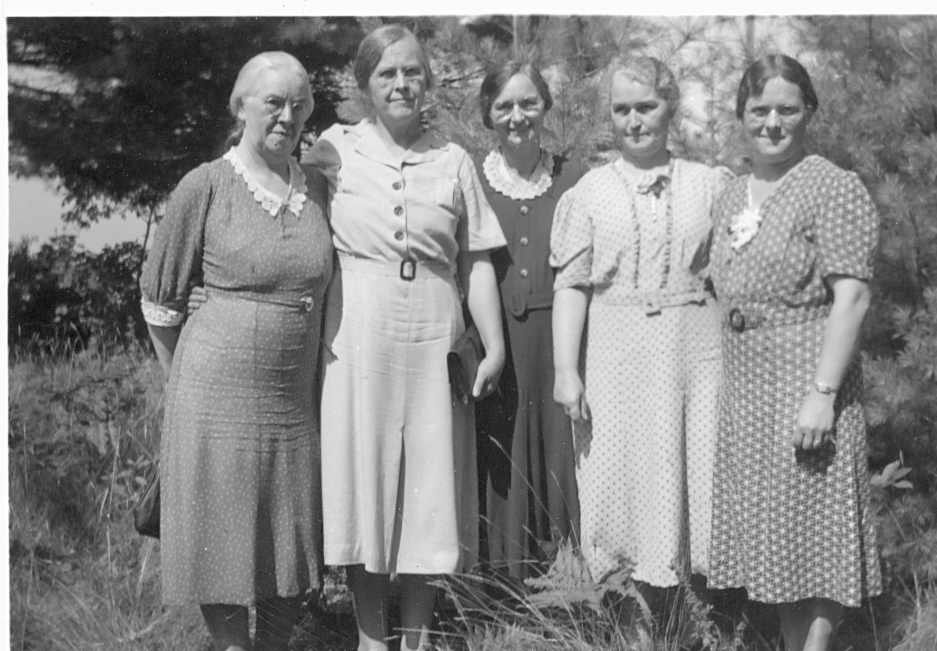
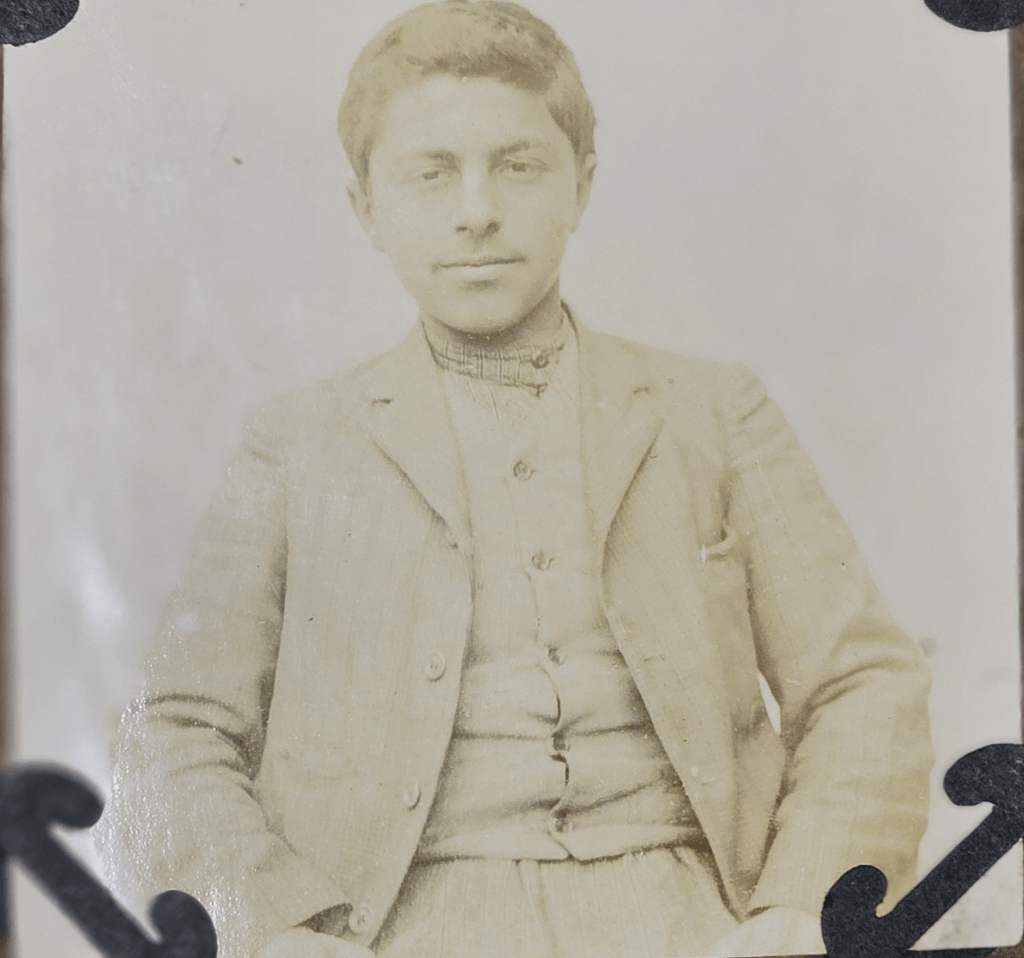
Courtesy: Missionary Church Historical Trust
On a furlough in 1936, Daniel Eby contributed a summary of the UOMS achievement in a 16-page booklet called “To Bind Up the Broken-Hearted.”16
The Armenian Spiritual Brotherhood and the UMS after 1938 In Syria and Lebanon, Armenians associated with the UOMS organized a church which in English is usually called the Armenian Spiritual Brotherhood or variants, such as Evangelical Spiritual Brotherhood. Researcher David Barrett believed the Spiritual Brotherhood was influenced by the Christian Brethren, commonly called the Plymouth Brethren, though I have seen no indication of it.17 Holiness doctrines from the MBiC, yes. The ASB Church itself acknowledged they descended from the much larger Armenian Evangelical Union, the church born out of the American Board Mission, that is, with a Congregational and some Presbyterian traditions.18 Interestingly, the Scandinavian-American evangelist Fredrik Franson19 held revival meetings in Turkey “which greatly influenced the emerging Armenian Spiritual Brotherhood.”20 That was around 1905. Barrett reported in his 1st edition at least 2,700 attended the Armenian Brotherhood churches in Syria (Aleppo), Beirut, Tehran, Baghdad and 4 centres in the USA in 1920. The Ebys, Bredemus and Bowman worked with refugee leaders Rev Abraham Seferian, Menas Bozoklian and Mihran Kasardjian. In 1927 Dorinda Bowman was assisting an “Aleppo Bible School,”21 probably the same school called the Aleppo School of Life which Jasper A Huffman visited in 1930 and 1950. He also spoke at a similar school formed in Beirut.22 Huffman and others were instrumental is sponsoring the Vartanian brothers to study at Bethel College in the 1950s (Missionary Banner, Oct 1957, p 7).
Missionary Church histories are vague about why the missionaries left the field in 1938, citing “dangers.” Storms claims the mission had completed the “three-selfs” of missions: leaving a self-governing, self-supporting and self-propagating church.23 Property still owned by the UMS in Beirut was finally handed over to the Brotherhood in 1950.24
In later years a few attempts to assist the Armenian Spiritual Brotherhood were noted in the magazines of the United Missionary Church, and friendships with some key ASB personnel maintained.25 American UMS missionary Ethyl Young visited the Cairo ASB Church and gave an encouraging report,26 and later was seconded from her Peniel Mission at Port Said, Egypt, to the Beirut school for a term.27 Virgil and Margaret Snyder from Mountain View Bible College, Didsbury, Alberta, also went to Beirut to help establish Ebenezer Bible School there with the ASB, though the plan met several difficulties, including civil war.28 Richard Reilly, the UMS Field Secretary, and his wife similarly hoped to assist in refreshing of the Bible School, then led by Dr Yeghia Bakikian, but a split in the Beirut church undermined much of their effort. Some younger members at Beirut were concerned that older leaders were only enforcing the purity of the church and were expelling members instead of evangelizing, as I understand it. Eventually the split was healed, and Reilly was able to speak to the reunited church in 1968.29
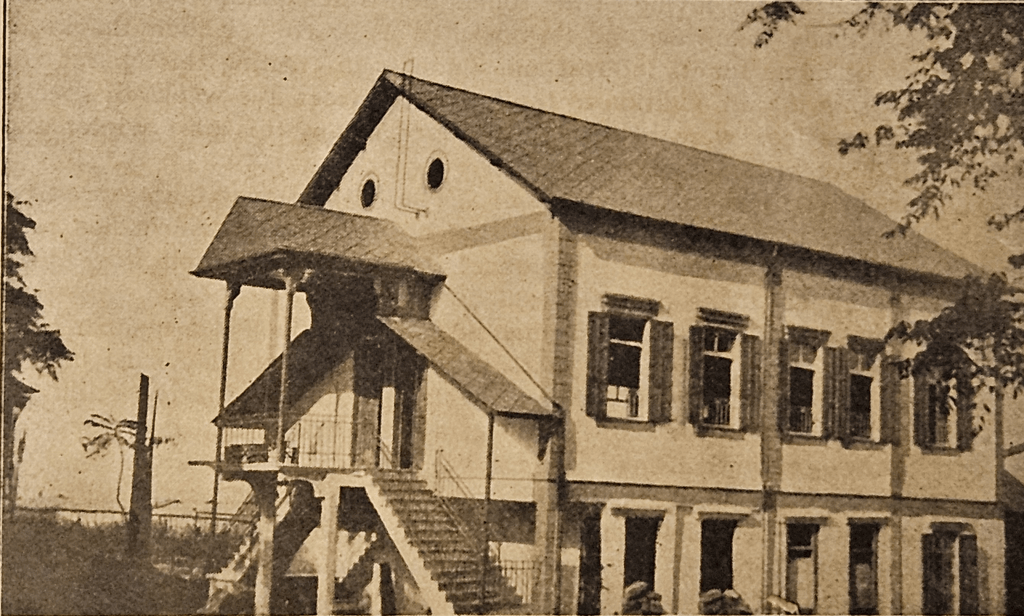
Evangelical Brotherhood churches exist around the world today, including some in the United States (at least 5) and Canada (at least 3).30 Other congregations exist in Buenos Aires and Cordova in Argentina, São Paulo, Brazil, and Montevideo, Uruguay. In Europe and Australia, congregations worship in Alfortville and Valance, France; in Athens, Greece; and Sydney, Australia. Others are recorded in Tehran, Beirut, Damascus, and some in the republic of Armenia itself, about 21 being currently listed world-wide.31 Many Armenians in Beirut in the 1960s had American citizenship, according to Richard Reilly, and when persecution or civil war threatened, they would emigrate to the US. The formerly large church in Aleppo is not listed in the website; perhaps this is related to the Syrian civil war which has dislocated millions. I have myself met Armenians who fled Syria in recent years, whose families originally came from Anatolia.
No record of the UOMS would be complete without mentioning Samuel Doctorian (1930-2016), a Beirut-born Armenian evangelist from a large family. The family moved to Jerusalem when he was six. After his conversion (at 9 or at 16, sources vary) he trained with and apparently was ordained by the Church of the Nazarene in Scotland.32 In 1955 he taught at the World Gospel Mission33/Spiritual Brotherhood Bible School in Beirut, and led revivals throughout the Middle East. His 1956 biography says he was elected as leader of the Evangelical Spiritual Brotherhood.34 In 1958 he toured United Missionary churches in the USA35 and appeared willing to work with the UM Church.36 Later they had a falling out, and he returned to the Nazarenes. Even in 1986, he visited Ontario Bible College as a Church of the Nazarene evangelist from Pasadena, California.37 In later years he promoted himself as a prophet with visions described online. He was a friend of Benny Hinn and other controversial preachers. Some websites complain he taught peculiar doctrines; however, at his death people from many countries posted tributes to him on the funeral home website, recalling interactions scattered over many decades.38
As late as 1978, Everek Storms reviewed the connection of the Missionary Church with Armenians, and named Bedros Sharian (originally Kurkyasharian),39 Kevork “George” Kooshian (Gejekoushian, b 1895 in Hadjin) and Toros Pooshian as people who testified to the good the UOMS orphanages did them.40
Armenians are scattered about the world, about eight to sixteen million of them, depending on how you define them.41 About 3 million live in the former Soviet Republic of Armenia in the Caucasus area and a million or more each in Russia and the USA.42 Canada counts about 69,000 (2021 census). The EMCC would have only casual contact with ASB churches today. Their Toronto church website shows them to be a fairly typical evangelical congregation, with the Armenian ancestry celebrated.
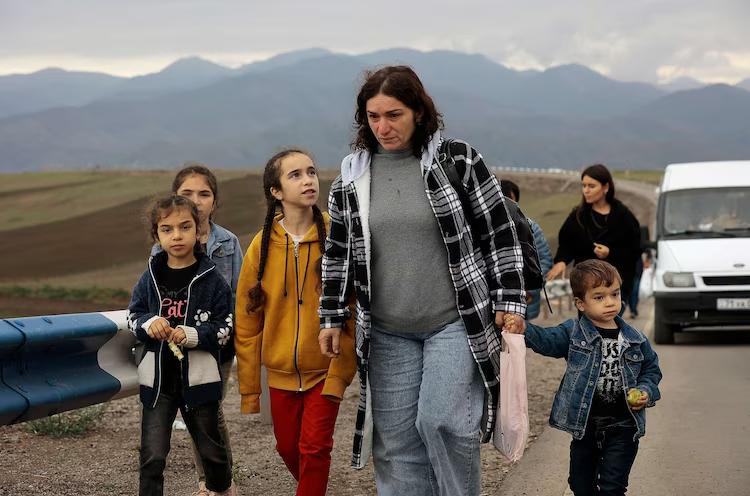
Banner: Armenian family fleeing from Nagorno-Karabakh, Sept 26 2023. Credit: Vasily Krestyaninov/ AP
1Documented in chilling detail by many, such as Taner Akçam, The Young Turks’ Crime against Humanity: The Armenian Genocide and Ethnic Cleansing in the Ottoman Empire (Princeton, NJ: Princeton University Press, 2012). See also Gordon Heath, https://mcmasterdivinity.ca/wp-content/uploads/2021/06/16.MJTM_.177-95-Heath.pdf
2Charles A Frazee, Catholics and Sultans: The Church and the Ottoman Empire (London: Cambridge University Press, 1983) p 272.
3Everek R Storms, History of the United Missionary Church (Elkhart, IN: Bethel Publishing, 1958) p 247.
4https://en.wikipedia.org/wiki/Greek_genocide#:~:text=By%20late%201922%2C%20most%20of,the%20return%20of%20the%20refugees.
5Later married to Oscar Weaver.
6On the Armenian community in Everek, see Jack K Der-Sarkissian (2013): https://www.researchgate.net/publication/260676697_A_Tale_of_Twin_Towns_Everek_and_Fenesse
7 Blanche (Remington) Eby, At the Mercy of Turkish Brigands (New Carlisle, OH: Bethel Publishing, 1922) p 240-282.
8Some background and activities of the Ebys: see Everek R Storms, What God Hath Wrought: The Foreign Missionary Efforts of the United Missionary Church (Springfield, OH: United Missionary Society, 1948), p 88, 91-93.
9Daniel C Eby, “The Lord’s Doings at Damascus,” United Missionary Call (July 1st 1924) 3-4.
10Storms (1948), p 93.
11Dorinda Bowman, “The Printing Press and Missions,” Abraham B Yoder, ed, United Missionary Society Year Book 1928 ([Elkhart, IN]: UMS, 1928) p 40-42.
12Laura Bertha (Fidler) Hoover (1897-1974): St Thomas 1918-1920, Petrolia 1920-1922, St Catharines 1922-1923, unassigned 1923-1924, St Thomas again 1924-1925. She was the first Director of the Ontario Women’s Missionary Society in 1939.
13 References to Rose Altic are pretty scarce in Missionary Church sources. “Missionary to Return April 28,” Dayton Herald (April 21 1938) p 5, gives her parents as Mr and Mrs R F Altick of Laura, Ohio, and that she graduated from Steele high school in 1920.
14Some of Mrs Brubacher’s sermons to school groups and congregations in Beirut survive; Box 3015 MCHT.
15“Minutes of the Annual Session of the United Missionary Society in Syria,” in Yoder (1928), p 24; Storms, (1948) p 93.
16David Sapelak Fonds, Mennonite Archives of Ontario, Conrad Grebel University College, University of Waterloo, file 68. Some details of each missionary were provided by Margaret Purdy, Vera Rosenberger and Grace Cressman, A Study of Pioneers of Missions of the United Missionary Church, Series I, Armenia and China (WMS,1966-1967) p 19-38.
17David Barrett, ed, World Christian Encyclopedia 2nd ed Vol 1 (Oxford, UK: Oxford University Press, 2001) p 446.
18Jasper A Huffman, “A Helping Hand in Lebanon and Syria,” Gospel Banner (April 12 1951) p 8-9.
19Edvard Torjeson, “Fredrik Franson 1852-1908,” in Gerald H Anderson and others, eds, Mission Legacies: Biographical Studies of Leaders of the Modern Missionary Movements (Maryknoll, NY: Orbis, 1994) p 52.
20O C Grauer, ed, Fredrik Franson: Founder of the Scandinavian Alliance Mission of North America (Chicago, IL: Scandinavian Alliance Mission, nd) p 178-183.
21Dorinda Bowman, Gospel Banner (November 3 1927) p 10. I haven’t seen this article myself, since it is not in the MCHT collection.
22Huffman (1951), p 8-9.
23Storms, (1958) p 241. “In 1938 conditions developed which necessitated the withdrawal of missionaries from Syria”; Storms (1948) p 93-94. For years, I have been curious what that phraseology means. Syrian and Lebanese politics were pretty chaotic most of the interwar period. Dangers rarely ceased, so what was new?
24UMS Journal, (1949) p 25; UMS Journal (1950), p 3.
25https://en.wikipedia.org/wiki/Armenian_Brotherhood_Church This article is not clear on the history of the ASBC but gives an indication of it.
26Ethyl Young, “A Visit to the Spiritual Brotherhood in Cairo,” Missionary Banner (February 1956) p 18.
27Ethyl Young, “Examination Time,” Missionary Banner (April 1958) p 12.
28Virgil K and Margaret Snyder, “Ebenezer Bible School and the Snyders,” Missionary Banner (February 1958) p 9.
29Richard S Reilly, “UMS Entering Open Door,” Missionary Banner (June 1963) p 3; (February 1964) p 12, (October 1964) p 5; Richard S Reilly, “Foreign Secretary’s Report,” Proceedings of the 21st General Conference of the United Missionary Church (1968) p 34.
30Not to be confused with Armenian Evangelical Churches stemming from the American Board missionary efforts, founded in 1846. They numbered around 100 congregations in 2020; https://en.wikipedia.org/w/index.php?title=Armenian_Evangelical_Church&oldid=1058282714
32Hurlet Nazarene College. Graduated 1952.
33Formerly called the National Holiness Missionary Society.
34Samuel Doctorian, My Life Story (Marion, IN: World Gospel Mission, 1956). Abraham Seferian was the ASBC leader in 1966, so leadership reverted to him or some of the story is missing.
35Everek Storms, “Brown City Camp Meeting,”Gospel Banner (September 24 1958) p 8. In this article, Doctorian is merely listed as one of the evangelists. Doctorian was one of the evangelists at Stayner Camp, ON, in the summer of 1959.
36Everek Storms, “Samuel Doctorian: Prophet of the Twentieth Century,” Gospel Banner (March 13 1958) p 2-3. Storms (1958) p 260.
37 Memory when I was attending Ontario Theological Seminary 1985-1987.
38https://www.legacy.com/funeral-homes/obituaries/name/samuel-doctorian-obituary?sid=104275908&v=forestlawn&pid=183183779&view=guestbook
39Seen in the photo at the head of Rosemary Russell’s article “Hadjin—Missionaries.” Sharian lived to over 102 in Florida, “Bedros M. Sharian Sr., 102, owned rug business,” The Atlantic Constitution (August 27 1994) p 45.
40Everek R Storms, “The Forgotten Country,” Emphasis (August 15 1978) p 2-3, 19.
41Ann-Margret Hovsepian, “Reviving Hope after Genocide,” Christianity Today (April 2015) p 48-51.
42As recently as September 2023, almost 120,000 Armenians fled from Nagorno-Karabakh, an enclave of Armenians in Muslim Azerbaijan, after decades of resistance to being expelled from yet another homeland. In a few weeks the Armenian population has reduced to near zero, not believing the Azeri assurances they wouldn’t harm them. Patrick Reevell, “Nagorno-Karabakh enclave emptied after entire ethnic Armenian population flees: More than 100,000 Armenians have fled in what’s being called “ethnic cleansing.”” October 2, 2023, https://abcnews.go.com/International/nagorno-karabakh-enclave-emptied-entire-armenian-population-flees/


 EMCC History
Leave a comment