A few years ago I read with interest an article in the Canadian magazine Faith Today1 telling the story of Canadian Presbyterians serving in a mission to assist Armenians after a massacre in 19th-century Turkey (officially known as Turkiye). Please note that “Armenian” refers to an ethnic group from Anatolia, and “Arminian” refers to the theology of Dutchman Jacobus Arminius. The two words are frequently confused.
Turkey was part of the Ottoman Empire that ruled much of the Middle East and eastern Europe for centuries, but was broken up at the end of the first World War. To this day the Turkish government objects to any ascription of responsibility by the Ottoman government or the continuing Turkish government for the massacres or any admission that any occurred at all.2 The author of the article, Peter Bush, assumed that the Armenian massacres were unknown to most Canadians, still less known, the Canadian family that worked there.3 It is doubtless true. Some Armenians even avoided telling their families about the atrocities, it was so bad. Michael Arlen, an American writer, awkwardly discovered his Armenian background which his father hid, and in a fascinating book reviewed the history and passion of Armenia, and his family story.4 There are many such diaspora stories, similar to the Mennonite dispersal stories of the 19th and 20th centuries, and the more numerous Jewish diaspora sagas, now spreading across many centuries. I did not know of any other Canadian missionary involvement with the Armenian people other than those who served in a largely Mennonite effort led by the United Orphanage and Mission Board (UOMB), acknowledged to be the first Mennonite involvement in the Middle East,5 sometimes referred to as the UOM Society.6
The UOMB effort is far less well known than that of three generations of the Chambers family, who for over 40 years sacrificed life and health to serve a persecuted people.7 The Chambers, originally from Oxford County, Ontario, served with the American Board of Commissioners for Foreign Missions (ABCFM). When they wrote family in Canada about the 1895-96 massacres, they were able to publicize the event in their church magazine and the Red Cross became involved. The Presbyterian editor of the Toronto Globe publicized the 1909 massacre and raised funds from the public for relief. Still later massacres and displacements led to the Near East Relief organization raising US$110,000,000 in the 1920s. In fact about two-thirds of the Armenian population of about 2 million was systematically killed in 1915-1919 alone.8 For those who wish to see a wide view of Christianity in Asia Minor, the books of Kenneth Latourette are invaluable.9
The UOMS, organized in 1901/02, was a small player compared to the American Board of Commissioners for Foreign Missions, which sent their first missionaries to the Ottoman Empire in 1819, and by 1902 had 12 stations, 270 “outstations,” about 150 missionaries and 114 congregations, 60,000 students in 132 high schools, 1100 elementary schools and 6 colleges!10 The ABCFM was itself small compared to the ancient Armenian Apostolic Church (Gregorian Church) which had many hundreds of thousands of members in the 19th century. Nevertheless, the UOMS was one of the very first North American Mennonite-based mission societies, and it was a real education for them.11 Most of the staff of the UOMS were members of the Mennonite Brethren in Christ, and many of those came from Ontario. I do not despise their efforts as “small.”
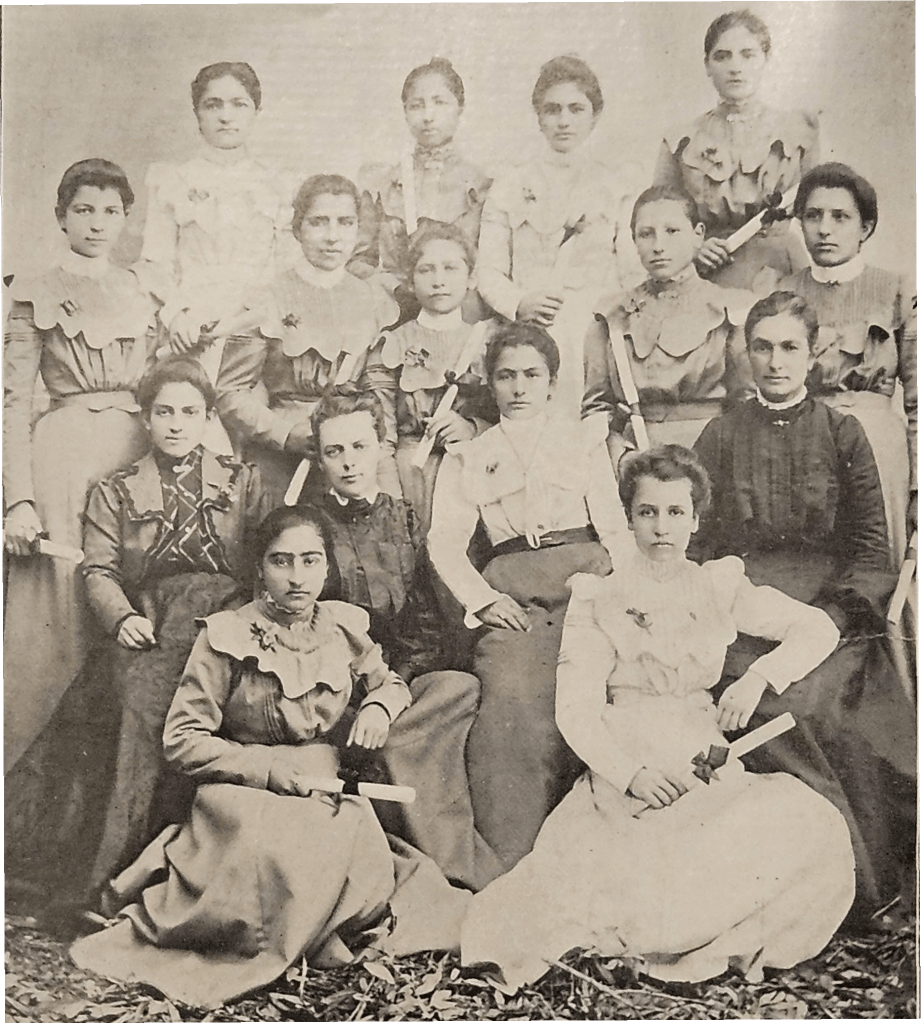
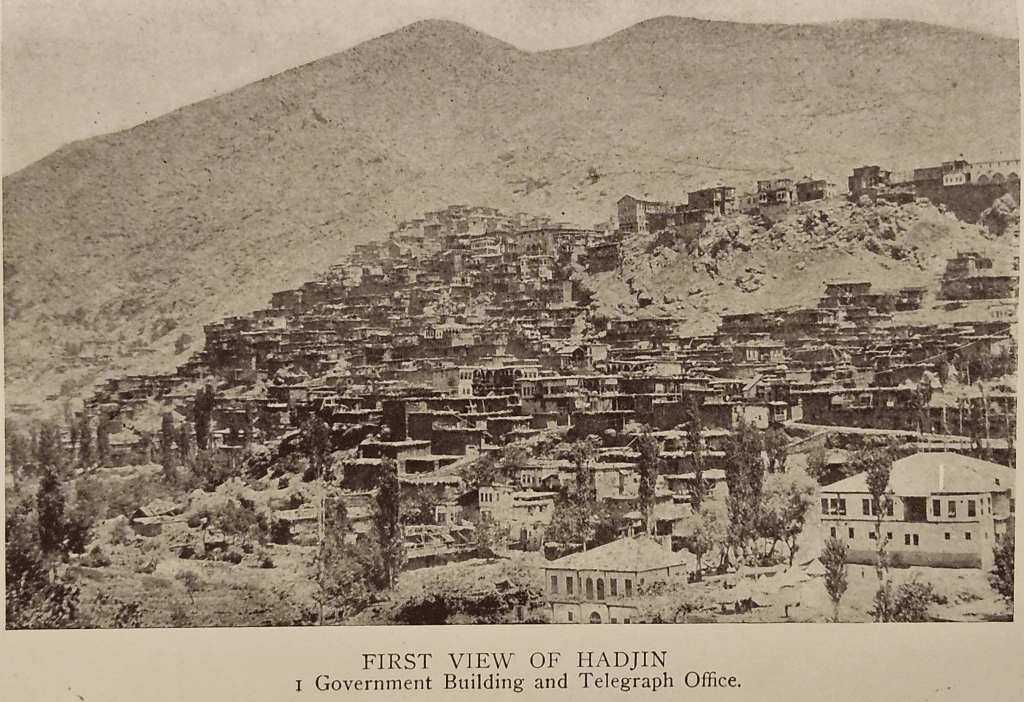
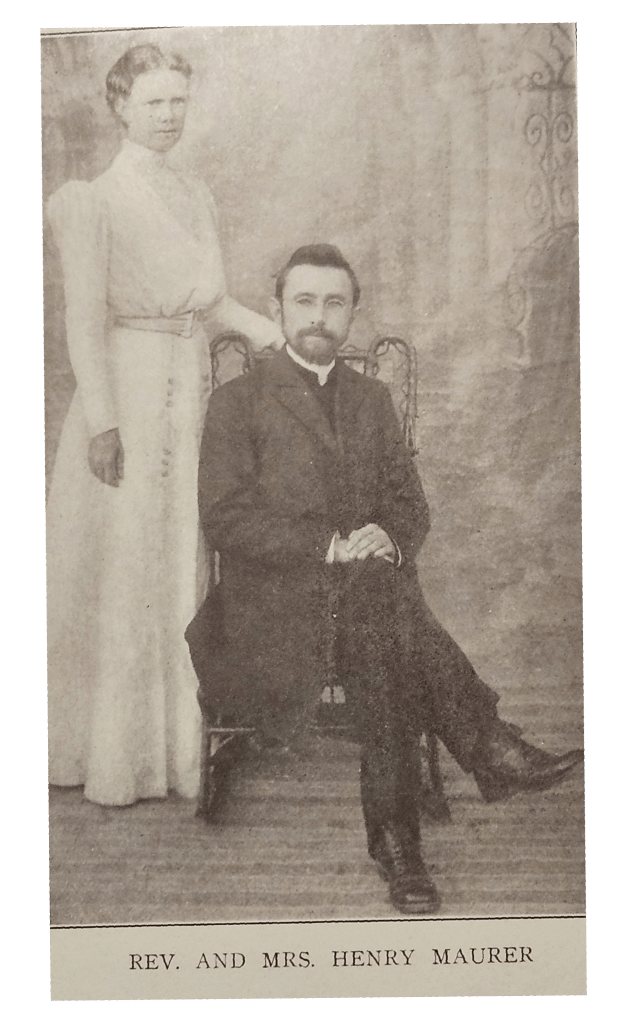
While still in the USA in 1897, the first two Mennonite missionaries, Maria Anna Gerber and Rose Lambert, heard from ABCFM missionary Mrs Josephine L Coffing12 about possibilities in Turkey. Coffing had cared for 100 orphans herself in Hadjin.13 In Turkey in 1898, the ABCFM helped them with advice and practically gave them an orphanage to take over at Hadjin, including 60 orphans the ABCFM could not help. Hadjin was unusual in that the majority of its inhabitants were Armenian. Normally Armenians lived in “Armenian quarters” of the cities. In 1902, “Hajin” had 5 ABCFM missionaries, 38 native workers (men and women), 7 outstations, 4 preaching places, 2 village schools, 2 high schools, an orphanage and 615 church members. At some point it was home to 2000 widows.14 The American Board was the source of some UOMS staff such as Dr Elizabeth Hawley. She arrived in Turkey in 1904, joined the UOMS in 1906, and married UOMS missionary Henry Maurer in 1907. Mennonite Brethren in Christ-published accounts are shy of telling us her origins for some reason.15 Dr (Hawley) Maurer died of typhoid 1908 and Henry was killed by a sniper while putting out fires in Adana in 1909.16
The new mission gained much good will from Armenians already assisted by the American Board which retained a school in Hadjin to which the Mennonite mission sent their orphans. James Dennis showed the widespread efforts of Christian missions from the USA, England, Switzerland and Germany to provide for orphans throughout Turkey. He calculates about 4000 children out of 50,000 orphans, mostly created by the 1895-96 massacre, were in the care of Protestant missions. The UOMS received about 200 within months of opening institutions. Hadjin was one of many.17 The next post will tell of their good start.
Banner: A View of Hadjin. A government building and Telegraph office is in the lower right. Credit: Rose Lambert, Hadjin, and the Armenian Massacres (1911) p 24.
1Peter Bush, Faith Today (January/ February 2016) p 44-47. A longer version is available: https://presbyterian.ca/wp-content/uploads/Presbyterian-History-Fall-2015.pdf
2Fatma Müge Gӧçek, “Turkey still refuses to confront its past,” The Globe and Mail (Friday June 3 2005) p A21; Jonathan Kay, “Turkey must accept the truth about the Armenian Genocide,” National Post (Tuesday April 29 2014) p A13. Readers should beware of the Turkish government’s punishing response to stories of atrocities.
3Another Canadian story recently came to light: Andria Hill-Lehr, Woman on a Mission: Katharine Bell Fraser in Armenia 1892-1897 (Halifax, NS: Nimbus Books, 2021) https://grapevinepublishing.ca/9330/books-by-locals-5 about a Nova Scotian woman.
4Michael J Arlen, Passage to Ararat (New York: Ballantine Books, 1975).
5LeRoy Friesen, Mennonite Witness in the Middle East 2nd ed (Elkhart, IN: Mennonite Board of Missions, 2000) p 26.
6https://gameo.org/index.php?title=United_Orphanage_and_Mission_Society,_The. Written by Max Haines (2020).
7Bush articles.
8Peter Balakian, The Burning Tigris: The Armenian Genocide and America’s Response (New York: HarperCollins, 2003) p 175-180. Also the well-researched Wikipedia article https://en.wikipedia.org/wiki/Armenian_genocide.
9Kenneth Scott Latourette, A History of the Expansion of Christianity Volume VI: The Great Century in Northern Africa and Asia A. D. 1800-A. D. 1914 (New York: Harper and Brothers, 1944, reprinted in 1975 by Zondervan) p 41-55 and Volume VII: Advance Through Storm A. D. 1914 and after, with Concluding Generalizations (1945) p 262-270. As usual, Mennonite missions are mostly invisible even in Latourette’s marvelously comprehensive sweep.
10Listed by Balakian, p 25 as referring to 1863. These same statistics are listed in Henry Otis Dwight, H Allen Tupper and Edwin Munsell Bliss, ed, The Encyclopedia of Missions 2nd ed (New York: Funk and Wagnalls, 1904) p 31, as current in 1902, which makes me wonder if Balakian has misquoted his source or his source mistook the year.
11Mennonites had sent relief supplies to India because of a famine there 1896-97, but John Sprunger’s Mission Light and Hope was probably the second. MLH staff joined Henry C Bartel to China after 1901, forming in 1912 the China Mennonite Mission Society; H C Bartel, A Short Review of the First Mennonite Mission in China: With a Testimony of the Workers (Tsao Hsien, Shantung, China:1913). At least 13 workers had Light and Hope experience, including Henry and Nellie Bartel.
12James S Dennis, Christian Missions and Social Progress Vol 2 (New York: Fleming H Revell, 1899) p 448.
13Rosemary Russell (2016), “Hadjin – Missionaries,” in https://www.houshamadyan.org/mapottomanempire/vilayet-of-adana/hadjin/religion/missionaries.html.
14Dwight, Tupper and Bliss, p 285. The UOMS, a new mission organized in 1901, is not visible in the Encyclopedia.
15Everek R Storms, What God Hath Wrought: The Story of the Foreign Missionary Efforts of the United Missionary Church (Springfield, OH: United Missionary Society, 1948) p 87.
16Rose Lambert, Hadjin, and the Armenian Massacres (New York: Fleming H Revell, 1911) p 99-104.
17Dennis, p 447-449.

 EMCC History
Leave a comment