
In EMCC History Blog “Women Preachers in the Early EMCC Part 1,” we looked at some of the supports for “women in ministry,” and in the Blog “How to Kill a Program of ‘Women in Ministry’ Part 1,” difficulties the whole Mennonite Brethren in Christ ministry (men and women) faced. Here I look more at…
Four More Problems the EMCC Women Faced.
More changes, as far as I can see, hurt the acceptance of women in the pulpit and women in the pastorate in decades leading up to 1946.
The second disadvantage was cultural: Growing prejudices against women in any kind of leadership in the 1920s and 30s and even more in the 1940s and 50s after the 2nd World War. My thinking on this has been influenced much by the findings of Ruth Tucker.1 In the early EMCC, congregational votes displaced women at Owen Sound (1931), Stratford (1939), St Catharines (1943) and perhaps Listowel (1946), evidence of societal and theological changes.2 This may be what P G Lehman was thinking of when he said there were forces beyond the Church’s control that were limiting the opportunities for women in Church work in Canada. The Evangelical Church’s deaconess program ended in 1939 when nursing, teaching and orphanage work became professionalized.3 The United Church of Canada deaconess program 1925-1945 experienced the same weaknesses: misunderstood mission, poor pay, long hours, low recognition, renunciation of marriage, and displacement by men after the war.4 In the 1920s, some denominational missions amalgamated women’s missions into themselves, reducing or ending the leadership of women in foreign missions programs.5

Credit: Wikimedia Commons public domain, City of Toronto Archives
The third was theological: the theological shift to fundamentalist (generally Reformed) thought about NT prophecy, mainly that it either a) ceased or b) had to look exactly like OT prophecy to be legitimate. Website posts by Samuel J Steiner from 2015-2017 described what he called “The Lure of Fundamentalism,” especially as it affected the MBiC, especially in diverting it from a holiness theological direction.6 The adoption of a more fundamentalist direction in the Ontario EMCC since the 1920s is an interesting question for study, which I cannot follow up here. Wayne Grudem, though a Calvinist, took the unusual step of accepting charismatic prophecy as a proper NT prophetic gift, which had to be judged/ weighed by “the others” (I Cor 14:29).7 Some might welcome this. The effect however, was to stifle ordinary spiritually-gifted women’s preaching, because then one agrees that NT prophecy is not preaching as such.
If this shift is accepted, it undermines the Methodist interpretation of Acts 2, and leaves the later EMCC with less theological resilience to withstand the attack on women in the pulpit and leadership. The Canada East District of the Missionary Church asked me to research the history of the City Mission Women in 1988, which resulted in the paper “Go and Proclaim: Ministering Sisters in the Missionary Church, Canada East, 1885-1987.”8 I was cautious in my conclusions over 30 years ago, (Phil Delsaut characterized it as an “irenic polemic”), but now I cheerfully declare my opinion that the debates in the 1980s and 1990s over women’s public ministries were compromised by alien theology (Reformed) which crept in among us Wesleyan-Arminians. Sorry, guys. It would be interesting to study the papers of the 1980s and 1990s to discern the theological influences to the various positions.9 In April 2004, the EMCC Board of Directors issued a Position Paper on “Headship.” I was out of the country when these discussions finally wound down and the current compromise effected.
I should mention that the MBiC, while enthusiastically pre-millennialist, never accepted dispensational theology, with its Reformed slant, although individual pastors may have. One of the reasons was, the early EMCC recognized that dispensationalism would undermine some core holiness teachings, women’s public ministry among them.
#4. Another problem was that while many functions of ministry were open to the women in City Mission work or missions overseas, ordination was not, and therefore church roles thought to be attached to it (marrying, appointment to established congregations, voting in Annual Conferences, presiding eldership, leading in the Lord’s Supper, and baptizing) were not. City Mission Workers’ membership in the annual Conference, with the privilege of voting, came up several times in the Ontario Conference, sometimes accepted, sometimes reversed. In 1931, the CMWS women detected dissatisfaction in the Conference over merely their leaders voting in the Conference, and voluntarily resigned that privilege.10
Whether ordination itself was a NT institution was not queried, but it could be. The question of the biblical status of “ordination,” was raised by a few voices in the late 20th century. For example, EMCC member and former missionary educator Dr Lois (Fuller) Dow, whose PhD is in New Testament, saw no NT support for ordination as a biblical practice.11 Similarly, Missionary Church philosopher and historian at Bethel University, Mishawaka, IN, Dr Timothy Paul Erdel, asked in a sermon “What is Biblical Ordination?” delivered several times from 1998, in which he described ordination as a human invention.12
The perception was that as soon as the women raised a congregation to a position to cease being counted as a “mission” (roughly defined as becoming self-supporting,)13 men would be appointed to lead the congregation. When the Parliament St (East End Toronto) mission,14 started by men in 1899 was severely disrupted by George Chambers’ change to Pentecostal doctrine in 1908, he took the majority of the members with him. Although Joshua Fidler and then Christian Raymer were appointed for a while, the women were called in soon to try to keep the struggling mission open. When the congregation was shifted to a new site on Jones Avenue and membership improved, men were again appointed and under Sam Goudie the church became the Grace Chapel congregation. Eileen Lageer suggested the women didn’t mind this custom,15 but they did. Whenever I heard women speaking of the pattern, they used irony to describe it, eg Louie Hoover, and even Eileen Lageer herself.16 The biography of Hazel (Hill) Etcher (City Mission Worker 1943-1951) reflects her feelings of the unfairness of regularly being displaced by men in Petrolia and Port Hope.17
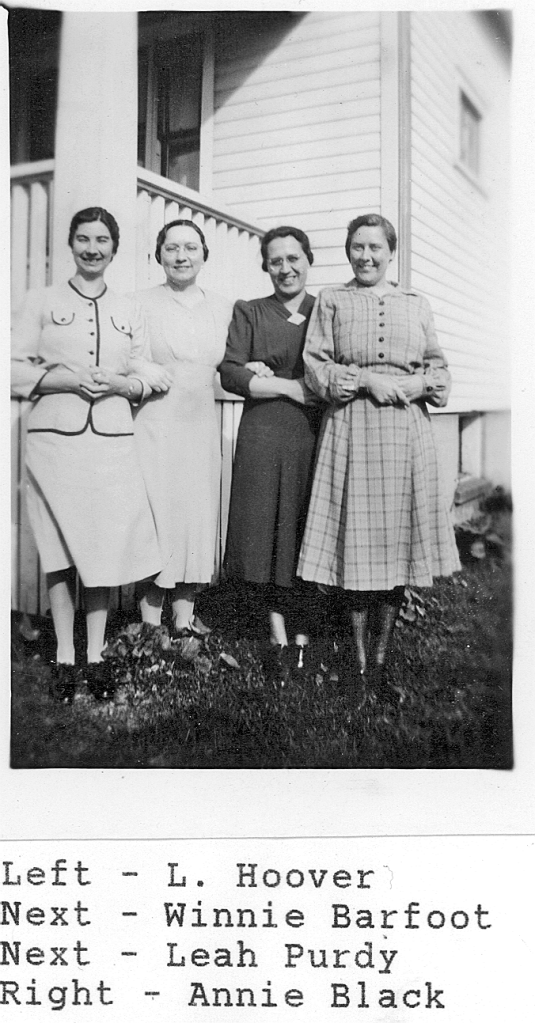
Courtesy Missionary Church Historical Trust
#5. In my mind a major disability to the City Mission Workers Society and any other program of its type is the prohibition of marriage to the participants. This thinking was never applied in foreign missions in the MBiC.18 I guess that if a woman must be quiet or silent (1 Cor 14:33-35) and wanted to learn something at home from her husband rather than speak in the worship time, the obvious work-around for those that wanted women to preach was to restrict them to having no husband. By ethnocentric (quasi-racist/ sexist) habits, this problem was not applied to women teaching on the MBiC mission fields, where women taught men regularly. Many Europeans/North Americans considered Africans as children or child-like.
When the New York Methodist Phoebe Palmer began speaking in Christian gatherings, her talks were called “addresses,” and her husband was generally present and spoke first.19 Men never faced that problem in their ordination-track, in fact, typically in Protestant churches, a man not being married is the problem.20 In Ellis Lageer’s Who’s Who in the UMS, Earl Honsberger—30 years old—when asked in a licensing interview whether he was married, admitted he hoped to be soon. “Well, son, you are old enough!” the committee advised.21 Some women as some men are not interested in marriage. This is somewhat culturally conditioned—few African men and women can imagine not marrying ever, while an increasing number of western young people avoid marriage. However, for a woman to think she had to close the door on marriage if God called her to full-time career ministry is a huge burden imposed by human rules.
Summary: There may have been other discouragements, similar to the theological barrage used by those called “complementarians” today. In the early EMCC, however, these are discernible: poor pay, poor health, poor prospects of advancement, restricted ministry opportunities, renunciation of marriage, prejudice against women leading, and denial of the biblical mandate for women in public congregational leadership roles. These pretty well killed off the attraction of this route to love God with heart, soul and mind, and exercising their spiritual gifts for many women. And no wonder.
Banner: A woman at a computer. She could be doing almost any ministry. Credit: Pixabay public domain
1Ruth A Tucker, “Women in Missions: Reaching Sisters in ‘Heathen Darkness,’” in Joel A Carpenter and Wilber R Shenk, ed, Earthen Vessels: American Evangelicals and Foreign Missions 1880-1980 (Grand Rapids, MI: Wm B Eerdmans, 1990) p 251-280, especially p 259-260 and 269.
2Culled from Conference Journals.
3J Henry Getz, ed, A Century in Canada: The Canada Conference of the Evangelical United Brethren Church, 1864-1964 (Kitchener, ON: George C Spaetzel, 1964) p 12.
4Mary Anne MacFarlane, “Faithful and Courageous Handmaidens: Deaconesses in the United Church of Canada 1925-1945,” in Changing Roles of Women within the Christian Church in Canada (Toronto: University of Toronto Press, 1995) ed by Elizabeth Gillan Muir and Marilyn Fardig Whiteley, p 238-258.
5Barbara Brown Zikmund, “Women and the Churches,” in Altered Landscapes: Christianity in America 1935-1985 (Grand Rapids, MI: Wm B Eerdmans Publishing, 1989) edited by David W Lotz, p 126.
6Timothy Erdel, “The Evangelical Tradition in the Missionary Church: Enduring Debts and Unresolved Dilemmas,” Reflections Vol 13-14 (2011-2012) p 74-109 is a good place to start.
7Wayne Grudem, Systematic Theology (Grand Rapids, MI: Zondervan, 1994) p 1054.
8Clare Fuller, “Go and Proclaim: Ministering Sisters in the Missionary Church, Canada East, 1885-1987,” paper commissioned by the Missionary Church, Canada East District, 1988.
9The MCHT preserves the many submissions by pastors and congregations on the discussions on the 1980s and 1990s in the Canada East District of the Missionary Church, pro and con “Women in Ministry.”
10Ontario Conference Journal (1931) p 10.
11Lois Fuller, “Notes on the Ordination of Women in the EMCC,” 1996, “Writings,” Box 3010 MCHT. Yes, she is my sister.
12Timothy Paul Erdel, “What is Biblical Ordination?” Box 7111 MCHT.
13It should be remembered that the MBiC also had (home) missions served by men from the start.
14See EMCC History Blog: “The Strange Case of the MBiC East End Mission.”
15Eileen Lageer, Common Bonds: Story of the Evangelical Missionary Church of Canada (Calgary, AB: Evangelical Missionary Church of Canada, 2004) p 76. Lageer was a mission worker herself 1946-1947 at Port Hope, ON, though she referred to herself as a deaconess. Her brother, Ellis A Lageer, “U.M.S. Who’s Who: Eileen Lageer,” Missionary Banner (September 1952) p 12, called her such. The City Mission Workers Society was dead by then, so what would she call herself? “A pastor” would have been correct, but not acceptable to many at the time or later.
16Louie Hoover, city mission worker 1929-1947, personal communication 1986. I forget when I heard Eileen Lageer speak of it.
17Margaret (Etcher) Theriault, Hazel’s Story: A Life of Faith (Kitchener, ON: By the Author, 2022) p 24, 26 and especially 82.
18Ruth Tucker notes that even the male-dominated Southern Baptists allowed women missionaries a vote in field conferences, which they would never allow in the USA; Tucker, p 267. In the United Missionary Society of the MBiC and the United Missionary Church it was the same: women voted in the field conferences.
19Her husband Dr Walter Palmer was usually nearby, so his “authority” was over her (1 Tim 2:12); Charles Edward White, The Beauty of Holiness: Phoebe Palmer as Theologian, Revivalist, Feminist, and Humanitarian (Grand Rapids, MI: Francis Asbury Press, 1986) p 43-46, but she did speak with him absent as well. Isabella Thoburn, a renowned Methodist missionary to India similarly respected prejudice by “answer[ing] questions from the front pew instead of ‘preaching’ from the pulpit;” Tucker, p 265
20John R W Stott, the British Anglican pastor and author, frequently had to explain why he did not marry; Timothy Dudley-Smith, John Stott: The Making of A Leader: A Biography of the Early Years (Downers’ Grove, IL: IVP, 2007) p 329-333. https://theaquilareport.com/john-stott-on-singleness-quncle-johnq-explains-why-he-stayed-single-for-90-years/
21Ellis Lageer, ed, Who’s Who in the UMS (Elkhart, IN: Bethel Publishing, 1960 with revisions to 1969) unpaginated.


 EMCC History
Leave a comment