
This blog brings us to a hymnbook, Hymns for Worship (1963), not produced in the early EMCC, but it is still separated from us by several changing fashions in congregational music. This is a book of which I have personal experience and opinions.
Tastes in music are formed early. A trained person can add to early experiences and preferences, but for some, what we like is settled at some age, just as with learning a language. What is in our environment, sticks. If we experienced pleasure with drums and dance first, that could be a standard for life. If organs and choirs met us early in our church life, organs and choirs could remain a criterion as we judge other styles. Or gongs. Or rock. Or a cappella singing. Or jazz.1 Others like new styles and traditions throughout life as chosen, learned pleasures.
Lester Reist was a Missionary Church song leader in Waterloo Region churches in recent decades.2 He conducted a cantata in 1985 at the Stayner Camp Grounds appreciating music used throughout the centuries. He included many hymns from the United Missionary Church Hymns for Worship, but had to go outside it for examples of more recent popular Christian music from John W Peterson, Andrae Crouch and the Gaithers.3 Even that 1985 performance omitted some trends in the churches.
It is not just the music we experienced in church that seems right. What we hear on the radio or download on our smartphones conditions us. In fact, if the church is successful, we will see new members come in to the Church who have little or no direct experience of any Christian musical tradition. They, too, will have had musical experiences that bias them in favour of some forms over others, guaranteed. No musical form is of itself sacred or not sacred, anyway.4
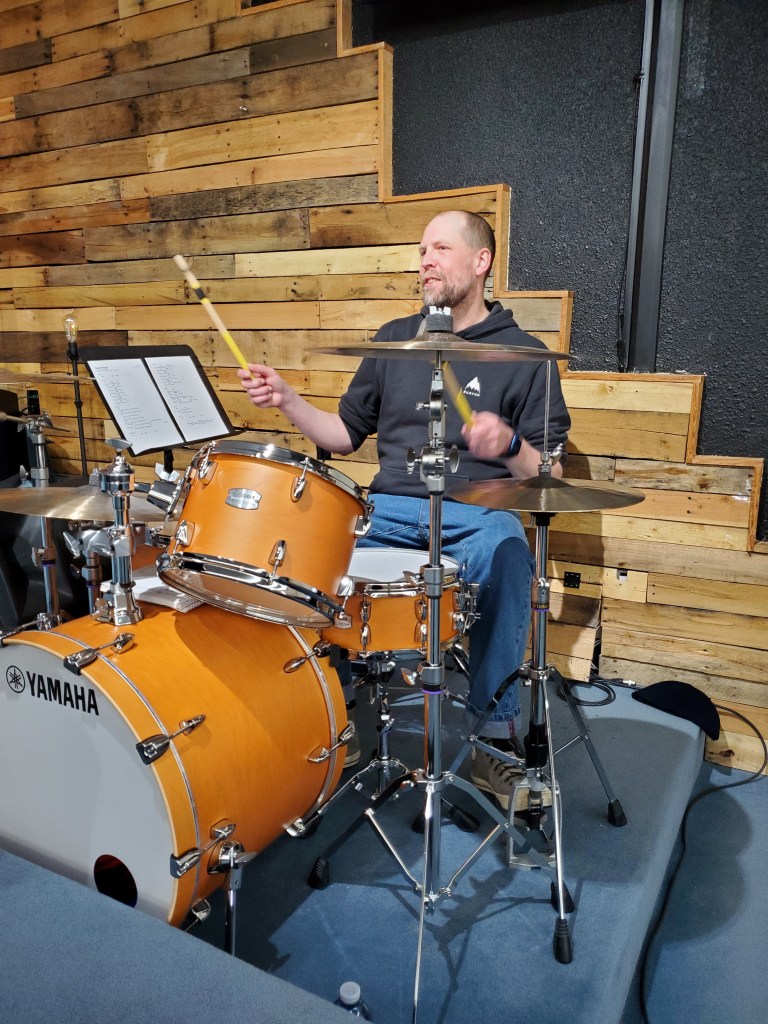
Courtesy: Isaac McFaul, March 2024.
Early in my time teaching in Nigeria, I visited a large United Missionary Church of Africa congregation in Igbeti, Oyo State,5 where the youth group was practicing for Sunday. They had electric guitars and a standard “set drum” as it is called (bass, snare drums and cymbals). The beat reminded me immediately of music in bars in Canada, the times I had had a cola with friends from YMCA volleyball nights, back in Sudbury, Ontario. I was a cross-cultural missionary, I told myself. These youth were preparing to praise God, not pick up women over a few beers. And later experience showed me it was true, the youth were zealous about writing their own lyrics to glorify God, serious to praise Jesus as the Saviour of the world. Drums are essential to all kinds of Nigerian music. They were getting ready to contribute to Christian worship.
Meeting Hymns for Worship. So when I became a follower of Jesus in 1965, after my family switched from the United Church of Canada to a 5-year-old United Missionary Church congregation in North Bay, Ontario,6 we met a new hymnbook in use. It was Hymns for Worship. It had some hymns I already knew from the UCC Hymnary,7 but also many ones new to me.
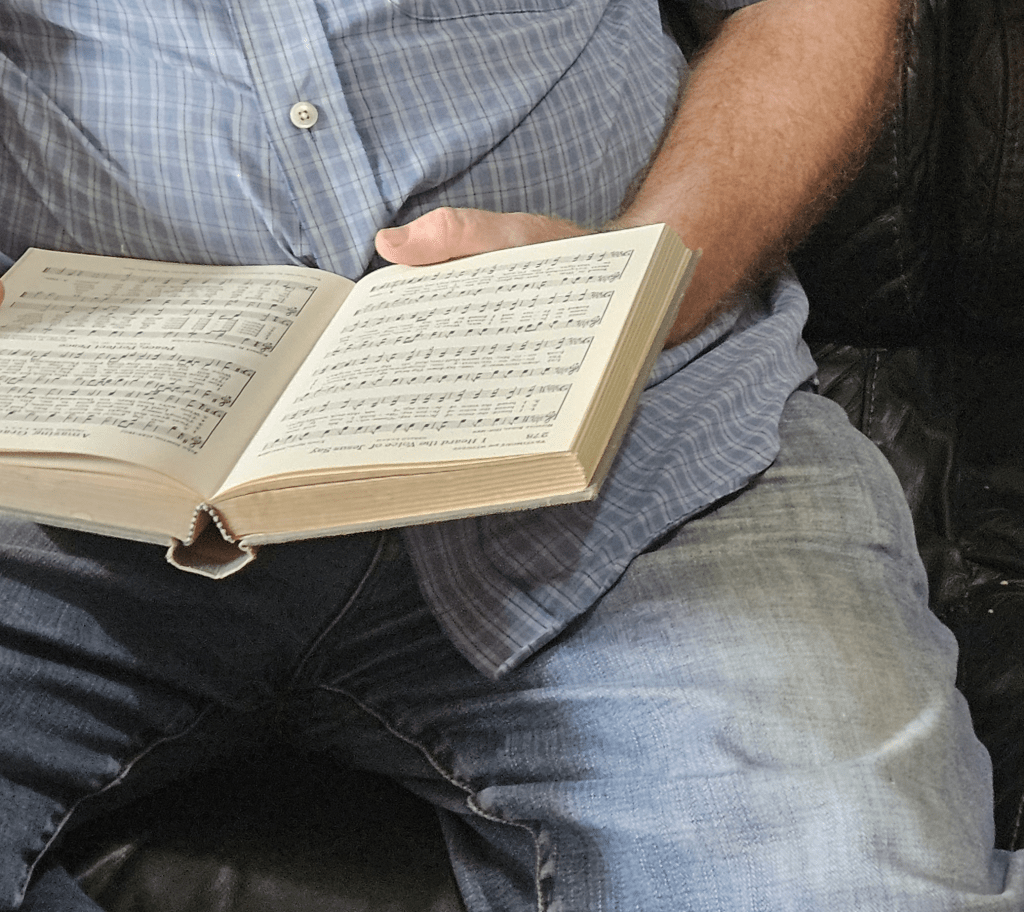
The experience of being converted to Christ encouraged me to accept the musical styles of my new faith, mainly what I later learned was called the “gospel song.” But you know what? Already by 11, I felt I knew what were “real” hymns. If the song leader on a Sunday night called for “favourites,” sooner or later, I would slip back and ask for “Fairest Lord Jesus,” “Praise to the Lord, the Almighty, the King of Creation,” or “Now Thank We All Our God.” They were in the new hymnbook, too, but most people tended to ask for “More, More About Jesus,” “The Old Rugged Cross” or “Blessed Assurance.”8
Don’t ask me what is the difference between a hymn and a gospel song; I tried for years to explain it to my children, unsuccessfully, for sure. One rough rule was supposed to be: a hymn addresses God in praise or petition, and a gospel song expresses experiences of the Christian life. Read Hustad’s book!9
Despite all that, though there are many fine hymnbooks, Hymns for Worship became my personal standard. There were reasons for this, I learned later. The United Missionary Churches of Canada and the USA had been without a denominational hymnbook since the 19th century.10 By the 1960s, however, the denomination had attempted to become more centralized under General Superintendent (later, President) Kenneth Geiger, with a centralized denominational program of departments. Semi-independent Conferences became districts. More pastors came from the church’s own colleges (Mountain View, Emmanuel, Bethel, Fort Wayne after 1969). I don’t know when the idea of a denominational hymnbook was addressed seriously. The church magazine, Gospel Banner, promoted good church music by a series of articles in the early 1960s.11
By 1963, a Hymnal Committee of Brethren in Christ and United Missionary scholars and knowledgeable people (mostly BiC) produced the hymnbook our family met in 1965.12 It was published by both Evangel Press (Nappanee, IN), the BiC publisher, and Bethel Publishing (Elkhart, IN), for the UMC and it went through at least 8 printings. As with the UCC Hymnary, I have a personal set of Hymns for Worship. I salvaged them from various sources, one rescued literally from a dumpster, from, for example, Dickson Hill, Country Hills (Kitchener), Faith Missionary (Kitchener), Zion Church (St Thomas, I believe), and one just stamped “United Missionary Church.” They say the usefulness of a hymnbook lasts about a generation and then would need to be replaced. This happened at Lincoln Heights Missionary Church, Waterloo, which bought a set of hymnbooks compiled by John W Peterson and Norman Johnson around 1982.13 As events turned out, Hymns for Worship was replaced in most EMCC congregations not by another hymnbook,14 but by crudely-produced chorus sheets (I made some myself), overhead projector acetates, Scripture in Song, and now Power Point-type words-only punctuation-less screens downloaded from the internet. Not necessarily bad, but something has been lost.
Why Hymns for Worship was good. Some years ago, I came across a list of the “50 most-used hymns” and found the UMC book included 49 of them. The only one left out? “The Son of God Goes Forth to War”–not a good choice for non-resistant or recently non-resistant churches such as the BiC and the UMC! My choir director from Emmanuel Bible College, Wishart Bell,15 told us to check any new hymnbook to see if it included Watts’ and the Wesleys’ hymns, and yes, there are 39 from the three of them.
Usable. There were useful responsive Scripture readings and good indexes of composers, and arrangers, authors and translators, a topical index, metrical index, Scripture allusion index as well as the standard index that distinguished first lines and titles. The music was singable (at least for my youthful and then tenor voice) and the stanzas were printed inside the staves of music. I found it useful when I led services in a congregation. Lately I have appreciated its theological vision that was Wesleyan and Arminian, yet also generously evangelical. I haven’t noticed non-resistant doctrinal lyrics however. I have only found two typos in many years of use, and I have a few quibbles over editorial choices where there are differing versions of the texts. Charles Wesley’s magnificent “And Can It Be” is represented in the gutted Singspiration version with uniform chorus, unfortunately. “Amazing Grace” thankfully has 5 verses, but the editors dropped the fine stanza beginning “And when this flesh and heart shall fail.”16 The big draw back, now, of course, is the use of the Authorized Version in the readings, and “thees” and thous” in so many lyrics, inevitable in 1963. It wasn’t until the popularity of the New International Version of 1978/1984 that songwriters finally abandoned obsolete English in new compositions.
As much as I like the translations, hymns and gospel songs of the 16th to the 20th century, we shouldn’t go back often without comment, for the sake of contemporary congregational worship. This would be as bad as Catholics returning to a Latin Mass. Old language was also the weakness of the Scripture in Song chorus books so popular in the 1970s in Ontario Missionary churches and many others. The return to biblical idiom was a better choice than some choruses, but the 400-year old vocabulary made barriers of its own.
No two persons will probably agree about hymns and gospel song choices. It’s good for our souls, no doubt, to sing songs that are not our favourites all the time.
This brings to an end my comments for now about music in the early EMCC. I will pick up the theme of worship including its relation to music, in later EMCC History blogs on “Public Worship.”
I thank my organist brother Peter Fuller for constructive criticism of an earlier draft and Dr Allen Stouffer for correcting a plain error on my part. As usual, don’t blame them for opinions I express here!
Banner: A collection of hymnbooks and resources. Courtesy: Fuller family photo collection.
1Or country or southern gospel. Or gospel quartets. I grew up thinking that the accent of country and western singers was put on, or fake. In other words, I could not accept that what they sang was truthful. When I watched a documentary on Nashville, Tennessee, I was shocked to realize that the “accent” was actually the way people in a certain part of the USA spoke. My early misconception has been hard to shake.
2https://erbgood.com/tribute/details/15590/Lester-Reist/obituary.html
3Lester Reist, “Our Musical Heritage,” catalogue # 8559, was recorded on audio-cassette by John Quanz and others the summer of 1985. Copy in the Missionary Church Historical Trust.
4This is another lesson learned from Donald Hustad’s Jubilate!: Church Music in the Evangelical Tradition (Carol Stream, IL: Hope Publishing, 1981) p 34-40, or the 2nd edition.
5The UMCA is the large denomination (1000+ congregations) started by the efforts of Mennonite Brethren in Christ missionaries and dedicated Nigerian Christians flowing from that mission; Eileen Lageer, Merging Streams: Story of the Missionary Church (Elkhart, IN: Bethel Publishing, 1979) p 179-198 or James Clare Fuller (MTh, McMaster Divinity College thesis, 2004), “We Trust God Will Own His Word: A Holiness-Mennonite Mission in Nigeria 1905-1978.” http://citeseerx.ist.psu.edu/viewdoc/download?doi=10.1.1.829.5971&rep=rep1&type=pdf
6Lakeshore United Missionary, now EM, Church. To be naggingly accurate, the church formed in West Ferris Township in 1960, just outside the city. Annexation of two townships in 1968 formed the city of today.
7The Hymnary of the United Church of Canada (with music) (Toronto: United Church Publishing House, 1930). I own several copies of this fine hymnbook for use in family devotions, with and without music.
8The blue paperback songbook used in Kitchener camp meetings and at Stayner was in fact titled Blessed Assurance (Nashville, TN: John T Benson, 1963).
9Or try James F White, Introduction to Christian Worship, rev ed (Nashville, TN: Abingdon Press, 1990) p 114.
10See EMCC History Blog: “Music in the early EMCC Part 2: Church song and hymn books.” The Brethren in Christ had issued Spiritual Songs and Hymns in 1934.
11Myron Leland Tweed, “A Study of the Function of Music Within the United Missionary Church Communion,” PhD dissertation, 1970, University of Southern California. I have not seen this PhD thesis, but it would be instructive to have it available. Tweed, from Alberta, became a professor at a Nazarene College in 1973 and was employed by Presbyterian Churches in California; https://www.sandiegouniontribune.com/2013/10/14/longtime-music-professor-myron-tweed-dies-at-83/
12The members were led by editor Earl D Miller, with chair Raymond G Niesley, secretary Ray M Zercher, Ralph Carpenter, Emerson C Frey, Franklin L Lusk, H Royce Salzman, Ronald R Sider, Jesse R Steckley, Ray Swalm, Erwin W Thomas, Myron L Tweed, LeRoy B Walters, Ira L Wood and John E Zercher. A musical friend of mine says this book was a huge improvement for the BiC. At least three people represented the UMC but only one (Tweed) was Canadian, (some BiCs were) indicating a poverty in the musical scholarship of the Canadian UMC probably.
13Norman Johnson, ed, Praise! Our Songs and Hymns (Grand Rapids, MI: Singspiration, 1979). Selected with Lester Reist’s advice when Harvey Fretz was the pastor; Brad Ullner, personal communication, August 2024.
14The Brethren in Christ did replace Hymns for Worship with Hymns for Praise and Worship (Nappanee, IN: Evangel Press, 1984). It does use NIV texts! The Missionary Church did not contribute to this effort.
15https://en.wikipedia.org/wiki/Wishart_Bryan_Bell
16Paul Beckwith, ed, Hymns: The Hymnal of the Inter-Varsity Christian Fellowship (Chicago: Inter-Varsity, various editions) did better, keeping six verses. Eldon T Sherk (EMCC History “Music in the Early EMCC Part 1: Eldon T Sherk Collection,”) had four copies, as do I.


 EMCC History
Leave a comment