
City Mission Workers Society.

In the Mar/Apr 1905 Mennonite Brethren in Christ Canada Conference annual meeting, Henry Schlichter Hallman, the CMWS President, announced that he was posting Emma Hostetler and Mary Markle to Winnipeg, MB. I assume as part of their work they were to follow up any former MBiC members who might have moved to Winnipeg, but I have seen no firm evidence of that yet. When Samuel Goudie, newly-elected Presiding Elder in Ontario visited them in mid-August, he stayed and visited with people he seems to have known, though his diary entries do not specify the Ontario connections. He preached in the MBiC Mission and other holiness missions, including the Christian and Missionary Alliance. Just before leaving Winnipeg, he attended a lecture by the Anglican Archdeacon Robert Phair, who supported the Alliance and was later active in Pentecostal circles in Winnipeg, and he visited the Home of the Friendless institutions.1

Many issues of the Gospel Banner from the first decade of the 20th century have not survived as far as I know, including most of the crucial years of the Manitoba mission (1905-1908), so the public reports from the women in Manitoba are unavailable. In one letter that does survive from August 1905, Hostetler and Markle write that they are anticipating an imminent visit from Goudie, and in October, from their society president (H S Hallman).2
Beulah Mennonite Mission. Hostetler and Markle called their mission “Beulah Mission,” as the CMWS women named several, though not all, of their other missions. I don’t know the reason behind this choice. Beulah popularly means “married” as interpreted by the Authorized Version (KJV) in Isaiah 62:4. The City Mission women were all unmarried, so to me it was a bit of an ironic choice. I suppose they meant it, as in Isaiah, (and in the reference to the Land of Beulah in Pilgrim’s Progress) that the work was blessed by intimate connection with God, or was close to heaven. A popular gospel song of the time also featured “Beulah Land.”3
Emma Hostetler had 8 years of experience in small town mission work and Mary Ellen Markle had none. Emma had a German Amish-Mennonite background, and Mary was Irish. They served in English-language ministries.4 Hostetler’s parents, from Waterloo County, farmed in Maryborough Township, Wellington County, before retiring with their daughters to Berlin in the early 1890s. Markle was born in Walkerton, ON.5

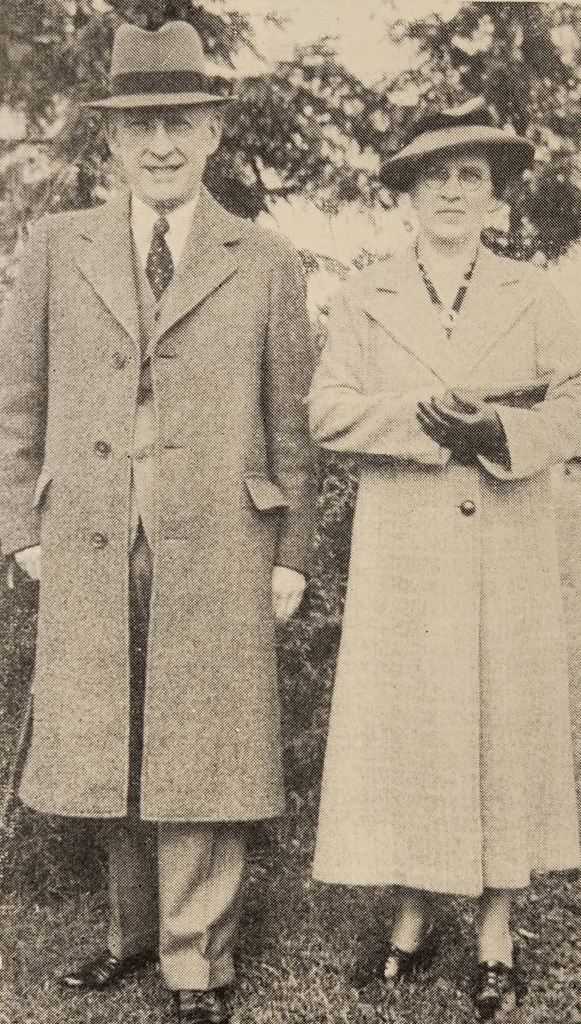
Courtesy Missionary Church Historical Trust
In March 1906, the two missionaries were confirmed in their assignment to Winnipeg. However, Emma Hostetler had applied to the new MBiC mission to Nigeria, and she left Winnipeg for Ontario to prepare mid-year.6 According to the drama about her written by Willis Hunking,7 she left behind in Winnipeg a man who proposed marriage to her, Dr Albert D Baker, a teacher at St John’s (Anglican) College. Baker was the son of Charles Baker, a Tunker (Brethren in Christ) bishop of their Nottawa District near Collingwood, ON. He arrived in Winnipeg the same year Hostetler did and would have known all about the Mennonite Brethren in Christ.8 When Emma died of smallpox in 1912, Baker had not forgotten her, and supplied the headstone for her grave in Tsonga, Nigeria. Curiously, Baker helped start a church in St Vital (Fort Garry), which was called “Beulah.” He never married, and was buried back in Ontario at Stayner, near Batteaux, ON, his birthplace. In 1921 he listed his religion in the Canada census as “Brethren in Christ.”

Credit: Memorable Manitobans, Manitoba Historical Society
The President of the City Mission Workers Society, now John Kitching, announced at the March 1907 Canada Conference that he was sending four women to Manitoba: Martha (Hisey) Edmand, Maud McClelland, Mary Markle and Mary Ann (Dresch) Blakeney, young women in their early 20s. Markle and Dresch he assigned to open a mission in Brandon, the second largest town in Manitoba. I don’t know if they reached Brandon or how long they were there if they did. Pentecostal accounts talk as if all four women were living in Winnipeg in the spring of 1907. As I mentioned, issues of the MBiC Gospel Banner are mostly unknown from precisely that time period. And I don’t even know where McClelland came from or when she died.
The Canada Conference re-named itself the Ontario Conference in 1907. They also changed the time of conference from March/ April to September. The next annual meeting would be September 1908, making a long conference “year” of 18 months. I think Sam Goudie, a Presiding Elder, was behind this change.
Most or all of the MBiC women in Winnipeg attended an inter-mission holiness prayer group (501 Alexander Avenue),9 which became famous in Pentecostal history.10 To an outsider like me, the wealth of partial accounts of events of 1907 from Pentecostal writers is quite confusing. The fame was a result of wealthy Andrew H Argue (later a prominent Pentecostal evangelist) visiting William Durham’s mission in Chicago in the spring of 1907 and returning speaking in tongues. Associated with the Holiness Movement Church in Winnipeg, Argue had gone to Chicago to get “the blessing,” as the jargon became, of the first to obtain it in Winnipeg. Dr Baker was early on involved in Pentecostal activities and taught 1931-1950 in Western Bible College, a Pentecostal Bible school.11
Ward and Markle. Another person who became famous in Pentecostal affairs, a former Methodist exhorter, Alfred G Ward, was a Christian and Missionary Alliance agent in Winnipeg. He became involved in these prayer meetings and spoke in tongues in the C&MA mission, according to one account.12 Many others gained an experience of tongues-speaking, interpreted with a new theology as the necessary initial evidence of baptism with the Spirit. Three of the four MBiC women accepted the new teaching, including Mary Markle who spoke in tongues then, in the C&MA mission hall.13
Strangely, a C&MA collection of newspaper clippings from 1904-1910 about their mission in Winnipeg does not mention A G Ward—other people are named as workers of the Home & Foreign Mission at Alexander and Martha Streets up to and after 1907.14 I could not find him mentioned in annual reports of the Canadian Methodists for western Canada in the United Church Archives, either.15 I do not conclude Ward was never a Methodist circuit-riding preacher, as he liked to say, nor a C&MA leader in Winnipeg, just that if he was, he must have been an extremely junior Methodist appointee (as exhorters were) and the C&MA appointment was quite short and not memorable.
Markle accepted a marriage proposal from Ward.16 Back in Ontario in June she visited Sam Goudie in Toronto, presumably to arrange for her marriage to Ward in Elmwood, ON. Goudie and Joshua Fidler, the Elmwood minister, conducted the wedding at the family home in October 1907.
At this writing, it is not known what happened to CMW staffing in Manitoba after the summer of 1907. Kitching suspended Dresch. All the women who had been in Winnipeg except Hostetler were in Ontario for the September 1908 Ontario annual Conference. That Conference discussed the new theology of the initial evidence of Spirit-baptism (tongues) and rejected it as a necessary evidence. Wesleyan holiness was decisively upheld by the MBiC General Conference in Michigan in October. Hisey, the Wards, Dresch, and others resigned or were suspended. This was in effect the end of the MBiC mission in Manitoba. Maud McClelland remained with the Church, and was appointed to the Guelph mission. Martha Hisey went to Liberia as a Pentecostal missionary. Mary Ann Dresch went with her husband Joseph Blakeney to South Africa and the Congo (under the Assemblies of God). The Wards served in Pentecostal pastorates.
So the Pentecostal message was rather devastating for the MBiC Manitoba mission and possibly other holiness groups in Winnipeg, but the new movement gained ardent workers. The next attempt at a Missionary Church mission in Winnipeg that I know of happened only in 1988.17
Banner: Calvary Temple, Winnipeg, grew out of holiness mission prayer meetings in 1907. Credit: Dilbar Singh, Pexels public domain
1Samuel Goudie, “Diary 1905,” August 9-18. Courtesy Eleanor (Goudie) Bunker Collection. A one-time CMWS worker, Emma Good, joined the Home of the Friendless in 1908, though not as a Pentecostal. MBiC preacher William Raymer Pike taught for the schools of the Home of the Friendless in 1909 after Sam Goudie suspended him for insisting on teaching the initial evidence doctrine; https://www.mhs.mb.ca/docs/people/pike_wr.shtml .
2Emma Hostetler and Mary Markle, “Letter,” Gospel Banner (August 26 1905). By the time the letter was published, Goudie had come and gone.
3Wikipedia, “Beulah Land,” (“I’ve Reached the Land of Corn and Wine,”) by Edgar Page Stites. Published in 1878, it is still a favourite gospel song; https://hymnary.org/text/ive_reached_the_land_of_corn_and_wine
4Emma Hostetler served in evangelism in Berlin (1897-99), spent a year in tent meetings alongside Ada Moyer, a year in St Catharines with Emma Bertram, another year at the Aylmer mission with Nellie Little, another with Althea Priest, and a further year supervising missions at St Thomas, Aylmer and Mt Salem. Finally she worked at Owen Sound with Emma Good and Diana Shantz. Mary (Markle) Ward (1882-1961) entered the mission in 1904. Winnipeg was her first assignment.
5From Find-A-Grave website.
6The Hostetler family story is told in a YouTube video on the “Ontario Church Stories” channel by Daniel Bennett, Thomas Fuller, and Clare Fuller (2017), “3 Generations of Hostetlers,” https://www.youtube.com/@ontariochurchstories7276
7Hunking depicted Baker as a professor of NT Greek, but actually he taught French and German. Willis Hunking collected EMCC stories and gathered many documents and photographs which are now in the MCHT.
8https://www.mhs.mb.ca/docs/people/baker_ad.shtm
9Other holiness women workers attended, Free Methodist, Gospel Workers or Holiness Movement Church staff probably; Stanley H Frodsham, With Signs Following: The Story of the Pentecostal Revival in the Twentieth Century rev ed (Springfield, MO: Gospel Publishing House, 1941) p 56. Pentecostal accounts, which are many, are often vague on the denominational affiliations of people before they became Pentecostals. 501 Alexander Ave appears to be a school yard today.
1070 Years of Divine Blessing 1907-1977 (Winnipeg, MB: Calvary Temple, 1977). Robert McAllister was a third famous Pentecostal worker to come out of Winnipeg. The 501 Alexander Avenue meetings (from May 1907) were not the first holiness/Pentecostal prayer meetings. The meetings in A H Argue’s home in April quickly shifted to Alexander Ave when numbers became too many. Another prayer group at the home of Mr and Mrs George Lockhart also fed the Alexander Ave meeting; Gloria Grace Kulbeck, What God Hath Wrought: A History of the Pentecostal Assemblies of Canada (Toronto: The Pentecostal Assemblies of Canada, 1958) p 138. Ward attended both the Argues’ and the Lockharts’ meetings. Thomas Miller in Canadian Pentecostals: A History of the Pentecostal Assemblies of Canada (Mississauga, ON: Full Gospel Publishing House, 1994) p 71, wrote that the MBiC city mission in Winnipeg used the site of the Alliance Home and Foreign Mission on Main St. The Calvary Temple 70th anniversary account reports the C&MA mission meeting at a building at the corner of Martha St and Alexander Ave, (agreeing with Reynolds, Footprints, p 339, which seems to date the C&MA mission at Martha and Alexander starting 1906) and the MBiC as having a mission on Main Street. The diary of Sam Goudie implies that when he was in Winnipeg in August 1905, the MBiC and the C&MA were using separate locations, but it is notorious for new city missions to shift, looking for better rent and location. People more familiar with the history of Winnipeg will have to figure this one out!
11Kulbeck, p 141, 52.
12Summarized in Douglas Rudd, When the Spirit Came upon Them: Highlights from the Early Years of the Pentecostal Movement in Canada (Burlington, ON: Antioch Books, 2002) p 202.
13Emma Hostetler was not involved, contra Miller, p 71, who says she went to Africa as a Pentecostal missionary. She went as a missionary of the MBiC and declared herself loyal to the doctrines of the Church in a letter to the Conference in 1909.
14Lindsay Reynolds, Footprints: The Beginnings of the Christian and Missionary Alliance in Canada (Toronto: The Christian and Missionary Alliance, 1981) p 336-341. In some Pentecostal accounts, Ward is variously called a field evangelist, or field supervisor. The Dictionary of Pentecostal and Charismatic Movements (Burgess and McGee, with corrections, 1993) p 878, certainly simplified matters by naming him a minister of the C&MA before ordination with the Assemblies of God in 1919!
15Then in Emmanuel College, U of Toronto.
16Pentecostal Evangel (August 7 1957) p 20 claimed Mary Markle spoke in tongues attended at this time.
17If I am able I would like to assemble the story of Missionary Church of Canada church planting in Winnipeg, though people who lived it would do it better.

 EMCC History
Leave a comment