Michael Haug’s mission.
Winnipeg. As early as 1884, the newly formed Mennonite Brethren in Christ Church in Ontario turned its attention to Manitoba as a place for missionary work. (See EMCC History blog page for “Formation of the EMCC.”) Winnipeg was a natural tempting focus for home missions. The city was growing—it would grow a lot faster after 1900—there was probably transfer growth (Ontario members of the Church moving west). Sam Goudie noted some in his diaries from Berlin and then Toronto 1900-1905. It was a major distribution centre for the Canadian prairies, some of it filling with Mennonite settlers from Russia after 1873. Jacob Y Shantz, Mennonite Brethren in Christ member from Berlin (Kitchener), Ontario, assisted many of them settle south of the city.1 Perhaps he suggested his Church think of the potential for evangelizing. And as everybody knew, the Canadian Pacific Railway was fast approaching completion from sea to sea, which happened in 1885. That year saw Metis resistance to the extension of Canadian authority to Saskatchewan. The Canadian government hoped the west would fill with European settlers, which did start happening after a long economic depression ended around 1893.2 Western wheat began to be marketed internationally with the first 1000 bushels in 1884. By 1900 the production of western wheat was 20,000,000 bushels.3
Credit: https://www.mhs.mb.ca/docs/pageant/21/mennonitewestreserve.shtml
MBiC leaders in Ontario, Menno Bowman, Solomon Eby, Henry Goudie and others saw an opportunity. Other Churches were investigating the prairies for missionary work at the same time, such as the Evangelical Association; Paul Himmel Eller, History of Evangelical Missions, p 106-110.
Mt Joy Canada Conference 1884. Whatever it was, in the April 1884 MBiC Canada Conference held in Markham, ON, Michael Haug was appointed to go to Manitoba and begin scouting the conditions for evangelization. As William Beese felt 15 years later when appointed to Winnipeg by the Evangelical Association,4 Haug was startled with the appointment by the stationing committee. He is quoted saying he “did not expect this work to fall to my lot…I will give due consideration. Pray for me.”5
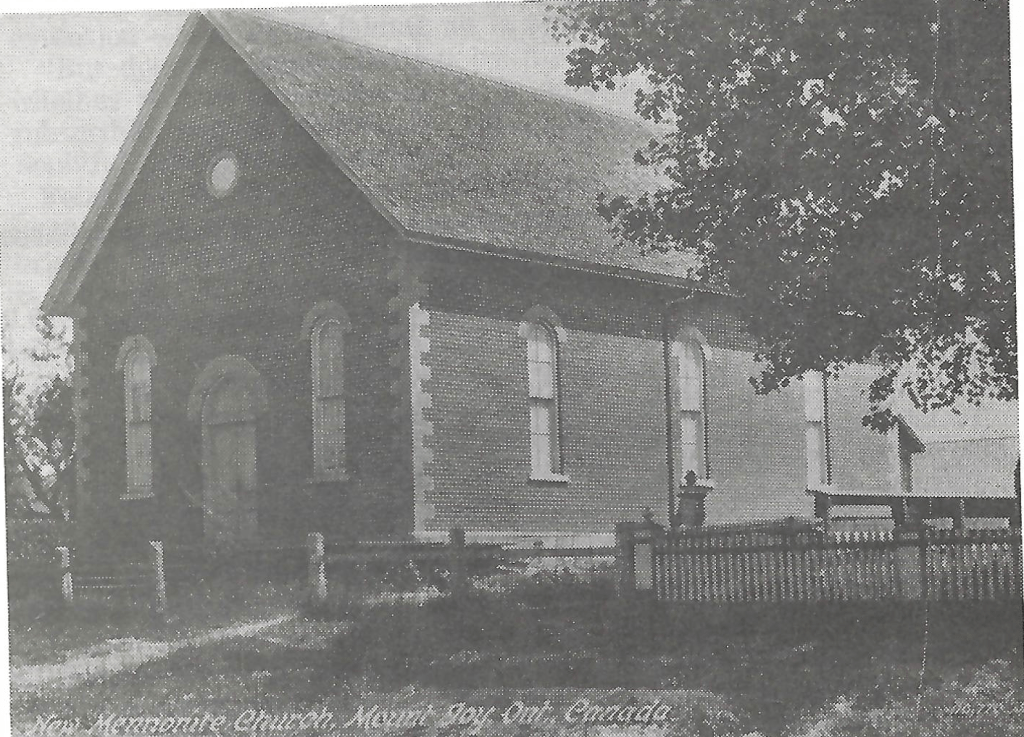
The Canada Conference gave Haug a task they hoped would assist him, by linking him to the Upper Canada Bible Society as a colporteur. I had to teach my computer dictionary the word “colporteur,” which is not in my Canadian Oxford Paperback Dictionary either. It means “One who travels about selling religious books, tracts, etc. for some society.”6 It is obviously from French, “one who carries on the shoulder” (recall “col,” a geographical term mountain climbers know.)
The Upper Canada Bible Society was one of the auxiliaries of the British and Foreign Bible Society in Canada, basically the Toronto regional Bible Society, founded with that name from earlier societies in 1839, and still functioning well into the 20th century, even past the organization of the Canadian Bible Society in 1904. The UCBS assumed responsibility for many parts of Canada not served by other auxiliaries.7
Michael Haug (b 1844) was from Berlin, ON, but from 1874 to 1880 he was preaching for the new Mennonite group in Maryborough Township, Wellington County, which became an appointment of the United Mennonites at Brotherston.8 He was the first probationer accepted by the merging conference of the New Mennonite Church and the Reforming Mennonites at Bloomingdale in 1875.9 Following his time at Maryborough, Haug was posted to the “Brant mission,” (Elmwood, in Grey County, which later included the town of Hanover) for two years, where the New Mennonite Church had followers at least as early as 1867.10 Then followed two years at Port Elgin in Bruce County on the shore of Lake Huron, 1882-1884. He was no newcomer to Christian ministry.

So Michael Haug went to Winnipeg and from there to Niverville, south of the city, on the western edge of the Eastern Reserve of Mennonite settlements. I haven’t seen an account of Michael’s work in Manitoba, but in any case, he left his assignment early and returned to Ontario. In the next annual conference, he had to answer questions about his actions. In 1885 he was listed an an evangelist, one of seven that year, and in 1886 he declined to be “unconditional” (willing to be assigned to any job or circuit) and instead became a local preacher and evangelist, apparently living in Port Elgin. I have a bit more on his life, but I will leave him there for now.
Meanwhile, the Evangelical Association mission to Winnipeg, though passing through its own trials, successfully planted a church in 1899, later called Albright Memorial and now just Albright Church, which continues to the present.11
That was the end of the first attempt of the MBiC to open mission work in Manitoba. Jacob Y Shantz urged the MBiC to send some settlers to the North West Territories in the 1890s, but that took them to Didsbury in Alberta. In the next Blog we will look at the vigorous second attempt to open a mission in Manitoba, a City Mission Society assignment involving 5 women 1905 to 1908.
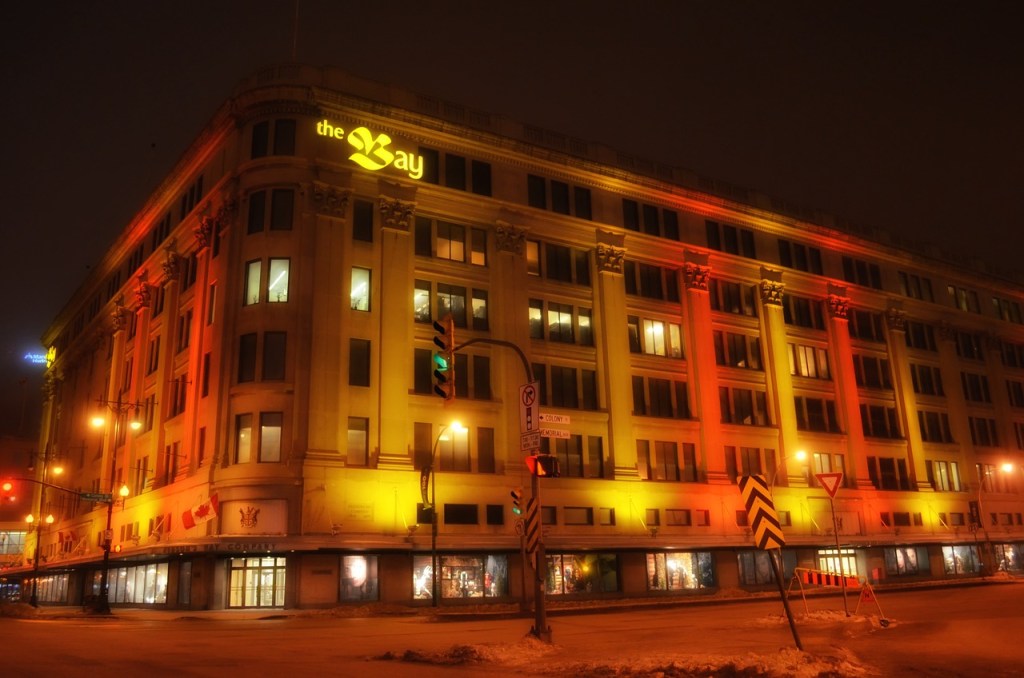
Banner: The Bay [Hudson Bay Company Store], on Portage Avenue, Winnipeg, MB, closed 2020. Winnipeg developed from the HBC Fort Garry at the junction of the Assiniboine and Red Rivers. Credit: Pixabay, public domain.
1Samuel J Steiner, Vicarious Pioneer: The Life of Jacob Y Shantz (Winnipeg, MB: Hyperion Press, 1988) p 77-98. Also Melvin Gingerich and Samuel J Steiner (1999), https://gameo.org/index.php?title=Shantz,_Jacob_Yost_(1822-1909)
2Three million immigrants entered Canada between 1884 and 1914, mostly after 1897 (many moved on to the USA); Edward Carruthers Woodley, The Bible in Canada: The Story of the British and Foreign Bible Society in Canada (Toronto: J M Dent and Sons (Canada), 1953) p 97.
3Woodley, p 98.
4Eileen Lageer, Common Bonds: The Story of the Evangelical Missionary Church of Canada (Calgary, AB: Evangelical Missionary Church of Canada, 2004) p 53.
5“Minutes of the Canada Conference Annual Meeting,” Gospel Banner (May 1 1884) p 68.
6A L Hayward and John J Sparkes, ed, The Concise English Dictionary (Ware, UK: Omega Books, 1984).
7Woodley, p 93.
8Letter from Michael Haug, Gospel Banner (July 1878) p 2, saying he had been at Maryborough for 4 years by then. The Canada Conference did not move him until 1880.
9He married his first wife, Phoebe Ann Detweiler (1849-1907) from Roseville, ON, on Nov 10 1867. The MCHT has no photographs of Michael Haug. Before serving as a preacher, he was a carpenter (Canada census 1871).
10Mentioned in the minutes published in Mennonitische Friendenbote (Aug 1867) p 61, in New Mennonite Church file, Mennonite Brethren in Christ fonds, Mennonite Archives of Ontario, Conrad Grebel University College, Waterloo, Ontario.
11Told from different points of view, including earlier Evangelical interest in the Canadian west in Theodore E Jesske, Pioneers of Faith: A History of the Evangelical Church in Canada ([Medicine Hat, AB]: Evangelical Church in Canada, 1985) p 24-29, 214-216, 248-252, 266-269. https://www.albrightchurch.com/

 EMCC History
Leave a comment