
Approved Ministering Sisters and Presidents.
Janet (Douglas) Hall was the first accredited woman preacher in the EMCC’s antecedent churches. She was licensed in Indiana and Ohio in 1884, and in Ontario in the following year. During the next dozen years Ontario similarly credentialed eight more women: Mary Ann Clemens (Hallman) Simmons (1886), Euphemia (Pool) Guy (1888), Maude Chatham (1891), Sarah Pool (1894), Sara (Klahr) Feldges (1897), Sarah (Madden) Bolwell (1897), Eliza Williams (1897) and Emma Hostetler (1897). Most of these are pictured in the photograph accompanying EMCC History Blog “Women Preachers in the Early EMCC Part 1”. In 1896 the American Conferences began reaching into small cities or towns with a plan relying on women.1 The Canada Conference of the Mennonite Brethren in Christ Church followed about 1897 with its own program, which it placed under a Conference committee’s direction the next year.2 Then in 1902, it formed a home mission Society with a constitution, a president and a reading course to train mission workers.3
What to call them? Most of the other MBiC Conferences developed similar programs. The titles given to the women varied: “tabernacle workers,” “city mission workers,” “approved ministering sisters (“AMS”s),” “deaconesses,” “evangelists,” “City Missionary” or “Home Missionary,” (abbreviated “H. M.” in the Gospel Banner to distinguish them from “F. M.” “Foreign Missionary”). Their qualifications varied as well. At first, like men, they simply became licensed preachers or probationers. Then, having passed the reading course as young men did, they could be appointed evangelists or tabernacle workers (for evangelistic meetings using tents seating hundreds of people). When the Ontario Society established its own reading course—a course similar to that taken by someone preparing for ordination—women having completed it would be “approved” (hence officially designated “approved ministering sister” from 1905 on) in a dedication ceremony. These women could not marry without losing their “dedication” or “consecration,” language borrowed from I Timothy 5:11 (even though in context Paul was talking about widows).4
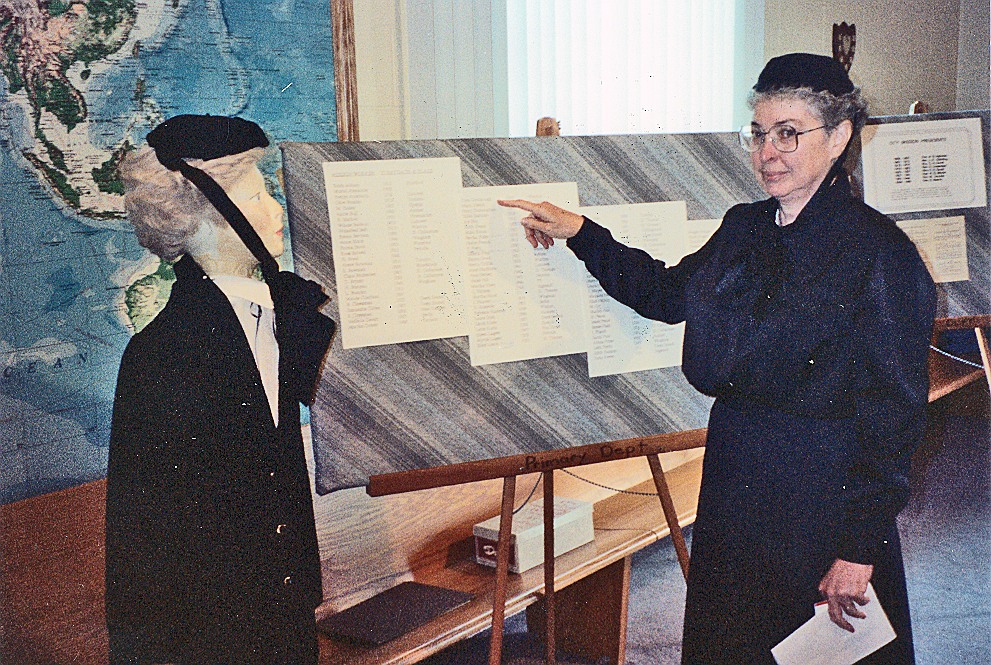
Seniors in Service celebration, Emmanuel Bible College, ON, May 1992
Courtesy Ellis Lageer Collection, Missionary Church Historical Trust
I am pretty certain that the CMWS kept records and minutes of their Conventions (held at other times and places than the Annual Conference), because the MBiC kept minutes in most of their institutions. The women had to fill in detailed report forms every year. The statistics (offerings in various categories, attendance, visits, number of Gospel Banners sold, number of converts, etc) were reported in the Annual Conference Journal but other records are not known, except a secretary’s partial minutes printed some years in the Gospel Banner. Only the minutes of the last CMWS Convention have been preserved so far as I know.5 Interestingly, the women’s names in the statistical reports were printed under the heading “Pastors.”
Presidents. At first the position of president in Ontario was full-time; later it was combined with the position of one of the Presiding Elders. There is a sort of myth in the EMCC in the east that C N Good was “the” President of the CMWS, but that is a partial truth. There were actually seven presidents in its lifespan:
- Annual Conference Committee (1898-1902); members:
1898-1899: Menno Bowman, Peter Cober
1899-1900: Menno Bowman, Peter Cober, Henry Schlichter Hallman
1900-1902: H S Hallman, Solomon Eby, Henry Goudie
- City Mission Workers Society organized in 1902, with a constitution and uniforms
1902-1907: President: H S Hallman
- In 1905, the position of “Approved Ministering Sister” was created. Reading course mandated.
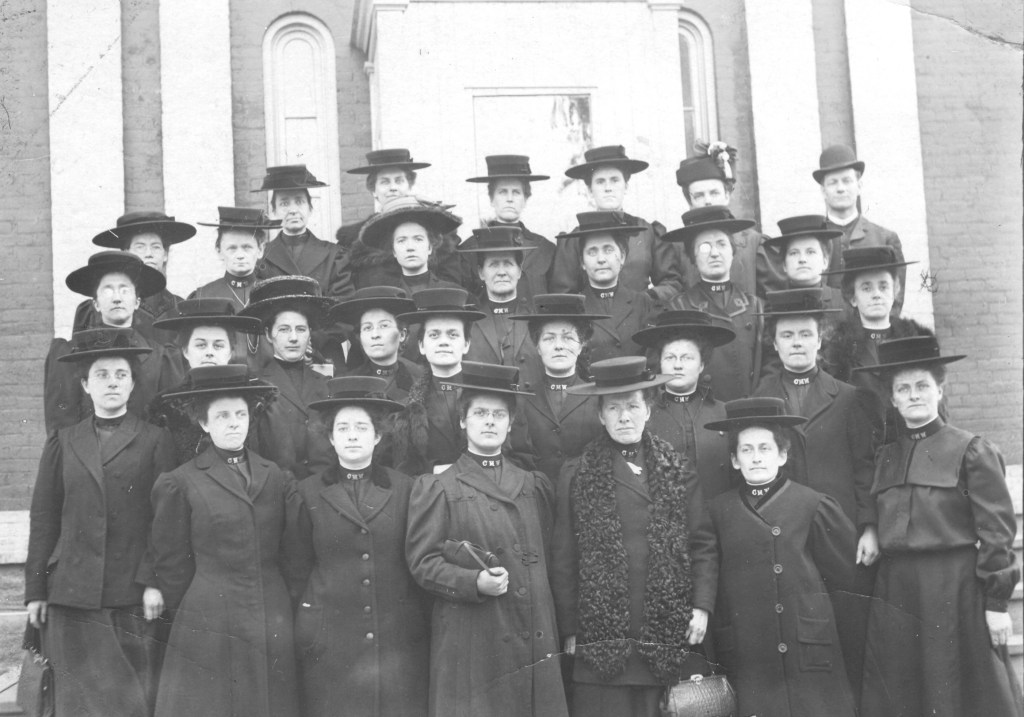
Courtesy Missionary Church Historical Trust
1907-1913: John Norman Kitching
1913-1919: Cyrus Nathaniel (“C N”) Good
1919-1920: Peter Cober
1920-1923: Silas Cressman
1923-1937: C N Good
1937-1941: William B Moyer
1941-1945: Milton Bricker (no president 1945-1946)
- 1946: the CMW Society held its last annual convention and was merged with, or was replaced by, the Home Mission Board.
- Thus the city mission program lasted 48 years, 44 years as a society.
- C N Good was the president who served the longest, a total of 20 years. The others, combined, served 23 years.

Courtesy Missionary Church Historical Society
- Six others served: J N Kitching, 6 years.
- H S Hallman, 5 years (but associated for other 3 years on the committee). When Kitching was ill, Hallman returned as interim President for the better part of a year.
- William B Moyer, 4 years
- Milton Bricker, 4 years
- Silas Cressman, 3 years
- Peter Cober, 1 year (but associated for 2 years before, on the committee)
Actors or servants? Some descriptions of the City Mission programs suggest the women were the initiators of their postings and strategies,6 but examination of the conference minutes demonstrates otherwise. The Conference or the Presiding Elder (in some Conferences) or the CM President assigned the women their times and places. H S Hallman was quite aggressive in posting the women in a fast-evolving attempt to found missions in small-town southern Ontario.7 My impression is that later presidents took less risks. Doubtless some women took more initiative than others, as Janet Douglas had. Sarah Pool was pretty independent,8 but the women generally obeyed the male leaders. John N Kitching was appreciative of the work of Emma Good, who had been a matron of the Berlin (later Kitchener) Orphanage and was taking up similar work in Manitoba at the Home of the Friendless: “Since Miss E. Good has gone to Winnipeg and remained there without my consent, as President, I am therefore unable to use her in the work. I pray God to bless her in her present work and calling.”9 Good was practicing her agency and Kitching was his, I suppose. I do not suggest the men were dictatorial. In fact, the presidents could receive warm thanks from the society members.10 One member wrote a poem of appreciation.11
Quite a few CMWs had hopes to become foreign missionaries,12 such as Sara Klahr, Emma Hostetler and Edith Evans. Sara (Klahr) Feldges (1875-1946) was licensed by the MBiC in 1897 and helped Maude Chatham start the St Thomas church, and then the Owen Sound church in 1899 with Maggie Spill.13 In 1903 the President assigned her temporarily to the Waterloo city mission, but she sailed for Chile under the Christian and Missionary Alliance mission that year.14 Emma Hostetler (1874-1912), from Bethany Church in Berlin (later Kitchener), Ontario, served at Bethany in 1897, was a tabernacle worker 1899-1900, and a CMW up to 1907, when she was sent to the British Protectorate of Northern Nigeria.15 Edith (Evans) Sherk (1882-1966) preached as a city mission worker in Ontario for ten years before venturing to Nigeria in 1913, partly to fulfill a childhood thought, but also to replace Hostetler who died in Nigeria.16
Several CM workers moved to western Canada,17 especially in the decade 1900 to 1910, the great migration of Ontario people to the west alongside many others from Europe and the USA. In Alberta and Saskatchewan, the scarcity of workers for any pastoral position convinced the Canada Northwest Conference to continue recognition for several women even after they married, despite the rules followed in Ontario.18 The Canada NW Conference tended to call the female workers “deaconesses.”19 The Ontario Conference could also use “deaconess”: Hazel Roger’s annual credentialing card for 1919 identified it as her “Deaconess Certificate.”20 Though biblically inaccurate in my opinion, “deaconess” was a more publicly recognized term. Most of the women in western Canada served in small pioneering settlements, so “city mission worker” was inappropriate and a new term needed.
When the Ontario MBiC/United Missionary Church closed down the CMWS, they maintained the credentials of the Approved Ministering Sisters, reporting them annually in the journal, but effectively the program was dead. None were appointed to open any mission, or serve in a congregation. The remaining women one by one resigned, married or died, and were “erased from the roll.”
Banner and thumbnail: Rene Fretz in the 1940s City Mission Workers’ uniform, in 1992. Courtesy Ellis Lageer Collection, Missionary Church Historical Trust
1Jasper Abraham Huffman, ed, History of the Mennonite Brethren in Christ Church (New Carlisle, OH: Bethel Publishing, 1920) p 202-213. The Pennsylvania Conference chose a different path: https://bfchistory.org/biographies/sisters/.
2Huffman, p 204-205. “Conference missions” using men were started at the same time. Sometimes the missions started by one branch were switched to the other, depending on personnel available, it seems.
3And a uniform, as the women always mentioned. In its various forms, the uniforms were not always enjoyed. For Annie Yeo, the hat was what she dreaded; Ruby Wilson and Olive Evans, Annie Yeo: A Life of Service (Burlington, ON: Welch Publishing, 1985) p 19-20.
4For guiding the unmarried women in the CMWS, the organizers probably considered 1 Corinthians 7:9 “But if they cannot control themselves, they should marry…,” alongside v 35: “I am saying this for your own good, not to restrict you, but that you may live in a right way in undivided devotion to the Lord.” (emphasis mine)
5Winnie Barfoot, “Minutes of the 43rd Convention of the CMWS, in Vineland, Ont.,1946,” Box 3001 MCHT.
6Storms says, “First known as women preachers, they eventually concentrated their efforts on opening missions in cities…they would rent a hall…,” Everek R Storms, History of the United Missionary Church (Elkhart, IN: Bethel Publishing, 1958) p 253; Eileen Lageer, Merging Streams: Story of the Missionary Church (Elkhart IN: Bethel Publishing, 1979) p 75 “…women who moved into town two by two, rented a store or empty hall….” The EMCC website video “Following Jesus Together: Our Story,” also uses the language of agency by the women, https://www.emcc.ca/who-we-are/our-back-story/.
7Visible in the chart of city missions from 1897 to 1920 in EMCC History blog, “Women Preachers in the MBiC Part 3: Sarah McQuarrie.”
8Clare Fuller, “Sarah Ann Pool, 1862-1913,” unpublished paper, 2016. See the example of Mae Shupe in the Michigan Conference; David R Swartz, “Woman Thou Art Almost Loosed!: The Rise of Women Ministers in the Nineteenth-Century Mennonite Brethren in Christ Church,” Reflections (Spring and Fall 2007) 9:1 & 2, p 19-20.
9Ontario Conference Journal (1908), p 32.
10One woman said of Daniel Brenneman, Presiding Elder in the Indiana and Ohio Conference: “He was like a father to us girls,” Lageer, p 76. In this day of recognizing male power harming women, we might be suspicious of such reports, but no contrary testimonies have surfaced.
11Margaret Tyndal/ Tindall, “To—Rev. C. N. Good,” Ontario Conference Journal (1937), p 74. This poem is evidence, by the way, that Margaret Tindall was indeed a CMW, though her name did not get in annual conference reports, just as a lady named only as “E. Foote” around 1908-1911. Foote is visible wearing the uniform in a group photograph ca 1908 and mentioned in the magazine doing children’s work; John N Kitching, “Home Missions-East End Mission,” Gospel Banner (April 27 1911) p 13.
12At least 22 licensed women up to 1940 did serve in MBiC missions, 14 from Ontario (plus two more who served in Ontario who came from other Conferences).
13Everek Richard Storms, What God Hath Wrought: The Story of the Foreign Missionary Efforts of the United Missionary Church (Springfield, OH: United Missionary Society,1948) p 114, and Canada Conference Journals.
14Sent from Bethany MBiC Church, Kitchener, Sara married W Herman Feldges from the MBiC Pennsylvania Conference in 1906. They later served in Ecuador (1922-1926), and Colombia (1934-1939). See Maude E Chatham, “In Memoriam-Feldges,” Gospel Banner (February 7 1946) p 15.
15She died of smallpox in 1912 in Mokwa, now in Niger State, Nigeria, but was buried at Shonga (Tsonga) in Kwara State.
16Edith Evans was born in Puslinch Township, Wellington County in 1882, died in Port Huron, Michigan in 1966; Everek R Storms, “Pioneer Missionary in Nigeria Mrs. I. W. Sherk Passes at 83 Began Stratford, Ont., Church,” Gospel Banner (February 24 1966) p 13. She served in Aylmer, Waterloo town, St Catharines, Guelph, Stratford, Toronto Dundas, Wiarton at various times.
17Eg Maude Chatham (1900), Mary (White) Finlay (1908), Luella Swalm (parents already in Didsbury by 1901, she was present in Didsbury in summer 1905, but moved west about 1910), later Mabel Dunnington (ca 1917). Others went west with their husband preachers: Daisy (Young) Gugin (1908), Janet (Douglas) Hall (1910), Johanna (Krauth) Brittain (ca 1912).
18Eileen Lageer, Common Bonds: The Story of the Evangelical Missionary Church of Canada (Calgary, AB: Evangelical Missionary Church of Canada, 2004) p 50-52. Janette Oke, the famous EMCC author and reviver of historical romance novels—“Prairie romances” in her case—wrote a novel in appreciation of one woman preacher she knew (Ontario-born Beatrice (Spreeman) Hedegaard 1913-2004) in The Calling of Emily Evans (Minneapolis, MN: Bethany House, 1990) Women of the West Book 1.
19I am preparing a blog on the term “deaconess”.
20“Wolff, Hazel (Rogers),” Box 2501 MCHT. However, Winnie Barfoot’s credential card just two years before called her an “Approved Ministering Sister,” Box 3001 MCHT.


 EMCC History
Leave a comment