
Jasper Abraham Huffman’s book, Voices from Rocks and Dust Heaps in Bible Lands,1 was probably the first book of biblical archaeology I ever read. I was likely less than 14 when I read it, but by then I had certainly read popular accounts of the discovery of Troy, Babylon, Mayan temples and Machu Picchu, and other archaeological wonders. The book was in our church library in Lakeshore United Missionary Church in North Bay, ON, a survivor of somebody’s pastoral or former church libraries. It looked kind of old and unauthoritative, (it didn’t have colour pictures like National Geographic!) and the title was a bit hokey. I did not appreciate the achievement it represented.

Credit: Lambert Huffman, Not of This World (1951)
Dr Huffman was an American, a Missionary Church pastor, educator and theological teacher, the first person to have an academic degree other than medical in the history of the denomination, the Mennonite Brethren in Christ Church.2 He started several publishing businesses, including Bethel Publishing, which the MBiC bought in 1919. Besides some coursework in archaeology, he actually spent several weeks in Palestine in 1930, joyfully sweating it out excavating at Tell Beit Mirsim,3 an Old Testament site, which he understood was Kirjath-Sephir4 (Joshua 15 and Judges 1) under the famous archaeologist William Foxwell Albright.5 Not an archaeologist, Huffman was actually a biblical theologian, teaching in several seminaries in his lifetime, and he delighted in visiting the places he knew from the Bible and history. Incidentally, he also visited twice the Armenian Spiritual Brotherhood churches of the Middle East in Aleppo, Beirut, Damascus and Alexandria, in 1930 and 1950.6 Huffman was also an editor, an evangelist, many times speaking in MBiC camp meetings and Bible conferences in Ontario, for example.7
Educational work. Huffman was not only the first person with degrees in the MBiC (BA, studies done at Bonebrake Theological Seminary of Dayton, Ohio,8 but granted through Bluffton College; BDiv, McCormick Theological Seminary, Chicago),9 he was an advocate for educating the young people of the Church when many pastors and members were suspicious of higher Christian education.10 Even in 1920, a large committee of the MBiC General Conference (meeting in Kitchener, ON) declared that “institutions of higher education, secular and theological with very few exceptions,” were “honey-combed” with liberal theology.11 Huffman could have named a few schools which were safe, but he, pointedly, I believe, was not on that committee.12 Wherever he taught, he encouraged young MBiC students to learn the Bible and theology and to use that learning.
So for Huffman to even bother to write Voices as a textbook, he was still speaking for a minority in the denomination, which was quite rural and used to limited educational opportunities. As editor of the Gospel Banner 1913-1924, he brought biblical archaeology to the notice of the Church as early as 1918.13 Attitudes had changed by the time of his book’s second edition (1943) for it was included in the Church’s Probationer’s Reading Course by 1945.14 In 1956, another text was substituted in the UMC Probationer’s Reading Course, Wheaton College’s Joseph P Free, Archaeology and Bible History (Wheaton, IL: Van Kampen Press, 1950), showing it was considered an important subject for young preachers.
Biblical archaeology (systematic study of remains of ancient societies in the Middle East that relate to the people, places and events in the Bible) flourished for over a century. Fashions in academies have tended to de-legitimize the search for connections between archaeological research and the Bible. Biblical history has been criticized as full of myth and legends, that it is partisan, and more theology than history anyway. (The answer of course, is, why couldn’t it be both?) There still is a vigorous interest in the Bible and archaeology among many ordinary Christians and Jews, as the glossy popular Biblical Archaeology Review testifies. Academics tend to be skeptical when amateurs claim to have discovered things like Noah’s ark or the tomb of Jesus’ relatives, stories which dot Christian and Jewish popular presses. We don’t need such sensational claims to profit from good archaeological studies to illustrate and illuminate many places, people, products and customs referred to in the Bible, such as in the two recent IVP Background Commentaries.15
Corroboration and Confirmation. Huffman went further than “to illustrate and illuminate”, he promoted Biblical Archaeology as corroboration and confirmation of the Bible.16 He was living in a period when skeptics doubted even the existence of many people and places mentioned in the Bible, not to mention institutions such as literacy in Moses’ time and events such as the Israelite conquest of Canaan. Some Christian apologists still fight battles detailed in old textbooks: you can still read of people who think scholars say there was no literacy in Moses’ day, but that has been debunked for about a century. Archaeological studies rewarded Huffman’s hopes on many questions. Skeptics are still with us, however, and the debates more sophisticated. The mass of data from archaeology often complicates interpretations of the past.
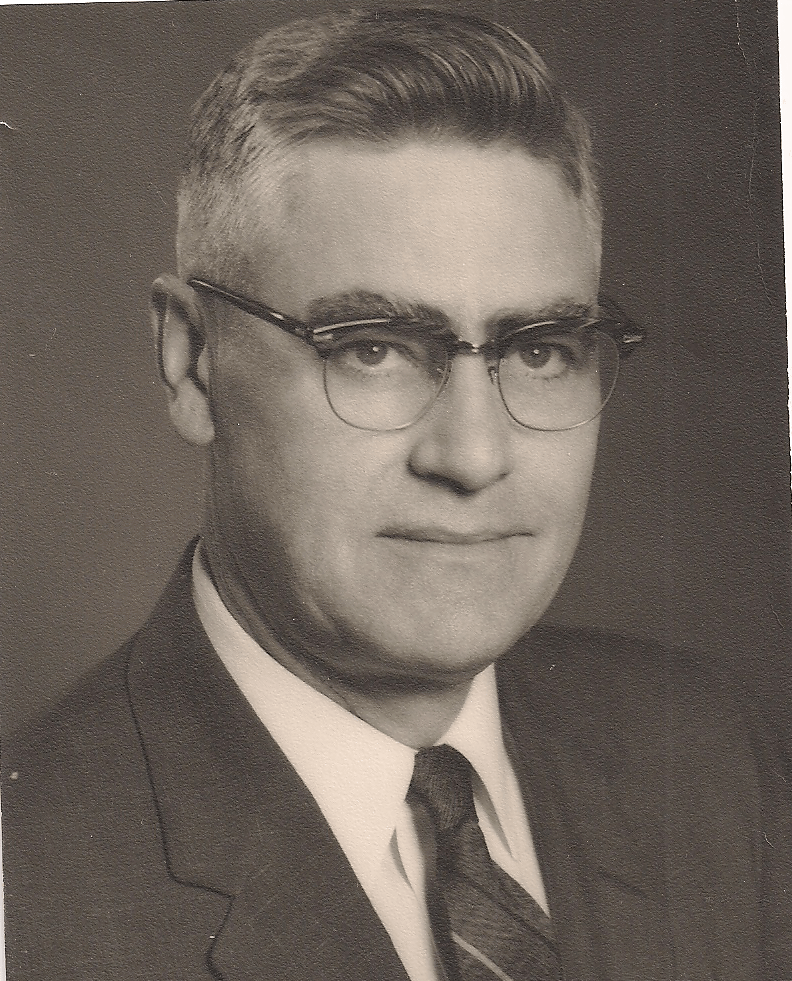
Courtesy Western Archives of the EMCC, Calgary
Taught in Bible Schools. With the start of the second wave of MBiC Colleges (Mountain View 1926, Mount Rainier 1938, Emmanuel 1940, Bethel 1947), Biblical Archaeology became part of a standard Bible College curriculum. Emmanuel Bible College in 1949 listed “Archaeology” as a course in the “Field of Apologetics,” described as “The manner in which discoveries of archaeology corroborate the Bible is revealed,” taught then by Virgil K Snyder.17
Missionaries often included a visit to Palestine as a part of a return trip from their field assignments. Most visited as tourists, or thought of themselves as pilgrims, but some could have caught a glimpse of the results of excavations in the mounds and caves of that ancient landscape.
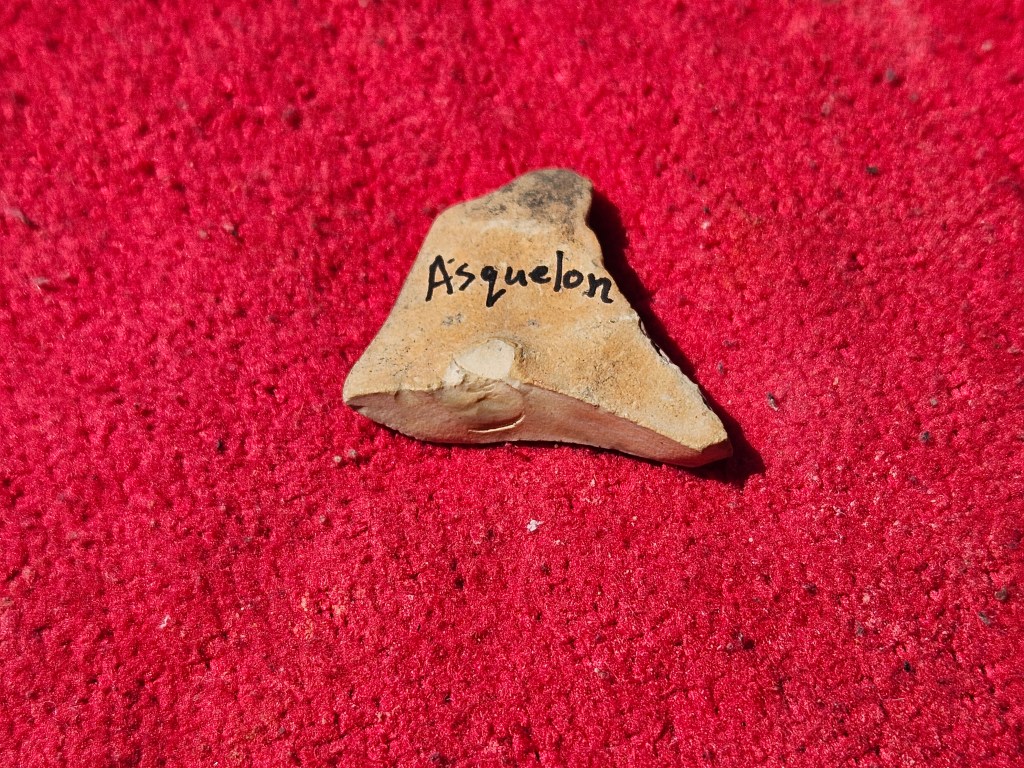
Photo: C Fuller, May 2024
By the time I became a student at EBC in 1977, trips to “the Holy Land” were routine for North American Missionary Church members.18 Classmates of mine joined trips in 1978, 1980 (and later) and brought back samples of stone for my rock collection. Some wrote essays for credit on places they visited connecting the sites to biblical events or people. Everyone probably knows lecturers and pastors who have hosted trips open to students and church members to visit Rome, Greece, Egypt, Jordan and Israel, perhaps even Turkey; any place where people of the Bible set foot. Such trips would touch on archaeological sites, but travelers may not learn much technical archaeology. Ray Priddle, academic dean and OT professor at EBC who taught me Greek and Hebrew, spent a study semester at the Holy Lands Institute in Jerusalem September-December 1981, and I am sure enjoyed every minute of it because he, as did Huffman, understood the methodology and significance of the science of archaeology.
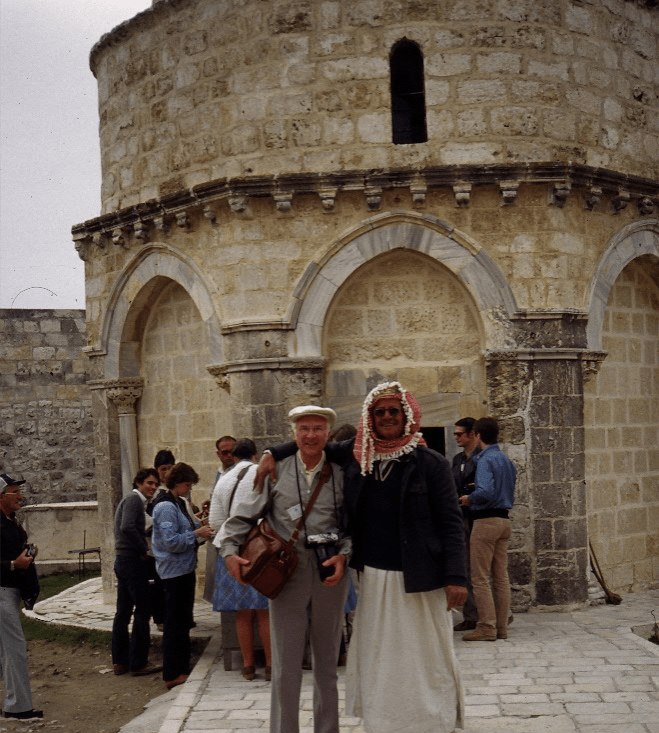
Mt of Olives, March 1983
Courtesy Missionary Church Historical Trust
Banner: Emmanuel Bible College student exploring a tomb on a tour, 1979. Courtesy MCHT
I thank Thomas Fuller for suggesting this topic.
1Issued in several editions, the Missionary Church Historical Trust has that of (Marion, IN: Standard Press, 1928) and 1943. We also have his sequel, The Stones Cry Out (1948), which explains the what, why and how of biblical archaeology.
2Two book sources exist, Huffman’s own autobiography, Seventy Years with Pen, Pointer and Pulpit: Memoirs of Jasper Abraham Huffman (Elkhart, IN: Bethel Publishing, 1968), and his son Lambert’s book in two editions, Not of This World (Np: For the Author, 1951, 2nd ed 1970?). There is also Everek R Storms, History of United Missionary Church (Elkhart, IN: Bethel Publishing, 1958) p 196-199, 212-213, 217-218, and other notices in various academic “Who’s Who.”
3Jenifer Blouin Policelli, “The Consecrated Scholar: J. A. Huffman and his Devout Approach to Archaeology,” Reflections (2018-2019) p 58-62.
4https://en.wikipedia.org/wiki/Tell_Beit_Mirsim
5Lambert Huffman, p 79.
6See my 4-part EMCC History Blog series: “Armenian Mission 1898-1939”; J A Huffman, Seventy Years, p 125, 129-132 and 144-148.
7J A Huffman, Seventy Years, p 93-95.
8Originally a United Brethren in Christ seminary.
9The honourary Doctor of Divinity was given by Taylor University, Upland, IN, in 1920.
10Lambert Huffman, p 85.
11MBiC Tenth General Conference, 1920, p 31.
12It is fair to point out that as Secretary of the Conference, Huffman would have found it difficult to have the time to serve on the Committee. They could have solicited his input, in fact he may have warned of the liberalism and undesirable behaviour tolerated in some schools.
13J A Huffman, “Archaeology and the Bible,” Gospel Banner (February 7 and February 14 1918) p 2, both issues.
14See EMCC History Blog to come, “The Probationer’s Reading List.”
15John Walton, Mark Chavalas and Victor M Matthews, The IVP Bible Background Commentary: Old Testament (Downers Grove, IL: InterVarsity Press, 2000) and Craig S Keener, The IVP Bible Background Commentary: New Testament 2nd ed (2014).
16Policelli, p 59.
17Students of Emmanuel Bible College, The Pilot, (Kitchener, ON: EBC, 1949) p 19.
18The Missionary Church Historical Trust has at least 635 slides (photographs) taken by some of these travelers from 1979, 1983, 1984, 1985, and 1993, and hundreds more by Ontario Missionary Church pastor Wayne F Good over several trips, notably in 1973, 1977 and 1978.


 EMCC History
Leave a comment