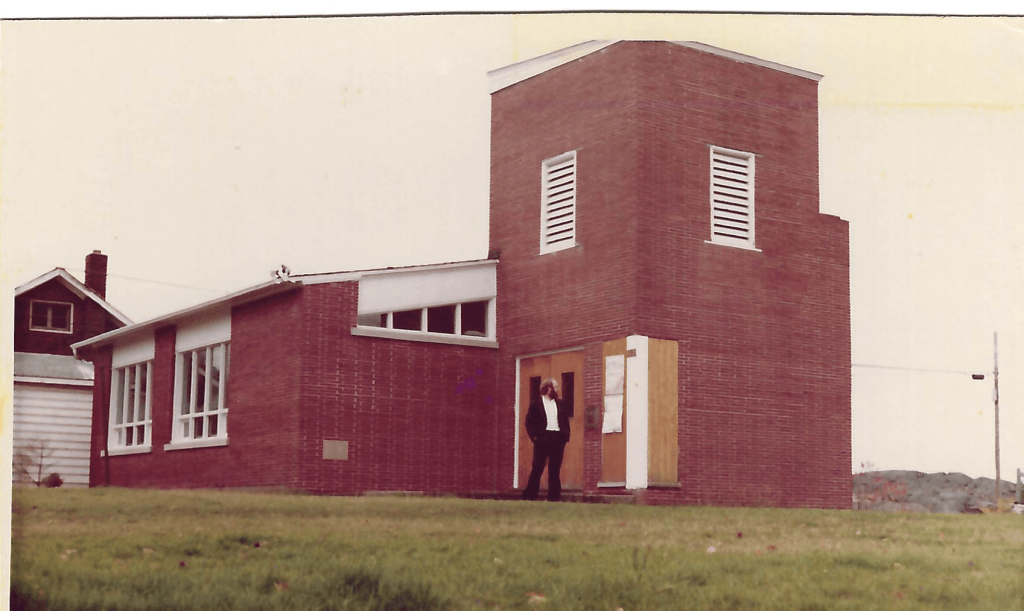
Like Harvey Stauffer, I did not last long in the pastorate. All fired up about church planting after Bible College, I and a handful of others tried to start an English-language church in Sudbury, ON, 1981-1984,1 and later I served again under the Evangelism and Church Extension (“Home Missions”) Board of the Missionary Church at Elk Lake, northern Ontario, for just 13 months 1986-1987. Both experiences were busy, exhilarating, and painful at times. I did not want to be a pastor afterwards, though I was an associate pastor in a large Nigerian congregation connected to the college I taught in. I have always supported church growth in the EMCC and the United Missionary Church of Africa and rejoice when it happens.2 I sympathize with those young pastors who leave the task after a few years for various reasons.
Harvey Stauffer came from a Mennonite Pennsylvania-Dutch family. Somehow, in Canada, the Stauffer name split between Stauffers in Waterloo County, and Stouffers in York County. Don’t worry about resolving it, let genealogists do that. His father, Isaac S Stauffer, was born in Butler County, Pennsylvania, in 1842, and his mother, Barbara Weber, in Ontario in 1844.3 Coming a bit later to Canada than other Mennonites, Harvey’s family settled in Peel Township, Wellington County (north of Waterloo) farming at Glenallen, where he was born in 1881, the youngest of eight children.4
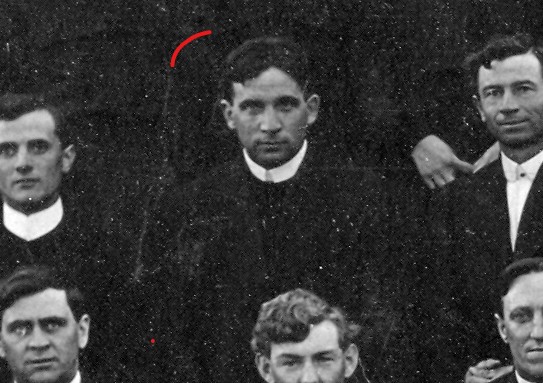
Courtesy Missionary Church Historical Trust
The Mennonite Brethren in Christ supported preaching appointments branching out from the Brotherston Mennonite Church (Kurtzville) in Wallace Township, which split in the early 1870s over the revivalism issue.5 Glenallen was served along with Wallace (in Perth County) and Maryborough (in the township of the same name in Wellington County). The circuit was often called the “Maryboro field” in the MBiC. Isaac Stauffer became a deacon of Maryboro in 1895, when an earlier deacon, Daniel Hostetler, retired from farm work and moved to Berlin (Kitchener).
MBiC Ministry. Harvey Stauffer shows up in the Canada Conference records as a helper to Charlie Krauth on the Elmwood circuit (Elmwood, Hanover and Allen Park, mostly in Grey County) 1904-1905. He had been a carpenter. With the appointment, Harvey married Sarah Adelaide “Addie” Cober, a daughter of Peter and Martha (Steinacker) Cober, a leader of the Canada Conference (renamed “Ontario Conference” in 1907) on September 28 1904. He continued on the Elmwood field to 1906. With that experience, the Conference appointed him as the pastor at Port Elgin, a village on Lake Huron, considered as a stable place for young preachers to start. At that time, the Port Elgin field included a preaching point called Sang’s School House. These were both in Bruce County.
Some sort of difficulty met Harvey at Port Elgin in his first year there, his third year of ministry, which I have heard is the most critical year for new preachers. Why we typically ordain ministers after two years, I do not know. Sam Goudie and Harvey’s father-in-law Peter Cober talked over the case when the two Presiding Elders met at Breslau in January.6 On his regular Quarterly Meeting visit to Port Elgin in February, Goudie met with Harvey and, visiting members house to house, found the people rather dissatisfied with their pastor. After the Meeting, Goudie wrote, “had quite a struggle to get things settled, but at last all was laid aside & people & pastor were again reconciled.”7 This can be quite traumatic for a young preacher.
Things must have improved, for at the end of his second year, Harvey was approved for ordination—the local Port Elgin delegate had to bring a recommendation to the Annual Conference about him. He was moved again, to the Scott field in Ontario County, north and east of Stouffville.8 Today we might say, just NE of Toronto. This circuit included Mt Pleasant near Zephyr in Scott Township, and Mt Zion near Ravenshoe on the 6th Line of East Gwillimbury Township, York County.9 During his second year, the Conference supplied him with a helper, Amos Hunsberger. I have not been able to learn more about this man.
After 6 years on three different fields, Harvey Stauffer was not placed on a circuit in 1910, or he asked to be left out for a while. Why he did not stay on a field for the typical 3 years, is not recorded, though it is not proof he was not a skilled pastor, as some able people were moved that often for other reasons. I do not know where he lived for the next three years as a “local preacher,” possibly Guelph, or Berlin, as we find him there later. Harvey and Addie had four children: Alda M (1907), Gordon C (1909), M Irene (1911), and Helen Beatrice (1915, born in Guelph).
After the MBiC ministry. In any case, in the 1913 Annual Conference, Harvey was “dropped from the [Conference] roll.” That is, he was no longer credentialed an ordained minister of the MBiC, probably simply because he was inactive and not seeking a placement. In 1921, the Canada census found the family in Kitchener. He was working as a shipping clerk, they were Mennonites, and listed their ethnic background as “Swiss.” Harvey died in 1956 and was buried in Woodland Cemetery in Kitchener.
I met Harvey’s son, Gordon Stauffer, in Kitchener in the late 1970s when I was attending Emmanuel Bible College and worshiping at Evangel Missionary Church. He was also a deacon, like his grandfather, and he told me he was the last deacon “ordained for life” under the old MBiC Discipline in the 1940s, after Evangel was established in 1949. Before that Gordon and his wife Mabel had been members of Bethany United Missionary Church, Kitchener. He mentioned his father a little but I did not understand the history and neglected to ask him more about his family story, unfortunately. Another of my series of missed opportunities to learn in time. I also heard Gordon’s sister Helen (Stauffer) Betzner who often sang as a soloist in Missionary Churches in the area.
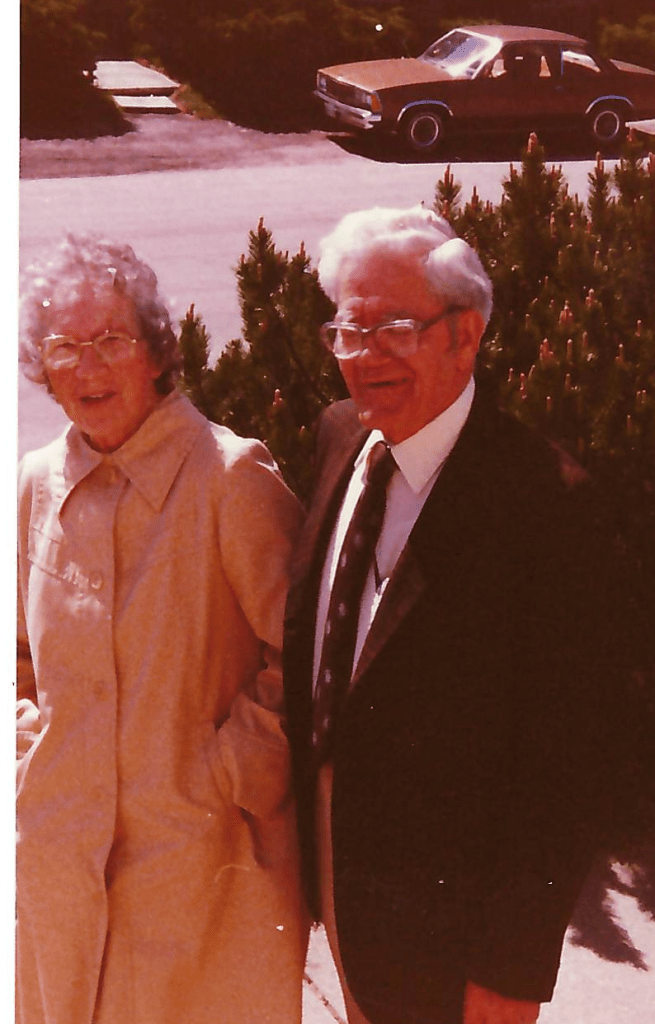
Kitchener, ON, ca 1988.
Courtesy Fuller Family Collection
Gordon was deeply involved in the Sunday School work of the Ontario Conference for many years. He had thick curly hair until the end of his life, which probably descended from his father. In photographs in the Missionary Church Historical Trust, especially the Annual Conference at Stouffville in 1910, Harvey Stauffer stands out with a head of dark curling hair, a rather handsome and pleasant-looking man, I would say, as was his son. I find comfort in this story because, though Harvey Stauffer’s career as a pastor in the MBiC was relatively short and maybe not all that easy, he and his family continued, serving and worshipping in the MBiC, the United Missionary Church and the Missionary Church.
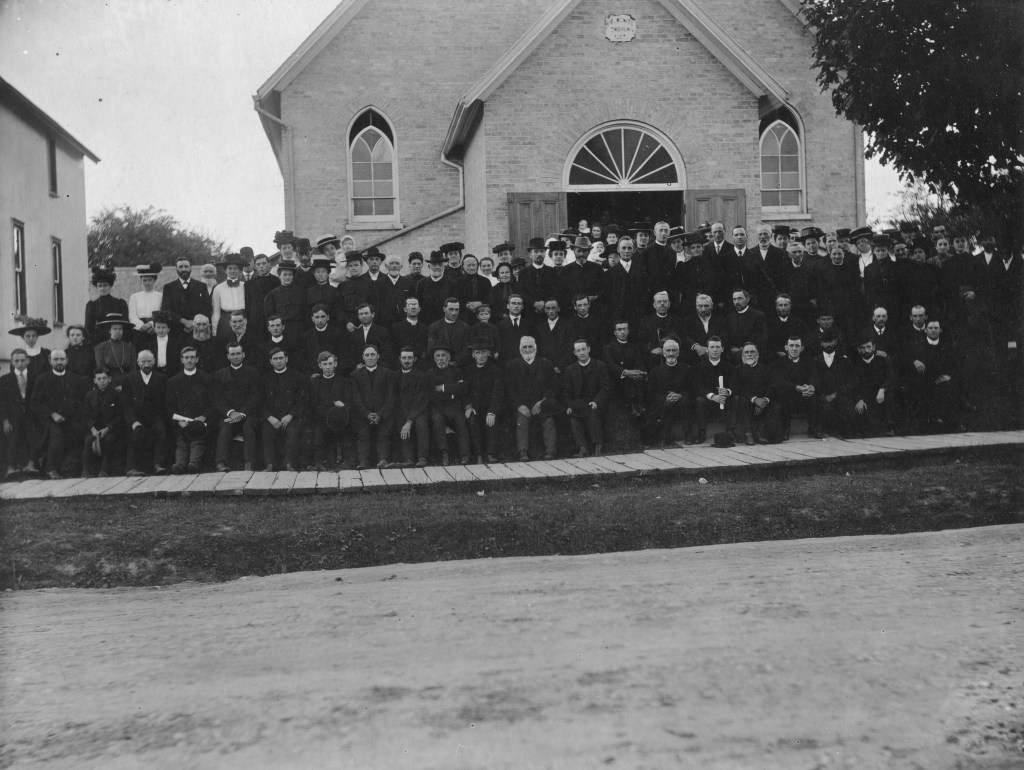
Banner: MBiC Ontario Conference at Stouffville, 1910. Courtesy Missionary Church Historical Trust
1A Chinese-language Missionary Church was also started in Sudbury at the same time which has continued to today (2024), which I helped to some extent.
2In Nigeria 1989-2010, I saw so many Church Growth principles in action and an increase in the church I served, the United Missionary Church of Africa. Four times I surveyed the denomination at 5 year intervals and documented its growth from about 325 congregations (about 1989) to at least 880 in that period!
3Married August 24 1862.
4Also called Glen Allen. Don’t confuse Peel Township with Peel Region. Peel Township amalgamated with Maryborough Township in 1999 forming Mapleton Township.
5Samuel J Steiner, In Search of Promised Lands: A Religious History of Mennonites in Ontario (Kitchener, ON: Harrisonburg, VA: Herald Press, 2015) p 33, has a detailed history of the results of German-Methodist revivalism on Mennonites in Ontario, p 125-152. See also EMCC History Blog homepage “Formation of the EMCC.”
6Sam Goudie, “Diary,” January 16 1908.
7Sam Goudie, “Diary,” February 19-23 1908.
8Ontario County is now Durham Region.
9York has become York Region. On Zephyr EM Church, see Clare Fuller (2023), https://gameo.org/index.php?title=Zephyr_Missionary_Church_(Zephyr,_Ontario,_Canada)

 EMCC History
Leave a comment