
Parliament St, Toronto.
[Banner: Grace Memorial EM Church, Toronto, ca 1999. Courtesy Glenn Menard Collection MCHT]
Students of Canadian Pentecostal history are familiar with a storefront mission in Toronto at 651 Queen St East sometimes called the East End Mission, or the Hebden Mission.1 The Evangelical Missionary Church of Canada precursor denomination, the Mennonite Brethren in Christ Church, also had an East End Mission (EEM) about the same time in Toronto. It has not received as much notice in EMCC history which it oddly has in Canadian Pentecostal history. The two missions were about six blocks apart. There was a West End Mission in the MBiC, which became Wellspring Worship Centre, Willowdale. For many years known as Banfield Memorial, it has an excellent centennial history by Dr Arthur Sherk.2
The EEM. The congregation on Jones Avenue, Toronto, called after 1936 “Grace Chapel,” and which after moving to Don Mills called itself first “O’Connor Hills” then “Grace Memorial,” finally closed its doors about 2015. But Grace Memorial had a root on Parliament Street that is often not counted or remembered.3
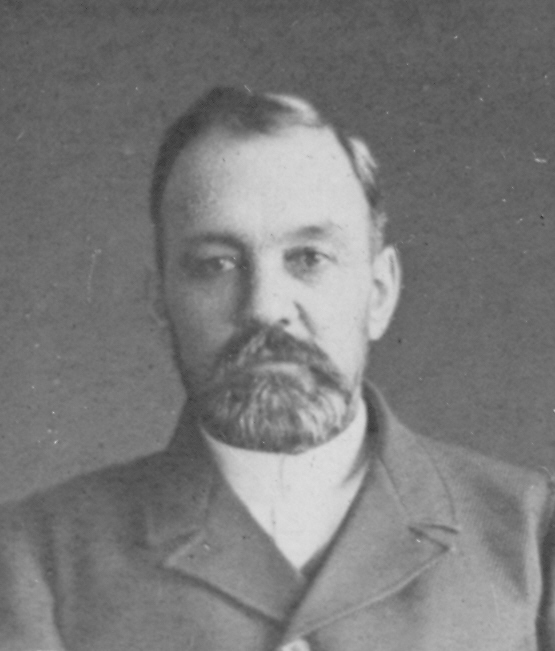
Courtesy Missionary Church Historical Trust
Noah Detwiler was the great tent evangelist of the Canada Conference of the Mennonite Brethren in Christ.4 He rented a space on Spadina Avenue, Toronto, in 1897, west of Yonge St that became the West End Mission. The following year, the MBiC assigned Robert Eltherington, a former Salvation Army officer, to begin a mission on the east side of Yonge St, the East End Mission.5 The first recognition of a Mennonite presence in the Toronto Street Directories for 1899 (compiled in 1898), is the Mennonite Gospel Mission at 339 Carlton St.6 In 1900, Eltherington was again assigned to the EEM, with Sarah Pool as a “slum worker” to co-ordinate with him. The Conference also posted that year two city mission women (Susie Bowman and Jennie Little) to the western Toronto location they called Toronto Junction. Typically, MBiC city missions held services five or six days a week, including three on Sunday. The MBiC supported their Toronto missions with camp meetings in a Toronto place (probably Dufferin Park) in 1899, 1900, 1902, 1904, and 1912, the last.
In 1901 and 1902, Eltherington was again posted to the EEM, now listed in the Street Directories as meeting at 435 Parliament St and called both “Mennonite Mission Hall” and “Mennonite Gospel Mission.” Noah Detwiler, who had not been well and went into semi-retirement, was willing to try evangelism again at a Dundas St W location.7
In 1902, Eltherington had finished his maximum of four years in Toronto, and Moses Weber took his place. By this year also, the mission had moved to 334-336 Parliament Street, where it was inaccurately called the Mission Hall of the “Mennonite Brethren.”
Moses Weber’s assignment lasted one year, and he was replaced by Amos Eby at the East End Mission in 1903. At some point in 1903, the EEM moved again, to 281 Parliament St, where it stayed until 1906 and was listed in the Street Directories as the “Mennonite Mission.”
In 1905, there was a switch of personnel again at the EEM, and George A Chambers was posted there, under the supervision of Henry Goudie (Sam’s older brother) then at the West End Mission.8 Sarah Pool was again assigned as the slum worker in Toronto. Sarah was an energetic woman. Some years she recorded over 1500 home visits! She had served as an MBiC preacher since 1892, had volunteered to work in China with the Christian and Missionary Alliance in 1899, but returned to Canada.9 In 1905 Pool suggested in an article in the Gospel Banner that the MBiC leadership (probably Presiding Elder Sam Goudie in particular) was stifling the Holy Spirit, a common complaint by proto-Pentecostals. A Presiding Elder of the MBiC, a Methodist term later replaced by District Superintendent, had considerable authority over congregations and ministers, but unlike traditional bishops, did not assign workers to their pastorates. A Stationing Committee did that. A Presiding Elder could take disciplinary actions, but his actions had to be ratified by the Annual Conference. Around this time, Goudie “had a talk with Sister Poole[sic],” his common way of cautioning workers who had difficulties with the Conference. She fell out with the Ontario MBiC after March 1907 after preaching a sermon for the Annual Conference which was critical of MBiC doctrine, and returned to Markham, her home town.10 You can read more about her in the GAMEO article referred to.
A new player: the Hebden Mission. In the fall of 1906, the holiness mission started by Ellen and James Hebden on Queen St East, Toronto, in May began practicing and teaching the possibility of speaking in other languages as a gift of the Holy Spirit as proof of being baptized with the Spirit. Their mission became well known in the holiness movement and higher Christian life circles in Toronto and soon much of central Ontario. North American holiness groups had been claiming to be baptized with the Spirit at their experience of sanctification for many years.11 The teaching at the Hebden Mission disturbed numbers of people in the MBiC. Others welcomed it. My biography of Sam Goudie goes into more detail about the influence of the Pentecostal message on holiness groups such as the MBiC.
As a Presiding Elder since 1905, Sam Goudie with two friends visited the Hebden Mission in March 1907, and he was not impressed by what he saw: “This P.M. bro Good bro Shantz & I went to the Mission where they claimed the gift of tongues. we heard some speak in strange tongues and acted strangely, they all seemed to shake.”12 Many other people, particularly members of the Holiness Movement Church and Christian Workers Churches were impressed and altered their preaching.13 When news of a similar event in Azusa St, Los Angeles, was publicized the Hebdens were overshadowed, but not before they had started quite a network of Pentecostal preachers, missions and activities in Ontario.14
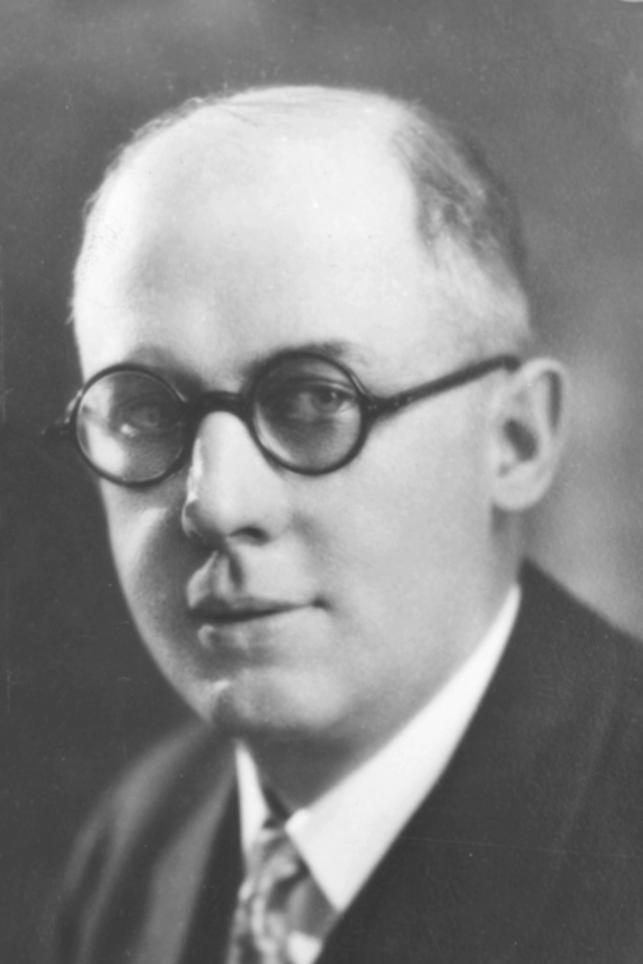
Courtesy Archives of the Pentecostal Assemblies of Canada
Disruption at the Parliament St Mission. Without going in to the whole story, which is detailed in my book,15 let’s just say that by September 1908, George Chambers was a convinced Pentecostal, that Sam Goudie removed him as pastor of the EEM, and replaced him by someone, possibly his helper Thomas Brook, and he resigned from the MBiC Ontario Conference. Soon after, he decided to “fight” (Chambers’ word) the MBiC so he opened a Pentecostal Mission elsewhere on Parliament St, taking, as often happens, a majority of the adherents with him.16
A number of members of the EEM resigned at the October 24th 1908 Quarterly Conference that Goudie led where Goudie as Presiding Elder passed along the decision of the MBiC General Conference in Brown City, Michigan earlier that month. The General Conference, by a vote of 30 to 1, rejected the initial evidence doctrine, as it came to be called.17 Thomas W Brook, and his wife Maggie (Rennie), a former City Mission preacher, both resigned. William Rennie and his wife, the steward and Sunday School Superintendent respectively and probably Maggie’s relatives, also resigned. They were, perhaps, all from the Aylmer/ St Thomas area and had become Christians through the MBiC there. The auditor, Sister Eunice Leach, also resigned. Goudie defended the Conference from accusations that these people had all been “crowded out by the Conference, which is not true.”18 In his mind the people who resigned simply did not accept the decision of the September Ontario Conference, nor that of the October General Conference. It was their choice to go. The disruption was very damaging to relationships, as many of these people, for and against Pentecostalism, had worked together in camp meetings, conferences and evangelism for up to ten years. For some, Goudie had been their pastor, counseled them and took them into church membership.
Recovery? Another pastor, Joshua Fidler, was assigned to the mission in September 1908, but the damage had been done. Goudie kept an eye on the EEM in the quarterly round of visits to his half of the Conference. He reported optimistically that the mission, which had formerly been a “soul-saving station” was recovering from the losses, but would need financial help.19 Fidler was not well and retired in 1910 but still attended the mission, Chris Raymer finishing out his term. The membership dropped from 61 (1905) to 14 (1910) and after 1910, two women replaced the male pastor.20 Conference leadership considered closing it entirely or turning it into a rescue mission for orphans.21 Eventually the Ontario Conference did run an orphanage home on a street near Danforth Avenue.22
On October 6 1911, the EEM members discussed whether or not to sell 266 Parliament St and relocate. Sunday School was suspended at 266 on July 27 1912,23 and a search went on to find a new site. The EEM moved into a narrow Jones Avenue mission hall April 21 1913, a few miles to the northeast near Danforth Ave. Some members followed, such as Thomas Kitching, a brother of Elder John Kitching, the City Mission Workers Society president.24 At Jones Avenue, the women slowly built up the Sunday School (103 enrollment in 1924, plus 16 staff) and membership (40) until Lloyd Cressman was put in charge in 1925. Goudie himself became a pastor there in 1933-1936 when he retired from the presiding eldership. Under him the mission changed its name to Grace Chapel, leaving its mission days behind.
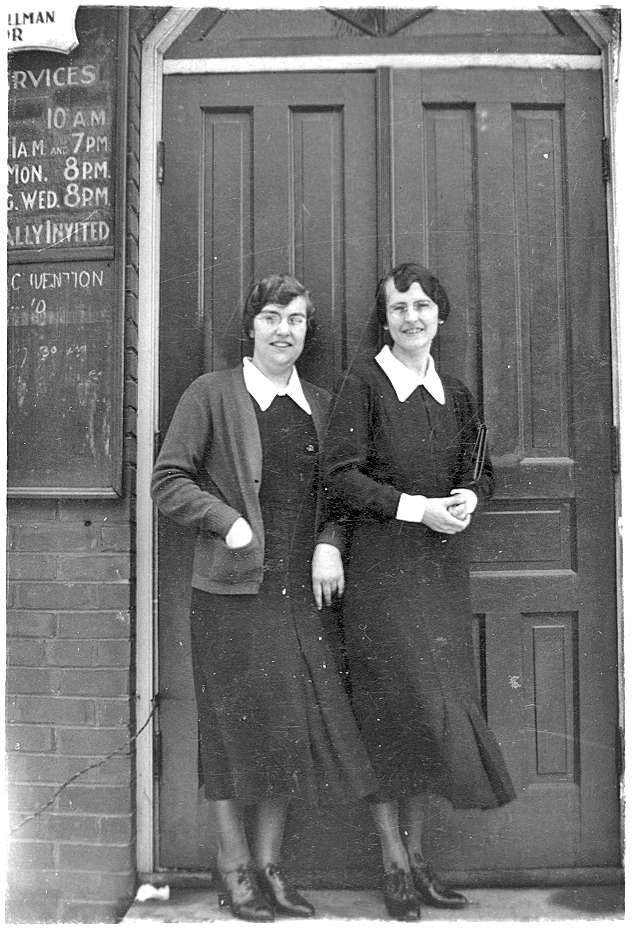
Courtesy Missionary Church Historical Trust
A sample of George Chambers’ career. Chambers and his family left for the United States after 1909. He put his mission in charge of a former Sunday School leader from the Parliament St mission, a Mrs Grant, and it continued for about 5 more years. Chambers returned to Canada and among other things was pastor of the Berlin (Kitchener) Pentecostal Assembly 1913-1916. When the Pentecostal Assemblies of Canada (PAOC) was formed in 1919, Chambers was one of the charter signers and went on to become a leading and honoured figure in that denomination.
When I went looking for the Parliament St locations in 2023, I found most of the buildings had been replaced by Regent Park and other developments.25 The Salvation Army had a branch at 304 Parliament St since 1912 up to 2019, perhaps filling the gap left by the other missions closing.26 The East End Mission to Grace Memorial congregations served hundreds of lives in its 117-year span.27
1Thomas William Miller, “The Canadian Azusa: The Hebden Mission in Toronto,” Pneuma (Spring 1986) p 1-29.
2F Arthur Sherk, Keeping the Faith: A History of Banfield Memorial Church (Willowdale, ON: Banfield Memorial Church, 1997).
3The Church Record of Grace Memorial goes back to the earliest days around 1900, listing members and Quarterly Conference minutes; Box 1022 MCHT.
4Clare Fuller, “Detweiler, Noah (1839-1914).” Global Anabaptist Mennonite Encyclopedia Online. October 2014. Web. 3 Aug 2021. https://gameo.org/index.php?title=Detweiler,_Noah_(1839-1914)&oldid=135607. The Canada Conference renamed itself the Ontario Conference in 1907.
5Sources on Robert Eltherington do not agree even closely about his birth dates. He died in 1933. He and his wife Prudence (“Dancy” in the census of 1901) had at least 8 children. They arrived as a married couple from England in 1875. Some Eltherington relatives settled in the Galt/Hespeler, ON, area.
6Mights’ Toronto Street Directories, 1898-1910.
7 Sam Goudie was assigned to the West End Mission in 1903 and by November, Goudie had found and the congregation had bought a new hall on Brunswick Avenue, numbered at first #161, but later #189 (from 1909 onward) in the Street Directories. The congregation chose to be called Bethel Chapel under Goudie.
8Sam Goudie re-recruited George Chambers when he had given up pastoral work for a while and worked as a Bible salesman for the Upper Canada Bible Society.
9Clare Fuller, “Pool, Sarah Ann (1862-1913),” https://gameo.org/index.php?title=Pool,_Sarah_Ann_(1862-1913).
10Sam Goudie, “Diary,” (October 22 1905).
11Christian Workers Churches, Holiness Movement Church, Mennonite Brethren in Christ, Christian and Missionary Alliance, independent mission halls of various sorts.
12Sam Goudie, “Diary,” (March 6 1907). He made another visit to Queen St, “Diary,” (March 25 1907), probably to the Hebden Mission again.
13Clare Fuller (1988), “Holiness People in Early Canadian Pentecostalism 1906-1919,” unpublished paper, in which I trace the denominational affiliations of numerous Pentecostals before the formation of the Pentecostal Assemblies of Canada in 1919. By far the largest numbers came from the groups named in note 11.
14Adam Stewart, “Hebden Mission,” in Adam Stewart, ed, Handbook of Pentecostal Christianity (DeKalb, IL: Northern Illinois University Press, 2012) p 103-108.
15Pentecostal sources give one version of it. Nearly 50 years later, Chambers published his memoirs, including an account of his work with the MBiC, in Fifty Years in the Service of the King 1907-1957 (Toronto: Testimony Press, 1960). Notice he removes his years with the MBiC 1904-1908. See also my 2024 book on Sam Goudie, Hidden in Plain Sight: Sam Goudie and the Ontario Mennonite Brethren in Christ (Eugene, OR: Pickwick Publications/ McMaster General Studies Series Vol 15).
16Chambers, p 17.
17Quarterly Conference minutes in the records of Grace Memorial EM Church.
18Sam Goudie, “P[residing] E[lder’s] Report,” Gospel Banner (January 15 1909).
19Sam Goudie, “PE’s Reports,” Gospel Banner (April 29 1909) p 11 and (February 11 1909) p 12.
20Joshua Fidler served 1908-1910, followed by Chris Raymer for part of 1910-1911. The mission was staffed 1911-1912 by Maggie Neill, Olive Baalim and Hattie Thompson; Sarah Moyer and Norah Shantz (1912-1913); Sarah Moyer and Anna Srigley (1913-1914); Clara Brubacher and Hattie Thompson (1916-1917); Norah Shantz and Winnie Bell (1917-1918); Norah Shantz and Rebecca Hostetler (1918-1919); etc.
21John Kitching, “City Mission President’s Report,” Ontario Conference Journal 1910, p 29.
22“Toronto Rescue Work,” in the Ontario Conference Journals, run by women such as Mabel Dunnington, Edna Jacobson and Annie Bowman 1912-1917. The women referred to their institution as “Berechah [“Blessing”] Home.” The orphanage was on a street near Jones Ave.
23Sunday School roll (not attendance) still listed 50 people in July 1912.
24Sam Goudie mentions this man in a Quarterly Meeting report in 1907, and Thomas Kitching’s name is listed in the membership of Jones Avenue/ Grace Chapel, Box 1022 MCHT.
25435 Parliament is probably still recognizable as a renovated “outdated Victorian retail shop with rental apartments above,” as real estate jargon would have it.
26https://www.sadowntowneast.com/history
27Some of this work is recorded in The Past Twenty-five Years: Grace Memorial Church 1962-1987 (Don Mills, ON: Grace Memorial Church, 1987).


 EMCC History
Leave a comment