Forgotten Women Preachers series
Among the numerous women preachers (I count 133 from 1884 to 1945) of the Mennonite Brethren in Christ Canada Conference is a lady called Sarah McQuarrie (b 1863), who entered city mission work in 1900. Not much is known about her. Some evidence suggests she married a Mr Cole about 1921 or 22, but died very soon after. I’ll get to that later.
Most of the Canada/ Ontario Conference Mennonite Brethren in Christ City Missions operated in small town Ontario. The personnel were largely from the farm, so the towns were a near but different environment for them.1 Some did come from small towns. The first places to which the women were assigned had these populations in 1901, according to the Canada census:
| Town | Population (1901) | Mission started | Notes |
| Collingwood | 5,755 | 1897 | |
| St Thomas | 11,485 | 1898 | |
| Owen Sound | 8,776 | 1899 | |
| Woodstock | 8,833 | 1899 | Closed 1900 |
| St Catharines | 9,946 | 1900 | |
| Aylmer | 2,204 | 1900 | |
| Toronto Junction | 6,091 | 1900 | Closed 1903, reopened as Toronto Dundas 1908 |
| Guelph started by men | 11,497 | 1900 | To CMW in 1901, closed 1911 |
| Waterloo town | 3,357 | 1902 | Closed 1904 |
| Mt Salem/ Orwell | Malahide Township | 1903 | Rural, under Aylmer, closed 1905 |
| Wiarton | 2,443 | 1904 | |
| Ingersoll | 4,573 | 1904 | Closed 1910 |
| Newmarket | 2,125 | 1904 | Closed 1910 |
| Winnipeg, MB | 42,340 (128,157 in 1911) | 1905 | Closed 1908 |
| Southampton | 1,636 | 1906 | Closed 1910 |
| Stratford | 9,959 | 1906 | |
| Brandon, MB | 13,839 in 1911 | 1907 | Assigned, maybe never started |
| Hamilton | 52,634 | 1908 | Closed 1912 |
| Toronto East/ Jones Ave | all of Toronto was 208,040 | 1911 | Replacing men until 1926 |
| Toronto Rescue Mission | 1913 | Closed 1917 | |
| Petrolia | 3,148 in 1921 | 1919 |
Two missions in Toronto were started by men in 1897 and 1898. Women were assigned to other cities later, Hamilton and Winnipeg.2
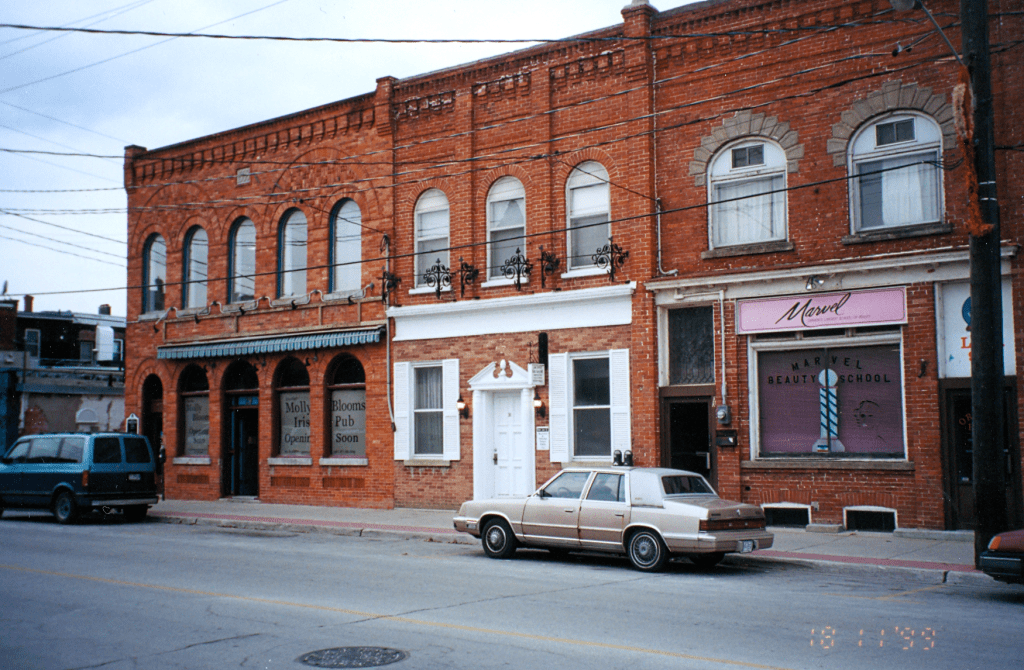
Courtesy Glenn Menard Collection, Missionary Church Historical Trust
The women were assigned in pairs by the Conference, or after 1902, by the Society President. They were instructed to rent halls or storefront places, and conduct as many evangelistic meetings as they could, even as many as 6 evenings a week and three on Sunday. They visited homes, saloons, the sick, the poor, and sold the Gospel Banner as publicity and income. Their financial support from the Conference was minimal at best, mostly just the rent. The denominational histories make the women heroes of faith, but their conditions of service were sometimes close to starvation.3 Sickness interrupted many careers.
In the 19th century and well into the 20th, a distinction was made in church work between Foreign Missions, considered to be “overseas” from North America or Europe, and Home Missions, which were understood as being conducted in the political boundaries of the nation. Missionary groups used other terms as well, such as Church Extension, but when a church sent an agent from Ontario, say, to the North West Territories, the word “missionary” was commonly used. When members of Bethany MBiC church in Berlin migrated to Didsbury, NWT, in 1894 (Alberta was declared a province only in 1905), the members did not think of themselves as missionaries, but as settlers and recreated an MBiC congregation, not a mission. Membership and the ordinances were not stressed at first in the missions.
McQuarrie’s City Mission Work. J A Huffman’s book on the history of the MBiC misspells Sarah’s surname as “McQuarni.”4 I suspect this happened through a compositor in the type-setting room misreading a handwritten text. In any case, we can trace some of McQuarrie’s life outside the work of the City Mission Workers Society. For the record, here are her assignments as reported in the Canada Conference annual journals until 1908, (assignments started at Annual Conference in March, after 1907 from September):
1900: helper to Maude Chatham until July at Collingwood. After July, Sarah led the mission.
1901: Collingwood, helped by Emma Bertram
1902: rest, for health
1903: Owen Sound, helped by Maggie Rennie (later married Thomas W Brook)
1904: Wiarton, with Sarah Pool, helper
1905: Wiarton, with Carrie Loop, helper (married Joseph Holmes)
1906: Southampton, with Maggie Neill, helper
1907: Ingersoll, with L[ouise?] Holmes, helper
1908: “not in active work”
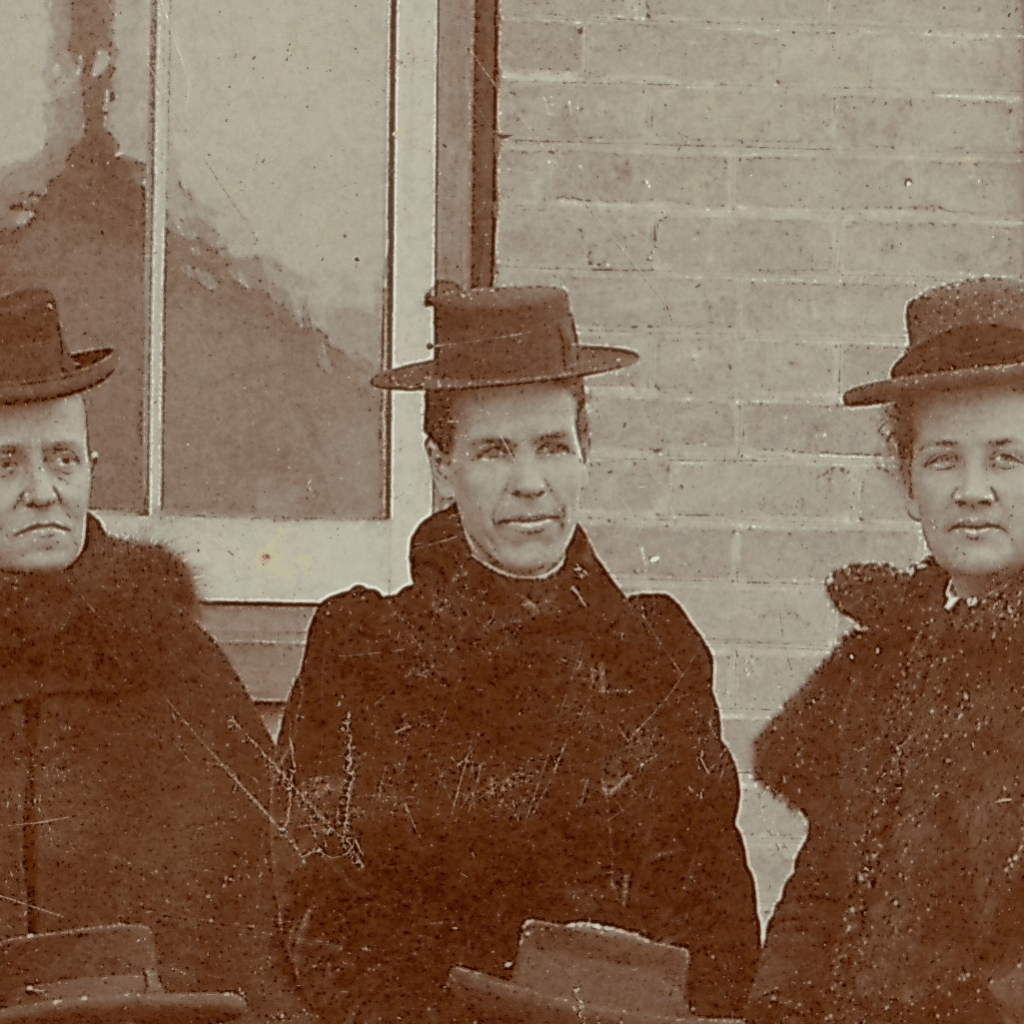
Courtesy Missionary Church Archives, Mishawaka, IN.
It is notable that all of McQuarrie’s assignments except for Ingersoll, were in the Georgian Bay area, where she came from. Normally the MBiC moved the women to any part of the province where they had city missions. It is also remarkable that she was a “helper” (junior worker) for only one year. If my identification is right, it would be true she was older than all the city mission women she was paired with except Sarah Pool, who was one year older and licensed about 6 years longer. In 1905, McQuarrie was dedicated as an “Approved Ministering Sister,” the designation adopted in 1905 by the MBiC to mark fully qualified female workers, roughly equivalent to being ordained. And then in 1908 Sarah McQuarrie’s record ends, except that the 1922 Ontario Conference Journal reported that she had died in the previous conference year, ie September 1921 to August 1922: “Whereas Sister S. McQuarrie, a former City Mission Worker has been removed by the hand of death, therefore, Resolved that we express our sympathy toward the family and pray God to sustain them in their loss.”5
The year McQuarrie left the MBiC work raises the question: was she influenced by the Pentecostal issue that led to the resignation of 4 men and 4 women (including her co-worker at Ingersoll, L Holmes) from the Ontario Conference of the MBiC? (Over 80 members from at least 5 congregations also left the MBiC at that time.) Against that is the way she was honoured in the 1922 journal.
Speaking in tongues was promoted from 1906 onward as the necessary evidence that someone was baptized with the Holy Spirit. Wesleyan-holiness and Higher Life denominations and movements which had claimed this experience but had few speaking in unknown tongues for well over a generation were thereby judged as grossly mistaken in their theology on this point.6 In nearly everything else Pentecostals and holiness churches, the MBiC among them, agreed.7 The extra doctrine made quite a difference in practice, however. I examine this story as far as the MBiC goes in three chapters in my biography of Samuel Goudie.8
Her background. Something more is known about Sarah than Edith Abbott whom I profiled in another blog.9 McQuarries are mentioned in Leaman Hunking’s book about Shrigley, ON.10 It is pretty certain to me that she is the Sarah McQuarrie, daughter of John and Catherine (McDougall) McQuarrie, both of Scottish ancestry, farming then in Melancthon Township in Dufferin County, Ontario. She was counted there in 1901, although she would have been living in nearby Collingwood. The oldest child was Sarah, born April 4 1863.11 John Sr listed himself as a Baptist in 1901, but his wife and children (3 sons and 4 daughters) were listed as Mennonites. Other McQuarrie families in the area, led by John Jr (34) and Daniel (36), are reported as Mennonites, too. Interestingly, a family by the name of Cole, “United Brethren,” lived on a farm nearby. In 1911, all the family were Mennonites, certainly meaning MBiC in that area. In the 1921 Canada census, conducted in the first half of the year, Sarah McQuarrie was living on her own in Grey County, still a Mennonite.
There were many Cole families living south of Collingwood and Meaford, ON. In this section of Ontario, from about 1890 onward, the MBiC had gathered a few congregations after a large camp meeting held at Maple Valley, 4 km east of Badjeros, ON, in the summer of 1890, before reconvening for more meetings in Collingwood.12 In this area, there seemed to be a small movement of people converting to Wesleyan holiness faith for two generations or so, beginning with Methodists (probably 1840s when the land was surveyed and opened for purchase,) United Brethren in Christ (before 1869), MBiC (from 1890), Gospel Workers Church (after 1898),13 and Pilgrim Holiness (after WW1), and so on. MBiC people and sympathizers from Nottawasaga (Simcoe), Melancthon (Dufferin) and Osprey (Grey) Townships took part. Maple Valley and Badjeros, are almost at the junction of the three counties. Few of these people were German Mennonite in background, rather they were Scotch, Irish and English.
From genealogical websites,14 a Sarah McQuarrie, 1863-1922, was buried at the South Line Union Cemetery, in nearby Badjeros, Osprey Twp, Grey County, along with other McQuarries. I have seen this gravestone myself in visits in 2021 and 2023. In 1900, Sarah would have been about 37, and in 1922, 59.
Marriage? The Missionary Church, Inc, archives in Mishawaka, IN, has a photograph of the 12 Ontario city mission workers in active service in the winter of 1900.15 Sarah McQuarrie is one of them. What is intriguing to me is that some time later, someone wrote on the back of the photo the names of all the women, updating some with their married names at the time of the annotations. Sarah McQuarrie is called “Sarah (McQuarrie) Cole.”
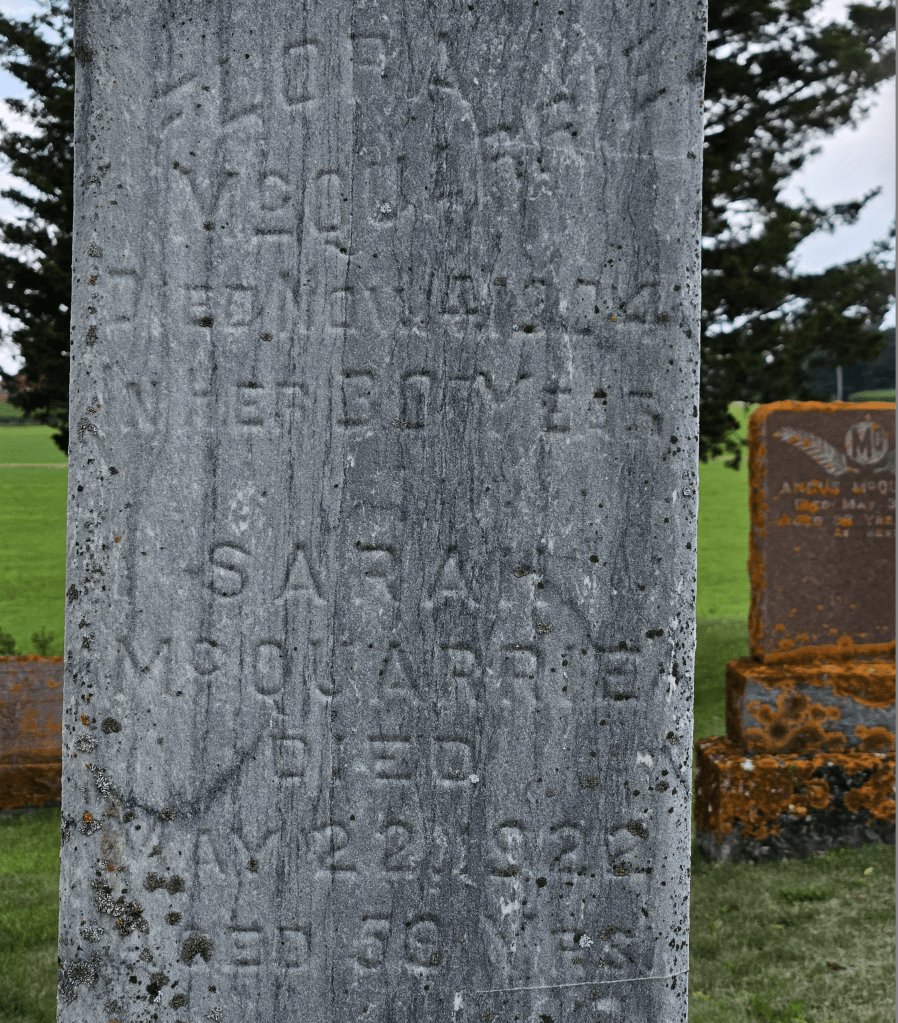
Credit: C Fuller photograph 2023
It is over 100 years ago that Sarah McQuarrie died and was buried in the cemetery at Badjeros. The memory is cold now. If she was truly married to a Mr Cole, it is somewhat strange that her grave does not mention that fact. I can only speculate that the marriage was a rumour? The Archives of the Province of Ontario records her as single, a spinster; cause of death: tuberculosis.
1Glenn Gibson, “Methods, Momentum, and Manpower: A Study of the Church Planting History of the Missionary Church, Canada East 1875 to 1980,” Research Paper for History of Christianity in Canada 662. Ontario Theological Seminary, 1986, p [4-6].
2I will chronicle the Winnipeg mission in a later blog. Unfortunately, many issues of the Gospel Banner 1900-1908 where letters and reports would have been published, have not survived in any archives so far known.
3Everek R Storms, History of the United Missionary Church (Elkhart, IN: Bethel Publishing, 1958) p 253; Eileen Lageer, Merging Streams: Story of the Missionary Church (Elkhart, IN: Bethel Publishing, 1979) p 74-76.
4Jasper Abraham Huffman, ed, History of the Mennonite Brethren in Christ Church (New Carlisle, OH: Bethel Publishing, 1920) p 205.
5Elmer Moyer, ed, Conference Journal: Proceedings of the Ontario Conference 1922 p 33: Three other women, wives of ordained men of the conference died that year, remembered with appropriate sympathetic resolutions with similar wording passed at the end of the conference. This supports that McQuarrie remained a member of the MBiC.
6There is an immense literature on early Pentecostalism, but less attention on its holiness origins; Donald Dayton, Theological Roots of Pentecostalism (Grand Rapids, MI: Baker, reprint of 1987). For the more Higher Life (Keswick) theology of the Christian and Missionary Alliance leading to Pentecostalism, see Charles W. Nienkirchen, A. B. Simpson and the Pentecostal Movement (Peabody, MS: Hendrickson Publishers, 1992) though C&MA scholars have contested Nienkirchen’s thesis that Simpson had a close relationship to Pentecostalism.
7Adam Stewart, ed, Handbook of Pentecostal Christianity, (DeKalb, IL: Northern Illinois University Press, 2012) has excellent articles on the relation of holiness and Keswick movements to Pentecostalism by Allan Heaton Anderson.
8Hidden in Plain Sight: Sam Goudie and the Ontario MBiC (Eugene, OR: Pickwick Publications/ McMaster Divinity College Press, 2024).
9EMCC History Blog: “Women Preachers in the MBiC Part 2: Edith Abbott.”
10Leaman Hunking, Home Spun Flashbacks of Shrigley and Community 1893-1995 (Dundalk, ON: For the Author, 1995) p 11, 15.
11Some others were Flora (27), Angus (25), Catharine (23), Lauchlan (21), and Ellen (19). Flora’s name is above Sarah’s on the pillar over the graves.
12Hunking, p 15-16.
13See the very interesting article by Helen G Hobbs, “‘What She Could’: Women in the Gospel Workers Church, 1902-1955,” in Changing Roles of Women within the Christian Church in Canada ed by Elizabeth Gillan Muir and Marilyn Fardig Whiteley (Toronto: University of Toronto Press, 1995) p 201-218.
14For example, Find-a-Grave, which also has a photograph of the grave stone.
15The Missionary Church Historical Trust recently acquired a copy of this photo from the Chester/ Hunking Family. See EMCC History Blog: “Women Preachers in the EMCC.” The women are wearing winter coats and there is snow on the ground around the steps of a house, numbered “15,” in the uncropped picture from which the image was taken; conference was in March in Berlin (Kitchener) that year. A valuable first record of the women, some unrecorded visually elsewhere in the MCHT.


 EMCC History
Leave a comment