Forgotten Women Preachers series
According to my reckoning, 133 women in Ontario were recognized by the Canada/Ontario Conference of the Mennonite Brethren in Christ Church as Christian workers who could evangelize, preach and lead worship from 1885 to 1945.1 Keeping their status as Approved Ministering Women, they were “grandmothered” until one by one they died or resigned and not replaced in the United Missionary Church. I have reports on about ten more women who were hired by congregations or voluntarily worked along side these City Mission Workers but for various reasons did not receive official status with the Church.2 God bless them, every one. Women always serve in congregational capacities, among other roles, no matter what polity we pick. Official recognition is not the same as God’s recognition.

“Miss Abbott” may be 5th woman from the right. Annie Srigley is sixth, Martha Doner first.
Courtesy Missionary Church Historical Trust
All of these women, whether they served for a year or a life time, deserve to be remembered for their role in preaching the gospel of Jesus Christ in Ontario and Alberta,3 and even in Manitoba for five of them.4 Some in addition became part of the foreign mission efforts of the MBiC, and others moved to western Canada and supported the MBiC in Alberta and Saskatchewan under the Canada Northwest Conference, which latterly was known as the Canada West District. A few women started their careers in American conferences and returned there, and still others joined other denominations or missions and continued their obedience to Christ’s way. Probably a number gave up in discouragement or even abandoned their hope in Jesus—such are unknown to me, but such an outcome is possible in this life. They deserve our respect nevertheless.
In a series of blogs, I want to resurrect the memory, or at least raise a meagre profile, of a few women who served and remain relatively unknown beyond the record of their name in the conference journals and reports in the church magazine, the Gospel Banner.
First in my alphabetical list, Edith Abbott, was recorded as appointed to the City Mission Workers Society in 1912.5 Abbott was mentioned in the annual Conference minutes of the Ontario Conference from 1912-1917. Here is her record:
1912: helper to Annie Srigley at Stratford
1913: with Martha Doner at Wiarton
1914: with Martha Doner and Harriett (Hattie) French at St Catharines
1915: “unable to take work at present”
1916: “labor as directed by the President”
1917: “unable to take work at present”
After 1917, there was no mention of Edith Abbott. Where did she come from? What did she do after 1917? Did she marry? Did she continue not well (the usual meaning of “unable to take work”)?
The Missionary Church Historical Trust has one photograph in which someone tentatively identified Miss Abbott, but it was taken in October 1920 so I have my doubts. Several other Approved Ministering Women were qualified to be in the photo, labelled “Advisory Members of the General Conference of 1920” in the journal, and by its motion, “all ordained ministers of our society present be received as advisory members…”(my emphasis.)6 I have searched the Canada census returns for any Edith Abbott of about the right age, marital status, location and denominational affiliation for the years 1891, 1901, 1911 and 1921 and found no suitable candidates.
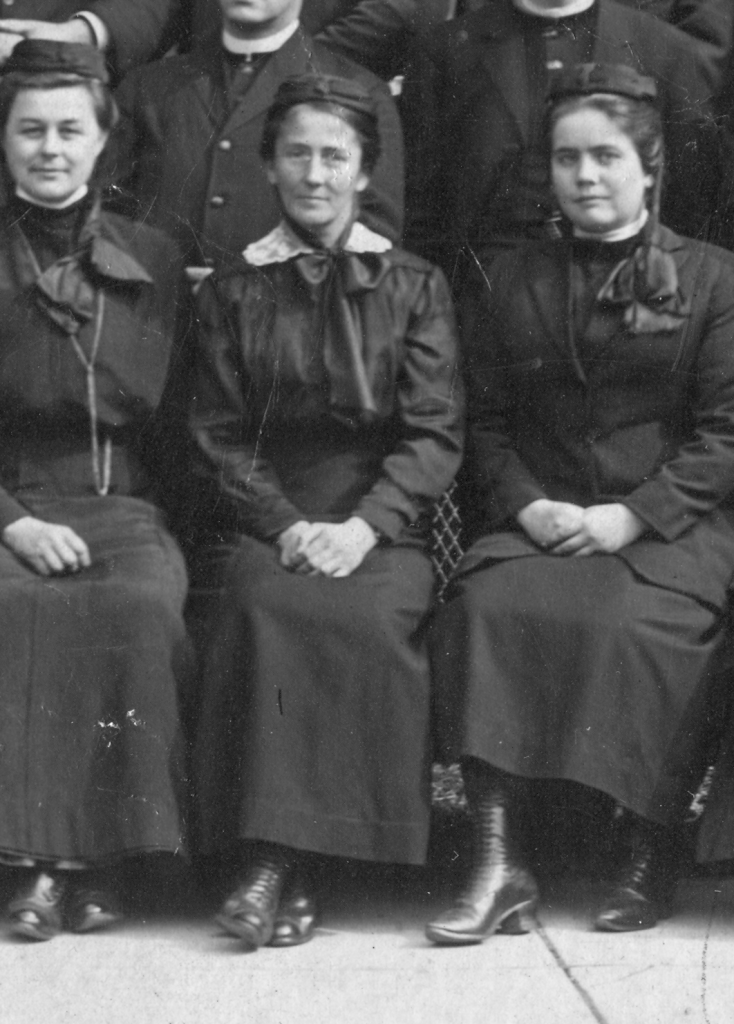
Courtesy MCHT
Here are examples of my search:
1. There was an “Edith Eulalia Abbott” from a large Methodist/ Baptist and English/ Irish family of Colchester, Essex County, ON, who was born in 1890, so was 20 years old early in 1911 at the time of the census. The age is right, but the location is wrong, ie not central Ontario (I have never seen any MBiC members in Essex County at this period) and the religious affiliation is marginal: Methodism in the father is OK, but Baptist affiliation from the mother (mother and children in 1901; the whole family of 14 children were Methodist in 1911) is rarely correlated with MBiC interests. This Edith, according to genealogical websites may have married a C I Johnson, (a Swedish man who came through the USA to Canada in 1908, naturalized in 1917), in November 1915, which effectively rules her out of being our Edith, anyway.
2. Then I thought, Edith Abbott may have been known by other names, or the other spellings of her surname, “Edyth,” or “Abbot” for instance, so I checked for that. She may have lived in the USA at times, or western Canada, or married after 1917, in which case only a search of marriage records could narrow the hunt. It is imaginable that she died after 1917, though likely she would have been noted in the Gospel Banner. That is not guaranteed, less so as time went on. Or she changed denominations. Or the census simply missed her, something I am concluding happened quite often to the single preaching women because of their frequent moves in rental housing and busy lives. Sometimes I have spotted them where they should be, but often they are invisible in the census.

There are a few more clues that need follow up:
3. Here is the best: in the local church history of Banfield Memorial (Wellspring EM) Church, Toronto,7 F Arthur Sherk quotes a diary of Della (Lehman) Lageer, that she went on an August excursion to the Scarborough Bluffs on the shore of Lake Ontario. She tells how 6 young women of the church took along the two probationer-preachers, single young men, stationed with the church that summer. The young women she names as “Anna [=Nancy] Good, Mabel Dunnington, Alice Dunnington, Edith Abbott, big Della, & little Della Lehman as they call us.”
Mabel and Alice probably came from the MBiC Kilsyth church south of Owen Sound where several Dunnington families attended. An older relative, Mary Dunnington (1857-1939), was a City Mission Worker in Ontario 1901 to 1916, who then migrated to Alberta. So many Dunnington families from Grey County had moved to around Castor, Alberta, in the first decade of the 20th century, the Kilsyth church was seriously depleted. Others apparently went to Toronto, likely to work.
Anna Good (b 1880) was from Waterloo County. She married fellow picnicer Dorwin Storms April 24 1912, so maybe this picnic was an important part in their story? In 1911, Anna was still lodging with her brother Josiah and his wife Esther Good, where Della Lehman (b 1890) also was a lodger. “Big Della” is unknown to me.
The men were Isaac Erb (1886-1965) of Berlin (Kitchener), later to become Dr Isaac H Erb, a longstanding local preacher at Banfield, as well as a pathologist at Sick Kids Hospital, Toronto,8 and Dorwin J Storms (1883-1948) from Vineland, soon to go (1913) to Turkey with his new wife, Nancy (Good) Storms, as missionaries to Armenian orphans.9
This Edith Abbott is in the right church (MBiC), in the right time (1910), and single (City Mission women had to be). Art Sherk claims she did go out in ministry with the City Mission Workers.10
4. Another clue might be the Edith Abbott mentioned once in John Sigsworth’s history of Free Methodism in Canada. He connects her with evangelist Lottie Babcock in Free Methodist tent meetings at Dry Lake, Saskatchewan, about 1920-1921.11 Again, right time, right doctrine and right work. This Abbott is also mentioned as a companion of Babcock for the Free Methodists at Estevan, SK, in the online Encyclopedia of Saskatchewan and she is “from Kitchener”! In the 1921 Canada census, however, Babcock was alone in a boarding house in Moose Jaw, SK.
5. A more remote clue is that in a reference to the Melancthon Township, Gray County, Srigley MBiC appointment, an Abbott family were members at about the right time period.12 But I cannot find any Ediths there in all these years.
That’s about it. Can anyone help?
Next Blog: Women Preachers Part 3: Sarah McQuarrie
1 See EMCC History Blog “Women Preachers Part 1,” which begins the series. Jason C Garnaat first compiled the names of women who are listed in the conference journals of the MBiC: “In Memory of Her: A List of Over 500 Women in North American Ministries in the Missionary Church and its Predecessors,” Reflections: A Publication of the Missionary Church Historical Society 3:2 (Fall 1995) 4-9. Many are mentioned in Jasper A Huffman, ed, History of the Mennonite Brethren in Christ Church (New Carlisle, OH: Bethel Publishing, 1920) p 150-154, and especially chapter 15, “City Missions,” p 202-213. Unfortunately, the journals and Huffman’s book contain errors, mainly of spelling, but also by omitting names. My studies of the Canada/ Ontario Conference offer a few corrections to Garnaat’s groundbreaking work.
2 One such is Elizabeth Risdon, profiled in two EMCC History Blogs “Mystery Woman: Mrs Elizabeth Risdon.”
3 Ontario hosted the membership of the Church in Alberta from 1894 until 1906 when the MBiC Canada Northwest Conference was set up. Several city mission workers moved to the west in those years. The new conference licensed new workers later.
4 Three of those five in Manitoba became Pentecostals, but what of that?
5 Founded in 1898, organized as a society under a male Conference-ordained, elder-president in 1902.
6 Mennonite Brethren in Christ Tenth General Conference 1920 p 4.
7 F Arthur Sherk, Keeping Faith: A Centennial History of Banfield Memorial Church (Willowdale, ON: Banfield Memorial Church, 1997) p 21.
8 Huffman, p 233, takes Erb’s and Storm’s careers to 1920.
9 Huffman, p 269. See also Clare Fuller (2016), https://gameo.org/index.php?title=Storms,_Everek_Richard_(1914-1983).
10 Sherk, p 68.
11 John W Sigsworth, The Battle Was the Lord’s: A History of the Free Methodist Church in Canada (Oshawa, ON: Sage Publishers, 1960) p 162.
12 Leamon Hunking, Home Spun Flashbacks of Shrigley and Community 1893-1995 (Dundalk, ON: For the Author, 1995) p 15.

 EMCC History
Leave a comment