Mennonite Brethren in Christ Church
In this blog I track Ontario MBiC connections with African-Canadians up to the 1940s. The interactions were not many, which reflects the rural nature of the MBiC that isolated them from urban Black populations. No doubt there were more interactions than the Church’s media recorded. Apart from the first story, it is plain that the MBiC encountered Blacks in the towns and cities of Ontario.

Courtesy Missionary Church Historical Trust
Glencairn, Sunnidale Twp, Simcoe County: 1870s-ca 1929
When New Mennonite Church members from Markham Township, York County, ON, such as Levi and Fannie Raymer, settled in Sunnidale Township in the 1860s, they found themselves among Black settlers.1 As the UM Church became organized from 1875 to 1878,2 it set up preaching points in various locations in Nottawasaga Township and Sunnidale, in particular at Glencairn on the south edge of Sunnidale as early as 1883 and probably earlier.3 Glencairn existed as an appointment up until the 1950s.
In 1929, a retired elder (pastor), John Bolwell, wrote to the Gospel Banner reporting that he had gone to Glencairn on behalf of the pastor of the Sunnidale circuit, who was sick. He said he enjoyed meeting again the members, including some coloured members he had known 21 years before (that is, in 1908), when he was himself the pastor for Sunnidale. I have not yet been able to identify those Black members, some of whose families must be mentioned in the Sunnidale history chapter on Black settlers. Some are probably buried in the Bethel Cemetery, Creemore Road, near New Lowell, ON.4 My family also visited the Glencairn Cemetery in the summer of 2018 or 2019, but we did not see any family names connected to the Black settlement. If members, they should be named in the Stayner Church records. There were some intermarriages of Blacks and whites in the area. In one case a lady with a last name (Rawn), which appears in more than one family in Stayner MBiC records, married one of the African men. Much more can be done by searching Canada census returns and other official documents no doubt.
While the Glencairn appointment may have been the first location of MBiC Black membership in Ontario,5 the Church encountered Blacks in the city missions, mainly through the women preachers who staffed them, in Owen Sound, Collingwood, St Catharines and the East End Mission in Toronto. The short-lived Guelph mission also encountered an African-Canadian Christian man.
Collingwood, Maude Chatham, May 1900:
Maude Chatham, her brother Edmund Chatham, and Sarah McQuarrie were appointed to serve here. Maude’s letter to the Gospel Banner refers to “colored people” they met and for whom they decided to start a Sunday school. She also mentioned a lack of clothing and need for shoes.6
Collingwood, Andrew Good, July 1900:
Andrew Good (b 1838), the MBiC Ohio evangelist, commenting on a camp meeting at Collingwood, wrote: “Here for the first time in my life did I see German, English, American, Negroes and Indians bow at the altar…My mind ran forward to the time where there will be a grand gathering from “every nation under heaven.”7
Guelph, Edith (Evans) Sherk, 1900:
Edith Evans (1882-1966) was a farm girl from Puslinch Township, Wellington County. Her family attended a Methodist-related congregation called Ellis Chapel. If you stop on Highway 401 westbound at the rest stop east of Cambridge, ON, you can find the Chapel by a path from the rear of the service centre.
When Edith was 18, she visited the new city mission in Guelph opened by the MBiC8 and was converted the first night (April 7th) she attended when a “black singer,” a “godly man,” sang.9 The evangelist assigned to Guelph, Thomas Ford Barker, reported “The night after arriving I was called to pray with a colored brother who was under great conviction. He found Christ.”10 Of a later day, he wrote, “Last night one unsaved sister sought and found Christ.” It is tempting to connect Barker’s reports with Edith’s. Sadly, the singer’s name was not recorded, but he deserves the Church’s gratitude. Two years later Evans joined the city mission society of the MBiC and served 11 years before going to Nigeria in 1913 as a missionary. There, she learned the Nupe language and became the composer of 22 Nupe hymns and other choruses. After 5 years there, she married fellow missionary Ira W Sherk from Michigan and they served another 31 years together.
St Catharines, Sarah Pool, July 1903:
On leaving the St Catharines mission to visit her home church in Markham, Sarah Pool (1862-1913) told of an emotional parting with “colored and white people,” who “alike rejoiced in Jesus.”11 St Catharines was a terminus of the Underground Railroad a half century before. The famous Harriet Tubman, escaped enslaved woman and Underground Railway “conductor,” lived in St Catharines many years.
West End Mission, Toronto (Spadina Rd) Samuel Goudie, “Diary,” August 1903:
Elder Sam Goudie (1866-1951) was transferred from Berlin (Kitchener) to Toronto in April 1903. In July Goudie mentioned in his diary that “barber Smith cut my hair.”12 Since Sam’s wife had been a Smith I wondered at first if he were joking that Eliza had cut his hair; further reading told a different story. On Wednesday, August 26, MBiC evangelist Noah Detwiler preached in the mission then meeting in a hall at 450 Spadina Rd, and Goudie noted, “a colored bro was there (Geo Washington).” This was probably George Washington Smith, a prominent black Baptist barber/businessman in Toronto.13

Credit: Dictionary of Canadian Biography
In his diary for a cool drizzly August Sunday a few days later, Goudie recorded that three coloured men attended the MBiC West End Mission, in the evening service. One, he noted, was a preacher. Goudie did not record their names or any other details.14 It was almost a random event among the myriad of incidents at the mission that year. Unfortunately, these encounters did not lead to other involvements that were mentioned in the diary.
Sunnidale Township, John Bolwell, 1908 (See above)
Beulah Mission, Edmonton Maude Chatham, ca 1909:
Maude Chatham went from Ontario to Alberta in 1900. She was from Chatsworth, ON, just south of Owen Sound, when she became a member of the MBiC. She and fellow preachers Mary White and Clara Shafer opened Beulah Home for unwed mothers in Edmonton in 1909. The baby in a photo of Maude Chatham holding the first baby born in the home apparently has some black heritage.15 You can see the photo in the GAMEO article about her.
East End Mission, Toronto Parliament St/Jones Ave, John Kitching, April 1911:
On his quarterly visits to churches, CMW Society President John Kitching said the women workers at Parliament St rounded up children for Sunday School, “white, some black, and some not quite white.” “Many needed clothes and shoes.”16 The women were City Mission Workers Olive Baalim, Maggie Neill and Martha Doner.
Stratford, ON: Fusee family, 1920s.
The Fusee family, members at the MBiC mission in Stratford, had a friend (Margaret Harrison) from a Black family in their neighbourhood in the 1920s. Many years later, Edma (Fusee) Brubacher (1911-2008) had a photo enlarged, which had been taken in 1920 with some of the family and Margaret, which I take to be a sign of respect for their Harrison friends.17 Margaret’s mother came from the United States, according to the 1921 Canada census. The MBiC mission, the United Missionary Society, appointed Edma first to the Armenian mission at Beirut, Lebanon, 1937-1939, and after her marriage to Elgin Brubacher, to Nigeria, where she served a generation of Nigerians 1939-1976.
Owen Sound, ON: Mrs Miller, 1926-1930
Annie Yeo (1904-1983) was a new City Mission Worker assigned as a helper to veteran CMW Becky Hostetler at Owen Sound in the fall of 1926. During her four years in the city, Annie was much encouraged by Mrs Miller:
“A black lady, Mrs. Miller, was another person who made a contribution to Annie’s Christian development in Owen Sound. Mrs. Miller knew how to call upon God and claim victory. Mrs. Miller and Annie enjoyed rich prayer fellowship together during those Owen Sound years.”18
This woman was probably Nancy Miller, whom the census recorded as: “Negro, married, 55, born USA,” and who reported her religion as “Beulah Miss[ion],” the name the MBiC city mission used.19 Owen Sound was a terminus of the Underground Railway from the USA before the American Civil War and still has a substantial Black community with many Christians. Yeo went to Nigeria under the UMS in 1938 until 1970 and worked with many Africans in their home continent.
Cleveland Colored Quintet, 1920s-1940s:
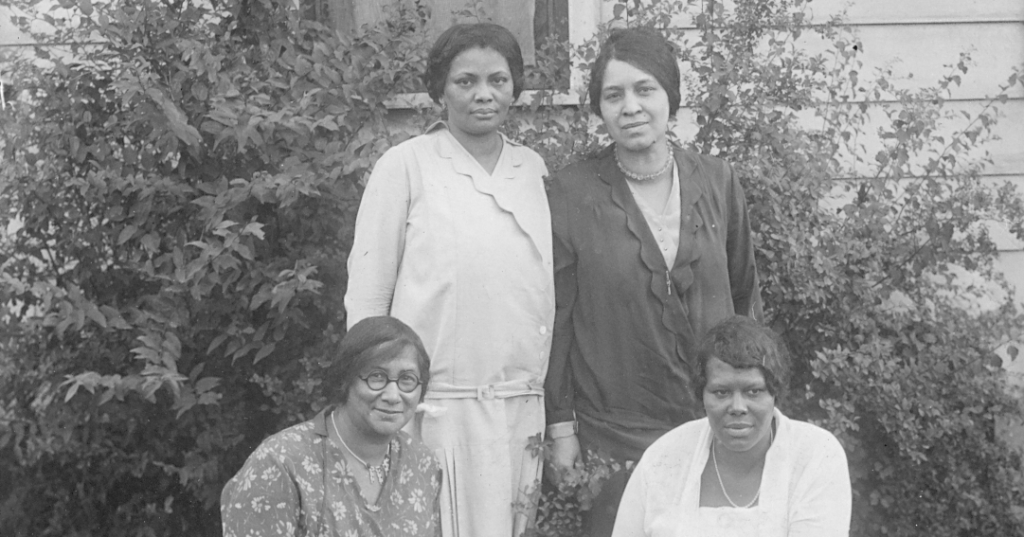
From at least 1929, the Ontario Conference frequently invited the Cleveland Colored Quintet (formed 1913)20 to sing at its camp meetings.21 These men, Floyd H Lacy, John H Parker, Spurgeon R Jones, Alexander E Talbert and Henry D Hodges, sometimes accompanied by their wives, were very popular in the Conference, judging by the number of surviving photographs that ministers and members took with them at camp time.
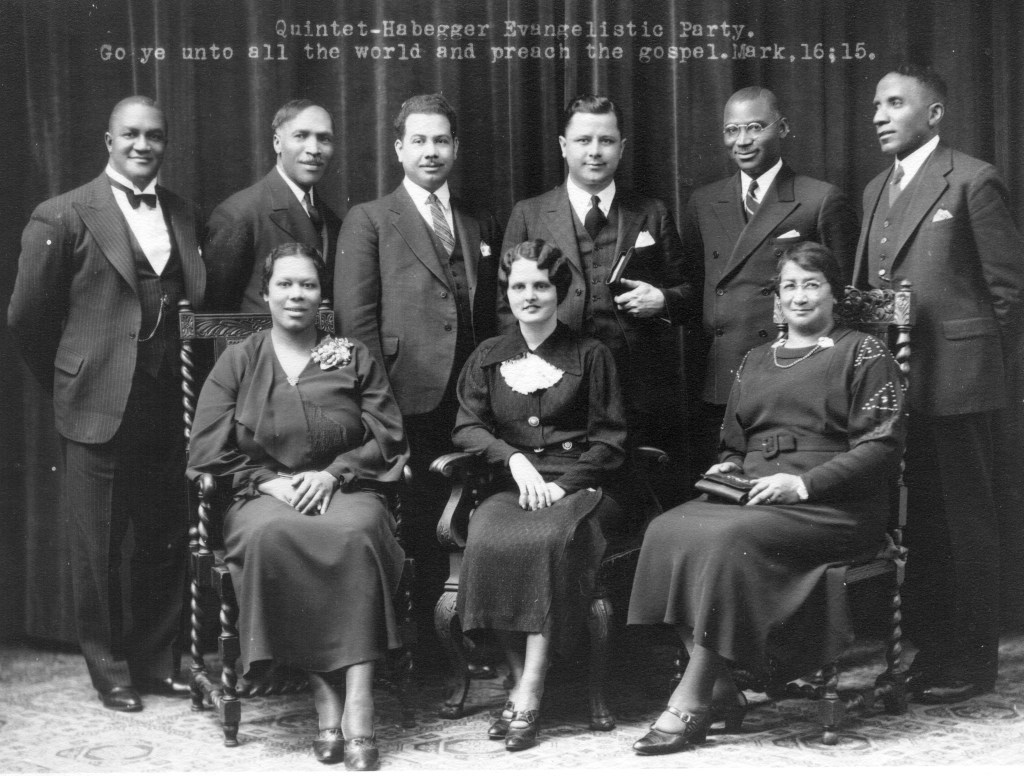
Courtesy Missionary Church Historical Trust
The Fusee sisters also photographed themselves with some of the Quintet members’ wives. Bethany MBiC Church in Kitchener invited the singers for Bible conferences.22 C N Good and others donated to the MCHT copies of a 1936 photo of ministers and friends at the Kitchener camp meeting with the Quintet. The MCHT also received some of the Quintet’s promotional materials, including a booklet by Alexander Talbert.23 These men became Christians through the Christian and Missionary Alliance in Cleveland, Ohio, so their experience was ideally suited to the MBiC camp meeting expectations. They could also have matched the Euro-Canadian stereotypical assumption that “Africans love to sing.” They obviously were good singers. You can hear their recordings on the Internet.24
Port Elgin, ON Mrs Lillian Jones
In May 1943, Mrs Lillian H Jones, an African-Canadian of Toronto, was invited by the Port Elgin MBiC church to sing in a program in which Arthur Walsh was to give “Inspirational Messages.”25
Listowel, ON Topp family
In the 1940s as well, the Listowel MBiC city mission enjoyed the Topp family in church activities. I understand other Black families lived in this small Ontario town. The family continued in the Listowel church for decades.26 Loretta Topp was a missionary some years.

Courtesy Oppertshauser Family Collection, Missionary Church Historical Trust
So until the second half of the 20th century, when there were more frequent notices of people of African descent, this seems to approximate the tally of Ontario MBiC interaction with African-Canadians and African-Americans. Missionaries from Ontario, of course, worked with Africans in Nigeria from 1901 under the Sudan Interior Mission, and from 1905 under the MBiC Foreign Missionary Society and its successors up to 2010. Alexander W Banfield, who was a missionary from Toronto under the MBiC Foreign Missionary Society 1905-1915, showed an unusual appreciation for African people and culture by a Euro-Canadian, which continued throughout his career in Africa (1901-1929) judging by captions in his 1905 illustrated book and further articles and photographs to the end of his career.27 Alex Banfield died in 1949 and his wife Althea in 1966. Some years ago on deputation, I spoke with an African-origin lady at Banfield Memorial Church who said she worked in the Banfield home in Toronto as house help (domestic), though I don’t recall her name or what years she worked. She said the house was full of African materials, though.
By 2024, hundreds of Nigerians were immigrating to Canada annually, the majority of them Christians. African-origin people make up 5.5% of the Ontario population (2021 census).
I would be extremely happy to know more stories of EMCC interaction with African-Canadians both before 1950 and later.
Banner: Four of the wives of the Cleveland Gospel Quintet on a visit at an MBiC camp meeting, ca 1930s. Courtesy Missionary Church Historical Trust.
1Stan Cowden, Nancy Rugman, Marjorie Gordon and Joyce Smith, ed, Sunnidale Looks at Yesterday: A History of Sunnidale Township (Sunnidale Township, ON: Council of the Township of Sunnidale, 1984).
2See EMCC History Blog homepage article “Formation of the EMCC,” for sorting out the name changes of EMCC antecedents.
3Solomon Eby, “Presiding Elder’s Report,” Gospel Banner (November 15 1883) p 169.
4Cowden et al, ch 2, “Black Heritage,” p 110-126. Black family names include: Alexander, Ashur, Bush, Cooper, Green, Grose (or Goss or Gross,), Harris, Harvey, Hollins or Holland, Jackson, Jefferson, Johnson, Mason, Morgan, Morrison, Poole, Richards, Robinson, Smith, Spiers, Sturgess, Thompson. I thank Timothy Epp for directions to the Bethel Cemetery which my wife and I visited the summer of 2023.
5All the Sunnidale and Nottawasaga MBiC/ United Missionary Church preaching locations amalgamated to Stayner or Wasaga Beach by 1963.
6Maude Chatham, “Letter,” Gospel Banner (May 8 1900) p 10-11.
7Andrew Good, Gospel Banner (July 14 1900) p 13, quoting Revelation 7:9.
8The first workers were T Ford Barker and Fred Carlton. On Barker, see Clare Fuller, “Barker, Ada Moyer (1875-1982),” GAMEO, https://gameo.org/index.php?title=Barker,_Ada_Moyer_(1875-1982). Yes, she lived to 106! On Carlton, see the EMCC History article I will post called “Fred Carlton.” The men served under the home mission committee of the Canada Conference before the (all women) City Mission Workers Society was organized in 1902.
9“Edith (Evans) Sherk” file, Everek Storms Collection, Missionary Church Archives, Mishawaka, Indiana and unpublished material collected by Harvey T Fretz. Also [Everek Storms], “Pioneer Missionary in Nigeria Mrs I. W. Sherk Passes at 83 Began Stratford, Ont., Church,” Gospel Banner (February 24 1966) p 13.
10T Ford Barker, “Guelph, Ont.,” Gospel Banner (February 1900) p 12.
11 Sarah Pool, “Letter,” Gospel Banner (August 22 1903) p 13.
12Samuel Goudie, “Diary 1903,” July 21. Eleanor (Goudie) Bunker Family Collection
13http://www.biographi.ca/en/bio/smith_george_washington_15E.html
14Samuel Goudie, “Diary 1903,” August 26 and 30. Bunker Family Collection.
15https://gameo.org/index.php?title=Chatham,_Maude_Elizabeth_(1870-1951)&oldid=132853. The cropped photo was published in Mary A (White) Finlay, ed, Twenty-five Years of Rescue Work: Beulah Home 1909-1934 (Edmonton, AB: Beulah Home, 1934). First published in Gospel Banner (September 22 1910) p 13 with Clara Shafer and Mary White and three babies. The mother was apparently the woman in extreme condition (mentioned in a memoir) brought to the door of the mission by city officials before the women even had a women’s shelter.
16 John N Kitching, “Ontario City Mission President’s Report,” Gospel Banner (April 27 1911) p 13.
17Fusee/ Brubacher Photograph Collection, Box 9015 MCHT.
18Ruby L Wilson and Olive M Evans, Annie Yeo: A Life of Service (Burlington, ON: Welch Publishing, 1985) p 22.
19Canada census 1921.
20Also known as the Cleveland Quintet, the Cleveland or C&MA Gospel Quintet. In Canada and England, where they also visited, they spelled the name “Quintette.”
21https://legacy.cmalliance.org/news/2017/02/28/cleveland-gospel-quintet/.
22Leaflets, Bethany EMC, Box 1013 MCHT.
23Alexander E Talbert, The Coloured Quintette (1937), appears to be a Canadianized edition of their book or the UK edition (note the British spelling), Box 4303 MCHT. Another copy was collected by the Raymer Family; Levi and Fannie Raymer Collection, Box 6050 MCHT.
24https://www.youtube.com/watch?v=-4sRBjbpVZU
25Clipping in Arthur Walsh Fonds #1, Box 6004 MCHT. Mrs Jones must have been known and recommended in Toronto area MBiC churches.
26Box 3002 MCHT. Verna (Oppertshauser) Hardie, personal communication, September 2023.
27Life Among the Nupe Tribe of West Africa (Berlin, ON: H S Hallman, 1905). Banfield wrote for British geographical magazines, for example.


 EMCC History
Leave a comment